
OCD & CBT: Your Path to Control and Calm

OCD & CBT: Your Fastest Path to Control and Calm (Starting Now)
OCD cognitive behavioral therapy is the most effective, research-backed treatment to break the cycle of obsessive thoughts and compulsive behaviors. Here is what you need to know if you want real change in the next few weeks, not years:
Quick Answer: What Is OCD Cognitive Behavioral Therapy?
| Component | What It Does |
|---|---|
| Exposure and Response Prevention (ERP) | Face fears gradually, stop rituals, anxiety drops naturally |
| Cognitive Restructuring | Challenge distorted beliefs, tolerate uncertainty, rewire thinking |
| Success Rate | 75–80% see major symptom relief |
| Timeline | Progress often starts in weeks, full treatment about 6 months |
| Delivery | Virtual or in-person in Florida, often covered by major insurance |
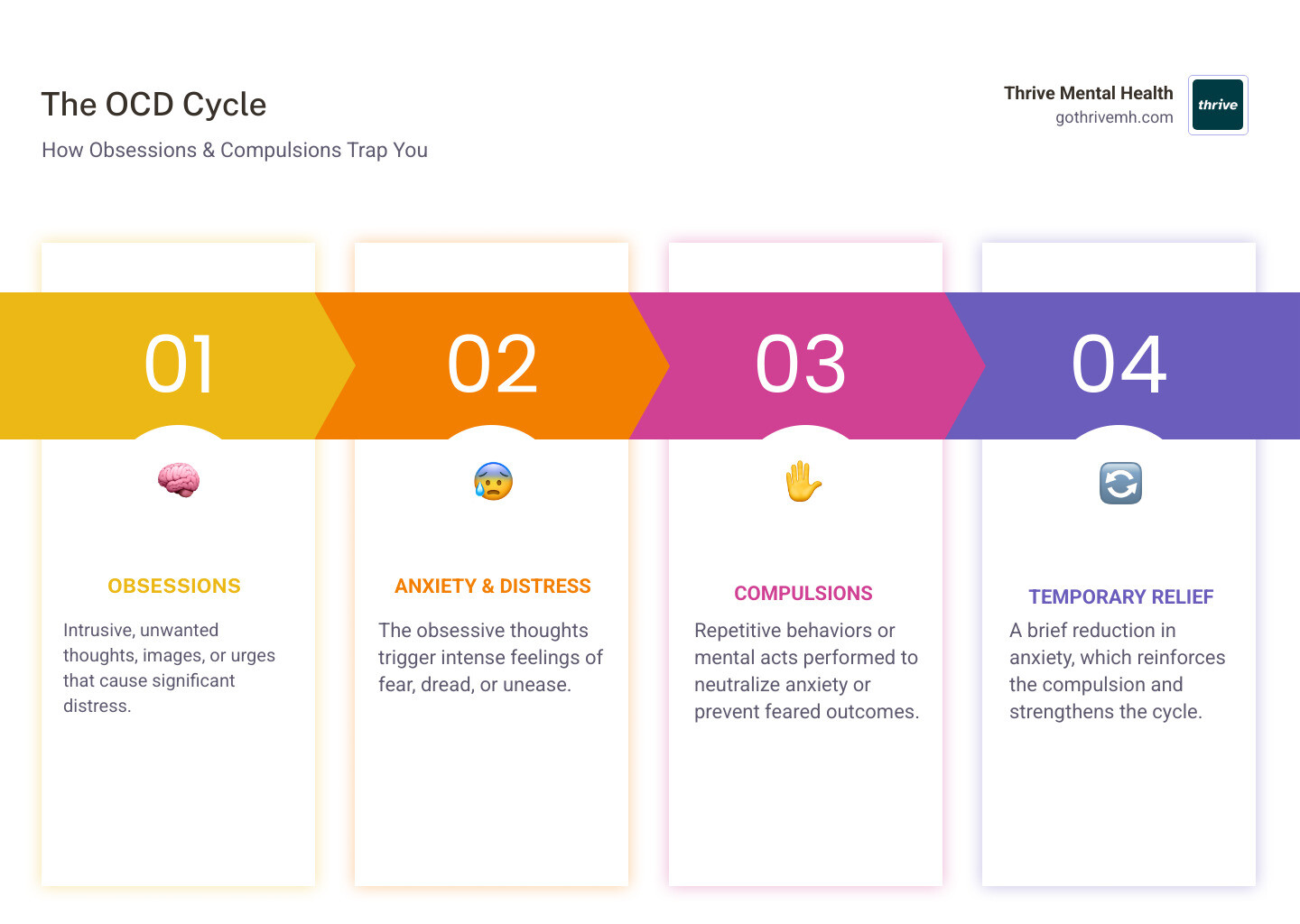
Obsessive-Compulsive Disorder hijacks your mind. Intrusive thoughts spiral into compulsions that eat your time, drain your energy, and steal your peace. You know the rituals do not really work, but the anxiety feels impossible to resist.
You are not stuck. OCD cognitive behavioral therapy disrupts this cycle at its source. It teaches you to face fears without rituals, challenge the thoughts that fuel OCD, and reclaim control over your life.
This is not about willpower. It is about rewiring the patterns that keep OCD alive. With the right guidance, most people see real progress within weeks and lasting freedom within months.
I am Nate Raine, CEO of Thrive Mental Health, where we have helped hundreds of people break free from OCD using evidence-based OCD cognitive behavioral therapy delivered through flexible virtual and in-person programs. Our team specializes in ERP, advanced CBT techniques, and personalized care that fits your life, because recovery should not have to wait for the perfect schedule.
OCD cognitive behavioral therapy definitions and deep dives:
- How cognitive behavioral therapy works
- Is cognitive behavioral therapy effective?
- Cognitive behavioral therapy for anxiety and panic
How OCD Cognitive Behavioral Therapy Works: Break the Cycle for Good
![Breaking a chain, alt=”CBT for OCD breaks the chain of compulsions and obsessive thoughts with ERP and cognitive tools – ocd cognitive behavioral therapy”]
Obsessive-Compulsive Disorder (OCD) traps you in a cycle of intrusive thoughts (obsessions) and repetitive rituals (compulsions). At Thrive Mental Health, our OCD cognitive behavioral therapy (CBT) breaks this cycle at its core so you can get your time, energy, and relationships back. This structured, short-term therapy focuses on your “here and now” problems by changing the interconnected patterns of your thoughts, behaviors, and emotions. The gold-standard approach is Exposure and Response Prevention (ERP), which helps you directly confront fears and stop engaging in rituals. Research shows that up to 75% of people with OCD are significantly helped by Cognitive Behavioural Therapy.
The core of effective OCD CBT lies in breaking two key associations:
- Distress with triggers: You learn that the feared situation or thought itself is not inherently dangerous.
- Ritualistic behavior with distress reduction: You find that avoiding compulsions does not lead to catastrophe, and your anxiety will naturally decrease over time.
This process, known as habituation, means that with repeated exposure, your brain learns to stop reacting strongly to a stimulus that it once perceived as threatening.
Learn more about Thrive’s OCD IOP and PHP programs and how we integrate these powerful techniques into our comprehensive care across Florida.
What Is Exposure and Response Prevention (ERP)?
Exposure and Response Prevention (ERP) is the most effective psychological treatment for OCD. It is a step-by-step method designed to gradually dismantle the power your obsessions and compulsions hold over you.
Here is how ERP works:
- Gradually Face Your Fears (Exposure): With your Thrive therapist, you will create a personalized “fear ladder” or hierarchy, ranking your feared situations from least to most anxiety-provoking. Then, you will systematically confront them.
- In Vivo Exposure: This is “real-life” exposure, where you directly engage with feared objects or situations. For example, if you fear contamination from public restrooms, you might start by touching a public doorknob and gradually progress to sitting in a public restroom until your anxiety naturally decreases.
- Imaginal Exposure: This involves mentally visualizing feared situations or consequences. It is particularly useful for obsessions not tied to specific physical situations, like intrusive thoughts about harming others or blasphemy.
- Resist Compulsions (Response Prevention): As you expose yourself to your triggers, you actively refrain from performing your usual ritualistic behaviors. If your compulsion is to wash your hands after touching a “contaminated” object, response prevention means touching the object and not washing your hands immediately.
- Anxiety Fades Over Time: When you confront a feared situation without ritualizing, your brain learns that the predicted catastrophe does not occur, and the anxiety eventually subsides naturally.
ERP directly challenges the mistaken ideas common in OCD, such as:
- The necessity of avoidance or rituals to prevent harm
- The belief that distress will last forever
- The fear of “losing one’s mind” from anxiety
For ERP to be effective, it must be emotionally engaging; you cannot distract yourself from the distress. Your Thrive therapist will guide you in designing exercises matched to your unique OCD triggers.
See how virtual therapy for OCD works at Thrive, making this powerful treatment accessible from anywhere in Florida.
The “Cognitive” in CBT: Rewire Your Thinking
While ERP focuses on changing behaviors, the “cognitive” part of OCD cognitive behavioral therapy targets the thought patterns that fuel OCD.
Here is how we help you rewire your thinking:
- Challenge Distorted Beliefs: OCD often involves an inflated sense of personal responsibility for events that may cause harm, or an overestimation of threats. Through cognitive restructuring, we help you identify these irrational thoughts, examine the evidence for and against them, and replace them with more balanced perspectives.
- Learn to Tolerate Uncertainty: A hallmark of OCD is an intense intolerance of uncertainty. CBT teaches you to accept that complete certainty is impossible in life and to tolerate the discomfort that comes with not knowing.
- Stop Overestimating Threats: OCD often leads to catastrophic thinking. We help you evaluate the actual probability of feared events and understand how your mind can exaggerate risks.
- Break the “Thought-Action Fusion” Trap: This is the mistaken belief that simply having a thought is equivalent to performing the action. CBT helps you differentiate between thoughts and actions.
- Build Confidence in Your Own Judgment: OCD erodes trust in your own senses and judgment. CBT helps you gradually rebuild this trust.
Our practical steps and techniques include:
- Cognitive Restructuring: Using thought records to systematically challenge negative or obsessive thoughts
- Journaling: Keeping a thought diary to identify patterns and process experiences
- Mindfulness: Learning to observe thoughts and feelings without judgment
Read our guide: How CBT Can Transform Negative Thought Patterns to dive deeper into how we help our clients achieve mental clarity and reduce OCD’s grip.
Beyond ERP: Advanced OCD CBT Approaches at Thrive
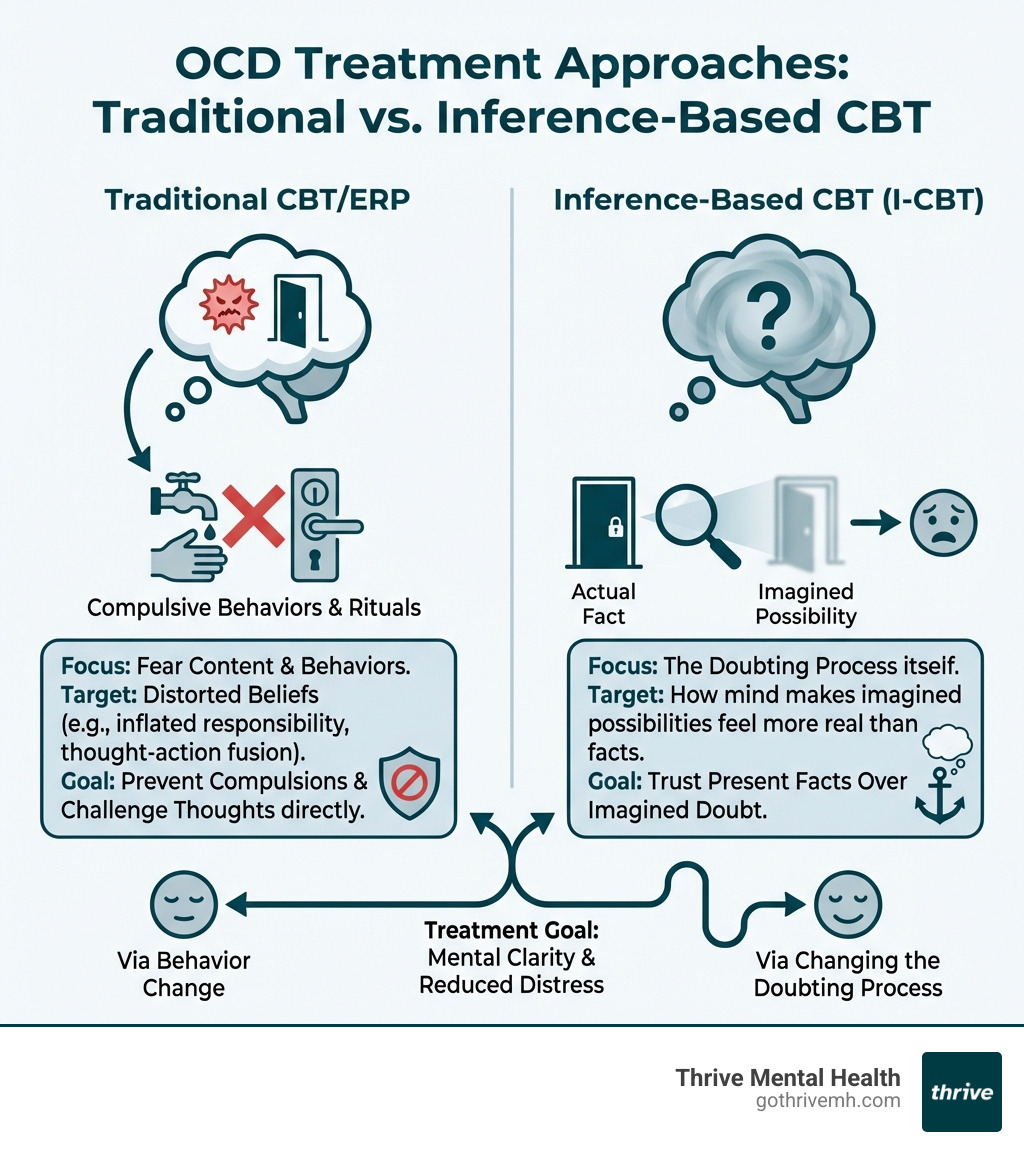
At Thrive Mental Health, we go beyond standard treatments. Our clinicians use advanced OCD cognitive behavioral therapy methods like Inference-Based CBT (I-CBT) to address complex or treatment-resistant cases. Because OCD is not a one-size-fits-all condition, our custom treatment plans are designed for your specific needs, whether you are in Miami, Orlando, Tampa, or elsewhere in Florida.
What is Inference-Based CBT (I-CBT) and how does it differ from traditional CBT for OCD?
Traditional CBT, especially ERP, focuses on challenging the content of your fears and preventing compulsive behaviors. I-CBT, however, takes a unique approach by focusing on the doubting process itself, rather than just the specific obsessive content. It addresses how your mind generates doubt and makes imagined possibilities feel more real than actual facts.
Here is how I-CBT works and how it uses the “Inner Wheel” and “Outer Wheel” concepts for understanding OCD:
- Fix “Inferential Confusion”—When Imagination Feels More Real Than Facts: I-CBT posits that OCD begins with a shift from the real world to an imagined one. You know, logically, that the door is locked, yet your mind might create a “what-if” scenario where it is not. This “inferential confusion” makes that imagined possibility feel as real and urgent as a direct sensory experience. I-CBT helps you identify the exact moment you “cross over” from reality into imagination, and to correct the reasoning errors that sustain this doubt.
- Separate Obsessional Doubt from Reality: We help you distinguish between what is actually happening (reality) and what is merely an imagined possibility. The power of obsessional doubt often comes from its ability to feel self-evident and undeniable, even when it originates from distorted reasoning.
- Trust Your Senses, Not Your Fears: I-CBT encourages you to rebuild trust in your immediate sensory evidence and everyday reasoning, rather than prioritizing the “what-if” scenarios generated by OCD. This means learning to rely on what you see, hear, and logically deduce, instead of succumbing to the doubt.
- Tackle the “Engine” of OCD from the Inside Out: This is where the “Inner Wheel” and “Outer Wheel” concepts come in.
- The Inner Wheel: This represents the hidden, internal processes that generate and sustain obsessional doubt before it manifests as anxiety or overt compulsions. It includes:
- Obsessional Reasoning: The distorted thought processes that prioritize imagined possibilities over direct evidence.
- Feared Possible Self: A distorted image of who you might become if you do not engage with the obsession (for example, a negligent parent, a dangerous driver, a contaminated person).
- Obsessional Narrative: The story your OCD tells you, making the doubt feel compelling and personally relevant.
- The Outer Wheel: This represents the visible manifestations of OCD, which are a result of the Inner Wheel’s processes. It includes:
- The experienced doubt and anxiety.
- The emotional distress (anxiety, guilt, disgust).
- The compulsions (checking, reassurance-seeking, avoidance) that you perform, which, paradoxically, affirm the doubt’s relevance and keep the cycle going.
- The Inner Wheel: This represents the hidden, internal processes that generate and sustain obsessional doubt before it manifests as anxiety or overt compulsions. It includes:
I-CBT works by addressing the Inner Wheel directly, dismantling the underlying reasoning errors. By correcting these internal processes, the fuel for the Outer Wheel diminishes, leading to a natural reduction in obsessions, anxiety, and compulsions. For many adults and young professionals in our virtual intensive outpatient programs, this approach is particularly helpful for managing the chronic doubt and uncertainty that define OCD.
What to Expect: Your OCD CBT Treatment Journey at Thrive

Starting your journey with OCD cognitive behavioral therapy at Thrive Mental Health means stepping into a supportive, structured, and personalized treatment experience.
How long does CBT for OCD typically take?
CBT for OCD generally consists of weekly, one-hour therapy sessions. While the exact duration varies based on the severity of your OCD symptoms, most people notice significant improvements within weeks. Full treatment typically lasts approximately six months. Factors influencing duration include:
- Severity of symptoms: More severe OCD may require longer or more intensive treatment.
- Commitment to practice: Consistent engagement with homework and exercises outside of sessions is crucial for faster progress.
- Co-occurring conditions: Addressing other mental health concerns like depression or generalized anxiety may impact the overall timeline.
- Treatment intensity: Our Intensive Outpatient Programs (IOP) and Partial Hospitalization Programs (PHP) offer more frequent therapy, often leading to quicker stabilization.
At Thrive, we offer flexible virtual and in-person options across Florida, with evening and flexible scheduling to fit your life. Our services are covered by major insurance providers including Cigna, Aetna, Optum, Florida Blue, and many more.
Verify your insurance in 2 minutes to understand your coverage options before you commit.
What are the practical steps and techniques involved in CBT for OCD?
Beyond ERP and cognitive restructuring, your Thrive therapist will introduce other practical techniques:
- Mindfulness: Helps you observe intrusive thoughts without judgment, allowing them to pass without engaging in compulsions.
- Deep Breathing Exercises: Simple techniques like inhaling for 5 seconds, holding for 5, and exhaling for 5 can help manage acute anxiety during exposure.
- Progressive Muscle Relaxation: Tensing and relaxing different muscle groups to release physical tension.
- Journaling: Tracking your thoughts, feelings, and behaviors helps identify patterns.
- Activity Scheduling: Planning pleasurable activities can help combat isolation and improve mood.
What is the role of the therapist in the CBT process for OCD?
Your Thrive therapist is your guide, coach, and expert partner. Their role includes:
- Assessment: Understanding your specific obsessions, compulsions, and their impact.
- Psychoeducation: Explaining OCD and the rationale behind CBT and ERP.
- Personalized Treatment Plan: Collaboratively developing your “fear ladder” custom to your unique needs.
- Guidance and Support: Guiding you through exposure exercises, ensuring you are emotionally involved and resisting compulsions effectively.
- Skill Teaching: Teaching cognitive restructuring, mindfulness, and other coping skills.
- Monitoring Progress: Using standardized assessments like the Yale-Brown Obsessive Compulsive Scale (Y-BOCS).
- Relapse Prevention: Equipping you with strategies to manage potential future symptom re-emergence.
At-Home Strategies to Boost Your Progress
To get the most benefit from OCD cognitive behavioral therapy, what you do outside of therapy sessions is just as important. Your Thrive therapist will assign “homework” to reinforce learning and accelerate your progress.
Here are some at-home exercises:
- Daily Exposure Practice: Consistently engage in planned exposure exercises from your fear hierarchy.
- Journaling Triggers and Wins: Keep a thought diary to record intrusive thoughts, anxiety levels, and response prevention attempts.
- Mindfulness and Relaxation: Practice mindfulness exercises and use deep breathing or progressive muscle relaxation.
- Support from Family and Friends: Educate loved ones about your OCD and treatment plan.
- Using Thrive’s Online Resources: Explore our extensive library of articles and tools.
How Effective Is OCD Cognitive Behavioral Therapy?
The effectiveness of OCD cognitive behavioral therapy is compelling:
- High Success Rates: Studies show that as many as 75% of people with OCD are significantly helped by Cognitive Behavioural Therapy, and 75% of patients who seek ERP find it effective.
- Rapid Improvement: Most people notice improvements within weeks.
- Long-Term Skills: CBT equips you with skills that have lasting benefits.
- Broader Benefits: Virtual CBT has yielded improvements in depression, quality of life, and overall OCD symptoms.
At Thrive, we track our outcomes to ensure you receive the most effective care. More on OCD treatment outcomes at Thrive.
How to Choose the Right OCD Therapist and Program
Finding the right support for OCD cognitive behavioral therapy is crucial. Here is how Thrive helps:
- Thrive Therapists Are OCD Specialists: Our team comprises clinicians specifically trained in evidence-based CBT for OCD, including ERP and advanced techniques like I-CBT.
- Personalized Treatment Plans: Your therapist will create a personalized “fear ladder” custom to your specific obsessions and compulsions.
- Flexible Program Options:
- Virtual Outpatient Therapy: Individual sessions for mild to moderate symptoms.
- Virtual Intensive Outpatient Programs (IOP): Multiple therapy sessions per week, group therapy, and medication management.
- Virtual Partial Hospitalization Programs (PHP): Comprehensive daily treatment.
- Covered by Major Insurance: Our programs are covered by most major insurance providers. Verify your insurance to focus on your recovery.
- Serving Your Community: We provide high-quality OCD cognitive behavioral therapy across numerous locations in Florida.
Explore Thrive’s virtual IOP programs to see how our flexible, expert-led care can fit into your life.
FAQs: OCD Cognitive Behavioral Therapy—What People Ask Most
How long does OCD CBT take to work?
Most people notice progress within weeks, often within the first month. Full treatment usually takes about 6 months with weekly sessions and consistent daily practice of learned skills. The duration can vary based on symptom severity, co-occurring conditions, and your commitment to ERP homework.
What is the success rate for OCD cognitive behavioral therapy?
Research shows 75–80% of people get significant relief and a better quality of life after completing OCD cognitive behavioral therapy with ERP. Many achieve long-term remission of symptoms when they stick with the full course and use relapse-prevention tools.
Is OCD CBT just about facing fears?
No. While Exposure and Response Prevention (ERP) is a core component, OCD cognitive behavioral therapy is a comprehensive, structured, step-by-step process with expert support. You learn to face fears and stop rituals safely, while also actively changing the way you think about intrusive thoughts, responsibility, and uncertainty through cognitive restructuring and mindfulness.
Does insurance cover OCD CBT at Thrive?
Yes. Most major plans, including Cigna, Aetna, Optum, Florida Blue, and many more, cover our virtual and in-person programs in Florida. We encourage you to check your benefits now for a quick, no-obligation verification.
Can I do OCD CBT virtually?
Absolutely. Thrive’s virtual IOP and PHP programs are designed to deliver the same evidence-based OCD cognitive behavioral therapy as in-person treatment. They fit your schedule with evening options, making treatment accessible and convenient from anywhere in Florida.
Summary: OCD Cognitive Behavioral Therapy—Your Fastest Path to Freedom
Living with Obsessive-Compulsive Disorder can feel like an endless battle against your own mind. But you do not have to fight alone. OCD cognitive behavioral therapy is the most effective, research-backed way to break free from obsessions and compulsions. It empowers you to understand your thought patterns, challenge distorted beliefs, and bravely confront your fears without giving in to rituals.
With Thrive Mental Health, you get OCD-specific CBT with ERP and advanced approaches like I-CBT, delivered through flexible virtual and in-person IOP and PHP programs across Florida. Our team works with your schedule, your insurance (including Cigna, Aetna, Optum, Florida Blue, and more), and your goals so you can reclaim your life faster and sustain your progress.
Ready for support? Thrive offers virtual and hybrid IOP/PHP programs with evening options. Verify your insurance in 2 minutes (no obligation) → Start benefits check or call 561-203-6085. If you are in crisis, call/text 988.