






Somatic therapy for grief: Transformative Healing 2025
Somatic Therapy for Grief: 9 Proven Techniques to Release Chest Tightness and Sleep Better [2025]
If you’re in crisis, call/text 988 right now. You are not alone.
Somatic therapy for grief is a body-centered approach that helps you process loss by working with physical sensations rather than just talking about your feelings. Unlike traditional talk therapy, it focuses on releasing the tension, pain, and overwhelm that grief stores in your nervous system.
Quick Answer: What Somatic Therapy for Grief Can Do
- Releases physical symptoms like chest tightness, fatigue, and muscle tension
- Regulates your nervous system to help you feel safer and more grounded
- Uses techniques like breathwork, body scanning, and gentle movement
- Works for all types of loss including death, relationship endings, and life transitions
- Complements talk therapy by addressing what words can’t reach
Grief doesn’t just live in your mind. It settles into your chest as tightness. It shows up as exhaustion that sleep won’t fix. It creates stomach knots, headaches, and a body that feels like it’s carrying a weight you can’t name.
The Body Keeps the Score became a bestseller for a reasonpeople are finally recognizing that trauma and grief leave physical marks. Your body remembers loss even when your mind tries to move forward. And sometimes, no amount of talking about your feelings can reach the grief that’s locked in your muscles, your breath, your nervous system.
That’s where somatic therapy comes in. It meets you where the grief actually lives: in your body.
I’m Anna Green, LMHC, LPC, Chief Clinical Officer at Thrive Mental Health. In my work with clients navigating complex trauma and loss, I’ve seen how somatic therapy for grief creates breakthroughs when other approaches fall shorthelping people finally release what they’ve been carrying and reconnect with a sense of safety and hope.
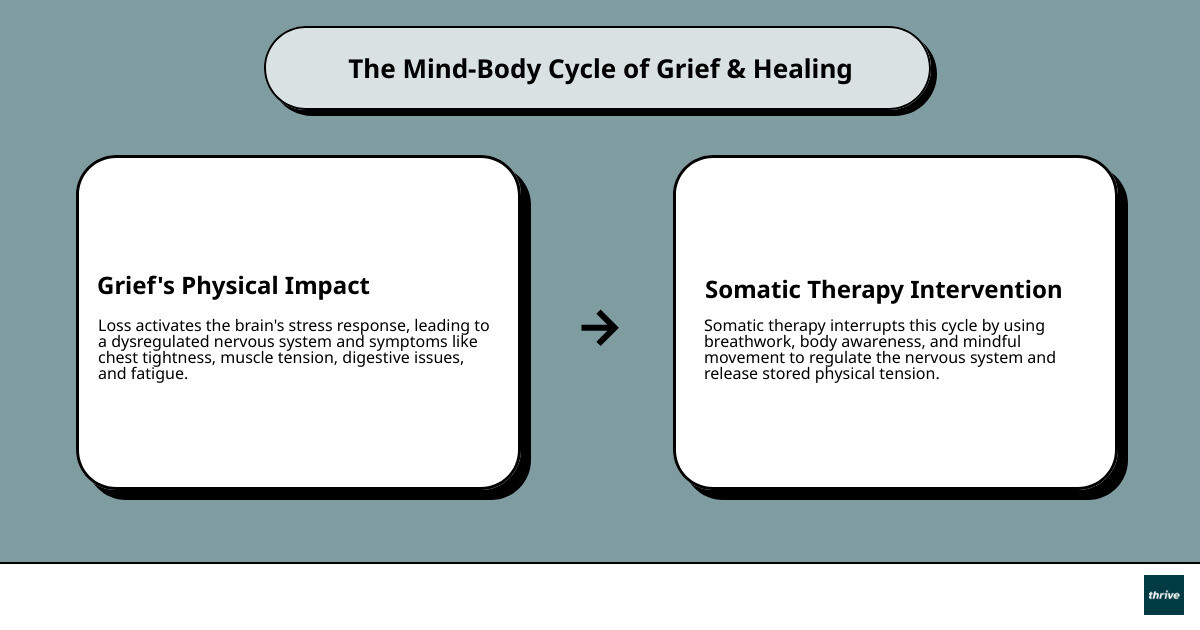
Somatic therapy for grief terms explained:
The Unspoken Weight: How Grief Manifests in Your Body
Your body knows you’re grieving before your mind fully catches up.
Maybe it’s the heaviness in your chest, the exhaustion that sleep doesn’t touch, or the tension locked in your shoulders. These aren’t just side effects of grief, they’re how grief speaks when words fall short.

When you experience profound loss, your body’s stress response system shifts into high gear. This survival mechanism is designed for immediate threats, but grief lingers. When your nervous system stays activated for weeks or months, your body pays the price through cortisol dysregulation and increased inflammation, affecting everything from sleep to immune function.
Here’s what that looks like in real life:
- Chest Tightness and Heart Symptoms: Grief can cause a literal ache or heaviness in the chest. In extreme cases, it can trigger “broken heart syndrome” (Takotsubo Cardiomyopathy), a temporary weakening of the heart muscle.
- Persistent Fatigue: This isn’t ordinary tiredness. Grief disrupts cortisol levels and sleep-wake cycles, leading to a deep exhaustion that rest doesn’t fix.
- Muscle Tension and Pain: Grief often settles in the neck, shoulders, and jaw, causing stiffness, headaches, and TMJ symptoms. Inflammation can also amplify existing aches and pains.
- Digestive Problems: The gut-brain connection means emotional overwhelm can lead to stomach pain, nausea, appetite changes, and other digestive issues.
- Brain Fog: Difficulty concentrating, memory slips, and mental cloudiness are common as your brain works overtime to process the loss.
- Weakened Immune System: Grief increases inflammation, making you more susceptible to illness and slowing down your body’s ability to heal.
These physical symptoms are your body’s way of communicating distress. This is exactly why somatic therapy for grief is so effective: it addresses the physical reality of grief, not just the emotional story. Studies have shown that somatic techniques can reduce the severity of grief symptoms and improve physical health. You can read more about the science in Scientific research on grief and inflammation and More on how grief affects the body.
The good news? When you work with grief through your body, these physical symptoms can begin to ease. That’s what we’ll explore next.
What is Somatic Therapy? A Body-First Approach to Healing
Somatic therapy starts with a simple truth: your body remembers what your mind tries to forget. The word “somatic” comes from the Greek “soma,” meaning body. This therapy begins by tuning into the physical sensations that grief creates in your chest, shoulders, and stomach.
When you experience loss, your nervous system goes into survival mode. Your body braces for impact, muscles tighten, and breathing becomes shallow. Sometimes, your body stays stuck in that protective state, holding onto tension and pain.
Somatic therapy for grief helps you access and release these physical patterns. It recognizes that loss lives in your tissues and posture, not just your memories. This is mind-body integration: the understanding that your thoughts, emotions, and physical sensations are interconnected. When grief is trapped in your body, talking about it may not be enough to release it.
That’s the key difference between somatic therapy and traditional talk therapy. Most conventional approaches, like Cognitive Behavioral Therapy (CBT), use a “top-down” approach, starting with your thoughts to change how you feel.
Somatic therapy uses “bottom-up” processing, starting with what’s happening in your body. By working directly with physical experiences, it helps your nervous system complete the stress responses that grief triggered. The goal isn’t to “fix” your grief, but to develop body awareness and learn to regulate your nervous system so you can feel your feelings without being overwhelmed. This creates a foundation of safety for healing to emerge. You can learn more in our guide on How Somatic Therapy Works.
Here’s how somatic therapy compares to traditional approaches:
| Feature | Somatic Therapy | Traditional Talk Therapy (e.g., CBT) |
|---|---|---|
| Primary Focus | Bodily sensations, physical responses, nervous system regulation | Thoughts, beliefs, narratives, cognitive patterns |
| Approach | “Bottom-up”, starts with the body to access emotions and memories | “Top-down”, starts with thoughts and verbal processing to influence emotions |
| Goal for Grief | Release stored emotional tension from the body, restore nervous system balance, integrate physical and emotional experience of loss | Process thoughts and feelings about loss, develop coping strategies, reframe perspectives, find meaning |
| Key Techniques | Body scan, breathwork, mindful movement, tracking sensations, pendulation, titration, grounding, expressive arts | Dialogue, cognitive restructuring, behavioral experiments, journaling, problem-solving, psychoeducation |
| View of Emotions | Emotions are embodied; physical sensations are direct manifestations of emotional states | Emotions are often seen as responses to thoughts and beliefs |
| Processing Style | Often non-verbal or minimally verbal, allowing the body to lead the release | Primarily verbal, relying on language and conscious thought |
| Outcome for Grief | Reduced physical symptoms of grief, increased capacity to tolerate difficult emotions, greater bodily awareness, sense of internal safety | Emotional understanding, improved coping skills, reduced rumination, healthier grief narrative, functional adjustments to loss |
Both approaches have value. But when grief has taken up residence in your body, somatic therapy for grief offers a pathway that words alone cannot reach.
Core Principles and Techniques of Somatic Therapy for Grief

Somatic therapy for grief works by helping you notice and process the story your body holds. The goal is to create space for stored emotional tension to release naturally, allowing your nervous system to complete stress responses that were interrupted by loss. For more on how trauma is processed, explore our page on trauma treatment.
This work is guided by several core principles:
- Titration: Processing difficult sensations in small, manageable doses to avoid overwhelm.
- Pendulation: Gently shifting your awareness between uncomfortable sensations and neutral or pleasant ones to build resilience.
- Resourcing: Identifying internal or external sources of safety and calm (like a cherished memory or a peaceful place) to create a stable foundation for healing.
These principles rely on body awareness (interoception), the ability to sense what’s happening inside your body, to read its signals and facilitate release.
Specific Somatic Techniques for Processing Grief
The techniques used in somatic therapy for grief are accessible and focus on gentle curiosity about your body.
- Breathwork: Intentional breathing, like diaphragmatic (belly) breathing, directly calms the nervous system by activating the rest-and-digest response, signaling to your body that it’s safe to relax.
- Body Scan Meditation: Systematically bringing non-judgmental awareness to different parts of your body to notice where grief is held as tension, numbness, or other sensations.
- Mindful Movement: Practices like gentle yoga, tai chi, or even mindful walking help release physical tension and reconnect you with your body. Shaking is another powerful way to discharge stress energy, similar to how animals do in the wild.
Studies show these techniques can lessen the severity of grief. For more ideas, check out our Mental Health Tips Ultimate Guide.
How Somatic Experiencing (SE) Helps Release Stored Grief
Somatic Experiencing (SE), developed by Dr. Peter Levine, is a specific approach that addresses how the Autonomic Nervous System (ANS) responds to overwhelming events like a traumatic loss. When you can’t fight or flee from the reality of loss, the intense survival energy of the fight-or-flight response can get stuck in your body.
 Virtual IOP in Tucson, ArizonaIntensive Outpatient Program
SE gently guides you to track these bodily sensations, allowing your body to gradually discharge the trapped energy and complete the interrupted stress response. This process expands your “window of tolerance”, your capacity to feel difficult emotions without shutting down, and restores a sense of internal safety. The goal is to release the physiological charge of the trauma, allowing you to carry your grief with more peace. Learn more at the Somatic Experiencing website or in our guide on Understanding Post Traumatic Stress Disorder.
The Role of Expressive Arts in Somatic Grief Work
When words fail, expressive arts therapy offers another way to process grief. Using creative modalities like painting, journaling, or movement allows you to tap into non-verbal parts of yourself and give form to emotions that are hard to articulate. The physical act of creating connects you to your body, making it an inherently somatic practice. The goal isn’t the final product but the process of externalizing your grief, which can be deeply cathartic and help you find new perspectives. Our Grief Art Therapy Activities Guide and guide on The Healing Power of Art Therapy offer more ideas.
Your Path to Healing: What to Expect and How to Find Support
Taking the first step toward somatic therapy for grief is a decision to listen to your body and learn to carry your loss differently. We know finding support can feel overwhelming, so we want to make the path clear.

Somatic therapy for grief offers a way to release the physical burden of grief, the chest tightness, exhaustion, and tension. It helps your nervous system find balance so you can feel your emotions without being consumed by them. Many people find they can finally breathe deeper and feel more at ease in their bodies. They develop skills to ground themselves and move through their days with more ease. You can explore more about these outcomes on our Benefits of Somatic Therapy page.
What a Typical Session of Somatic Therapy for Grief Looks Like
A somatic therapy for grief session is different from traditional talk therapy. While there is space to talk, the focus is on your bodily experience.
- Creating Safety: Your therapist first establishes a safe, trusting environment.
- Body-Focused Check-in: You’ll be invited to notice what’s happening in your body in the present moment, without judgment.
- Tracking Sensations: The core of the work involves your therapist guiding you to focus on physical sensations of grief (e.g., chest tightness). This is done using titration (working in small bits) and pendulation (shifting between discomfort and calm).
- Allowing Release: There’s no pressure to talk. The goal is to allow your body to release stored energy, which might happen through tears, sighs, or trembling.
- Grounding: Every session ends with grounding exercises to ensure you feel stable and present before leaving.
Finding a Qualified Somatic Therapist in Florida and Online
Finding the right therapist is crucial. Look for a licensed mental health professional (LMHC, LCSW, LMFT) with specialized training in somatic modalities like Somatic Experiencing (SE) and specific experience with grief and loss. The US Association for Body Psychotherapy offers a Find a Therapist directory.
At Thrive Mental Health, our team is trained in body-centered care for grief and trauma. We offer virtual therapy through our Intensive Outpatient (IOP) program, accessible from anywhere, with a focus on serving clients throughout Florida. Our flexible evening options ensure you can get support without disrupting your life. Explore care options:
- Virtual IOP → https://gothrivemh.com/areas-of-care-virtual-iop/
- Virtual Therapy → https://gothrivemh.com/virtual-therapy/
- Verify Insurance → https://gothrivemh.com/treatment-modalities-virtual-iop/
We also help you steer insurance coverage. Many major plans, including Cigna, Optum, and Florida Blue, cover somatic therapy provided by a licensed professional. You can verify your benefits with us in minutes, with no obligation, so you understand your options clearly. Our programs are designed to help you process grief and overcome trauma.
Frequently Asked Questions about Somatic Therapy for Grief
{
  "@context": "https://schema.org",
  "@type": "FAQPage",
  "mainEntity": [{
    "@type": "Question",
    "name": "How is somatic therapy different from talk therapy for grief?",
    "acceptedAnswer": {
      "@type": "Answer",
      "text": "Somatic therapy for grief focuses on the body's physical sensations as the entry point for healing, using a 'bottom-up' approach. Unlike traditional talk therapy, which is 'top-down' and centers on thoughts and narratives, somatic therapy helps you process and release grief stored in your nervous system through breathwork, body scanning, and gentle movement."
    }
  },{
    "@type": "Question",
    "name": "Can somatic therapy really help with the physical pain of grief?",
    "acceptedAnswer": {
      "@type": "Answer",
      "text": "Yes. Many physical symptoms of grief, like chest tightness, stomach aches, and muscle tension, are linked to a dysregulated nervous system. Somatic therapy helps the body complete its stress responses and return to balance, which can ease these symptoms."
    }
  },{
    "@type": "Question",
    "name": "How long does somatic therapy for grief take?",
    "acceptedAnswer": {
      "@type": "Answer",
      "text": "It varies. Some people feel relief in a few sessions; others benefit from longer-term support. Your pace depends on the type of loss, history, and goals."
    }
  },{
    "@type": "Question",
    "name": "Is somatic therapy for grief covered by insurance?",
    "acceptedAnswer": {
      "@type": "Answer",
      "text": "Coverage depends on your plan and provider. Many plans, including Cigna, Optum, and Florida Blue, may cover somatic therapy when delivered by a licensed clinician. Verify with your insurer or the therapy center."
    }
  },{
    "@type": "Question",
    "name": "Is somatic therapy for grief available online in Florida?",
    "acceptedAnswer": {
      "@type": "Answer",
      "text": "Yes. Thrive offers virtual IOP throughout Florida, with evening options. Learn more at https://gothrivemh.com/areas-of-care-virtual-iop/."
    }
  }]
}
How is somatic therapy different from talk therapy for grief?
Somatic therapy uses a bottom-up approach, focusing on body sensations to release grief stored in the nervous system. Talk therapy is top-down, centering on thoughts and narratives.
Can somatic therapy really help with the physical pain of grief?
Yes. By regulating your nervous system and completing stress responses, somatic therapy can ease chest tightness, muscle tension, and digestive distress.
How long does somatic therapy for grief take?
It depends on your needs. Some people notice changes within a few sessions; others prefer ongoing care.
Is somatic therapy for grief covered by insurance?
Often, yes, especially with providers like Cigna, Optum, and Florida Blue. Check your benefits or contact Thrive to verify.
Is somatic therapy for grief available online in Florida?
Yes. Thrive offers virtual IOP with evening options throughout Florida. See details: https://gothrivemh.com/areas-of-care-virtual-iop/.
Ready for Support?
Moving through loss is one of life’s most challenging journeys, and the truth is, you don’t have to walk it alone. If you’ve made it this far, you already know that grief isn’t just something you think about; it’s something you feel, in your chest, your shoulders, your stomach, your entire being.
Somatic therapy for grief offers a powerful and holistic path to healing that honors this reality. It helps you integrate your experience, release the physical burdens you’ve been carrying, and reconnect with your resilience, not by forcing you to “move on,” but by helping you move through with greater ease and self-compassion.
At Thrive Mental Health, we’re dedicated to providing compassionate, evidence-based care that honors the unique wisdom of both your body and mind. Our virtual Intensive Outpatient (IOP) program is designed to meet you where you are, with flexible scheduling options, including evening sessions, that fit into your life. Whether you’re in Florida or anywhere else, expert-led support is accessible.
We understand that taking the first step can feel overwhelming, especially when you’re already carrying so much. That’s why we’ve made it simple. You can verify your insurance coverage in just two minutes, with no obligation, to see what options are available to you. Our team works with major providers like Cigna, Optum, and Florida Blue, and we’re here to guide you through the process with care and transparency.
Healing isn’t about erasing your grief or pretending it doesn’t exist. It’s about learning to carry it in a way that doesn’t break you, finding moments of peace, reclaiming your sense of safety, and refinding hope, even in the midst of loss.
Ready for support? Thrive offers virtual IOP with evening options. Verify your insurance in 2 minutes (no obligation) → Start benefits check or call 561-203-6085. If you’re in crisis, call/text 988.

This article is for informational purposes only and is not a substitute for individualized clinical advice or insurance verification.