
Top Dialectical Behavior Therapy Workbooks You Need Right Now

Stop Drowning in Your Emotions—DBT Workbooks Can Throw You a Lifeline
If you are in a crisis or may be in danger, please use the following resources to get immediate help:
- Call or text the 988 Suicide & Crisis Lifeline at 988.
- For emergencies, call 911 or go to your nearest emergency room.
- The following article is for informational purposes and is not a substitute for professional medical advice.
A dbt workbook is a structured self-help resource that teaches the four core skills of Dialectical Behavior Therapy: mindfulness, distress tolerance, emotion regulation, and interpersonal effectiveness. These workbooks provide step-by-step exercises designed to help you manage intense emotions, reduce impulsive behaviors, and improve relationships—whether you’re dealing with anxiety, depression, trauma, or feeling chronically overwhelmed.
Quick Answer: Top DBT Workbook Features to Look For
- Evidence-based exercises across all four DBT skill modules
- Step-by-step worksheets with real-world examples and practice plans
- Updated content including self-compassion and cognitive rehearsal techniques
- Clear explanations that make complex therapy concepts accessible
- Practical tools like the REST strategy (Relax, Evaluate, Set intention, Take action)
You know that feeling when your emotions hijack your day? Maybe it’s an argument that replays in your head for hours. Or anxiety that won’t let you focus. Or anger that erupts before you can stop it.
You’re not broken. Your brain just needs better tools.
That’s where DBT workbooks come in. Originally developed by psychologist Marsha Linehan for treating Borderline Personality Disorder, DBT has proven effective for anyone struggling with emotional intensity. The most popular workbook in this space—The Dialectical Behavior Therapy Skills Workbook—has sold over 2.5 million copies and maintains a 4.7-star rating with nearly 10,000 reviews. That’s not hype. That’s real people finding real relief.
But here’s the catch: reading alone won’t change anything. DBT workbooks require practice—daily application of specific skills in moments when you’re actually activated. Think of it like going to the gym. You can read about bench pressing all day, but your muscles won’t grow until you lift the weight.
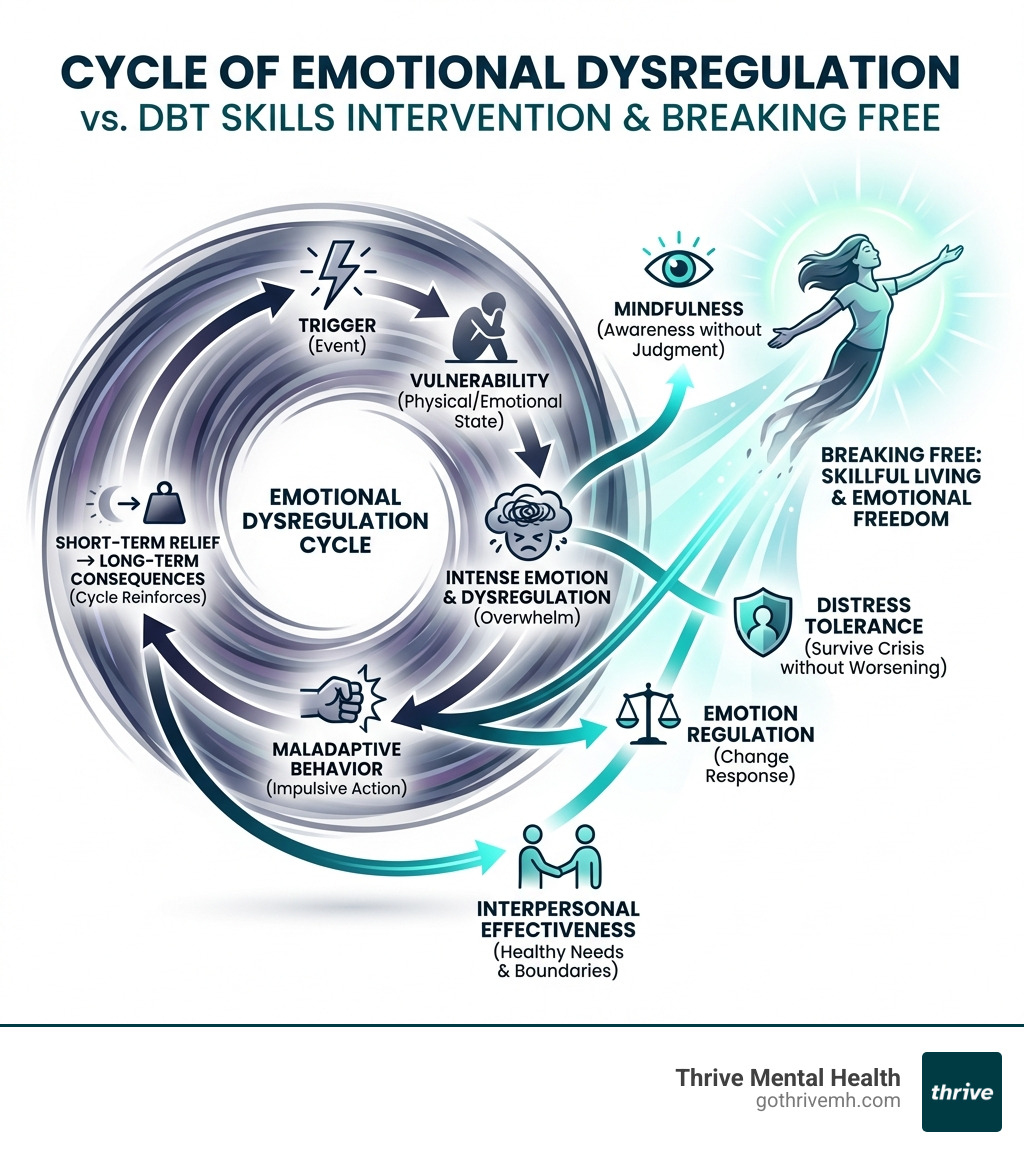
The good news? These skills are learnable. Distress tolerance techniques help you survive crises without making things worse. Mindfulness grounds you in the present instead of spiraling about the past or future. Emotion regulation gives you the ability to feel without losing control. And interpersonal effectiveness teaches you to ask for what you need while keeping relationships intact.
I’m Nate Raine, CEO of Thrive Mental Health, where we’ve integrated dbt workbook principles into our evidence-based virtual and hybrid programs across Florida. Over the past decade leading behavioral health and digital change initiatives, I’ve seen how structured DBT skills training—whether through workbooks or intensive outpatient programs—creates measurable change for people who felt stuck for years.
Handy dbt workbook terms:
- dialectical behavior therapy components
- how does dialectical behavioral therapy work
- what does dialectical mean in dialectical behavior therapy
What Is DBT? Your Crash Course on a Life-Changing Therapy
Dialectical Behavior Therapy (DBT) is a type of cognitive-behavioral therapy that was initially developed by Dr. Marsha Linehan in the late 1980s to treat individuals with Borderline Personality Disorder (BPD). While it remains the gold standard for BPD, its profound effectiveness quickly led to its application for a wide range of mental health challenges. DBT is now a proven treatment for anxiety, depression, post-traumatic stress disorder (PTSD), eating disorders, and substance abuse, among others.
At its core, DBT is “dialectical,” meaning it emphasizes the balance and integration of seemingly opposite ideas. The two main principles are acceptance and change. We learn to accept ourselves and our current situation as they are, while simultaneously working to change unhealthy behaviors and thought patterns. This isn’t about giving up; it’s about acknowledging reality while actively striving for a better one.
Think of it this way: if you’re stuck in traffic in Miami, you can rage against it (no acceptance, no change), or you can accept you’re in traffic and try to find an alternate route (acceptance and change). DBT gives us the skills to steer the emotional “traffic” of life with greater ease and effectiveness.
For a deeper dive into the foundations of this powerful therapy, explore our Dialectical Behavior Therapy explained guide.
The Four Core Skills You’ll Master
A dbt workbook is designed to teach you four core modules of skills, each building upon the others to create a robust toolkit for emotional well-being. Mastering these skills is like learning a new language for your emotions—it takes practice, but the fluency you gain is invaluable.
-
Mindfulness: This is the foundation of all DBT skills. Mindfulness teaches us to be present in the moment, observing our thoughts, feelings, and sensations without judgment. Instead of being swept away by a wave of anxiety, we learn to notice the wave, acknowledge it, and let it pass. This skill helps us reduce suffering by keeping us from dwelling on the past or worrying excessively about the future. For example, practicing mindfulness during a stressful day in Orlando can help us focus on our breath and surroundings, rather than letting worries about work consume us.
-
Distress Tolerance: Life throws curveballs, and sometimes, you can’t fix a problem immediately. Distress tolerance skills are about getting through a crisis without making things worse. These are your emergency coping mechanisms. Instead of resorting to destructive behaviors like substance use or self-harm when overwhelmed, you learn techniques like the REST strategy (Relax, Evaluate, Set an intention, Take action), holding ice, or engaging in intense exercise. These skills help you “ride out” intense emotions, buying time until the emotion subsides or a solution can be found. Imagine a difficult conversation in Jacksonville; distress tolerance helps you stay present without escalating or shutting down.
-
Emotion Regulation: This module focuses on understanding, reducing, and changing unwanted emotions. We learn to identify our emotions, understand what triggers them, and then apply strategies to shift our emotional state. This isn’t about suppressing feelings, but about modulating them so they don’t control us. For instance, if you’re experiencing intense anger in Fort Lauderdale, emotion regulation skills teach you to check the facts, engage in opposite action, or build positive experiences to shift your mood. The goal is to feel emotions fully but respond effectively.
-
Interpersonal Effectiveness: Relationships are central to our lives, and navigating them can be challenging, especially when emotions run high. Interpersonal effectiveness skills teach us how to ask for what we need, say no effectively, and maintain self-respect while strengthening relationships. These skills help us communicate clearly, set boundaries, and resolve conflicts constructively. Whether it’s advocating for yourself at work in Tampa or communicating needs to a partner in Jacksonville, these skills help you build healthier connections.
Together, these four modules provide a comprehensive approach to skill-building, empowering you to live a more balanced and fulfilling life.
How to Choose the Best DBT Workbook for You
With so many options available, choosing the right dbt workbook can feel overwhelming. But don’t worry, we’ve got you covered. Our goal is to help you find a workbook that truly resonates with your needs and supports your journey toward emotional wellness.
When selecting a dbt workbook, consider these critical factors:
- Author Credentials and Reputation: Look for workbooks written by licensed mental health professionals, ideally those with experience in DBT. For example, The Dialectical Behavior Therapy Skills Workbook is authored by Matthew McKay, Jeffrey C. Wood, and Jeffrey Brantley, all highly respected in the field.
- Practical Exercises and Worksheets: A good workbook isn’t just theory; it’s about doing. Ensure it contains clear, step-by-step exercises and worksheets that encourage active practice. The more opportunities you have to apply the skills, the more they will stick.
- Evidence-Based Techniques: Verify that the workbook’s content aligns with established DBT principles and incorporates techniques proven to be effective. The field of DBT is constantly evolving, so look for updated editions that include newer strategies.
- Condition-Specific Focus: While DBT is broadly applicable, some workbooks might be custom to specific challenges like BPD, anxiety, trauma, or eating disorders. For example, the aforementioned Dialectical Behavior Therapy Skills Workbook is a #1 Best Seller in “Self-Help for Eating Disorders & Body Image Issues” on Amazon.ca, indicating its relevance to those struggles.
- Inclusion of Newer Techniques: The second edition of leading workbooks often includes important advancements like self-compassion and exposure-based cognitive rehearsal. These techniques help bridge the gap between learning skills in a calm state and applying them effectively during emotional arousal.
- Reviews and Recommendations: What are others saying? Customer reviews can offer valuable insights into a workbook’s usability and effectiveness. The Dialectical Behavior Therapy Skills Workbook boasts 9,270 ratings on Amazon.ca with an impressive 78% being 5-star reviews. You can always Check book reviews and recommendations to get a broader perspective.
Key Features of a High-Quality DBT Workbook
A truly effective dbt workbook goes beyond just explaining concepts. It provides a structured, interactive experience that guides you through the process of skill acquisition. Here’s what we recommend looking for:
- Worksheets for Every Skill: Each skill should come with dedicated worksheets that prompt you to reflect, plan, and practice. These aren’t just busywork; they’re essential tools for internalizing new behaviors.
- Step-by-Step Exercises: Breakdowns of complex skills into manageable steps make them less daunting. A good workbook will guide you through each stage, from understanding the concept to applying it in real-life situations.
- Real-World Examples and Anecdotes: Learning from others’ experiences can be incredibly powerful. A workbook that includes scenarios like Bryan using the REST strategy in an argument or Lucy using distraction techniques instead of self-injury helps you visualize how to apply skills in your own life.
- Clear, Accessible Explanations: DBT concepts can be nuanced. A high-quality workbook will explain them in plain language, avoiding jargon where possible, and using analogies to make them relatable.
- Focus on Consistent Practice: The best workbooks emphasize that reading is not enough. They encourage daily practice, perhaps with diary cards or commitment exercises, reinforcing the idea that skills are built through repetition.
- Updated Research and Techniques: As DBT evolves, so should the workbooks. Look for editions that incorporate the latest understanding of skills like cognitive rehearsal, which helps you practice coping in emotionally activated states, addressing the challenge of “state-dependent learning.”
Matching a DBT Workbook to Your Specific Goals
Your individual needs should be the ultimate guide in selecting a dbt workbook. What are you hoping to achieve?
- Anxiety Focus: If anxiety often feels overwhelming, look for workbooks that heavily emphasize mindfulness to ground you in the present, and distress tolerance to ride out panic or worry without engaging in avoidance behaviors.
- Trauma-Informed Exercises: For those dealing with trauma or PTSD, a workbook that incorporates self-compassion and techniques like exposure-based cognitive rehearsal can be particularly beneficial. Reviewers have noted that some DBT workbooks are useful for PTSD therapy as an adjunct tool.
- BPD-Specific Skills: While all DBT workbooks are rooted in BPD treatment, some might offer more detailed sections or examples directly addressing BPD symptoms, such as managing intense mood swings or chronic feelings of emptiness. One reviewer even shared ordering a specific workbook for the fourth time due to its utility for BPD.
- General Emotional Wellness: If your goal is broader emotional intelligence and improved coping, a comprehensive workbook covering all four core modules equally will serve you well.
- Relationship Improvement: If interpersonal conflicts or communication challenges are a primary concern, prioritize workbooks with strong sections on interpersonal effectiveness, including skills for asking for what you need and setting boundaries. The ‘Mindful Communication with Others’ chapter in one popular workbook, for example, has been praised by users for improving relationships.
Getting the Most Out of Your Workbook: Self-Help vs. Guided Therapy
A dbt workbook is a phenomenal self-help tool, offering accessible, structured guidance for developing crucial coping skills. For many, it’s a powerful first step towards managing intense emotions and improving overall well-being. However, it’s important to understand both its strengths and limitations, especially when considering the profound impact a therapist can have.
On the self-help side, the benefits are clear:
- Accessibility: Workbooks are affordable and available to anyone, anywhere, making DBT skills accessible even in areas with limited mental health resources, like some of Florida’s more remote communities.
- Flexibility: You can work through the material at your own pace, fitting it into your schedule.
- Privacy: Some individuals prefer to start their journey in a private, self-guided manner.
- Foundational Skills: Workbooks excel at teaching the basic concepts and providing exercises for initial skill acquisition.
However, workbooks alone have limitations. For example, some users find the format daunting, suggesting that professional guidance could help break down the material. One reviewer even stated they no longer needed a therapist after using a particular workbook, which, while a testament to its power, might not be the typical outcome for everyone, especially those with complex needs.
This is where the role of a therapist or mental health professional becomes invaluable. A therapist provides:
- Accountability: They help you stay motivated and on track with your practice.
- Personalized Feedback: They can clarify concepts, correct misunderstandings, and offer custom strategies based on your specific challenges. This is especially crucial for “state-dependent learning,” where skills learned in calm settings might be forgotten during intense emotional arousal. A therapist can help you bridge that gap.
- Validation and Support: Navigating intense emotions can be isolating. A therapist offers a safe space for processing and emotional support.
- Crisis Management: In moments of acute distress, a therapist can provide immediate guidance and safety planning.
- Deeper Processing: For underlying issues like trauma, a therapist can guide you through deeper processing that a workbook simply cannot provide.

At Thrive Mental Health, we believe in combining the power of structured learning with expert guidance. Our virtual and hybrid Intensive Outpatient (IOP) and Partial Hospitalization (PHP) programs integrate dbt workbook principles with live, interactive group and individual therapy. This approach ensures you not only learn the skills but also gain the support and accountability needed to apply them effectively in your daily life. It’s how How Online DBT is Revolutionizing Mental Health Care for residents throughout Florida.
| Feature | Self-Help DBT Workbook | DBT Workbook with a Therapist (e.g., IOP/PHP) |
|---|---|---|
| Cost | Low (cost of book) | Higher (covered by insurance in many cases) |
| Flexibility | High (self-paced) | Structured schedule, but often with evening options |
| Accountability | Self-driven | High (therapist, group support) |
| Personalization | General exercises | Custom feedback, problem-solving, crisis intervention |
| Depth of Processing | Limited to self-reflection | Facilitated deeper emotional processing, trauma work |
| Crisis Support | None | Immediate guidance, safety planning |
| Effectiveness | Good for foundational skills, highly motivated individuals | Improved, especially for complex issues, consistent application |
When Self-Help Isn’t Enough
While a dbt workbook can be a fantastic resource, there are times when self-help simply isn’t enough. It’s crucial to recognize these moments and reach out for professional support. We’re here for you when:
- Persistent Symptoms: If your intense emotions, anxiety, or depression continue to significantly impact your daily life despite consistent workbook practice, it’s a sign that more comprehensive support is needed.
- Crisis Situations: If you’re experiencing suicidal thoughts, self-harm urges, or severe emotional dysregulation that puts your safety at risk, immediate professional intervention is essential. (Remember: If you’re in crisis, call/text 988 right now. You are not alone.)
- Lack of Progress: If you feel stuck, overwhelmed by the material, or unable to apply the skills effectively, a therapist can help identify roadblocks and provide custom strategies.
- Need for Deeper Processing: Workbooks can’t replace the therapeutic relationship needed to process complex trauma, long-standing interpersonal patterns, or deeply ingrained negative beliefs.
- Co-occurring Conditions: If you’re managing multiple mental health conditions simultaneously, such as BPD alongside substance use or an eating disorder, integrated care from a team of professionals is often the most effective path.
If you find yourself in these situations, our Intensive Outpatient Programs (IOP) and Partial Hospitalization Programs (PHP) at Thrive Mental Health offer a more intensive, structured, and supportive environment. Available in locations like Tampa Bay, Orlando, and Fort Lauderdale, our programs provide the expert guidance and community support necessary for significant healing. Find Finding an IOP Near Me: The Benefits of Online DBT and how it can provide the comprehensive care you need.
Frequently Asked Questions about DBT Workbooks
Can a DBT workbook replace therapy?
No, a dbt workbook is a powerful tool but cannot replace the personalized guidance, diagnosis, and support of a licensed therapist, especially for complex conditions. It is best used as a supplement to therapy or for building foundational skills. While some individuals report significant progress with self-help alone, for many, especially those struggling with conditions like BPD, severe anxiety, or trauma, a therapist provides crucial accountability, personalized feedback, and crisis support that workbooks cannot.
How long does it take to see results from a DBT workbook?
Results vary, but consistent practice is key. Some people notice small changes in weeks, such as improved awareness of emotions or a reduction in impulsive reactions. However, mastering the skills and creating lasting change is a long-term process, often taking months or even years. The more committed you are to daily practice of even one skill, the faster you will build momentum and integrate these transformative tools into your life.
Are DBT workbooks only for Borderline Personality Disorder?
No. While originally developed for BPD, DBT skills are now proven effective for a wide range of issues, including anxiety, depression, PTSD, eating disorders, and general emotional dysregulation. The core skills of mindfulness, distress tolerance, emotion regulation, and interpersonal effectiveness are universally beneficial for anyone seeking to better manage intense emotions, improve relationships, and build a life worth living. Many of our clients across Florida, from Miami to Jacksonville, find these skills invaluable regardless of their specific diagnosis.
Your Next Step: From Workbook to Wellness
You’ve taken the crucial first step by researching dbt workbooks and understanding their immense potential. You now know that these resources can provide you with practical, evidence-based skills to steer life’s emotional challenges. But remember, a workbook is a starting point—a powerful map, but you still need to walk the journey.
For many, the path to lasting wellness involves more than just self-study. It requires the power of professional support, a guiding hand, and a supportive community to help you apply those skills when it matters most. That’s where Thrive Mental Health comes in.

Our virtual and hybrid IOP/PHP programs are designed to provide that next level of care, building upon the principles you’ve learned from a dbt workbook. We offer:
- Clinical Expertise: Our team of compassionate professionals guides you through advanced DBT techniques and personalized strategies.
- Flexible Scheduling: With evening options and virtual access, our programs fit into your life, whether you’re in Orlando, Tampa, or Miami.
- Measurable Results: We focus on tangible progress, helping you move from simply coping to truly thriving.
If you’re ready to stop drowning in your emotions and truly take control of your mental health, we’re here to help.
Ready for support? Thrive offers virtual and hybrid IOP/PHP programs with evening options, available throughout Florida. We accept most major insurance, including Cigna, Aetna, and Florida Blue. Verify your insurance in 2 minutes (no obligation) → Start your benefits check now or call 561-203-6085. If you’re in crisis, call/text 988.