
In-Depth Guide: Best Virtual Mental Health for Small Business Owners

Why Small Business Owners Can’t Afford to Ignore Their Mental Health
If you’re in crisis, call/text 988 right now. You are not alone.
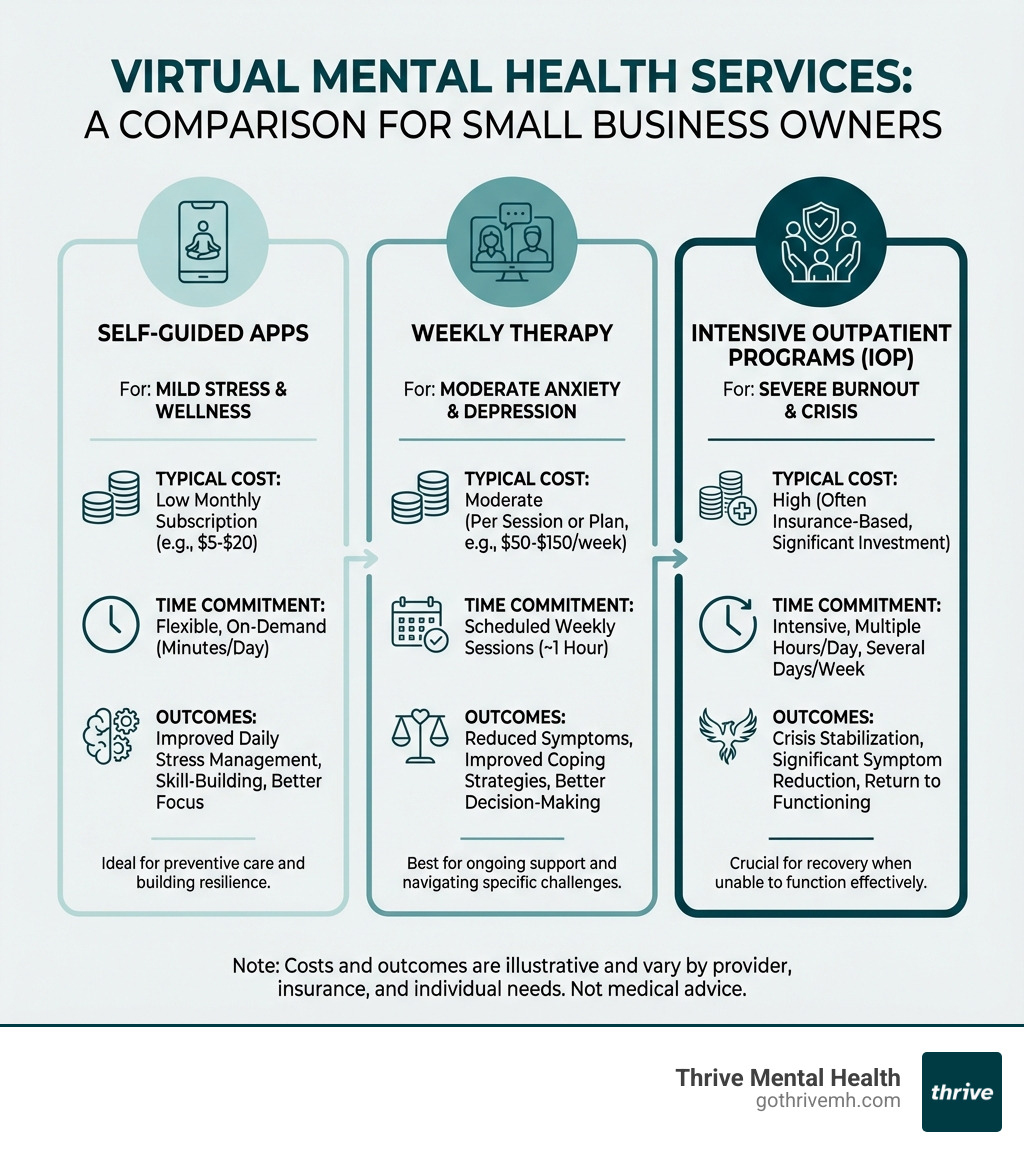
What are the best virtual mental health services for small business owners? The right choice depends on your needs. Options range from self-guided apps for daily stress and weekly therapy for ongoing anxiety, to intensive programs like a virtual IOP/PHP for severe burnout when you’re struggling to function.
Here’s the brutal truth: 45% of Canadian business owners report mental health challenges, and over 250,000 Canadian entrepreneurs consider seeking professional help every week. Depression and anxiety cost the global economy over $1 trillion annually in lost productivity. If you’re building a business, you’re likely facing financial pressure, impossible hours, and the weight of decisions that affect not just you, but your employees and their families.
The cost of ignoring your mental health isn’t just personal—it’s measurable in missed work hours, poor decisions, and declining productivity. 70% of employees say mental health impacts their work performance. As a small business owner, you don’t have the luxury of checking out. But traditional therapy—expensive, inflexible, and often requiring weeks to get an appointment—wasn’t built for the reality of running a business.
Virtual mental health services have changed the game. They offer 24/7 access, transparent pricing, and care that fits your schedule instead of a therapist’s office hours. Whether you need a quick stress-management app, weekly therapy for anxiety, or an intensive program to pull you back from burnout, there’s a solution that works without adding another impossible commitment to your calendar.
I’m Nate Raine, CEO of Thrive Mental Health, and I’ve spent over a decade building healthcare organizations that integrate clinical care with technology to expand access. In my work exploring what are the best virtual mental health services for small business owners, I’ve seen how the right support can transform not just individual well-being, but business performance and resilience.
Why Entrepreneurs Burn Out (And What It’s Costing Your Business)

Entrepreneurship is often romanticized, but the reality for small business owners is a relentless grind. The sheer weight of responsibility—financial, operational, and emotional—can lead to severe mental health challenges and burnout. This is a deep exhaustion that impacts every facet of your life and, crucially, your business’s bottom line.
The global economy loses over $1 trillion each year due to depression and anxiety-related lost productivity. When your mental health falters, so does your business. From constant financial pressure to the endless stream of decisions, the entrepreneurial journey is rife with unique stressors. This isn’t just personal suffering; it’s a direct threat to your business’s survival. When 70% of employees report that their mental health impacts their productivity, imagine the ripple effect when the leader is struggling.
The Unique Mental Health Challenges of a Small Business Owner
The line between life and work often blurs for small business owners, creating a perfect storm for mental health struggles. This constant activation can lead to a host of unique challenges:
- Stress vs. Burnout: Stress is temporary, but burnout is chronic physical and emotional exhaustion, often accompanied by cynicism and a sense of ineffectiveness.
- Anxiety and Depression: Financial instability and the immense pressure to succeed frequently trigger anxiety and can lead to depressive episodes.
- Loneliness and Isolation: Despite managing teams, many owners feel profoundly lonely, as the burden of leadership makes it difficult to confide in others.
- Blurring Work-Life Boundaries: The “always-on” culture prevents proper rest and recovery, fueling burnout.
- Responsibility for Others: You’re responsible for your employees, their families, and your customers. This immense pressure can be overwhelming.
- Financial Instability: The rollercoaster of revenue, payroll, and investments creates a constant undercurrent of debilitating financial stress.
How Poor Mental Health Sinks Productivity and Profits
Ignoring these mental health challenges actively sabotages your business. The impacts are far-reaching and directly affect your company’s performance:
- Absenteeism and Presenteeism: Poor mental health leads to decreased focus and energy even when you’re physically present, resulting in longer hours for less output.
- Reduced Innovation: Burnout stifles the creativity and problem-solving skills essential for a growing business.
- Poor Decision-Making: Stress and anxiety impair cognitive function, leading to impulsive choices or indecisiveness.
- Increased Employee Turnover: A stressed leader often creates a tense work environment, impacting morale and leading to higher turnover.
- Strained Client Relationships: A lack of patience or clear communication can damage crucial client relationships, leading to lost business.
The Virtual Advantage: Why Online Support Crushes Traditional Therapy for Busy Founders
The traditional mental healthcare model often feels incompatible with the demanding life of a small business owner. Scheduling appointments during business hours, commuting, and the perceived stigma are all significant barriers. This is precisely where virtual mental health services shine, offering a lifeline that traditional options simply can’t match.
We’ve seen that traditional Employee Assistance Programs (EAPs) are typically underused, with engagement rates as low as 5%. This is a stark contrast to modern virtual mental health tools, which boast usage rates between 25–40%. The difference? Accessibility, convenience, and a removal of traditional barriers.
Here’s how virtual care offers a distinct advantage:
| Feature | Virtual Mental Health Services | Traditional Therapy |
|---|---|---|
| Accessibility | 24/7 access, global reach, support from anywhere with an internet connection. | Limited to office hours, geographical constraints, long waitlists for specialists. |
| Convenience | Sessions from home or office, flexible scheduling, various communication methods (video, text, phone). | Requires travel, fixed appointments, can be difficult to fit into a busy schedule. |
| Privacy | Discreet access, no waiting rooms, improved confidentiality through secure platforms. | Potential for bumping into acquaintances in waiting rooms, less anonymity. |
| Cost | Often more affordable, subscription models, potential for insurance coverage. | Higher per-session costs, travel expenses, can be a significant financial burden without strong insurance. |
| Flexibility | Easy to switch providers, diverse therapeutic modalities, self-guided tools available. | More rigid, less choice of providers in a specific area, often a commitment to one therapist. |
| Stigma | Reduced stigma due to discreet, private nature of access. | Higher perceived stigma due to public nature of attending appointments. |
| Engagement | Higher engagement rates (25-40%) due to ease of access and diverse tools. | Lower engagement rates (as low as 5%) often due to accessibility barriers and perceived stigma. |
Find Help on Your Schedule, Not a Therapist’s
One of the most compelling benefits of virtual mental health support for small business owners is the unparalleled flexibility it offers. Your schedule is chaotic and rarely fits neatly into a 9-to-5. Virtual care understands this.
- 24/7 Access: Many platforms offer on-demand resources or tools around the clock. While live therapy sessions are scheduled, the ability to access supportive content anytime is invaluable.
- No Commute Time: Eliminate the stress and time drain of traveling to an appointment. Your session can be from your home office, a quiet corner of your business, or a hotel room while traveling.
- Flexible Session Formats: Choose what works best for you: video calls, phone calls, or even text-based therapy for quick check-ins.
- Support from Anywhere: As a Florida-based business owner, virtual services connect you with licensed professionals from the comfort of your home or office, anywhere in the state.
What are the best virtual mental health services for small business owners?
When evaluating services, look beyond mere availability. The quality, security, and applicability to your needs are paramount. Here’s what we consider essential:
- HIPAA-Compliant Platforms: This is non-negotiable. Ensure any platform you use adheres to strict privacy and security standards.
- Licensed Therapists: Verify that professionals are fully licensed to practice in Florida and have relevant experience. Reputable platforms require therapists to have advanced degrees, significant clinical experience, and proper accreditation.
- Evidence-Based Care (CBT): Look for services that use proven therapeutic approaches like Cognitive Behavioral Therapy (CBT) or Dialectical Behavior Therapy (DBT).
- Personalized Matching: A good fit with your therapist is crucial. Platforms that use intelligent matching algorithms to connect you with professionals based on your needs significantly improve outcomes.
- Transparent Pricing: Understand the cost upfront, whether it’s a per-employee-per-month (PEPM) model or self-pay.
- Insurance Coverage Options: Many virtual providers are now in-network with major insurance carriers. We recommend checking if they accept your plan, such as Cigna, Optum, or Florida Blue.
For those seeking robust and confidential mental health support, exploring comprehensive virtual therapy options is a critical step. Our programs at Thrive Mental Health offer expert-led care designed for busy professionals like you in Florida.
What are the best virtual mental health services for small business owners? [A Founder’s Checklist]

Choosing the right virtual mental health service can feel overwhelming. To simplify this crucial decision, we’ve developed a founder’s checklist focusing on vetting providers, understanding key features, navigating pricing, ensuring data security, and considering scalability. This checklist will help you find a service that truly supports your well-being and your business.
Must-Have Features in a Virtual Mental Health Service
-
Licensed & Vetted Professionals: Ensure any service employs therapists, coaches, and psychiatrists who are fully licensed to practice in Florida. Look for providers with a Master’s degree, substantial clinical experience (five or more years), and accreditation from their respective regulatory bodies.
-
HIPAA-Compliant Security: Your privacy is paramount. A virtual mental health service must be HIPAA-compliant, using end-to-end encryption and secure servers to protect your personal health information (PHI). Look for platforms that highlight banking-grade 256-bit encryption and HITRUST certification, which set a high standard for data security. Always review a provider’s privacy statement.
-
Evidence-Based Treatments: Prioritize services that offer evidence-based treatments such as Cognitive Behavioral Therapy (CBT) and Dialectical Behavior Therapy (DBT). These approaches provide practical tools and strategies to manage symptoms and promote lasting change.
-
Flexible Care Options: The best virtual services offer a spectrum of care to meet your evolving needs:
- 1:1 Therapy
- Psychiatry for medication management
- Coaching for professional development
- Group Sessions for peer support
- Self-Guided Apps for skill-building
-
Clear Pricing & Insurance Acceptance: Look for services with transparent pricing models, whether per-employee-per-month (PEPM) plans or self-pay rates. Crucially, investigate their insurance acceptance. Many leading virtual providers are in-network with major insurance plans, including Cigna, Optum, Aetna, and Florida Blue, which can significantly reduce your costs.
How Pricing Models Work for Small Businesses
Understanding the financial commitment is a critical step. Here’s a breakdown of common pricing models:
- Per-Employee Per-Month (PEPM) Models: This popular model involves a set fee for each employee per month, granting them access to the platform’s services. Plans may have minimums for organization size and often include discounts for larger teams.
- Tiered Plans: Some providers offer different service tiers with varying levels of access, allowing you to choose a plan that aligns with your budget and your team’s needs.
- Self-Pay Options: For individual entrepreneurs, many services offer individual subscription models or per-session fees.
- Using Health Insurance: Don’t overlook your existing health insurance. Many virtual platforms are in-network with major providers like Cigna, Aetna, Optum, and Florida Blue. It’s essential to verify your benefits directly with the provider to understand your specific mental health coverage, deductibles, and co-pays for services in Florida. For higher levels of care like Intensive Outpatient (IOP) and Partial Hospitalization (PHP), confirming in-network status can dramatically lower your out-of-pocket costs.
Beyond Basic Apps: How AI and Intensive Virtual Programs Drive Real Results
The landscape of virtual mental health is rapidly evolving beyond simple meditation apps to leverage advanced technology and offer more intensive levels of care. For small business owners, this means access to more precise and effective support. Data shows that after just 12 weeks of therapy, employees report feeling more energized and productive, leading to 50% fewer work hours missed due to mental health issues and a 36% increase in overall productivity. This isn’t just about feeling better; it’s about quantifiable improvements to your business.
The Rise of AI in Mental Wellness
Artificial Intelligence (AI) is changing how mental health services are delivered, making support more personalized and efficient. For busy owners, AI-powered tools can be a game-changer:
- AI-Powered Matching: Advanced algorithms analyze your needs and preferences to connect you with the most suitable therapist, reducing the trial-and-error of finding the right fit.
- Chatbots for Initial Support: AI chatbots can offer immediate, anonymous support for stress or anxiety using evidence-based techniques like CBT to provide self-help tools.
- AI-Assisted Notes for Therapists: AI tools can reduce administrative burden for professionals by helping draft notes from session transcripts, saving them hours on documentation and allowing more time for client care.
- Personalized Content Recommendations: AI can tailor self-guided exercises and educational content based on your progress and identified needs.
However, AI also raises critical questions about privacy. Research suggests concerns about data security in AI healthcare are valid. Studies have shown that anonymous health information can be re-identified, and many therapy apps are at “critical risk” for privacy issues. This underscores the necessity of choosing providers that prioritize robust, HIPAA-compliant security measures. For more insights, you can review scientific research on AI and health information privacy.
When Weekly Therapy Isn’t Enough: Intensive Outpatient (IOP) Programs
Sometimes, challenges like acute burnout or severe depression require more than weekly therapy. This is where Intensive Outpatient Programs (IOPs) and Partial Hospitalization Programs (PHPs) become invaluable. These programs offer a higher level of care without requiring inpatient hospitalization, a practical choice for busy professionals.
- Defining IOP/PHP: These are structured treatment programs that provide comprehensive mental health care. PHPs offer the most intensive outpatient care, while IOPs are a step-down with fewer hours but still more frequent sessions than traditional therapy.
- For Moderate to Severe Symptoms: These programs are ideal for individuals experiencing significant depressive episodes, debilitating anxiety, or prolonged burnout where weekly therapy isn’t enough.
- More Structure, Less Disruption: IOPs and PHPs involve a combination of individual therapy, group therapy, and psychoeducation. Crucially for business owners, these virtual programs allow you to continue living at home and managing your business.
- A Solution for Acute Burnout or Crisis: If you are deep in the throes of entrepreneurial burnout, an IOP or PHP can provide the intensive intervention needed to regain stability and develop robust coping mechanisms.
At Thrive Mental Health, we specialize in delivering virtual and in-person Intensive Outpatient (IOP) and Partial Hospitalization (PHP) programs across Florida. Our programs are designed for adults who need comprehensive, evidence-based treatment that fits their demanding lives.
Frequently Asked Questions about Virtual Mental Health for Entrepreneurs
How do I know which type of virtual mental health service is right for me?
Determining the right service depends on your current needs and symptom severity. We recommend a phased approach:
- For daily stress or general well-being: Start with self-guided apps or coaching services for proactive skill-building.
- For ongoing anxiety or depression: Consider 1:1 virtual therapy for stress. This provides personalized support and evidence-based treatments like CBT.
- For moderate to severe symptoms or acute burnout: Explore Intensive Outpatient (IOP) or Partial Hospitalization (PHP) programs. These offer structured, multi-day support without requiring inpatient stays. You can learn more about Thrive’s virtual and hybrid options on our remote mental health support page.
An initial assessment from a provider can also guide you to the appropriate level of care.
How can I ensure my data is private and secure with a virtual provider?
Your mental health data is highly sensitive. Ensuring its privacy is paramount. Here’s what to look for:
- HIPAA Compliance: This is the U.S. standard for protecting patient health information. Only use services that explicitly state they are HIPAA-compliant.
- Encryption: Look for platforms that use end-to-end encryption for all communications and data storage. Reputable services often highlight banking-grade 256-bit encryption and HITRUST certification.
- Secure Servers: Inquire where data is stored. Reputable providers use secure servers with robust access controls.
- Transparent Privacy Policies: Read the provider’s privacy policy. It should clearly outline what data is collected, how it’s used, and your rights. Avoid services with vague data-sharing clauses.
- Two-Factor Authentication (2FA): This adds an extra layer of security to your account.
Can I use my health insurance for virtual mental health services?
Yes, absolutely. Many virtual providers now accept health insurance, making care more affordable.
- Major Insurance Providers: A large number of virtual mental health services are in-network with major insurance companies in Florida, including Cigna, Aetna, Optum, and Florida Blue.
- Verification is Key: It’s crucial to verify your benefits directly with the virtual provider before starting treatment. They can inform you about your coverage, co-pays, and deductibles.
- In-Network vs. Out-of-Network: In-network providers have agreements with your insurance company, resulting in lower costs. Out-of-network may still be covered, but you might have to pay upfront and seek reimbursement.
- Florida-Specific Coverage: Always confirm that the provider is licensed and able to accept your insurance for services provided in Florida.
We encourage you to take advantage of your insurance benefits to reduce the financial burden of seeking mental health support.
Your Business Thrives When You Do
Prioritizing your mental health is not a luxury; it’s a core business strategy. Virtual services have removed the traditional barriers of cost, time, and stigma, making it easier than ever for small business owners to get the support they need. From self-guided apps for daily stress to intensive programs for burnout, the right help is available. By investing in your well-being, you invest directly in the resilience and success of your business. For those needing more than once-a-week therapy, providers like Thrive Mental Health offer flexible, virtual Intensive Outpatient (IOP) and Partial Hospitalization (PHP) programs designed for busy professionals.
Ready for support? Thrive offers virtual and hybrid IOP/PHP programs with evening options. Verify your insurance in 2 minutes (no obligation) → Start benefits check or call 561-203-6085. If you’re in crisis, call/text 988.