





What is cognitive behavioral therapy: 3 Proven Benefits
Why CBT Is the Fast Track Out of Anxiety and Depression
What is cognitive behavioral therapy? It’s a short-term, research-backed talk therapy that teaches you how to change the negative thoughts and behaviors keeping you stuck. Instead of digging into your past, CBT focuses on solving problems now, usually in just 12 to 20 sessions.
Here’s what you need to know:
- It’s proven. Hundreds of studies show it’s as effective as medication for depression and anxiety.
- It’s practical. You learn real skills like challenging negative thoughts and facing fears step by step.
- It’s fast. Most people see results in 5 to 20 sessions.
- It’s flexible. CBT works for depression, anxiety, PTSD, OCD, chronic pain, and more.
For busy professionals, CBT is goal-oriented, actionable, and designed to help you function better without taking over your schedule. But the longer you wait, the harder it gets. Negative thought patterns dig deeper, avoidance becomes a habit, and work and relationships suffer.
I’m Anna Green, LMHC, LPC, Chief Clinical Officer at Thrive Mental Health. I’ve spent my career leading evidence-based programs and have seen CBT change lives, when people actually start.
If you’re in crisis, call or text 988 right now. You are not alone.
Know your what is cognitive behavioral therapy terms:
What Is Cognitive Behavioral Therapy (CBT)?
What is cognitive behavioral therapy? It’s a structured, evidence-based talk therapy that helps you change unhelpful thinking patterns and behaviors. Unlike therapies that explore your childhood for years, CBT focuses on solving problems right now with practical skills.
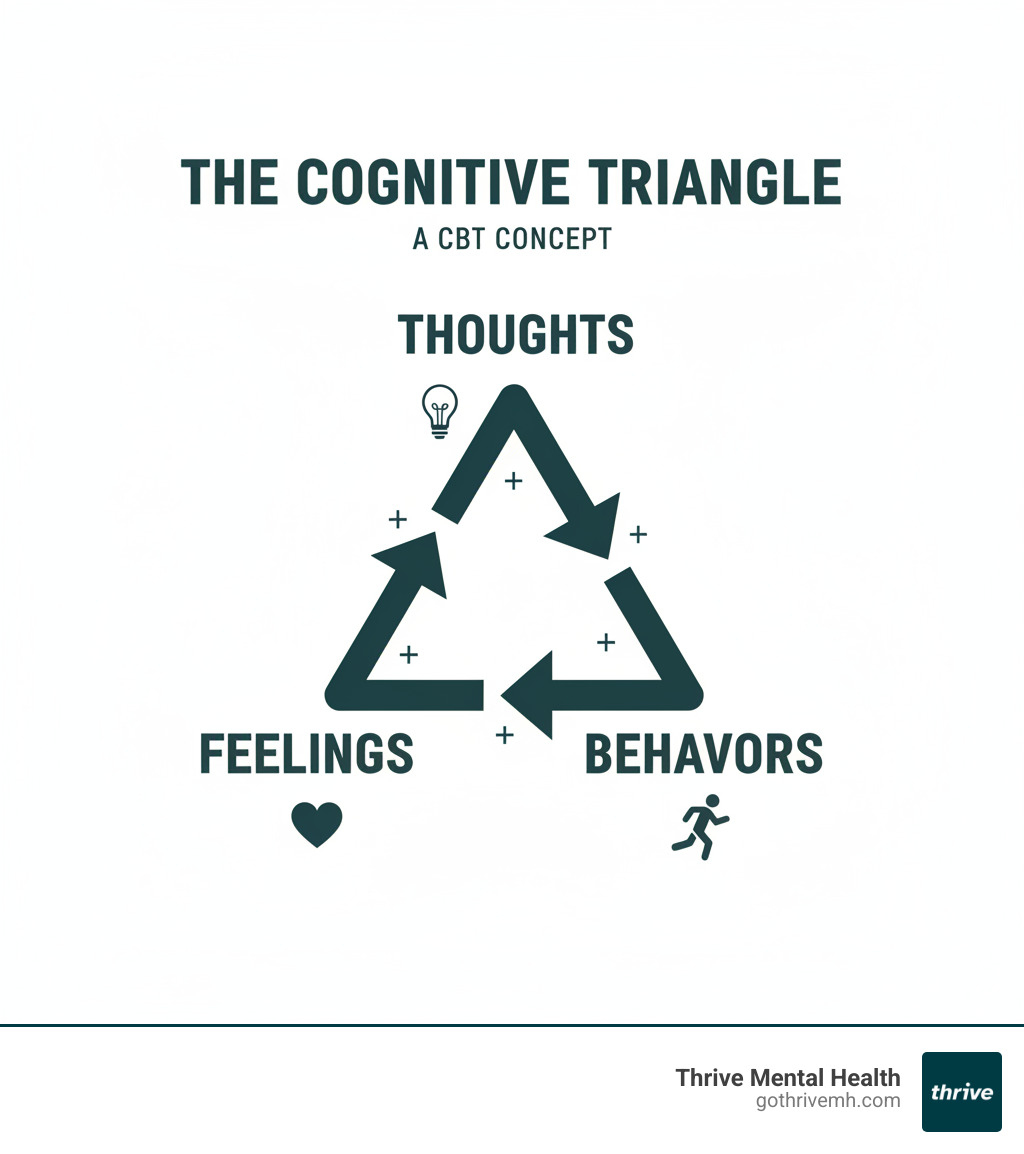
The core idea is the “Cognitive Triangle”: your thoughts, feelings, and behaviors are all connected. A negative thought (e.g., “I’m going to get fired” after your boss doesn’t reply to an email) triggers anxiety, which leads to avoidance (not checking your inbox), creating more anxiety. CBT teaches you to spot and break these cycles.
CBT works. Hundreds of studies show it’s as effective as medication for depression and anxiety, and it’s recommended as a first-line treatment by organizations like the American Psychological Association. You can read more about the scientific research on CBT’s effectiveness.
At Thrive Mental Health, we use CBT to help clients across Florida become their own therapists. Whether in our Virtual IOP Programs or one-on-one, we equip you with skills that last.
Core Principles of CBT
CBT is guided by three core ideas:
- Problems stem from unhelpful thinking and learned behaviors. Many struggles come from faulty thought patterns you’ve picked up over time. They may have helped you cope once, but now they’re holding you back.
- You can learn better coping skills. Because these patterns are learned, they can be unlearned. CBT teaches you healthier ways to think and act, relieving symptoms and improving daily life.
- Active participation is key. CBT is a collaboration. You’ll practice skills, complete homework, and apply what you learn in real life. Your effort directly impacts your results.
What Happens in a Typical CBT Session?
At Thrive, sessions are structured and purposeful. A typical session includes:
- Mood Check-in: We start by discussing how you’re feeling and what’s happened since we last met.
- Agenda Setting: We collaboratively decide what to focus on, aligning with your treatment goals.
- Homework Review: We discuss what you learned from practicing skills between sessions.
- Skill Practice: The core of the session is learning and practicing new tools, like challenging a negative thought or role-playing a conversation.
- New Homework: We assign practical exercises to help you apply what you’ve learned in your daily life.
- Summary: We review key takeaways to set you up for success.
For more intensive support, such as a PHP with more frequent sessions, our team can help you find the right program.
CBT Techniques That Stop Negative Thought Spirals
What is cognitive behavioral therapy if not a practical toolkit to interrupt negative spirals and give you back control? These are real, actionable strategies you can use today.

Cognitive Strategies: Changing How You Think
- Identify Cognitive Distortions: The first step is to recognize common thinking errors that fuel negative emotions. These include all-or-nothing thinking (if you’re not perfect, you’re a failure), catastrophizing (jumping to the worst-case scenario), and mind reading (assuming you know what others think).
- Challenge Negative Thoughts: This is the core of cognitive restructuring. Using tools like thought records and Socratic questioning, your therapist helps you examine the evidence for and against your automatic thoughts. You learn to replace harsh, inaccurate stories with more balanced and realistic ones.
Behavioral Strategies: Changing What You Do
- Behavioral Activation: When you’re depressed or anxious, you stop doing things you enjoy. This technique involves scheduling activities that bring you joy or a sense of accomplishment, even if you don’t feel like it. Action often comes before motivation.
- Behavioral Experiments: Test your negative predictions in real life. If you think asking for help makes you look weak, the experiment is to ask for help and see what happens. These experiments provide concrete evidence to challenge your fears.
- Relaxation and Stress Reduction: Techniques like deep breathing, progressive muscle relaxation, and mindfulness calm your nervous system. When your body relaxes, your mind follows, which can stop anxiety or panic in its tracks.
At Thrive Mental Health, we teach these skills in our Virtual IOP Programs, which are designed to fit the lives of our clients in Florida. You’ll learn, practice, and apply these techniques with expert support so they stick.
Who Benefits from CBT? (And What Happens If You Don’t Get Help?)
The beauty of what is cognitive behavioral therapy is that it works for almost everyone, regardless of age or background. It offers practical tools that fit your life.

CBT is highly effective for:
- Mental Health Conditions: It helps with depression by challenging thoughts like “I’m worthless,” and with anxiety by teaching you to face fears. It’s also a primary treatment for PTSD, OCD, and eating disorders.
- Physical Health Issues: CBT is remarkably effective for managing chronic pain, insomnia (CBT-I), and stress-related conditions like migraines and IBS. The scientific evidence for CBT treating these health issues is extensive.
But what happens if you wait? Negative thought patterns get stronger. Avoidance spreads. The anxiety you’re managing “well enough” starts costing you missed opportunities, strained relationships, and sleepless nights. Many people who finally seek help say, “I wish I’d done this sooner.”
If you’re in crisis, call/text 988 right now. You are not alone.
Your Role in CBT and Finding a Therapist
Success in CBT is a partnership. Your therapist is a guide and coach, but your role is active. This means showing up consistently, being honest, and completing homework to practice skills in your real life. Our programs are designed to support this active learning process.
 Heal in the Capital: Specialized Trauma Therapy for Sacramento AdultsMental Health
Finding the right therapist is crucial. Look for licensed professionals with specific CBT training. Most major insurance plans, like Cigna, Optum, and Florida Blue, cover CBT. At Thrive, we serve clients throughout Florida and can simplify the process.
The fastest way to get started is to verify your insurance coverage with us. It’s fast, confidential, and there’s no obligation.
How Long Does CBT Take? What Results Can I Expect?
CBT is designed to be efficient. Most people see tangible improvements within 5 to 20 sessions, typically meeting weekly for 30-60 minutes. It’s not meant to drag on for years.
Your timeline depends on the complexity of your situation, your goals, and how actively you engage. While complex issues like severe PTSD may take longer, you’ll learn practical skills from day one.
What results can you expect? You’ll gain lasting skills to manage spiraling thoughts and choose healthier behaviors. This leads to significant symptom relief (less anxiety, better mood, improved sleep), more effective stress coping, and a better overall quality of life.
CBT does require effort and can be emotionally challenging at times. You may feel temporary distress as you confront difficult thoughts, but this is a normal part of the process. A Thrive therapist will support you in a safe environment.
Here’s a quick look at what makes CBT stand out:
| Feature | Cognitive Behavioral Therapy (CBT) |
|---|---|
| Focus | Present-focused; thoughts, feelings, behaviors are interconnected |
| Duration | Short-term (typically 5-20 sessions) |
| Approach | Structured, goal-oriented, collaborative, skill-based |
| Outcome | Lasting coping skills, symptom reduction, functional improvement |
Our Virtual IOP Programs deliver these techniques in a format that fits your life.
Frequently Asked Questions about CBT
Here are answers to common questions about what is cognitive behavioral therapy.
We suggest adding JSON-LD Schema for FAQs to help this content appear in Google’s “People Also Ask” features.
What is the main goal of cognitive behavioral therapy?
The main goal is to help you identify and change the negative thought and behavior patterns keeping you stuck. It’s about giving you practical tools to relieve symptoms, cope more effectively, and improve your quality of life now.
Can I do CBT on myself?
While self-help resources are available, working with a trained therapist is far more effective. A therapist provides personalized guidance, accountability, and expert support that a book can’t. At Thrive Mental Health, our therapists tailor CBT to your unique needs for faster, more lasting results.
What’s a simple example of CBT in action?
Imagine you make a mistake at work and think, “I’m a total failure.” CBT helps you challenge that “all-or-nothing” thought by examining the evidence. You’d reframe it to something more realistic, like, “I made a mistake, and I can learn from it.” This shift from catastrophic to constructive is CBT in action.
How is CBT different from just “positive thinking”?
CBT is not about forced positivity. It’s about realistic, evidence-based thinking. It teaches you to examine your thoughts for accuracy and replace distortions with balanced perspectives, not just happy ones. The goal is to think clearly, not just positively.
Does insurance cover CBT?
Yes, most major insurance plans, including Cigna, Optum, and Florida Blue, cover CBT because it’s an evidence-based treatment. Thrive Mental Health serves clients in Florida, and we can quickly verify your insurance for you.
Summary: Why You Can’t Afford to Wait on CBT
You now know what is cognitive behavioral therapy can do: it offers a proven, evidence-based path to lasting change. At Thrive Mental Health, we’ve seen it help countless professionals, young adults, and others reclaim their lives from anxiety, depression, PTSD, and more.
Here’s the hard truth: the longer you wait, the deeper negative patterns become. Occasional worry turns into constant anxiety, and avoidance becomes a habit, impacting your work, relationships, and health. The cost of waiting is real.
But you don’t have to wait. CBT is designed to work efficiently, often showing results in just a few weeks. You just need to be willing to show up and practice the new skills you learn.
Your future self, the one who sleeps better, feels more confident, and handles stress without spiraling, is waiting. That version of you is closer than you think.
Ready to get started? Learn more about Thrive’s Virtual Therapy options or verify your insurance in 2 minutes. You can also read our guide: “5 Signs You Need Therapy Now”.
Ready for support? Thrive offers virtual IOP with evening options. Verify your insurance in 2 minutes (no obligation) → Start benefits check or call 561-203-6085. If you’re in crisis, call/text 988.
{
  "@context": "https://schema.org",
  "@type": "FAQPage",
  "mainEntity": [
    {
      "@type": "Question",
      "name": "What is the main goal of cognitive behavioral therapy?",
      "acceptedAnswer": {
        "@type": "Answer",
        "text": "The main goal of what is cognitive behavioral therapy is to help you identify and change the negative thought and behavior patterns that are contributing to your emotional distress and holding you back. By learning these skills, you can relieve symptoms, cope more effectively, and improve your overall quality of life."
      }
    },
    {
      "@type": "Question",
      "name": "Can I do CBT on myself?",
      "acceptedAnswer": {
        "@type": "Answer",
        "text": "While you can certainly learn CBT skills from self-help books or apps, working with a trained and licensed therapist is generally much more effective. A therapist provides personalized guidance, helps you identify blind spots, and offers crucial support and accountability that self-study often lacks. At Thrive Mental Health, our expert therapists ensure you get the most out of your CBT journey."
      }
    },
    {
      "@type": "Question",
      "name": "What's a simple example of CBT in action?",
      "acceptedAnswer": {
        "@type": "Answer",
        "text": "Imagine you've received constructive criticism at work, and your immediate thought is, 'I'm terrible at my job, I'll never succeed.' A CBT therapist would help you challenge this 'all-or-nothing' thinking. You'd examine the evidence (e.g., past successes, specific feedback points) and reframe the thought into something more balanced, like, 'This is valuable feedback, and I can use it to improve. My performance isn't defined by one piece of criticism.'"
      }
    },
    {
      "@type": "Question",
      "name": "How is CBT different from just \"positive thinking\"?",
      "acceptedAnswer": {
        "@type": "Answer",
        "text": "CBT is not about forcing yourself to be positive. Instead, it's about realistic, evidence-based thinking. It teaches you to critically evaluate your thoughts, identify distortions, and replace them with thoughts that are accurate and helpful, even if they're not always 'positive.' It's about finding a balanced perspective rooted in reality."
      }
    },
    {
      "@type": "Question",
      "name": "Does insurance cover CBT?",
      "acceptedAnswer": {
        "@type": "Answer",
        "text": "Yes, most major insurance plans, including Cigna, Optum, and Florida Blue, typically cover CBT as it is an evidence-based and widely recognized form of psychotherapy. We encourage you to contact us at Thrive Mental Health to verify your insurance coverage for our programs in Florida."
      }
    }
  ]
}

This article is for informational purposes only and is not a substitute for individualized clinical advice or insurance verification.