





Is PTSD an Anxiety Disorder? [2025] 5 Key Differences + Faster Treatment Options
Short answer: No, PTSD isn’t classified as an anxiety disorder in DSM-5, but the overlap can cause misdiagnosis. Below you’ll learn the 5 biggest differences, how to tell what you’re dealing with, and the fastest ways to treat it.
The question is ptsd an anxiety disorder has sparked significant debate in the mental health field, especially since major diagnostic changes in 2013. Here’s what you need to know:
Quick Answer:
- No, PTSD is no longer classified as an anxiety disorder in the DSM-5
- But, It shares many symptoms with anxiety disorders and they often occur together
- Classification, PTSD is now categorized under “Trauma- and Stressor-Related Disorders”
- Key difference, PTSD requires exposure to a specific traumatic event, while anxiety disorders can develop without trauma
This reclassification reflects our growing understanding of how trauma uniquely affects the brain compared to other forms of anxiety.
The confusion is understandable. Both conditions involve intense fear, avoidance, and persistent worry. Research shows that around 80% of people with PTSD also have another mental health condition, and anxiety disorders are among the most common.
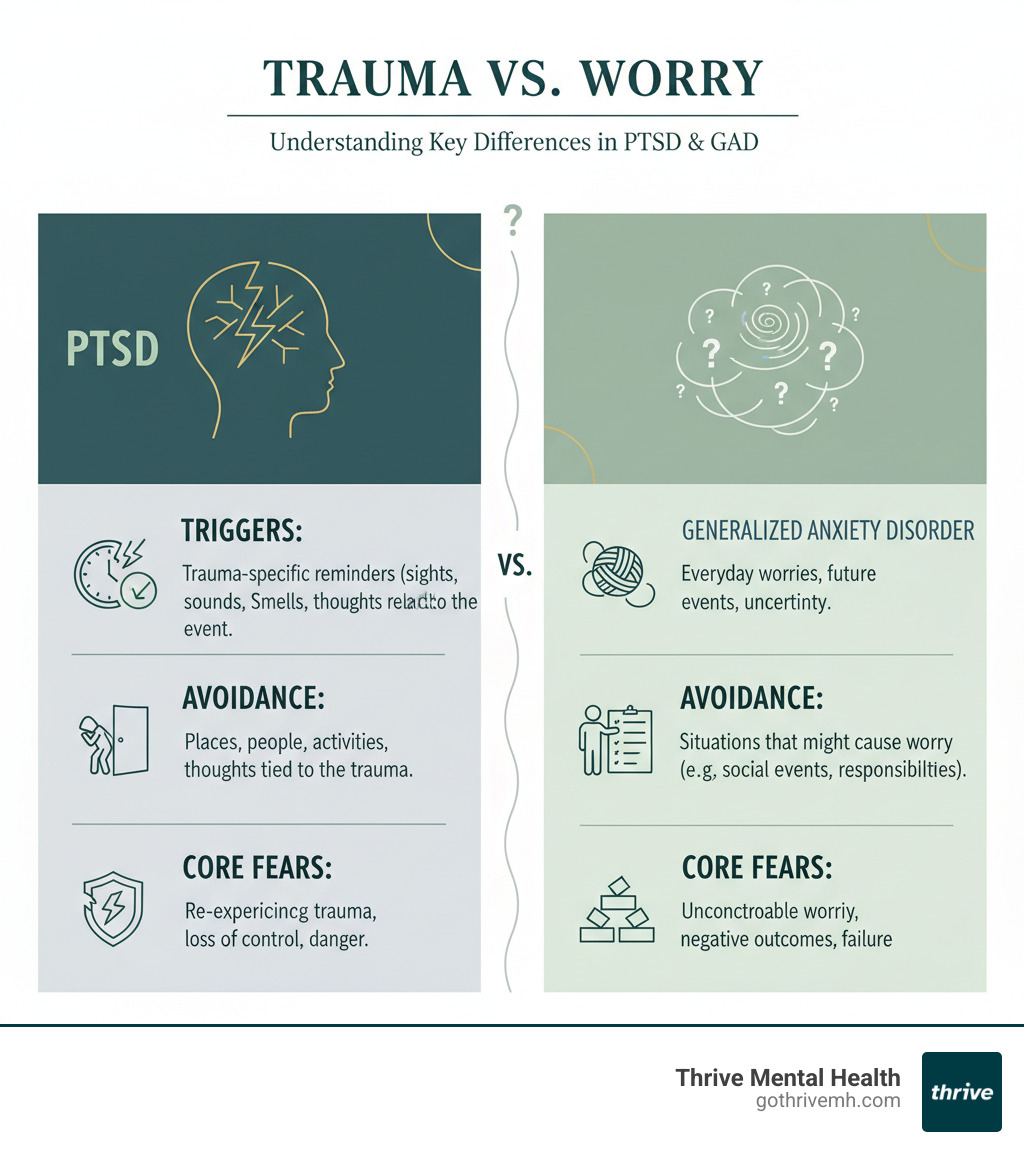
Yet, the brain processes trauma differently. While anxiety often focuses on future threats, PTSD keeps the nervous system stuck in past danger. The brain’s alarm system (amygdala) stays hyperactive, while the prefrontal cortex struggles to distinguish between actual and perceived threats.
Understanding this distinction is vital for recovery. Misdiagnosis can lead to treatments that manage symptoms without addressing the underlying trauma, potentially prolonging suffering.
Basic is ptsd an anxiety disorder terms:
Why the Answer to “Is PTSD An Anxiety Disorder?” Changed with the DSM-5
For decades, PTSD was classified as an anxiety disorder in the Diagnostic and Statistical Manual of Mental Disorders (DSM). This made sense, as people with PTSD experience intense anxiety, fear, and worry. But in 2013, the American Psychiatric Association moved PTSD to a new category in the DSM-5: “Trauma- and Stressor-Related Disorders.”
This change, based on decades of research, acknowledged that trauma causes unique psychological wounds. Previously, these responses were often dismissed as personal weakness. The key insight was that PTSD requires exposure to a specific traumatic event. Unlike other anxiety disorders, which can develop without a clear trigger, PTSD has an identifiable cause.
Scientific research on the DSM-5 reclassification showed that while anxiety is present in PTSD, it doesn’t capture the full picture. PTSD also includes anhedonic symptoms (inability to feel pleasure) and dysphoric presentations (persistent negative emotions) that go beyond typical anxiety. The DSM-5 also expanded the criteria to 20 symptoms, including disruptive behaviors like angry outbursts and reckless actions, which don’t fit the anxiety disorder framework.
Core Symptoms That Set PTSD Apart
Understanding why is PTSD an anxiety disorder became “no” requires looking at PTSD’s unique symptom profile. These are direct responses to a traumatic event, organized into four clusters:
Re-experiencing is a core PTSD symptom. It includes flashbacks that feel like reliving the trauma, distressing nightmares, and unwanted intrusive thoughts. These lead to intense psychological and physical distress when exposed to trauma reminders.
Avoidance is a survival strategy that severely restricts life. People with PTSD actively avoid anything, thoughts, places, people, that reminds them of the trauma. This avoidance is often comprehensive and life-altering.
Negative changes in thinking and mood show how trauma alters one’s worldview. This includes memory gaps, persistent negative beliefs (“I am damaged”), emotional numbness, and feelings of detachment from others, leading to isolation.
Alterations in arousal and reactivity mean the body’s alarm system is in overdrive. This leads to hypervigilance (constantly scanning for danger), an exaggerated startle response, sleep problems, poor concentration, and irritability or angry outbursts.
These symptom clusters paint a picture of a nervous system trapped in past danger, which is fundamentally different from the future-focused worry of anxiety disorders.
How This Change Impacts Diagnosis and Understanding
The reclassification clarified clinical practice. Clinicians now look beyond general anxiety to assess for trauma exposure and PTSD’s unique symptoms. This precision is vital. Someone with chronic worry may have Generalized Anxiety Disorder, but if they also have flashbacks from an accident, they need trauma-specific treatment. The right diagnosis can be the difference between managing symptoms and true healing.
Reducing stigma was another benefit. By identifying trauma as the cause, PTSD is now understood as a natural response to an abnormal event, not a personal weakness. This understanding is empowering, reframing symptoms as the body’s attempt to protect itself and opening the door to healing. More info about understanding trauma.
This focus highlights that PTSD’s origins require specialized treatments that address how the brain stores and processes traumatic memories.
The Deep Connection: Shared Symptoms and Brain Science
Though no longer classified together, PTSD and anxiety disorders are deeply connected. The symptom overlap is so significant that distinguishing between them can be challenging, even for professionals.
From the inside, the symptoms feel nearly identical: persistent fear, racing thoughts, sleep problems, and avoidance. The body is on high alert. The key difference is the why. For example, someone with PTSD might avoid a barbecue because the smell triggers a trauma memory, while someone with GAD might avoid it due to social worries. The behavior is the same, but the root cause differs.
Complicating matters, around 80% of people with PTSD have a co-occurring condition, most commonly an anxiety disorder. Many people steer both simultaneously.
Brain science explains this overlap. In both conditions, the brain struggles with fear extinction learning, the ability to recognize when danger has passed. Three brain regions are key: the amygdala (alarm system) stays hyperactive, the prefrontal cortex (rational thought) struggles to regulate it, and the hippocampus (memory) has trouble distinguishing past from present.
This shared neurobiology explains the similar physical responses. The sympathetic nervous system goes into overdrive, creating a constant state of fight-or-flight. Understanding these shared pathways clarifies why some treatments work for both and why an accurate diagnosis is so critical. For a deeper dive, see this study on Posttraumatic Stress Disorder and Anxiety-Related Conditions, PubMed.
Comparing PTSD vs. Common Anxiety Disorders
| Symptom/Feature | Post-Traumatic Stress Disorder (PTSD) | Generalized Anxiety Disorder (GAD) | Panic Disorder |
|---|---|---|---|
| Core Driver | Past traumatic event (actual or threatened death, serious injury, sexual violence) | Excessive, uncontrollable worry about future/general events (e.g., health, work, finances) | Fear of future panic attacks and their consequences |
| Key Symptom | Flashbacks, nightmares, re-experiencing the trauma, intense distress to trauma reminders | Persistent, widespread anxiety and worry, often out of proportion to actual events | Sudden, recurrent, unexpected panic attacks (intense fear with physical symptoms) |
| Avoidance | Cues (people, places, thoughts, feelings) related to the specific trauma | Situations that might trigger worry; sometimes avoiding decisions to prevent bad outcomes | Places or situations where attacks have occurred or where escape might be difficult (agoraphobia) |
| Mood | Negative beliefs, guilt, shame, detachment, emotional numbness, anhedonia | Irritability, restlessness, feeling on edge, difficulty concentrating | Fear, sense of impending doom, feeling of losing control or going crazy |
The table highlights key differences, but the timeline is also crucial. PTSD looks backward, processing a past event. Anxiety disorders look forward, worrying about what might happen. Think of it this way: With PTSD, you fear the specific intersection where you had an accident. With GAD, you fear every intersection because an accident could happen. With Panic Disorder, you fear the feeling of terror itself.
Why it’s crucial to know if it’s PTSD or an anxiety disorder
An accurate diagnosis is the first step to getting your life back. Misdiagnosing trauma as general anxiety means treating symptoms without addressing the root cause, like putting a band-aid on a broken bone.
Untreated trauma often grows. PTSD can lead to anxiety disorders, depression, or substance use. The brain gets stuck in survival mode, and this constant hypervigilance can make anxiety the default setting.
Treatment implications are huge. Treating PTSD as GAD means you might learn coping skills but miss out on crucial trauma-focused therapies like EMDR therapy, which helps reprocess traumatic memories. The brain changes from trauma are specific and require targeted interventions that go beyond surface-level anxiety symptoms.
Knowing if you have PTSD, an anxiety disorder, or both provides a roadmap for recovery. It explains your reactions and points to the most effective healing approaches. Learn more about recognizing anxiety symptoms and their patterns.
How Treatment Approaches Differ (And Where They Converge)

While PTSD and anxiety disorders are in different diagnostic categories, their treatments overlap, but crucial differences can determine recovery success. Anxiety disorder treatment typically focuses on managing symptoms and developing coping skills. PTSD treatment is different; while symptom management is part of it, the core work involves processing the traumatic memory itself.
 Reality Check! Your Guide to Virtual Reality Therapy in ArizonaMental Health
Both conditions may benefit from medications like SSRIs and SNRIs to regulate mood and reduce anxiety. Treating sleep disruption is also crucial for both. However, effective treatment must be customized to account for how the brain processes trauma differently from general anxiety.
So, is PTSD an anxiety disorder in practice? Tailoring the Therapy
In practice, many therapies work for both, but they are applied differently depending on the root cause of the symptoms.
Cognitive Behavioral Therapy (CBT) is a foundation for both. For anxiety, CBT challenges “what if” thoughts. For PTSD, Trauma-Focused CBT processes the traumatic event and related negative beliefs. The focus is different, even if the techniques seem similar.
Exposure Therapy is also applied differently. For anxiety, it involves gradual exposure to feared situations. For PTSD, Prolonged Exposure therapy involves carefully revisiting the traumatic memory and confronting avoided situations.
Eye Movement Desensitization and Reprocessing (EMDR) is a therapy designed specifically for trauma. It changes how traumatic memories are stored, reducing their emotional impact. While not typically used for general anxiety, it is highly effective for PTSD. Learn more about EMDR Therapy and its role in trauma recovery.
The key takeaway is that while techniques overlap, their application differs. Effective treatment depends on understanding if the root is trauma, anxiety, or both.
Managing Complications: Substance Use, Depression, and Suicidal Thoughts
Disclaimer: If you or a loved one are experiencing thoughts of suicide or self-harm, please call or text the 988 Suicide & Crisis Lifeline. Help is available 24/7, and you are not alone.

If you’re in crisis, call/text 988 right now. You are not alone.
Both PTSD and anxiety disorders often co-occur with other conditions, which can complicate recovery if not addressed.
- Substance use is a common but dangerous coping mechanism. Alcohol or drugs may offer temporary relief but create a vicious cycle that worsens symptoms and makes recovery harder.
- Depression often co-occurs with both conditions. The constant stress and emotional exhaustion can lead to hopelessness.
- Suicidal thoughts are the most serious risk. The intense pain and exhaustion can lead people to consider suicide, which is why comprehensive, integrated treatment is life-saving.
Treating each condition separately often fails. Integrated treatment is necessary because these conditions interact. An integrated plan might include trauma-focused therapy, anxiety management, medication, and substance use support to heal the whole person. At Thrive Mental Health, our Virtual Intensive Outpatient Programs for Florida residents are designed for these complex cases, offering structured, flexible support.
Frequently Asked Questions about PTSD and Anxiety
Is PTSD an anxiety disorder?
No. DSM-5 classifies PTSD under Trauma- and Stressor-Related Disorders. Still, it overlaps with anxiety and often co-occurs.
What’s the main difference between PTSD and anxiety disorders?
PTSD is tied to a past traumatic event and includes re-experiencing (flashbacks, nightmares). Anxiety disorders center on future-oriented worry without a required trauma.
Can you have PTSD and an anxiety disorder at the same time?
Yes, very common. An integrated plan should treat the trauma and the anxiety together.
What treatments work best for PTSD vs. anxiety?
PTSD: EMDR and Prolonged Exposure (trauma-focused). Anxiety: CBT and exposure for worry/avoidance. SSRIs/SNRIs can support both.
How do I know if it’s PTSD or anxiety?
Ask: Did symptoms start after a specific event? Do you have flashbacks/nightmares and strong reactions to reminders? If yes, get a trauma-focused assessment.
Suggested JSON-LD FAQ schema markup:
Conclusion: Get the Right Diagnosis, Get Better Faster
The debate over is ptsd an anxiety disorder highlights a key truth: healing isn’t about labels, it’s about fast, accurate care that matches your symptoms. PTSD and anxiety can look similar, but trauma-focused care (EMDR, Prolonged Exposure) is essential when a specific event is the driver, while CBT-based strategies target generalized worry.
Insurance and locations: Thrive works with many plans, including Cigna, Optum, Florida Blue, and more, and serves clients in Florida with flexible scheduling.
Explore services: Our Virtual Intensive Outpatient Program (IOP) and trauma track, plus evening options, fit busy schedules. Not sure what you need? Start with a quick benefits check and we’ll guide your next step.
Ready for support? Thrive offers virtual IOP with evening options for clients in Florida. Verify your insurance in 2 minutes (no obligation) → Start benefits check or call 561-203-6085. If you’re in crisis, call/text 988.

This article is for informational purposes only and is not a substitute for individualized clinical advice or insurance verification.