





Online Mental Health Support Group: 10 Best
You’re Not Alone: How Online Support Groups Cut Depression Symptoms by 30% in 8 Weeks
If you’re in crisis, call or text 988 right now. You are not alone. Support groups are for ongoing connection, not emergencies.
Online mental health support groups connect you with people who truly understand what you’re going through. Whether you’re dealing with anxiety, depression, or grief, these virtual communities offer a safe space to share experiences and find support.
Quick Answer: Top 5 Free Online Mental Health Support Groups [2025]
- ADAA Communities, 80,000+ members, anxiety & depression focus
- DBSA Groups, Depression and bipolar disorder support
- NAMI Connection, Peer-led groups for all mental health conditions
- HeyPeers, Certified peer specialist-led groups
- Crisis Text Line, Text HOME to 741741 for immediate support
When life feels overwhelming, it’s easy to feel isolated. But the truth is, millions of people are navigating similar challenges. Research shows that support groups can reduce symptoms of anxiety and depression by 30% in just 8 weeks, with some communities connecting tens of thousands of people worldwide.
These groups come in different forms: some are peer-led, while others are facilitated by trained professionals. They can focus on specific conditions like depression, life challenges like grief, or broader communities.
I’m Anna Green, LMHC, LPC, Chief Clinical Officer at Thrive Mental Health. I’ve seen how online mental health support groups complement professional treatment by providing vital community connection. The right group can be a game-changer in your mental health journey.
6 Ways Support Groups Save You $2,400/Year on Mental Health Costs
There’s something magical that happens when you realize you’re not alone. In an online mental health support group, you find understanding nods and shared experiences from people who truly get it.

These communities are powerful because they offer:
- A way to break through isolation. Mental health struggles can feel lonely. Hearing others share similar experiences lifts that heavy blanket.
- Empowerment. Sharing your story and helping others reveals your own resilience and strength.
- Practical wisdom. Members share a toolkit of real-world coping strategies that have been tested by people with similar challenges.
- Motivation. Knowing your group is rooting for you makes it easier to take the next step. Celebrating small wins together keeps you moving forward.
- Genuine validation. Hearing someone say, “I understand exactly what you mean,” and knowing they do, is incredibly healing and helps reduce shame.
- Cost savings. Free support groups can supplement therapy, potentially saving $200/month or $2,400/year on additional sessions.
Research consistently shows that social support is crucial for mental health recovery. People in support groups often see 30% reduction in anxiety and depression symptoms, with 91% of participants reporting improvement with the right support.
How Shared Experiences Build Resilience in 4 Weeks
The real magic happens when people share their stories. Hearing someone else describe what you’ve been feeling is profoundly validating.
- Week 1: Normalizing struggles. When you hear that others share your anxieties or intrusive thoughts, it stops being a “weird thing” and becomes a shared human experience.
- Week 2: Reducing shame. Shame thrives in secrecy. Sharing your struggles with other capable people makes it harder to beat yourself up.
- Week 3: Building belonging. You become part of a tribe that accepts you exactly as you are, which is larger than your individual struggle.
- Week 4: Gentle accountability. Checking in with people who care about your progress encourages you to follow through on small, positive changes.
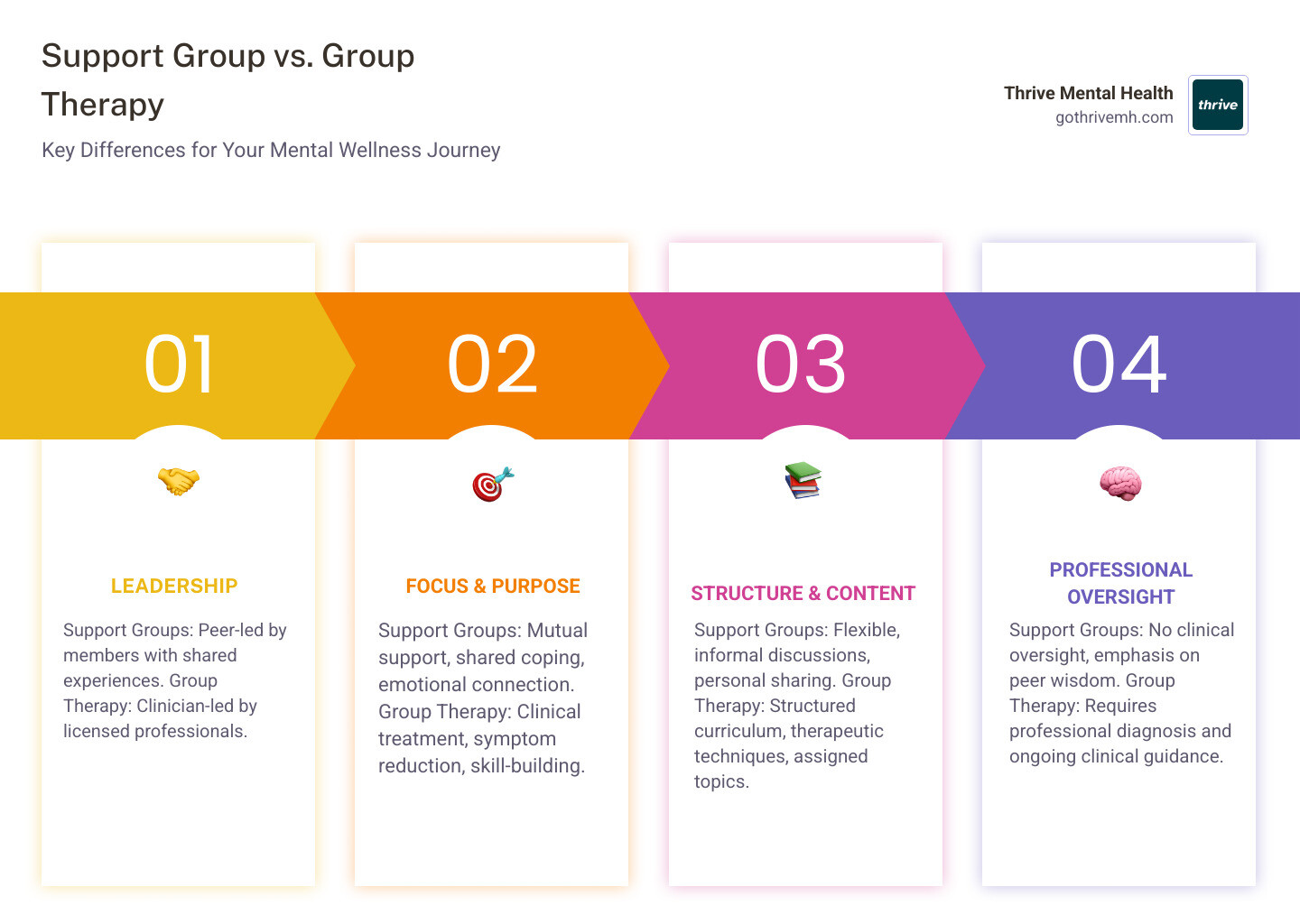
Support Group vs. Group Therapy: Knowing What You Need
It’s easy to wonder whether an online mental health support group or group therapy is the right fit. While both involve connecting with others, they serve different purposes. A support group is like coffee with friends who get it; group therapy is a structured class led by a professional.
Here’s how they compare:
| Feature | Support Group | Group Therapy |
|---|---|---|
| Leader | Peer-led (lived experience) or volunteer | Licensed mental health professional |
| Goal | Mutual support, shared experience, coping | Clinical treatment, skill development |
| Structure | Flexible, informal, discussion-based | Structured, therapeutic techniques |
| Cost | Often free or low-cost | Varies, often covered by insurance |
| Best For | Community, validation, sharing tips | Addressing specific conditions, growth |
Support groups are built on peer connection and mutual encouragement. Group therapy is a clinical treatment using evidence-based methods to address specific conditions, as detailed in the American Psychological Association guide on group therapy.
When to Choose a Support Group
A support group might be perfect if you are:
- Seeking community and connection with people who have experience.
- Supplementing individual therapy with an extra layer of peer validation.
- Exploring feelings in a safe, informal space without pressure.
- Looking for a low-cost or free support option.
When to Consider Group Therapy
Group therapy is a better choice if you are:
- Needing structured treatment for persistent anxiety, depression, or trauma.
- Working on specific goals, like managing panic attacks or processing grief.
- Requiring a licensed professional to address complex patterns or severe symptoms.
- Enrolled in an IOP or PHP plan, where group therapy is a core component.
If you’re exploring more intensive options, our guide on structured group therapy explains how these programs work. You can also learn more by Exploring the Benefits of Virtual Intensive Outpatient Programs.
You don’t have to choose just one. Combining a support group with professional therapy often provides the best of both worlds: clinical expertise and peer connection.
Find Your Tribe in 5 Minutes: 12 Types of Free Online Support Groups
The beauty of online mental health support groups is the variety. You can find communities focused on specific diagnoses, life challenges, or shared identities, making it easier to connect with people who understand your unique perspective.

Groups are typically peer-led by those with lived experience or professionally-facilitated by a mental health expert who provides structure while still centering peer connection.
7 Condition-Specific Groups That Meet Tonight
Targeted groups can be incredibly valuable. Here are some resources:
- Depression & Bipolar Disorder: The Depression and Bipolar Support Alliance (DBSA) offers many DBSA Online Support Groups and lists various DBSA’s Meeting Topics.
- Anxiety Disorders: The Anxiety and Depression Association of America (ADAA) has an ADAA Anxiety and Depression Support Community and a Spanish-language option, ADAA Apoyo para Ansiedad y Depresión (Español). Explore all options in their guide to support groups.
- PTSD: ADAA also hosts a dedicated Post-Traumatic Stress Disorder (PTSD) Support Community.
- OCD: The International OCD Foundation provides peer-led IOCDF support groups.
- Substance Use Disorders: Organizations like Alcoholics Anonymous and Narcotics Anonymous offer online meetings around the clock.
5 Identity-Based Groups Starting This Week
Sometimes you need support for a specific circumstance or identity:
 The Best Behavioral Health IOP Providers for Adults in PhoenixMental Health
- Life Challenges: You can find groups focused on grief and loss, caregiver burnout, and living with chronic illness.
- Identity-Focused: DBSA offers Identity-Focused Online Support Groups for communities including LGBTQIA+, Military Veterans, and Young Adults (ages 18-30).
For broader support, the National Alliance on Mental Illness (NAMI) offers free, peer-led NAMI Connection support groups for any mental health condition. The HeyPeers platform is another excellent resource for groups led by certified peer specialists.
Finding the right group may take a few tries. Don’t be discouraged if the first one isn’t a perfect fit, your community is out there. For more structured support, explore our virtual therapy options.
10-Point Safety Checklist: Avoid Toxic Groups in 2 Minutes
With so many options, finding the right online mental health support group can feel overwhelming. Asking a few key questions upfront can help you find a safe, welcoming community that fits your needs.

If you’re in crisis, call or text 988 right now. You are not alone. The 988 Suicide & Crisis Lifeline is available 24/7. Support groups are for ongoing support, not emergencies.
Before joining, consider these factors:
- Safety and Moderation: Prioritize groups with clear rules and active moderators to avoid misinformation and ensure a supportive space. Unmoderated groups can pose risks.
- Privacy and Anonymity: Look for password-protected meetings and clear privacy policies. Check if you can use a pseudonym or keep your camera off.
- Group Format: Do you prefer large forums or small video calls? Text-based or video-only? Choose a format that makes you feel comfortable.
- Meeting Schedule: Find a group that fits your availability, whether it’s a weekly session or a flexible drop-in format.
6 Red Flags That Mean “Run” (Not Walk) Away
Based on guidance from the Mayo Clinic, ask these questions:
- Is there a trained facilitator? A moderator or peer specialist keeps discussions safe and focused.
- What are the confidentiality rules? Ensure there are clear guidelines that what’s shared in the group stays in the group.
- Is there a cost? Many non-profit groups (NAMI, DBSA) are free. Others may have a fee.
- How are conflicts handled? A clear process for resolving disagreements indicates a well-run group.
- What is the group’s focus? Make sure its purpose aligns with your needs, whether it’s for a specific condition, life challenge, or demographic.
- Are there cult-like behaviors? Avoid groups that discourage professional help or claim to have all the answers.
Insurance Coverage: Save $3,000+ in Florida
Many peer-led online mental health support groups are free. For professionally-facilitated groups or structured programs like IOP/PHP, insurance can often help. Major providers like Cigna, Optum, Aetna, and Florida Blue frequently cover virtual mental health services, potentially saving you $3,000+ per month.
If you’re in a Thrive Mental Health service area, such as Miami, Orlando, Tampa, or Jacksonville, we encourage you to verify your insurance benefits. Our Comprehensive Guide to Finding the Best Mental Health Therapist Near You can help you navigate insurance and find the right support.
Frequently Asked Questions about Online Support Groups
It’s natural to have questions before joining an online mental health support group. Here are answers to some of the most common ones.
Are online support groups really anonymous?
Most reputable groups prioritize privacy. They typically allow you to use a pseudonym, keep your camera off, or participate via text chat. However, always review a group’s privacy policy and choose one with active moderation and password-protected meetings to ensure your information is handled safely.
Can a support group replace therapy?
No, a support group is a supplement to, not a replacement for, therapy. Groups provide invaluable community and shared experience. Therapy is clinical treatment from a licensed professional who uses evidence-based techniques to address your specific condition. The two work best together. If you’re dealing with significant symptoms, consider professional options like our virtual IOP programs.
What is a peer support specialist?
A peer support specialist is a trained individual with personal, lived experience of mental health or substance use recovery. They use their journey to offer hope, encouragement, and practical guidance. They can say “I understand” and truly mean it. While they are not licensed therapists, their role is vital for providing authentic support and reducing shame. Many online mental health support groups are led by certified peer specialists.
Stop Waiting: Get Professional Help in 48 Hours (Insurance Covers 80%)
While an online mental health support group offers vital community, you may realize you’re ready for more structured, professional support. If you need more intensive attention for your symptoms or want to combine peer connection with evidence-based therapy, a higher level of care might be the right next step.
Programs like Intensive Outpatient Programs (IOP) and Partial Hospitalization Programs (PHP) provide this. They offer structured group therapy led by licensed clinicians, often from the comfort of your home. With flexible virtual options available across Florida, including evening sessions, you can integrate treatment into your life without sacrificing work or family responsibilities. Most insurance plans cover 80% of costs.
Transitioning to structured treatment doesn’t mean leaving community behind; it means adding professional guidance to the peer connection you already value. Learn more about PHP programs and how they differ from support groups.
Ready for support? Thrive Mental Health offers virtual IOP with evening options. Verify your insurance in 2 minutes (no obligation) → Start benefits check or call 561-203-6085. If you’re in crisis, call/text 988.

This article is for informational purposes only and is not a substitute for individualized clinical advice or insurance verification.