
Navigating Autism Therapies: Evidence-Based Options Explained

Your Guide to Autism Spectrum Disorder Therapy: Evidence-Based Options
If you’re in crisis, call or text 988 right now. You are not alone.
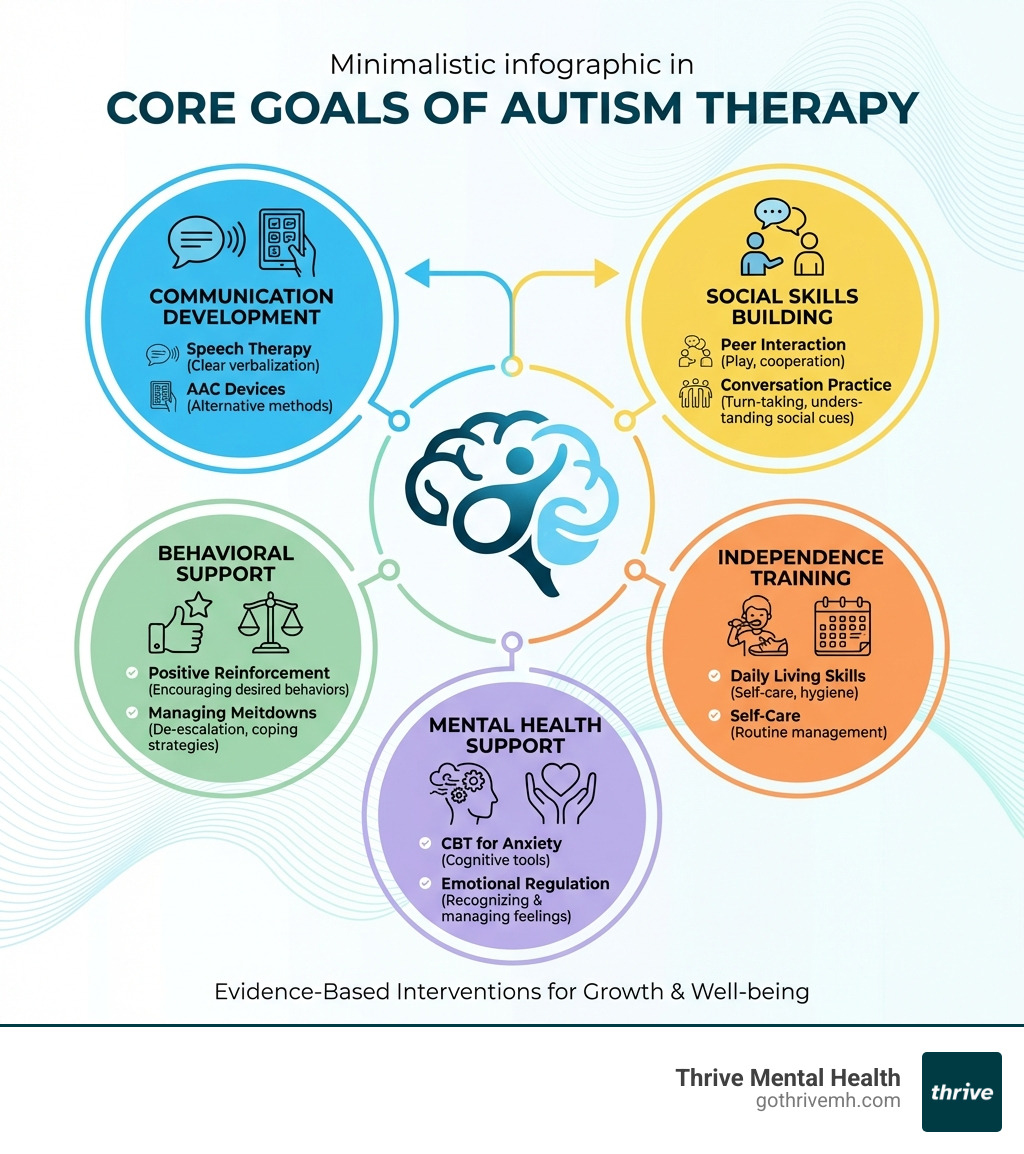
Autism spectrum disorder therapy includes a range of evidence-based interventions designed to help individuals develop communication skills, build independence, and manage challenging behaviors. While there is no single “best” therapy for everyone, research consistently supports behavioral approaches (like ABA), developmental therapies (speech, occupational), social skills training, and psychological interventions (CBT for co-occurring anxiety or depression). The most effective programs start early, tailor treatment to individual needs, and involve families in the process.
Primary Autism Therapy Options:
- Applied Behavior Analysis (ABA) – Uses positive reinforcement to teach new skills and reduce challenging behaviors
- Speech-Language Therapy – Improves communication, from spoken language to alternative communication devices (AAC)
- Occupational Therapy (OT) – Builds daily living skills, addresses sensory sensitivities, improves motor coordination
- Social Skills Training – Teaches conversation skills, peer interaction, and understanding social cues
- Cognitive Behavioral Therapy (CBT) – Helps manage co-occurring anxiety and depression, especially in teens and adults
- Early Intervention Programs – Intensive support for young children (ages 0-3) through school or home-based services
Therapy goals focus on:
- Building communication and social interaction skills
- Increasing independence in daily routines
- Managing sensory sensitivities and emotional regulation
- Reducing behaviors that interfere with learning or relationships
- Supporting transitions (school, work, adulthood)
Finding the right support means understanding what works, what doesn’t, and how to access services through insurance or schools. This guide breaks down the evidence, cuts through the noise, and gives you a clear path forward.
I’m Nate Raine, CEO of Thrive Mental Health, and I’ve spent over a decade building evidence-based behavioral health programs that integrate data, clinical expertise, and real-world outcomes for individuals and families navigating autism spectrum disorder therapy. My work focuses on scaling access to high-quality care, including our IOP and PHP programs available to residents throughout Florida that address autism and co-occurring mental health conditions.
Key autism spectrum disorder therapy vocabulary:
The Landscape of Autism Spectrum Disorder Therapy: What Actually Works?
When we talk about autism spectrum disorder therapy, we’re discussing a dynamic field with many approaches. The sheer volume of options can feel overwhelming, but our goal at Thrive Mental Health is to help you understand what actually works, based on solid evidence. It’s crucial to remember that there’s no one-size-fits-all solution; effective therapy is always individualized. What works wonders for one person might not be the best fit for another. This is why a thorough professional assessment is the first and most critical step in crafting a personalized treatment plan.
We prioritize evidence-based practices—interventions supported by credible research and data. This means we focus on therapies that have been shown to be safe and effective in well-designed studies, rather than relying on anecdotes or unproven methods.
Behavioral Approaches: Understanding ABA
Applied Behavior Analysis (ABA) is widely considered the gold standard in autism spectrum disorder therapy. It’s a structured, scientific approach that focuses on understanding behavior and how it is affected by the environment. The core principle of ABA is to encourage desired behaviors and reduce challenging ones through positive reinforcement. This method helps individuals learn new skills, from communication and social interaction to self-care and academic abilities.
In a strong ABA program, a dedicated therapy team sets clear goals. The therapist then works with the individual, and often their parents, focusing on one goal at a time. A key aspect of modern ABA is incorporating the individual’s favorite interests and activities into the learning process, creating a motivating and engaging environment. It also involves developing clear behavioral plans and carefully measuring progress to ensure the therapy is effective. ABA therapy can be conducted in various settings, including at home, in schools, and in specialized clinics, offering flexibility to meet individual needs.
Two common techniques within ABA are:
- Discrete Trial Training (DTT): This method breaks down skills into their simplest components and teaches them step-by-step. Each step is taught individually, with clear instructions and immediate positive reinforcement for correct responses.
- Pivotal Response Training (PRT): PRT takes place in more natural settings and focuses on “pivotal” skills that, once learned, lead to widespread improvements in other areas. These include motivation, self-initiation, self-regulation, and responsiveness to multiple cues.
It’s important to distinguish between modern ABA and earlier forms. While earlier applications of ABA sometimes used aversive techniques, contemporary ABA is firmly rooted in positive reinforcement and a neurodiversity-affirming approach. However, it’s also true that some adults with autism have reported long-lasting trauma associated with experiencing ABA therapy, often stemming from older, more rigid applications. This highlights the importance of choosing a provider who practices ethical, individualized, and compassionate ABA. At Thrive, our autism behavioral health services are designed with these principles at their core.
Developmental & Relational Therapies
Beyond behavioral approaches, developmental and relational therapies play a crucial role in autism spectrum disorder therapy. These therapies often focus on improving specific developmental skills or fostering more natural social and emotional connections. They are frequently integrated with behavioral strategies to provide a comprehensive treatment plan.
-
Speech-Language Therapy: This therapy is vital for individuals with ASD who face communication challenges, which can range from difficulties with spoken language to understanding social cues. Speech-language therapists help improve both verbal and non-verbal communication skills, such as asking for help, engaging in conversations, expressing feelings, and understanding speech rhythm. For those with limited verbal communication, therapists may introduce Augmentative and Alternative Communication (AAC) methods, including picture exchange systems or speech-generating devices. Improving communication can significantly impact an individual’s ability to learn and interact. For more on how learning abilities are impacted and supported, see our guide on understanding the impact of autism on learning abilities.
-
Occupational Therapy (OT): OT helps individuals develop the skills needed for daily living activities (ADLs). This can include tasks like dressing, eating independently, handwriting, and fine motor skills (e.g., using scissors or zippers). A significant component of OT for many with ASD is addressing sensory sensitivities, helping them to better process and respond to sensory input that might otherwise be overwhelming or restrictive.
-
Sensory Integration Therapy: Often a part of OT, this specialized therapy helps individuals with ASD who struggle with sensory processing differences. It aims to improve how the brain organizes and interprets sensory information, helping them respond more appropriately to sights, sounds, smells, tastes, and touch.
-
Physical Therapy (PT): PT focuses on improving gross motor skills, balance, coordination, and gait stability. For example, it can help with issues like toe-walking, which is common in some individuals with ASD.
-
DIR/Floortime (Developmental, Individual Differences, Relationship-Based): This developmental approach emphasizes meeting the individual where they are developmentally and building upon their unique strengths. It focuses on fostering warm, engaging relationships through play to encourage communication, emotional expression, and social interaction.
-
Early Start Denver Model (ESDM): ESDM is a naturalistic developmental behavioral intervention (NDBI) that combines principles from ABA with developmental and relationship-based approaches. It uses play and shared activities in natural settings to improve cognitive performance, language skills, and adaptive behavior, particularly in young children. Research shows promising results for ESDM in improving cognitive performance, language skills, and adaptive behavior in some groups of children.
Psychological Approaches for Adults and Teens
As individuals with ASD grow, they often face unique mental health challenges. Research shows that the vast majority of autistic people experience co-occurring conditions such as anxiety, depression, attention-deficit/hyperactivity disorder (ADHD), or obsessive-compulsive disorder (OCD). Autistic people may also be at a higher risk of psychiatric conditions like psychosis and schizophrenia. This is where psychological approaches like Cognitive Behavioral Therapy (CBT) become invaluable.
- Cognitive Behavioral Therapy (CBT): CBT is a psychological therapy that helps individuals understand the connections between their thoughts, feelings, and behaviors. For adults and teens with ASD, CBT can be highly effective in managing co-occurring anxiety and depression. Studies examining the effects of CBT on anxiety reported positive results in older children with IQs ≥70. It helps individuals identify unhelpful thought patterns and develop healthier coping mechanisms and emotional regulation strategies. This therapy can be particularly beneficial for those who experience heightened levels of emotional distress or struggle with social communication. For adults seeking support, autism counseling for adults often incorporates CBT techniques custom to neurodivergent experiences. We also offer specialized support for autism and depression treatment for those in our programs.
Educational & Social Skills Training
Education and social-relational approaches are cornerstones of comprehensive autism spectrum disorder therapy, helping individuals thrive in academic and social environments.

-
Treatment and Education of Autistic and Communication related handicapped CHildren (TEACCH): The TEACCH program is a structured educational approach that leverages visual learning and consistency to adjust classroom structure and improve academic and other outcomes. It emphasizes understanding the culture of autism and tailoring the environment to an individual’s strengths and needs. The TEACCH program has demonstrated some improvements in motor skills and cognitive measures.
-
School-based services (IEP/IFSP): In the United States, children with ASD have a legal right to free appropriate public education under the Individuals with Disabilities Education Act (IDEA). This includes access to specialized autism spectrum disorder therapy services within the school setting.
- Individualized Family Service Plans (IFSPs) are for children under age 3.
- Individualized Education Programs (IEPs) are for children aged 3 and older. These plans are developed by a team including parents, educators, and therapists, outlining specific goals and services (e.g., speech therapy, occupational therapy, behavioral support) to meet the child’s unique educational needs.
-
Social Skills Groups: These groups provide structured opportunities for individuals with ASD to learn and practice social skills in a supportive environment. They focus on practical aspects like initiating conversations, understanding nonverbal cues, taking turns, sharing, and navigating peer relationships. Social skills interventions have shown some positive effects on social behaviors for older children in small studies.
-
Social Stories: Developed by Carol Gray, Social Stories are short, personalized narratives that describe social situations, cues, and appropriate responses. They help individuals with ASD understand social expectations, predict outcomes, and develop strategies for navigating various social contexts.
-
Peer Training: This approach involves training neurotypical peers to interact effectively with individuals with ASD, fostering inclusion and providing natural opportunities for social skill development.
Medications & Alternative Treatments: A Critical Look at the Evidence
Navigating autism spectrum disorder therapy can bring you face-to-face with a wide array of treatment claims. It’s vital to approach both medications and alternative treatments with a critical eye, always prioritizing evidence-based information and consulting with trusted healthcare professionals. There are many myths and misinformation about autism out there, and our commitment is to guide you toward what is proven to be safe and effective.

What is the role of medication in autism spectrum disorder therapy?
It’s important to understand that there is currently no medication that treats the core symptoms of ASD itself—such as social communication difficulties or restricted, repetitive behaviors. Instead, pharmacological approaches in autism spectrum disorder therapy are used to manage co-occurring conditions and challenging symptoms that can significantly impact an individual’s quality of life.
These co-occurring conditions commonly include:
- ADHD (hyperactivity, inattention)
- Anxiety
- Depression
- Aggression
- Irritability
- Self-injury
- Sleep problems
- Seizure disorders
- Gastrointestinal issues
For instance, the antipsychotic drugs risperidone and aripiprazole have been shown to improve challenging behaviors like emotional distress, aggression, hyperactivity, and self-injury in some individuals with ASD. However, it’s also crucial to acknowledge that both medications have a high incidence of adverse side effects. This underscores the need for careful consideration, close monitoring, and a thorough discussion with a doctor experienced in treating individuals with ASD before starting any medication. The Centers for Disease Control and Prevention (CDC) provides further details on various treatment options.
Evaluating Complementary & Alternative Medicine (CAM)
Complementary and Alternative Medicine (CAM) treatments for ASD encompass a broad range of practices that fall outside conventional medical care. These can include:
- Special diets: Such as gluten-free, casein-free diets.
- Herbal supplements: Various vitamins, minerals, and botanical extracts.
- Animal therapy: Including pet therapy or equine therapy.
- Art and music therapy: Creative outlets for expression and skill development.
- Mindfulness and relaxation therapies: Techniques to reduce stress and anxiety.
- Chiropractic care: Spinal adjustments and other manual therapies.
While some CAM approaches like art, music, or animal therapy may offer therapeutic benefits (such as stress reduction or engagement), many lack rigorous scientific evidence to support their claims for treating ASD symptoms. Furthermore, some alternative treatments carry significant risks. For example, chelation therapy, which aims to remove heavy metals from the body, is not supported by evidence and can be very dangerous. Similarly, special diets often lack evidence of efficacy and can lead to nutritional deficiencies if not carefully managed by a professional.
Our position, supported by leading medical organizations, is to always talk to your doctor or healthcare provider before starting any complementary or alternative treatment. They can help you evaluate the potential benefits against the risks and ensure it doesn’t interfere with established, evidence-based autism spectrum disorder therapy.
How to Choose (and Access) the Right Therapy Program
Choosing the right autism spectrum disorder therapy program is one of the most impactful decisions you’ll make. It requires a blend of research, advocacy, and trusting your instincts. At Thrive Mental Health, we believe in empowering families with actionable steps to make informed decisions and confidently steer the complex landscape of intervention services. For parents of neurodivergent children, finding the right support is a journey that benefits from clear guidance and practical advice, as highlighted in our resources like parenting neurodivergent children: essential tips and advice.
Key Factors for Choosing an Autism Therapy Program
When evaluating potential programs for autism spectrum disorder therapy, we recommend considering these crucial factors:
- Evidence-Based Practices: Prioritize therapies that are backed by scientific research and have demonstrated effectiveness. Don’t be afraid to ask for the data.
- Individual Needs and Goals: The program should be custom to the individual’s unique strengths, challenges, and specific goals, rather than a generic approach.
- Age-Appropriateness: Therapies should be suitable for the individual’s developmental stage and age. For example, early intervention for young children will differ significantly from support for adults.
- Provider Qualifications: Ensure therapists are highly qualified and have specific experience in ASD. Look for credentials such as Board Certified Behavior Analysts (BCBAs) for ABA, licensed Speech-Language Pathologists (SLPs), and registered Occupational Therapists (OTs).
- Family Involvement: A strong program actively involves parents and caregivers, providing training and strategies to reinforce skills learned in therapy at home and in the community.
- Program Structure and Setting: Consider if the program offers a structured learning environment, a good balance of clinic, home, and community-based settings, and how it incorporates the individual’s interests.
Here are some key questions we encourage you to ask potential providers:
- How do you assess my child/loved one’s unique needs and strengths?
- What are the specific, measurable goals for therapy, and how will progress be tracked?
- What are the qualifications and training of your therapy staff?
- How do you involve families in the therapy process, and what kind of parent training do you offer?
- What is the typical staff-to-client ratio during sessions?
- How do you incorporate the individual’s interests and preferences into the therapy plan?
- What happens if the therapy doesn’t seem to be working, or if our needs change?
- Can you provide references from other families?
Navigating Insurance and School Services for autism spectrum disorder therapy
Accessing autism spectrum disorder therapy can be complex, but significant resources are available through both educational systems and health insurance.
-
Accessing Services Through Schools: For children, federal law (Individuals with Disabilities Education Act – IDEA) guarantees a legal right to free therapy services through the public school system. In Florida, these services are managed through local school districts’ Exceptional Student Education (ESE) programs.
- For children aged 0-3, services are provided under an Individualized Family Service Plan (IFSP).
- For children aged 3 and older, services are outlined in an Individualized Education Program (IEP).
These plans are developed collaboratively and ensure children receive necessary therapies like speech, occupational, and behavioral support within the school environment. If you have concerns about your child’s development, reach out to your local Florida school district or pediatrician to initiate this process.
-
Navigating Health Insurance Coverage: In Florida, state law mandates that many health insurers cover autism spectrum disorder therapy services, sometimes up to 40 hours per week. This makes accessing care more feasible for many families across the state. However, coverage details vary widely by plan.
- Contact your insurance provider: Call the number on your insurance card to understand what specific autism therapies are covered, any limits (e.g., number of sessions, age caps), and your out-of-pocket costs (deductibles, co-pays, co-insurance). It’s important to check your specific plan, whether it’s with a major provider like Cigna, Optum, or Florida Blue.
- In-network vs. Out-of-network: Ask for a list of in-network providers to minimize costs.
- Medicaid Services: If you have Medicaid, check your state’s specific behavioral health benefits, as Medicaid services can cover various therapies for individuals with ASD.
- Advocacy: Be prepared for paperwork and potential waiting lists. Your child’s pediatrician, a social worker, or community organizations can be invaluable advocates in navigating this process.
Frequently Asked Questions about Autism Therapy
When is the best time to start autism therapy?
Research consistently shows that early diagnosis and interventions, particularly during preschool years or even before, are more likely to have major positive effects on symptoms and later skills. Therapies for autism have the greatest long-term impact when they start before age 3, as the brain is still developing and more open to change. However, it’s crucial to understand that autism spectrum disorder therapy is beneficial at any age. While early intervention is ideal, adults seeking to build skills, manage co-occurring conditions like anxiety or depression, or improve daily functioning can still achieve significant positive outcomes through custom therapy. It’s never “too late” to seek support.
What is the difference between therapy for a child vs. an adult with autism?
The fundamental goals of autism spectrum disorder therapy remain consistent across the lifespan—to improve quality of life, build skills, and foster independence. However, the specific focus and modalities often shift with age:
- Child Therapy: For children, therapy typically centers on foundational developmental skills such as play, language acquisition, basic social interaction, and early academic readiness. The emphasis is often on intensive behavioral and developmental interventions to support core skill development during critical periods.
- Adult Therapy: For adults, therapy often targets more advanced skills relevant to independent living, vocational success, and social relationships. This can include executive functioning skills (planning, organization), workplace social skills, navigating complex social situations, managing sensory environments, and addressing co-occurring mental health conditions like anxiety or depression. Our autism counseling for adults programs are specifically designed to address these unique adult needs.
How do I know if a therapy is working?
A high-quality autism spectrum disorder therapy program will establish clear, measurable goals from the outset. This means defining what success looks like in concrete terms (e.g., “will initiate conversation with peers 3 times per day” rather than “will be more social”). Progress should be regularly tracked with data, and these results should be reviewed with you frequently. You should see tangible improvements in specific skills, communication abilities, behavioral regulation, and overall quality of life. If you’re not seeing measurable progress or don’t understand how progress is being tracked, it’s important to discuss this openly with your therapy team.
Take the Next Step Toward Effective Autism Support
Navigating autism spectrum disorder therapy is a personalized journey, often requiring patience, advocacy, and a deep understanding of available options. We hope this guide has empowered you with the knowledge to make informed decisions for yourself or your loved one. The most effective therapy is custom to individual needs, rooted in evidence, and supported by a collaborative team.
At Thrive Mental Health, we offer evidence-based, neurodiversity-affirming virtual Intensive Outpatient (IOP) and Partial Hospitalization (PHP) programs for residents throughout Florida. These programs are specifically designed for adults and young professionals with ASD and co-occurring mental health conditions, providing comprehensive support beyond traditional weekly therapy. Our virtual model makes high-quality care accessible across the state, from the Panhandle to the Keys, ensuring you can access expert-led treatment from the comfort of your home. Learn more about our approach to comprehensive autism therapy from personalized treatments to online support programs.
Ready for support? Thrive offers virtual and hybrid IOP/PHP programs with evening options. Verify your insurance in 2 minutes (no obligation) → Start benefits check or call 561-203-6085. If you’re in crisis, call/text 988.