



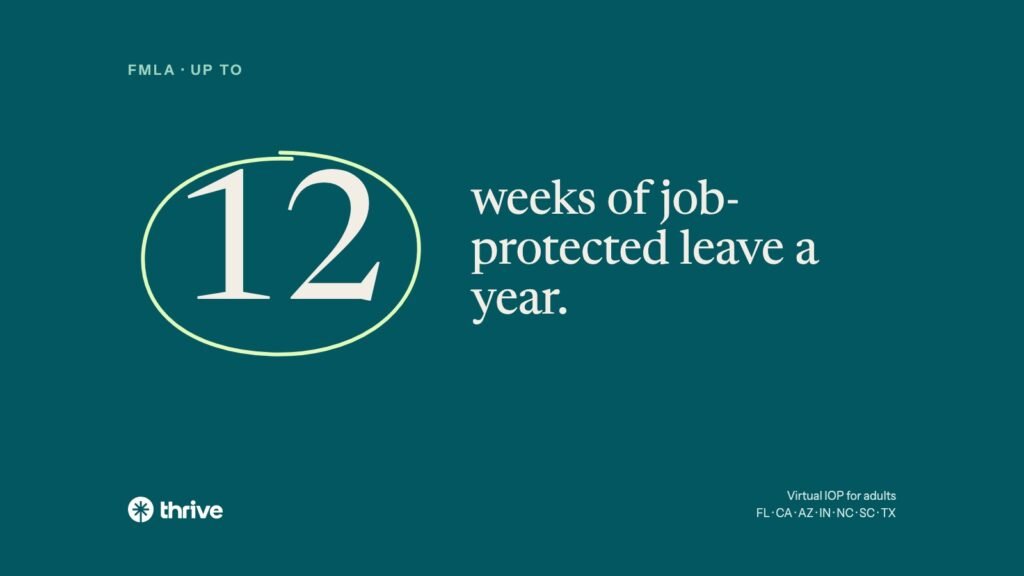

Yes, mental health treatment can qualify for job-protected leave under the Family and Medical Leave Act, including intermittent leave taken a few hours at a time for treatment sessions. If you are eligible, FMLA lets you attend a virtual intensive outpatient program (IOP) without using vacation days, without resigning, and without your employer being told your diagnosis. The U.S. Department of Labor confirmed this application to mental health conditions explicitly in its guidance on the topic.
This guide explains how FMLA works for intensive outpatient treatment: who qualifies, how intermittent leave maps onto an IOP schedule, what your employer can and cannot ask, and how to set it up cleanly. It is general information, not legal advice; an HR professional or employment attorney can advise on your specific situation.
The short answer for busy people
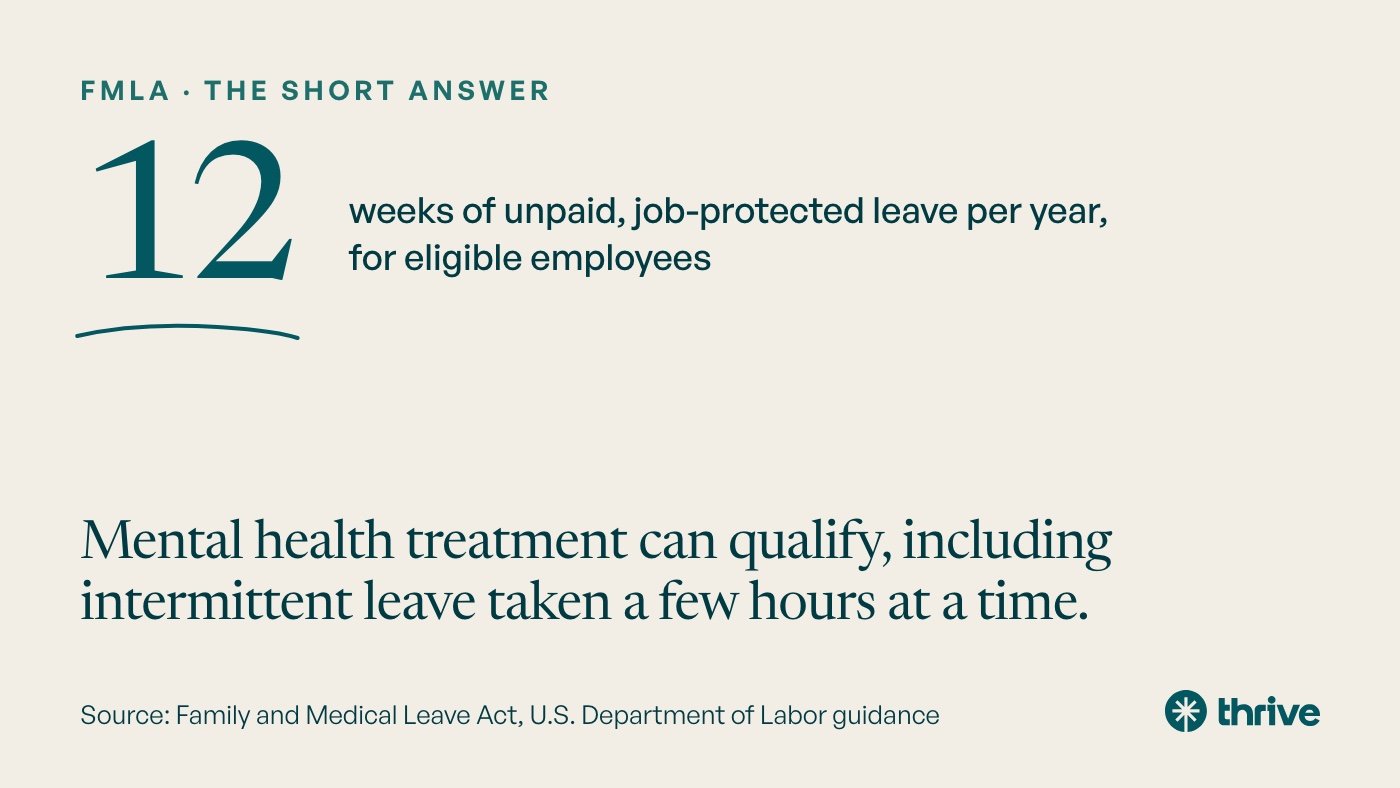
- FMLA gives eligible employees up to 12 weeks of unpaid, job-protected leave per year for a serious health condition, and mental health conditions qualify on the same terms as physical ones.
- Leave can be intermittent: hours or days at a time, tracked against your 12-week bank, which fits IOP’s three-sessions-a-week rhythm precisely.
- Your health insurance continues during FMLA leave on the same terms as if you were working.
- Your employer learns you have a certified serious health condition, not your diagnosis. The certification form does not require disclosing what you are being treated for to your manager.
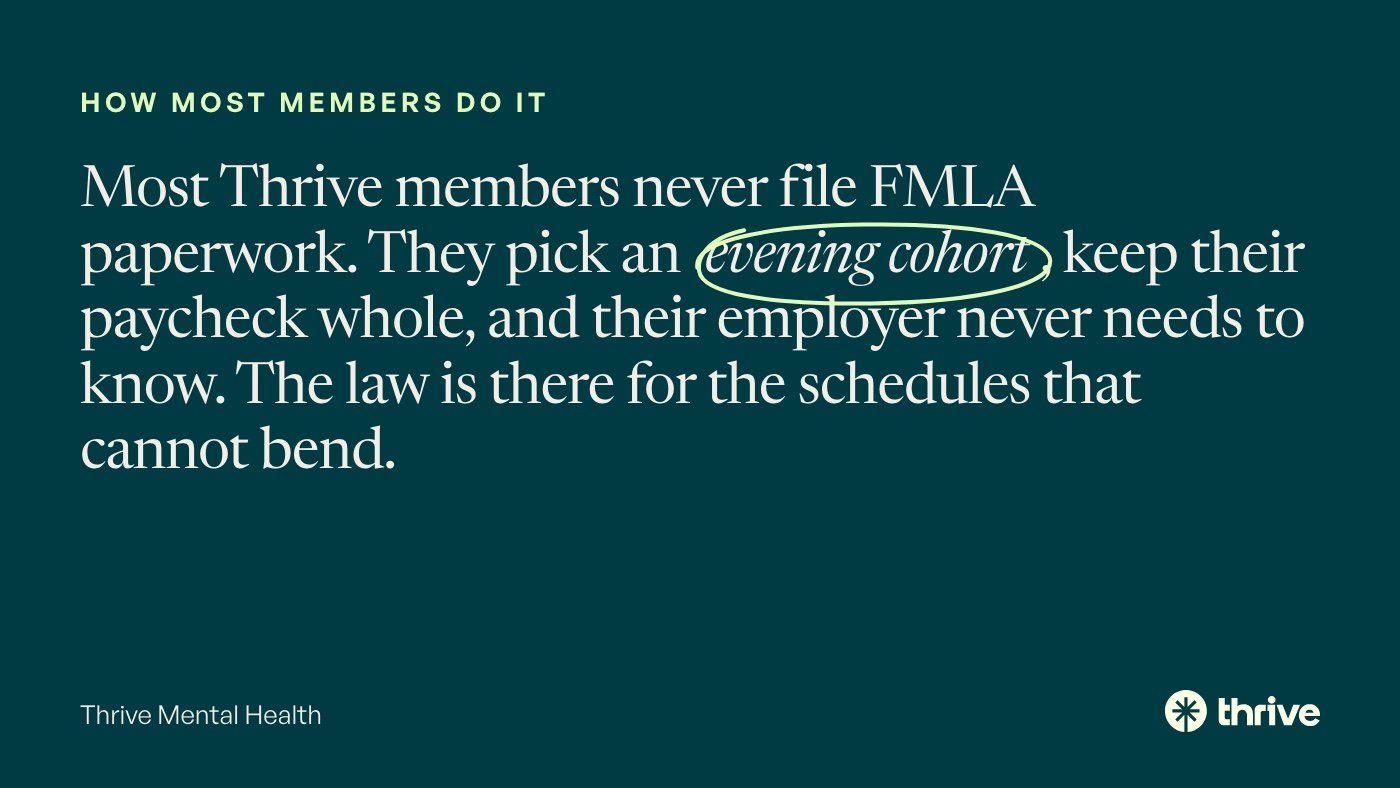
- Many people in virtual IOP never need FMLA at all, because morning and evening cohorts fit around a standard workday. FMLA is the safety net, not the default.
Does your situation qualify?
Three tests, all from the Department of Labor’s FMLA rules:
- Employer size: private employers with 50 or more employees within 75 miles, plus public agencies and schools of any size.
- Your tenure: at least 12 months with the employer and at least 1,250 hours worked in the past 12 months.
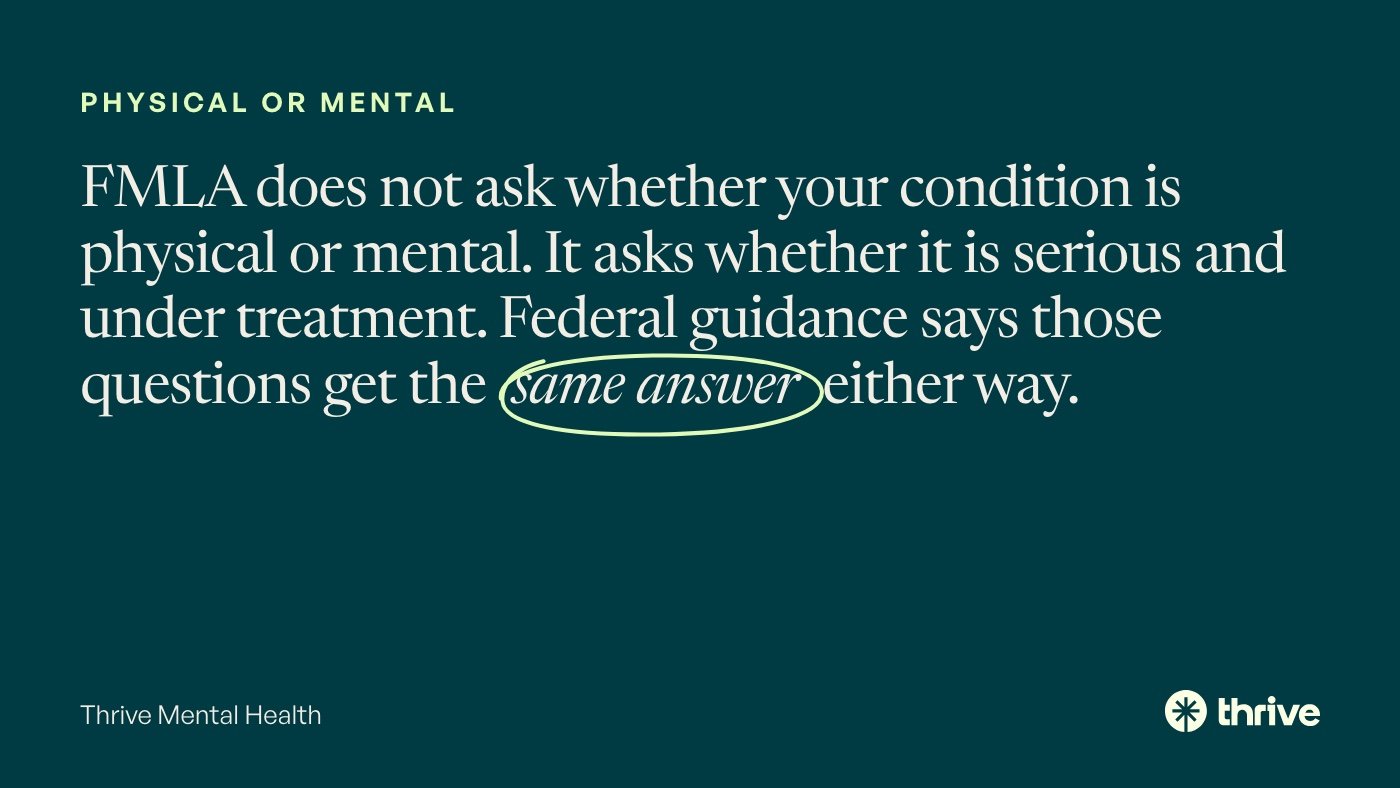
- A serious health condition: per the DOL’s Fact Sheet #28O on mental health conditions and the FMLA, this includes conditions requiring continuing treatment by a health care provider. Chronic conditions such as anxiety, depression, PTSD, and bipolar disorder qualify when they require treatment at least twice a year, and a condition requiring multiple appointments with a clinician, exactly what an IOP is, fits the continuing-treatment definition.
An intensive outpatient program is close to a textbook case: a licensed clinical team, a documented treatment plan, and multiple scheduled sessions per week. The ASAM Criteria formally define IOP as a distinct level of care, which helps when a certification form asks about the medical necessity of the schedule.
How intermittent leave maps onto a virtual IOP week
A typical virtual IOP schedule runs three sessions of about three hours per week for six to twelve weeks. Under intermittent FMLA:
- You take leave only for the treatment hours, for example 9 hours per week rather than full days. Intermittent use draws down your 12-week bank slowly; 9 hours a week for 10 weeks uses roughly 2.5 weeks of a 40-hour-week employee’s annual entitlement.
- Virtual delivery shrinks the leave you need. No commute means a 3-hour session costs 3 hours, not 5. Many members use a morning cohort and work an adjusted afternoon schedule, or an evening cohort and take no leave at all.
- Scheduling is supposed to be collaborative. The law expects employees to make reasonable efforts to schedule treatment so it does not unduly disrupt operations, which fixed cohort times make straightforward to document.
Setting it up: a clean five-step sequence
- Get assessed first. A licensed clinician confirms IOP is the right level of care; that assessment underpins the certification. If you are still deciding whether you need more than weekly therapy, our IOP vs weekly therapy guide covers the signs.
- Notify HR, not your manager, and keep it procedural. “I need to request FMLA leave for a medical treatment schedule” is a complete sentence. Thirty days notice when treatment is foreseeable; as soon as practicable otherwise.
- Have the clinical team complete the certification. Your employer may require the DOL’s medical certification form. It asks for the schedule and the fact of a serious health condition; the program’s clinical staff completes it routinely.
- Agree on the tracking method in writing. How hours are logged, who they are reported to, and how schedule changes are communicated. Ambiguity here causes most FMLA friction.
- Keep records of everything. Dates, approvals, and any schedule adjustments. If a dispute ever arises, the DOL’s Wage and Hour Division enforces FMLA rights.
What your employer can and cannot do
| Your employer can | Your employer cannot |
|---|---|
| Require medical certification of a serious health condition | Demand your diagnosis or session notes |
| Ask you to follow normal call-in and scheduling procedures | Deny properly certified FMLA leave because it is “just” mental health |
| Count intermittent hours against your 12-week bank | Retaliate against you for taking protected leave |
| Temporarily transfer you to an equivalent role that better fits intermittent leave | Cut your pay rate or benefits for the transfer |
| Continue your normal share of insurance premiums | Cancel your health coverage during leave |
Separate from FMLA, the Americans with Disabilities Act may entitle you to reasonable accommodations, such as a shifted schedule, even when FMLA does not apply; the EEOC’s guidance on mental health conditions at work explains those rights. Smaller-employer employees, who fall outside FMLA, often find the ADA route or a simple schedule agreement gets them the same practical result.
The paycheck question, answered honestly
FMLA leave is unpaid, and that shapes real decisions. Four softeners, in the order worth checking:
- Choose a cohort that needs no leave. Evening and early-morning virtual groups let many members keep full hours. This is the most common outcome at Thrive.
- Short-term disability insurance may replace partial income during treatment if your employer offers it; mental health conditions are commonly covered. Ask HR before assuming.
- Employer sick leave and PTO can run concurrently with FMLA, converting unpaid protected time into paid protected time.
- The cost of waiting is not zero. Untreated symptoms erode performance reviews, attendance, and eventually employment itself. Treatment that stabilizes you is job protection of a more durable kind. The NIMH’s prevalence data is a useful reminder that roughly one in five U.S. adults lives with a mental health condition; workplaces handle this constantly, even when nobody talks about it.
If your FMLA request hits friction
Most certified requests are approved without drama. When friction happens, it usually takes one of three shapes:
 5 Tips to Find The country’s #1 intensive outpatient clinicMental Health
- An incomplete certification. Employers may give you seven days to cure gaps in the form. Loop in the program’s clinical team immediately; they complete these routinely.
- A request for second opinion. Employers can require one at their own expense. It is a delay, not a denial; leave protections continue while it resolves.
- Manager-level pushback. Scheduling complaints belong in the HR process, not in hallway conversations. Redirect politely and keep everything in writing.
If leave is denied or you face retaliation, the DOL’s Wage and Hour Division takes complaints directly, and employment attorneys handle FMLA disputes on contingency more often than people expect. Document dates and communications from day one and you will likely never need either.
Common questions about FMLA and virtual IOP
Does mental health treatment really qualify for FMLA?
Yes. DOL Fact Sheet #28O states plainly that mental health conditions qualify as serious health conditions when they involve inpatient care or continuing treatment, which IOP-level treatment typically satisfies.
Will my boss find out my diagnosis?
No. The certification confirms a serious health condition and the needed schedule. Diagnosis details go to HR’s certification file at most, and many employers use third-party leave administrators so even HR sees little.
How much of my 12 weeks does an IOP use?
Taken intermittently for sessions only, a typical virtual IOP uses roughly two to three weeks of the annual bank. Full-day leave is rarely necessary for the virtual format.
What if I have not been at my job 12 months?
FMLA will not apply, but ADA accommodations, employer sick-leave policies, and evening treatment cohorts remain available. Do not conclude treatment is impossible before checking those.
Can I be laid off while on FMLA?
FMLA protects against leave-based retaliation, not against layoffs that would have happened anyway. Document timing carefully and get advice if a termination follows your request closely.
Does insurance keep paying for treatment during leave?
Yes. Group health coverage continues during FMLA leave on the same terms, so the treatment itself stays covered per your plan’s behavioral benefits.
Next steps
If treatment is the right move, the logistics are more solvable than they look from the outside. Thrive Mental Health is a Joint Commission accredited provider of virtual IOP serving adults in Florida, Indiana, Arizona, California, North Carolina, South Carolina, and Texas. Our cohorts are built around working adults, our clinical team completes leave certifications routinely, and our admissions staff can tell you what your insurance covers before you talk to anyone at work.
Start with a free, confidential benefits check. Most people receive a summary within 24 hours, and many begin treatment the same week. Prefer to talk it through? Call (561) 203-6085.

This article is for informational purposes only and is not a substitute for individualized clinical advice or insurance verification.