


Group therapy and individual therapy produce equivalent outcomes for most mental health conditions; that is one of the most consistent findings in psychotherapy research. The real question is not which one is better, but which format fits your goals, your condition, and this stage of your treatment. For many adults the strongest answer is both, which is exactly how intensive outpatient programs are built.
This guide walks through what the research actually shows, where each format shines, where each struggles, and how to choose. It is written by a clinical team that runs both formats every week, so the trade-offs below come from practice as well as the literature.
What the research actually shows
The evidence base here is unusually deep. A landmark series of 11 meta-analyses spanning 329 studies compared group with individual therapy across conditions. Group therapy proved effective for depression, anxiety disorders, social anxiety, panic, OCD, PTSD, eating disorders, borderline personality disorder, substance use disorders, and chronic pain.
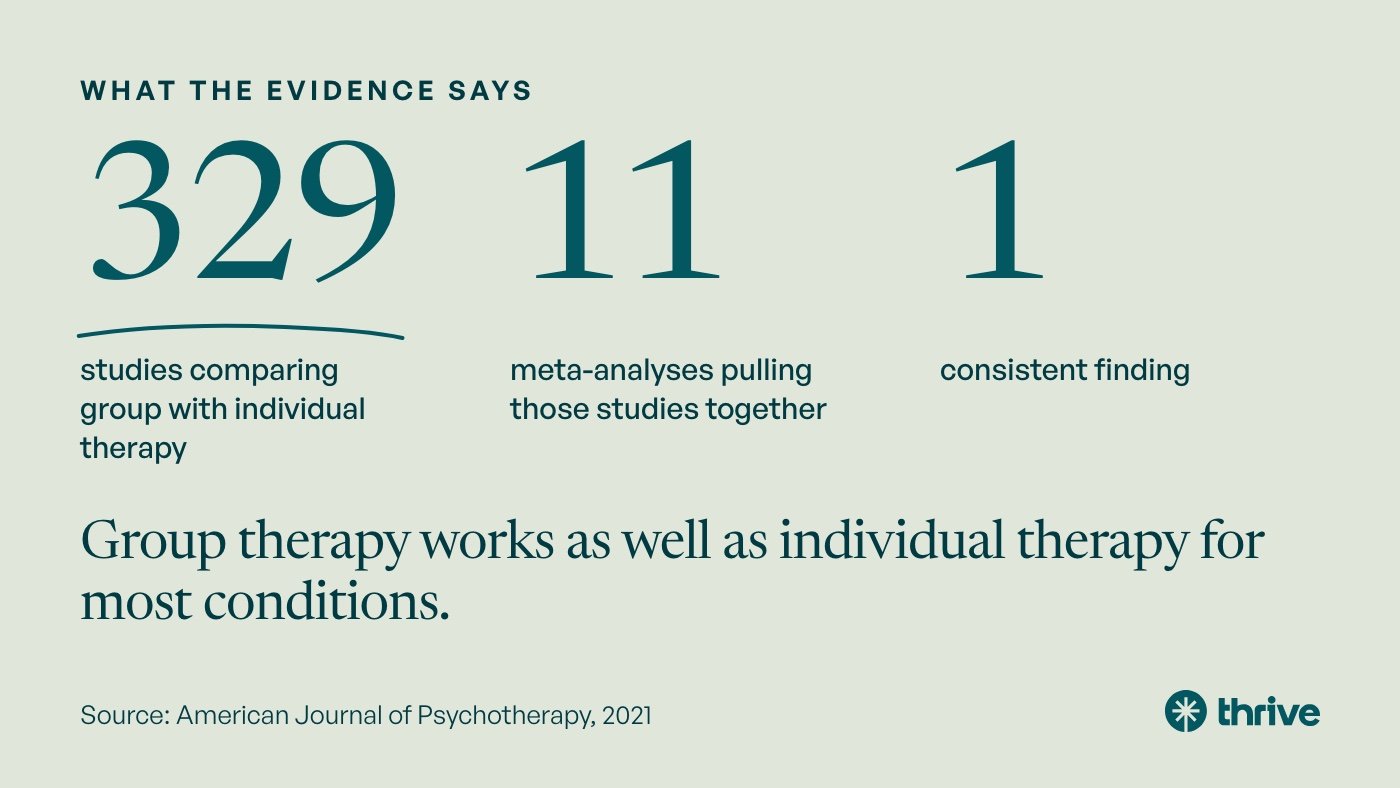
The American Psychological Association’s summary of that literature is blunt: group therapy is as effective as individual therapy, and more efficient. Head-to-head trials back this up. A randomized study of adults with anxiety and depression symptoms found significant improvement in both formats, with no meaningful difference between them, and no difference in satisfaction or dropout.
One more finding worth knowing: cohesion, the felt sense of belonging in a group, is not a soft extra. A meta-analysis of 55 studies found the cohesion-outcome link in groups is about as strong as the therapist-client alliance is in individual therapy. The relationship still drives the result; in groups, the relationship is plural.
The honest comparison
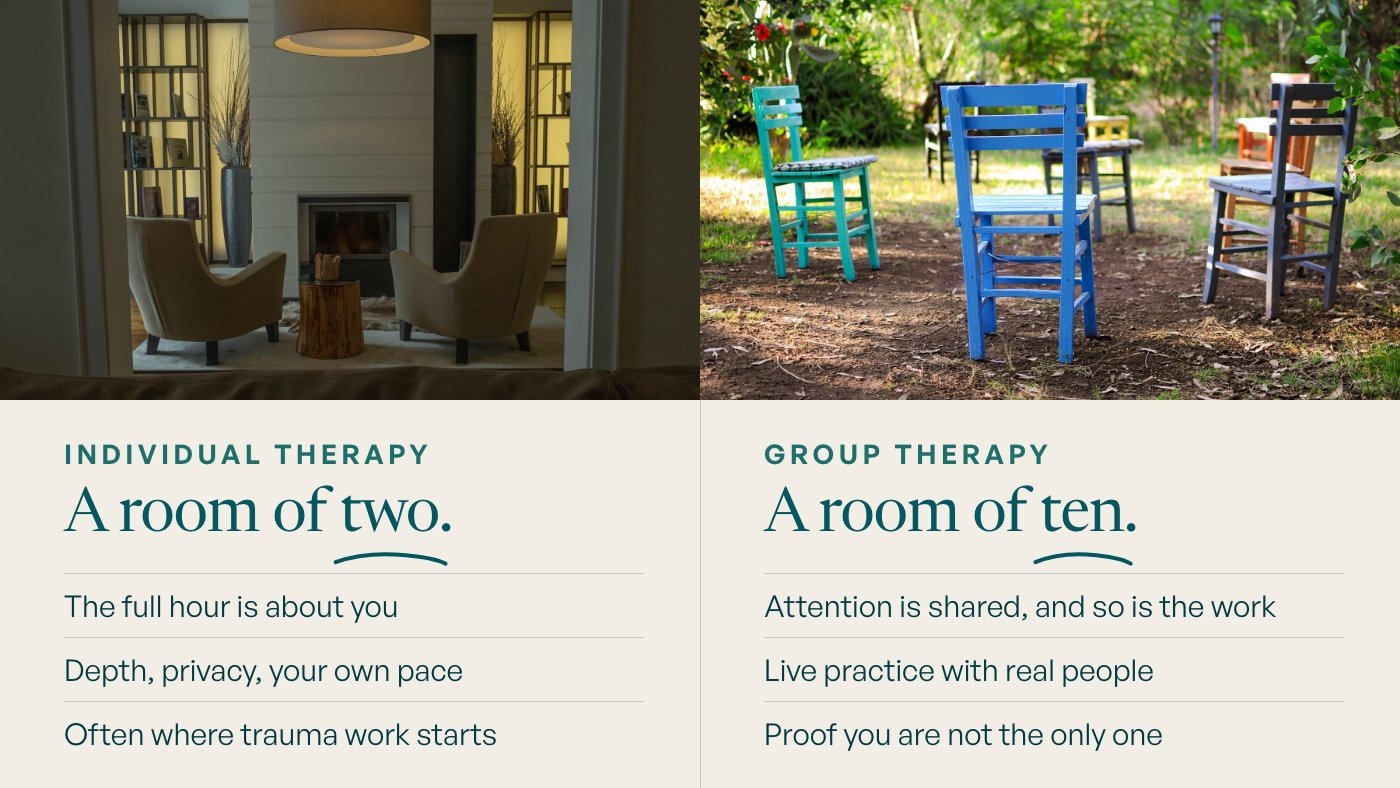
| Individual therapy | Group therapy | |
|---|---|---|
| Attention | The full hour is about you | Attention is shared; so is the work |
| Best evidence for | Most conditions; complex trauma processing; highly personalized work | Most conditions; especially skills training, social anxiety, shame-heavy struggles |
| What it uniquely offers | Depth, privacy, a pace set entirely by you | Feedback from peers, live practice with real people, proof you are not the only one |
| Common friction | Easy to intellectualize; no place to practice skills with others | Initial anxiety about sharing; less time on your specific story |
| Cost per session | Higher | Lower |
| Availability | Long waitlists in many areas | Often faster to join |
What group therapy does that individual therapy cannot
- It shrinks shame on contact. Hearing another adult describe your exact 3 a.m. thought pattern does something no reassurance from a therapist can do.
- It is a live laboratory. Boundary-setting, conflict, asking for help: in group you practice these with actual people and get honest feedback, in the moment.
- It multiplies perspectives. One therapist sees you one way. Eight group members catch things one person misses, including your strengths.
- It rebuilds social confidence. For the anxiety and depression conditions that isolate people, the format itself is part of the treatment.
What individual therapy does that group cannot
- Total privacy. Some material needs a room of two before it can survive a room of ten. Trauma processing work, in particular, often starts here.
- A pace set only by you. No shared agenda, no waiting your turn, no group curriculum.
- Deep personalization. Treatment built entirely around your history, patterns, and goals, adjusted session by session.
- A single, deep alliance. For people whose core wound is relational, one consistent, trustworthy relationship is itself the treatment.
Why the best programs use both
This is not actually an either-or decision at higher levels of care. An intensive outpatient program combines group therapy several times a week with regular individual sessions, which is exactly what the evidence supports: skills and connection from the group, depth and privacy from the individual work. SAMHSA’s Treatment Improvement Protocol on intensive outpatient treatment describes group work as the backbone of the IOP model for this reason.
The virtual format does not weaken the group effect. Research on telehealth-delivered intensive care in the Journal of Psychiatric Research found outcomes comparable to in-person treatment. Our own groups at Thrive run over secure video with cameras on, small rosters, and adult-only cohorts; members regularly tell us the screen made it easier to show up the first week, not harder. You can read more about the format in our guide to online group therapy.
How to choose, by situation
- Mild to moderate symptoms, first time in therapy: either format works. Choose by access and preference; the best therapy is the one you will attend.
- Social anxiety, isolation, or shame at the center: group, or a program that includes group. The format targets the problem directly.
- Trauma history you have never spoken aloud: often start individual, then add group when ready. Many trauma-focused modalities, including EMDR, run individually.
- Symptoms weekly sessions are not containing: a combined-format IOP. More hours, both formats, measured progress. Our IOP vs weekly therapy guide covers the step-up decision.
- Budget or waitlist is the constraint: group gets you evidence-based care sooner and at lower cost per session.
Whatever you choose, the National Institute of Mental Health guidance holds: fit matters. Give a format a fair trial, measure whether life is improving, and change the plan if it is not.
What a blended week actually looks like
Abstract comparisons hide how naturally the two formats interlock. Here is a representative week inside a virtual IOP:
| Day | Session | What happens |
|---|---|---|
| Monday | Group, 3 hours | Skills teaching (CBT or DBT module), then process time where members apply it to their week |
| Wednesday | Group, 3 hours | Deeper process work; members give and receive feedback on real situations |
| Thursday | Individual, 1 hour | Private session: trauma work, personal treatment goals, anything not group-ready |
| Friday | Group, 3 hours | Skills consolidation and weekend planning; psychiatric consults scheduled as needed |
Notice the division of labor. The group carries skills, accountability, and connection. The individual hour carries privacy and depth. Members frequently bring something from the individual session into group weeks later, once it is ready for more witnesses; that pipeline is where much of the change happens.
 OCD & CBT: Your Path to Control and CalmMental Health
Access and cost, briefly
Two practical asymmetries are worth naming. Group therapy is usually cheaper per session and faster to join; individual therapists in many areas carry waitlists measured in months, while groups add seats on a cadence. If you are paying out of pocket, a weekly group often costs a third to a half of a weekly individual session. With commercial insurance, both are covered benefits, and combined-format programs like IOP are billed as one program rather than as separate line items. Verify your specific plan either way.
Common questions about group vs individual therapy
Is group therapy as effective as individual therapy?
For most conditions, yes. Meta-analyses across hundreds of studies find equivalent outcomes for depression, anxiety, PTSD, eating disorders, and substance use, with similar satisfaction and dropout rates.
Will I be forced to share in group therapy?
No. Good facilitators let members set their own pace. Most people who dread speaking find they share voluntarily within a few sessions.
Is group therapy just cheaper individual therapy?
No. It has distinct active ingredients: peer feedback, live skills practice, and cohesion, which research links to outcomes about as strongly as the alliance in individual work.
Can I do both at the same time?
Yes, and structured programs like IOP are built exactly that way: group sessions several times a week plus individual therapy.
Does group therapy work over video?
Yes. Studies of telehealth-delivered intensive treatment show outcomes comparable to in-person care, and virtual groups remove the commute that ends many treatment attempts.
What if my problem feels too private for a group?
Start individually. A skilled clinician can help you decide if and when adding group would help. Privacy needs are a fit question, not a barrier to treatment.
How big should a therapy group be?
Most process and skills groups run best with six to ten members. That size keeps enough voices for real feedback while preserving airtime for everyone. Programs that pack far more people into a session are running a class, not a therapy group, and it is fair to ask a program directly about its typical group size.
Next steps
If you are weighing formats because your current care is not enough, an assessment can settle the question quickly. Thrive Mental Health is a Joint Commission accredited provider of virtual IOP, combining group and individual therapy for adults in Florida, Indiana, Arizona, California, North Carolina, South Carolina, and Texas.
Start with a free, confidential benefits check. Most members receive a summary within 24 hours, and many begin the same week. Prefer to talk first? Call (561) 203-6085.

This article is for informational purposes only and is not a substitute for individualized clinical advice or insurance verification.