


Break Free from Anxiety, Why ERP Therapy Gets Results When Nothing Else Does
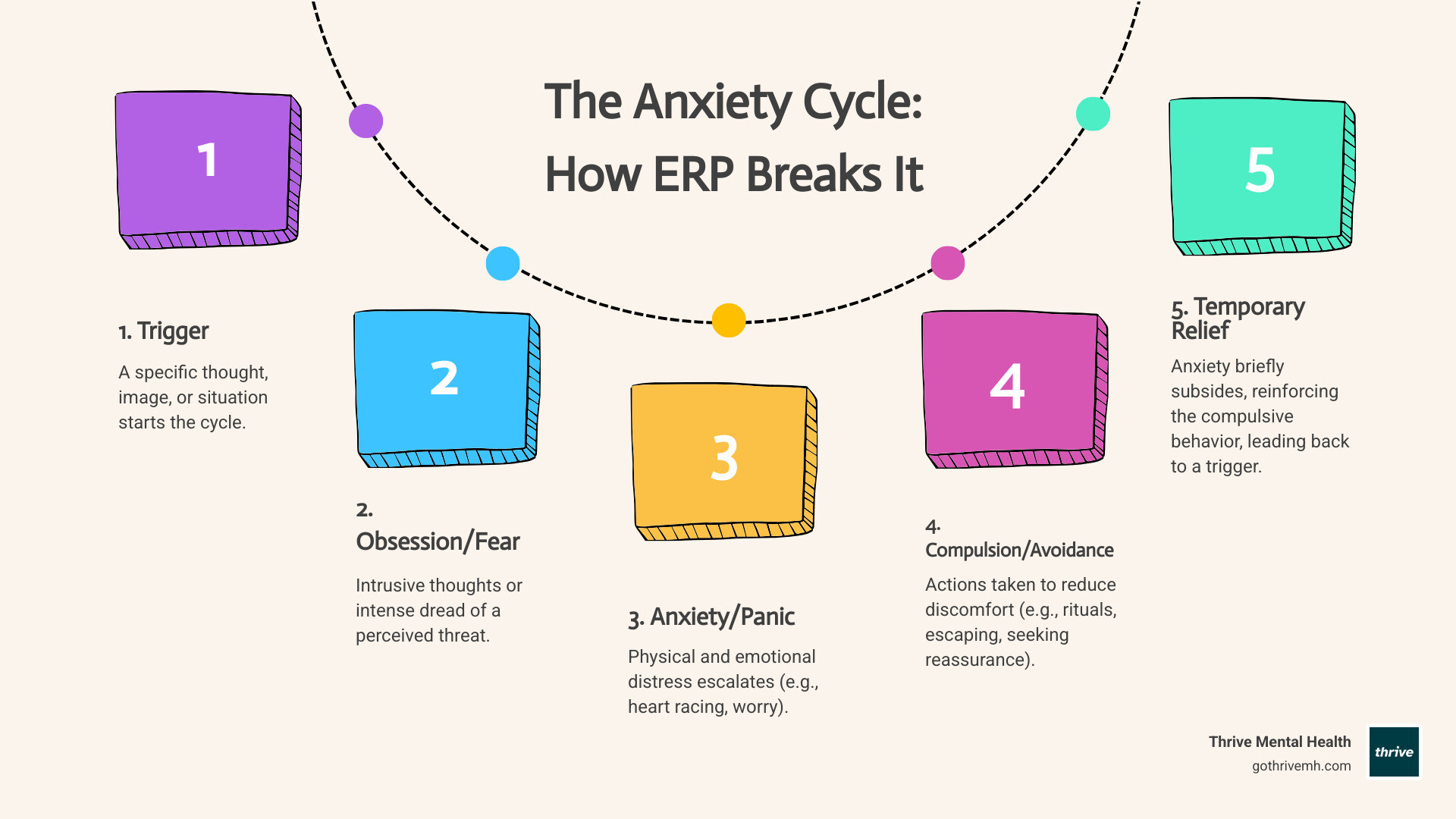
You’re trapped in the anxiety cycle. Something triggers your fear. Your heart pounds. Your mind races. You do anything to make it stop, avoid the situation, check one more time, seek reassurance. You get temporary relief. Then the cycle starts again.
If you’re searching for real relief, Exposure and Response Prevention (ERP) therapy is the gold-standard treatment that breaks this pattern. It’s not about managing anxiety, it’s about ending the behaviors that keep you stuck. ERP teaches your brain that you don’t need to escape, avoid, or perform rituals to survive anxiety. The fear passes on its own.
The research is clear: ERP delivers 60-80% success rates for anxiety disorders, with most people seeing major improvement in 12-20 sessions. It works for OCD, panic disorder, social anxiety, phobias, and generalized anxiety disorder. And unlike medication alone, the results last.
But here’s the problem: not all therapists are trained in ERP. Standard talk therapy can actually make anxiety worse by reinforcing avoidance patterns. You need a specialist who understands the neuroscience of fear and knows how to guide you through exposures safely and effectively.
I’m Nate Raine, CEO of Thrive Mental Health, and I’ve spent over a decade changing access to evidence-based behavioral health care. At Thrive, we help people find clinics in Scottsdale that specialize in exposure and response prevention therapy for anxiety, whether through our own virtual programs or by connecting you with the right care. Our mission is simple: get you the right treatment, faster, so you can take back your life.
This guide shows you exactly how to find qualified ERP therapists in Scottsdale, what to expect from treatment, and how to access care that fits your schedule and budget, including virtual options that work as well as in-person therapy.
Find clinics in Scottsdale that specialize in exposure and response prevention therapy for anxiety. terms to remember:
What Is Exposure and Response Prevention (ERP) Therapy?
Anxiety feels like a relentless enemy, pushing you into patterns of avoidance and rituals that offer only temporary reprieve. We advocate for Exposure and Response Prevention (ERP) therapy, the gold-standard treatment that has helped countless individuals break free from the grip of anxiety and Obsessive-Compulsive Disorder (OCD).
At its core, ERP is a highly effective form of Cognitive Behavioral Therapy (CBT). Unlike talk therapy that might dig into the origins of your anxiety, ERP is an action-oriented approach designed to retrain your brain’s fear response.
Here’s how it works:
- Exposure: You gradually and systematically confront the situations, thoughts, or objects that trigger your anxiety in a controlled, safe way. This is a step-by-step process, starting with manageable challenges and progressing to more difficult ones.
- Response Prevention: This crucial component teaches you to resist the urge to perform your usual compulsive behaviors or avoidance strategies. By preventing the response, you allow your brain to learn a new, vital lesson: the anxiety will eventually decrease on its own.
- Results: The outcome of consistent ERP practice is transformative. You develop new neural pathways, teaching your brain that the triggers you once feared are not dangerous. This leads to less anxiety, a significant reduction in compulsive behaviors, and a profound sense of freedom.
This structured, evidence-based approach is why ERP is so effective. It directly confronts the mechanisms that keep anxiety disorders alive, offering a clear path to lasting relief.
5 Ways ERP Delivers Real, Lasting Anxiety Relief
ERP isn’t a temporary fix; it’s a fundamental shift in how your brain processes fear. Here are five ways ERP delivers real, lasting anxiety relief:
- Long-Term Symptom Reduction: By consistently facing fears without engaging in compulsions, you teach your brain that triggers are not dangerous. This leads to a significant and sustained reduction in anxiety symptoms, with intensive programs showing major improvements in just a few weeks.
- More Confidence in Daily Life: As you successfully complete exposures, your self-efficacy skyrockets. You learn that you are stronger than your anxiety, leading to a profound sense of empowerment in all areas of your life.
- Resilience Against Future Anxiety: ERP equips you with robust coping mechanisms. The skills learned, tolerance of discomfort, mindful awareness, and differentiating between real and imagined threats, become ingrained, making you more resilient to future stressors.
- Fewer Panic Attacks and Compulsions: ERP systematically desensitizes you to your triggers, weakening the association between the trigger and the panic response. As you learn to tolerate the physical sensations of anxiety, panic attacks and compulsions naturally diminish.
- Reduced Anxiety Symptoms, Not Just a Temporary Fix: ERP rewires your brain for enduring change. It’s about genuine habituation and extinction of the fear response, allowing you to live a life guided by your values, not your fears.
Is ERP Right for You? Who Gets the Biggest Results from ERP Therapy

If you’re struggling with anxiety that controls your daily decisions, whether you’re checking locks repeatedly, avoiding social situations, or feeling trapped by constant worry, ERP might be exactly what you need. It’s the most researched, most effective approach for breaking the patterns that keep anxiety alive.
When you find clinics in Scottsdale that specialize in exposure and response prevention therapy for anxiety, you’re looking for freedom from the exhausting cycle of fear and avoidance. ERP works because it teaches your brain that you can survive anxiety without running from it, and that changes everything.
Conditions ERP Treats in Scottsdale
ERP has proven itself across a wide range of anxiety disorders. While it earned its reputation treating OCD, its power extends far beyond that single diagnosis.
- Obsessive-Compulsive Disorder (OCD): ERP is the top treatment for intrusive thoughts and compulsions. It helps you face triggers related to contamination, harm, doubt, or perfectionism without performing the rituals that offer false relief.
- Panic Disorder and Agoraphobia: Living in fear of the next panic attack is exhausting. ERP helps you confront the physical sensations of panic in a controlled setting, so your brain learns these sensations aren’t dangerous. You gradually face the places you’ve been avoiding.
- Social Anxiety and Specific Phobias: If fear of judgment or specific triggers like flying or heights traps you in isolation, ERP provides a clear path forward. You face these situations step-by-step, learning that the anxiety is tolerable and the feared outcome rarely happens.
- Generalized Anxiety Disorder (GAD): For persistent, excessive worry, ERP helps you learn to tolerate uncertainty without seeking constant reassurance and stop the mental rumination that keeps the worry machine running.
- Related Conditions: ERP principles are also used to address body-focused repetitive behaviors like hair pulling (trichotillomania) and skin picking (excoriation disorder). For children and teens with sudden onset OCD/anxiety after an infection (PANS/PANDAS), ERP is often a key part of comprehensive care.
The common thread? All these conditions involve learned patterns of fear and avoidance. ERP breaks those patterns at their root, which is why the results last long after therapy ends.
At Thrive Mental Health, we understand that finding the right treatment means finding specialists who truly understand these conditions. Our virtual therapy programs and Intensive Outpatient Programs bring expert-led ERP care directly to you, whether you’re in Scottsdale or anywhere across Arizona, with flexible scheduling that fits your life.
How to Find the Best ERP Therapy in Scottsdale for Anxiety

You’re ready to take the next step, but not every therapist who lists ERP is a true specialist. Generic therapy won’t cut it, you need someone who knows how to guide you through exposures safely and effectively.
When you’re trying to find clinics in Scottsdale that specialize in exposure and response prevention therapy for anxiety, knowing what to look for can save you months of wasted time and money.
What to Look for in a Scottsdale ERP Specialist
- Credentials and Training: Look for a licensed therapist (LPC, Psy.D., LCSW) with advanced, specialized training in ERP and CBT from reputable organizations. Ask about their experience with your specific type of anxiety.
- Collaborative Approach: A good ERP therapist works with you to build your fear ladder and adjusts the plan based on your progress. It’s a partnership.
- Insurance Acceptance: Quality ERP specialists often accept major insurance plans like Aetna, Cigna, UnitedHealthcare, and Optum. At Thrive Mental Health, we work with most major carriers because care should be accessible. You can use our quick insurance verification tool to check your benefits.
Where to Start Your Search for ERP Therapy in Scottsdale
Online directories are a good starting point. The International OCD Foundation (IOCDF) therapist directory is an excellent resource for finding verified ERP specialists. You can also check the websites of specialized clinics directly to understand their approach and qualifications.
But you’re no longer limited by geography. Thrive Mental Health’s Arizona Virtual Therapy brings expert ERP care directly to you, whether you’re in Scottsdale, Phoenix, or anywhere else in Arizona. Our virtual and hybrid programs mean you get access to top specialists with flexible scheduling that fits your life.
For faster results, our Intensive Outpatient Programs (IOP) deliver structured, comprehensive ERP treatment that can lead to breakthrough progress in weeks, not months.
Why Virtual ERP Therapy in Arizona Is a Game-Changer
Finding a highly trained ERP specialist in your neighborhood used to be a matter of luck. Virtual therapy changed everything.
Research shows that Remote Therapy for Anxiety is just as effective as in-person treatment. For ERP, it can be even better. You do exposures in your actual environment, your home, your car, your neighborhood, where triggers live. This makes the learning more direct and powerful.
 Detailed Reviews of Top 10 Mental Health Programs for Mood DisordersMental Health
- Convenience: Evening and weekend options mean you don’t have to choose between your mental health and your job.
- Access: Virtual ERP removes the geographical lottery, expanding your access to specialists who truly know what they’re doing.
- Coverage: It’s covered by most major insurance plans, including Cigna, Aetna, and UnitedHealthcare. The barrier isn’t coverage, it’s knowing where to look.
What to Expect: Your ERP Therapy Journey in Scottsdale (Process and Results)

Starting ERP therapy is a brave step. It can feel intimidating to face your fears, but the outcome, a life free from the shackles of anxiety, is profoundly rewarding. Here’s a clear roadmap of what your ERP therapy journey will look like.
The ERP Therapy Process: Step-by-Step
Your ERP journey is highly personalized, but the core steps remain consistent:
- Initial Assessment and Goal Setting: Your therapist will conduct a thorough assessment to understand your specific anxiety and define your treatment goals. This ensures your treatment is custom to your needs.
- Build Your “Fear Ladder” (Exposure Hierarchy): Together, you and your therapist will create a list of situations that trigger your anxiety, ranked from least to most provoking. You are always in control of the pace.
- In-Session and At-Home Exposures: You’ll start with exposures at the bottom of your fear ladder, gradually working your way up. The key is to stay in the exposure until your anxiety naturally decreases, without resorting to compulsions or avoidance.
- Weekly Progress Reviews: Each session will involve reviewing your progress, discussing challenges, and planning the next steps on your fear ladder.
- Typical Program: 12-20 Sessions: Most people experience significant improvement within 12 to 20 sessions of consistent ERP therapy. You’ll often start feeling some relief within the first 4-6 sessions.
- Intensive Outpatient Programs (IOP) for Accelerated Progress: For those with moderate to severe symptoms, an IOP can provide accelerated results. These programs offer more frequent and structured ERP, often leading to faster symptom reduction and skill acquisition.
ERP vs. Other Anxiety Treatments: What the Numbers Say
When considering treatment options, the evidence for ERP is compelling. It consistently stands out as the most effective, evidence-based treatment for anxiety disorders and OCD.
Here’s a comparison of ERP against other common anxiety treatment modalities:
| Treatment | Success Rate | Speed of Results | Lasting Change |
|---|---|---|---|
| ERP Therapy | 60-80% | 12-20 sessions | Yes |
| Talk Therapy | 30-40% | 20+ sessions | Sometimes |
| Medication Only | 40-60% | Varies | Often needs ongoing use |
Let’s break down why these numbers matter:
- ERP Therapy: With a 60-80% success rate, ERP is the most effective psychological treatment for OCD and many anxiety disorders. It rewires your brain’s fear response, leading to durable relief in a relatively short time.
- Talk Therapy (Non-ERP): General talk therapy can be helpful, but success rates are lower because it may not directly address the behavioral patterns that fuel anxiety. Without systematic exposure, avoidance behaviors can remain unchallenged.
- Medication Only: Medication can reduce symptom intensity, but it rarely teaches coping skills or changes behavioral patterns. Benefits often subside if medication is discontinued, and many prefer a non-medication approach to healing.
The data shows that ERP targets the root behavior of anxiety, avoidance. By directly changing these behaviors, you get results that last, empowering you to live a life free from the constant demands of anxiety.
FAQs: ERP Therapy in Scottsdale, What People Ask Most
We know you have questions about ERP therapy in Scottsdale. You want to know if it’ll work, how much it costs, and how to fit it into your life. Here are the straight answers.
How much does ERP therapy cost in Scottsdale?
The cost of ERP therapy in Scottsdale depends on the provider and your insurance coverage. Weekly sessions can range from $100 to $250+, while intensive programs have a different cost structure. The good news is many quality clinics accept major insurance like Cigna, Aetna, UnitedHealthcare, and Optum. At Thrive Mental Health, we believe in accessibility. You can verify your insurance in 2 minutes with no obligation to know your exact costs upfront.
How long does ERP therapy take to work?
Most people see significant improvement in 12 to 20 sessions of consistent ERP. Many start feeling relief within the first 4 to 6 sessions as they begin practicing exposures. For faster results, a Virtual IOP can accelerate progress, often showing major symptom reduction in just a few weeks.
Is virtual ERP therapy as effective as in-person?
Yes, absolutely. Research consistently proves that virtual therapy for ERP is just as effective as in-person treatment. It can even be more effective because you practice exposures in your real-world environment, with your therapist’s live support. Plus, no commute means better consistency.
Does Thrive Mental Health offer ERP therapy in Scottsdale?
Yes. Thrive Mental Health offers expert-led ERP therapy for Scottsdale residents through our virtual and hybrid Intensive Outpatient Programs (IOP) and PHP. Our programs are designed for adults and young professionals, with evening options to fit your schedule. You can access our Arizona virtual therapy from anywhere in the state.
What insurance does Thrive accept for ERP therapy?
Thrive Mental Health works with most major insurance plans, including Cigna, Optum, Florida Blue, Aetna, and UnitedHealthcare. We believe cost shouldn’t be a barrier to specialized care. Use our quick online tool to verify your insurance in just 2 minutes and understand your coverage for our programs.
Summary: Find Clinics in Scottsdale That Specialize in Exposure and Response Prevention Therapy for Anxiety, And Take Back Your Life
You’re ready for change. You’re tired of anxiety controlling your decisions, your relationships, and your life. You’re done with treatments that only scratch the surface.
Here’s what we know for certain: anxiety doesn’t have to call the shots anymore. When you find clinics in Scottsdale that specialize in exposure and response prevention therapy for anxiety, you are choosing the most effective, evidence-based path to breaking free. You’re choosing a treatment with 60-80% success rates that delivers real, lasting change.
This guide has shown you what ERP is, why it works, and how to find a qualified specialist. The bottom line is that options exist that accept your insurance and fit your life. You don’t have to settle for generic talk therapy or wait months for an appointment.
Thrive Mental Health delivers expert ERP care through our virtual IOP programs, designed for adults and young professionals. We offer evening options and serve Arizona, Florida, California, Indiana, and South Carolina, bringing specialized care directly to you.
We work with most major insurance plans, including Cigna, Optum, Florida Blue, Aetna, and UnitedHealthcare, because we believe cost should never be a barrier to the treatment that works. You’ve spent enough time managing anxiety. It’s time to break free from it.
Ready for support? Thrive offers virtual IOP programs with evening options. Verify your insurance in 2 minutes (no obligation) → Start benefits check or call 561-203-6085. If you’re in crisis, call/text 988.

This article is for informational purposes only and is not a substitute for individualized clinical advice or insurance verification.