






Yes, you can often use out-of-network benefits to pay for virtual IOP in Florida, if your plan is a PPO or POS with out-of-network coverage. Plans with out-of-network behavioral benefits typically reimburse 50% to 80% of an allowed amount after a separate out-of-network deductible, and you file the claims yourself using a superbill from the provider. HMO and EPO plans generally cover in-network care only, which makes this route unavailable to many Floridians.
This guide explains how out-of-network coverage actually works for intensive outpatient care in Florida: the paperwork, the math, the traps, and when going out of network is worth it versus finding a strong in-network program. It is informational, not financial advice; verify every number against your own plan documents.
First, check whether you have out-of-network benefits at all
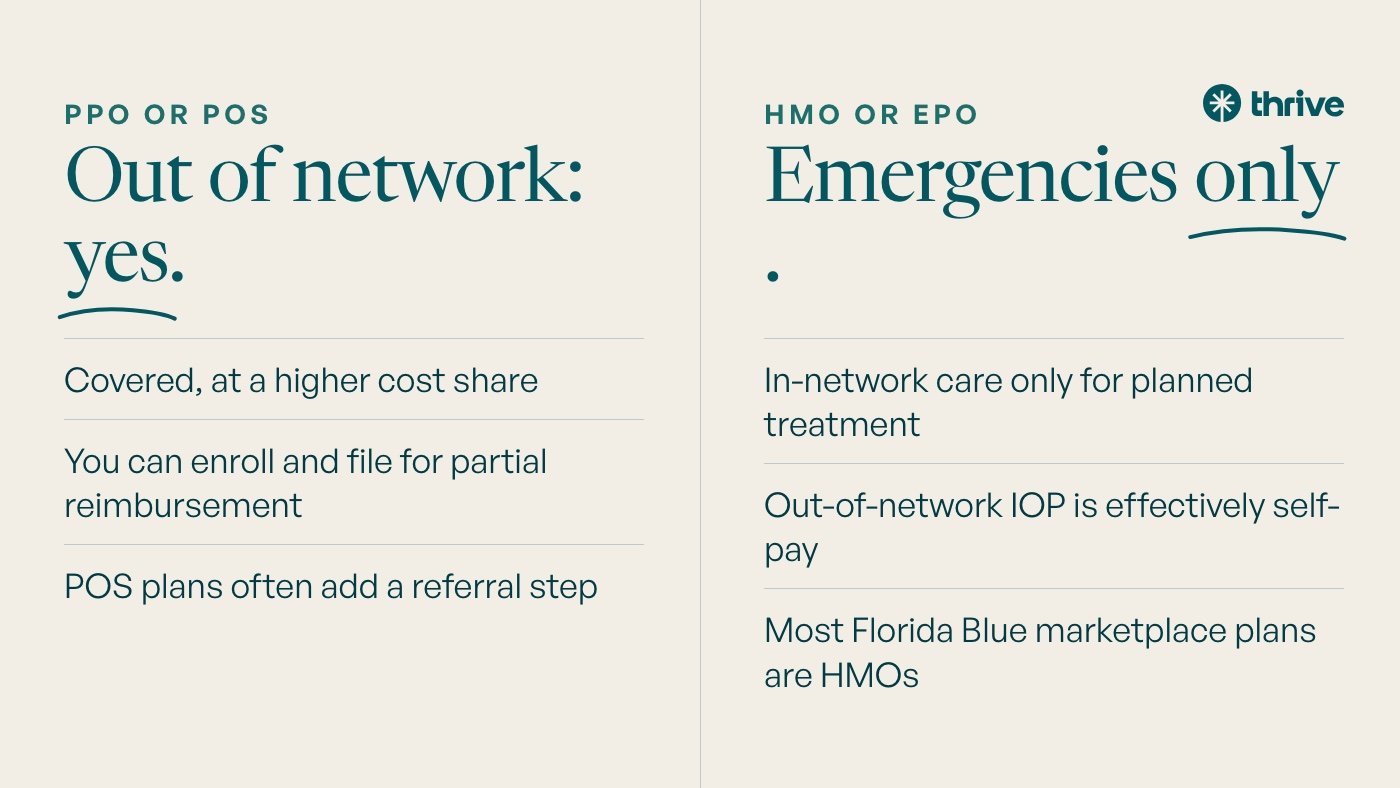
| Plan type | Out-of-network coverage? | What that means for virtual IOP |
|---|---|---|
| PPO | Yes, at higher cost share | You can enroll out of network and file for partial reimbursement |
| POS | Yes, usually with referral rules | Same as PPO, often with a primary-care referral step |
| HMO | Emergencies only | Out-of-network IOP is effectively self-pay |
| EPO | Emergencies only | Same as HMO for planned treatment |
Florida’s individual market skews heavily toward HMO designs, including most Florida Blue marketplace plans, while employer coverage is where PPOs live. Find your plan type on your card, then call the behavioral health number and ask one precise question: “Do I have out-of-network benefits for outpatient behavioral health, including intensive outpatient programs?” Our Florida Blue HMO vs PPO guide explains the structural difference in depth.
The vocabulary that decides your reimbursement
- Out-of-network deductible. Separate from, and usually larger than, your in-network deductible. It must be met before reimbursement starts.
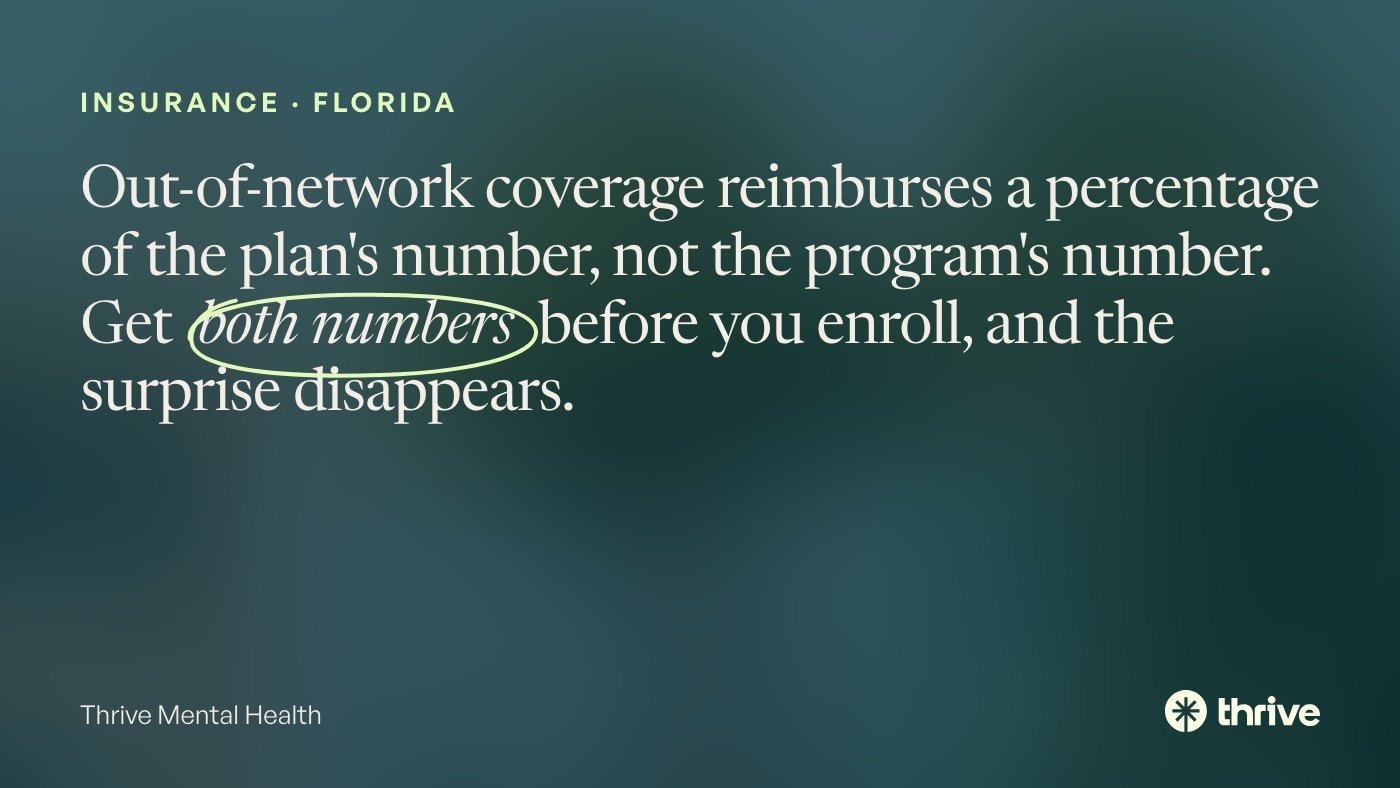
- Allowed amount. The plan does not reimburse a percentage of what the program charges; it reimburses a percentage of what the plan decides the service is worth. If the program bills $400 a day and the allowed amount is $250, your “70% coverage” is 70% of $250.
- Coinsurance. Your share of the allowed amount, commonly 30% to 50% out of network.
- Balance billing. The gap between the charge and the allowed amount is yours out of network. The federal No Surprises Act protects against surprise balance bills in emergencies and certain facility situations, but planned out-of-network outpatient care is not generally shielded.
- Superbill. The itemized receipt with provider credentials, diagnosis and procedure codes, dates, and charges that you submit to your plan for reimbursement.
How the process works, step by step
- Verify benefits in writing. Ask the behavioral health line for: out-of-network deductible and how much you have met, coinsurance for outpatient behavioral care, whether IOP requires prior authorization out of network, and the claim submission address or portal.
- Ask the program for its billing codes and rates up front. Any reputable program will provide them, plus a Good Faith Estimate of expected charges under federal law.
- Confirm authorization requirements. Some plans require prior authorization even out of network; skipping it can zero out reimbursement.
- Pay, collect superbills, and file promptly. Most plans allow 90 to 180 days to file. Weekly or monthly batches keep it manageable; processing typically takes two to four weeks per claim.
- Track everything. Log each claim, date filed, and outcome. If a claim is denied, request the reason in writing and appeal; federal law guarantees an internal appeal and then independent external review.
If you believe your plan is applying stricter rules to behavioral claims than medical ones, that may violate the Mental Health Parity and Addiction Equity Act. Florida consumers can escalate through the state insurance regulator via the NAIC directory.
The math: a worked Florida example
Suppose a virtual IOP charges $350 per treatment day, three days a week for ten weeks: $10,500 billed. Your PPO has a $2,500 out-of-network deductible (unmet), 60% reimbursement of allowed amounts, and an allowed amount of $250 per day ($7,500 total allowed).
- First $2,500 of allowed charges: all yours (deductible).
- Remaining $5,000 allowed: plan reimburses 60%, or $3,000.
- Balance between billed and allowed ($3,000 across the course): yours.
- Net: you pay roughly $7,500 of $10,500, recovering about $3,000.
Now compare in-network: the same course under a plan with a $1,500 in-network deductible and 20% coinsurance typically lands between $2,000 and $3,000 total, sometimes far less if the deductible is already met. That gap is why the first question is never “how do I file superbills,” but “is there a strong in-network program that fits.” Our Florida virtual IOP cost guide walks the in-network math.
When out-of-network is actually worth it
- The program you clinically need is not in any network you can reach. Specialized treatment needs sometimes justify the premium.
- You have a rich PPO with a low out-of-network deductible already met. Late in a heavy-healthcare year, the math can be surprisingly close.
- Your employer offers an HRA or you hold HSA funds. Tax-advantaged dollars soften the net cost; IOP is a qualified medical expense.
When it is usually not worth it: HMO and EPO members (no benefits to use), high unmet out-of-network deductibles, and cases where an equivalent in-network program exists. An in-network virtual IOP that runs the same evidence-based model, with insurance verification handled for you, nearly always costs less and starts faster.
Florida-specific wrinkles worth knowing
- The individual market is HMO country. Most Florida marketplace plans, including the bulk of Florida Blue’s individual offerings, are HMO designs with no planned out-of-network benefits. If you bought your own coverage, check the plan type before investing hope in the superbill route.
- Employer PPOs are where the benefits live. Florida’s large employers commonly offer PPO tiers; the out-of-network route is realistic mainly for this group.
- Network-gap exceptions exist. If your plan’s network genuinely lacks an appropriate program for your clinical needs, you can request a network-gap exception (sometimes called a single-case agreement) asking the plan to cover an out-of-network program at in-network rates. It requires clinical documentation and persistence, and it succeeds more often when the treating provider makes the clinical case directly.
- Keep your paper trail Florida-ready. The state’s consumer services line mediates insurer disputes, and a dated log of calls, reference numbers, and written benefit quotes is what turns a complaint into a resolution.
Your documentation checklist
- Written out-of-network benefits quote, with deductible status and coinsurance
- The program’s Good Faith Estimate and billing codes, before day one
- Prior authorization confirmation, if required
- Every superbill, plus a log of claim numbers and filing dates
- Explanation of benefits for every processed claim, checked against the quote
Common questions about out-of-network virtual IOP in Florida
Can I use out-of-network benefits for a virtual IOP in Florida?

Yes, if your plan is a PPO or POS with out-of-network behavioral benefits and the program provides superbills. HMO and EPO plans generally do not cover planned out-of-network treatment.
How much will my plan reimburse?
Typically 50% to 80% of the plan’s allowed amount, after a separate out-of-network deductible. The allowed amount is usually lower than the program’s billed rate, and the difference is yours.
Does the provider need to be licensed in Florida?
Yes. Even for telehealth, the treating clinicians generally must hold Florida licenses for services to be reimbursable.
Do I need prior authorization for out-of-network IOP?
Often yes. Confirm before starting; a missing authorization is one of the most common reasons out-of-network claims pay nothing.
Can I use my HSA or FSA for the out-of-pocket portion?
Generally yes. IOP treatment is a qualified medical expense, which makes tax-advantaged funds one of the better ways to absorb the out-of-network gap.
Is it easier to just find an in-network program?
Usually, yes: lower cost, no claims paperwork, and faster starts. Verify in-network options before committing to the superbill route.
How long do I have to submit superbills?
Most plans allow 90 to 180 days from the date of service, and some allow a year. The deadline is in your plan documents and enforced strictly. Filing weekly or monthly while treatment is ongoing avoids a stack of expired claims and catches processing problems while they are still fixable.
Next steps
Before you commit to months of superbills, find out what in-network care would actually cost you. Thrive Mental Health is a Joint Commission accredited provider of virtual IOP serving adults across Florida, with in-person care in Boca Raton, plus Indiana, Arizona, California, North Carolina, South Carolina, and Texas. Our admissions team verifies your benefits, in and out of network, and gives you both numbers in plain English, free.
Run a free, confidential benefits check with Thrive. Most people receive a summary within 24 hours, and many start treatment the same week. Prefer to talk first? Call (561) 203-6085.

This article is for informational purposes only and is not a substitute for individualized clinical advice or insurance verification.