
Understanding Trauma-Focused CBT: An Evidence-Based Approach to Healing

Why Trauma-Focused CBT Works When Nothing Else Does
Trauma focused cognitive behavioral therapy (TF-CBT) is a proven treatment that helps children, teens, and adults heal from trauma—including PTSD, anxiety, depression, and behavioral issues. If standard therapy hasn’t worked, TF-CBT offers a structured, short-term approach (8–25 sessions) that gets results.
What is TF-CBT?
- A specialized form of CBT designed for trauma survivors
- Combines cognitive-behavioral tools with trauma-sensitive care
- Involves caregivers (parents, family) to maximize healing
- Based on 25+ randomized controlled trials
- Considered the gold standard for treating childhood trauma and PTSD
Who benefits from TF-CBT?
- Children and teens who’ve experienced abuse, violence, loss, or disasters
- Adults struggling with unresolved childhood trauma
- Families looking to rebuild trust and communication
- Anyone with PTSD, complex trauma, or trauma-related depression/anxiety
How long does it take?
- Typical cases: 12–16 sessions
- Complex trauma: 16–25 sessions
- Most people see major symptom reduction within 3–6 months
What makes TF-CBT different from regular CBT?
- It includes a trauma narrative (safely processing your story)
- Uses gradual exposure (no forced reliving)
- Involves caregivers as partners in healing
- Focuses on safety, meaning-making, and future skills
Trauma doesn’t have to define you. Research shows that 80% of people who complete TF-CBT see significant improvement in PTSD symptoms, depression, anxiety, and behavior problems—and those gains last long-term.
At Thrive Mental Health, we’ve seen trauma-focused cognitive behavioral therapy change lives—not just for the person who experienced trauma, but for entire families. Whether you’re a parent supporting a child, a teen trying to make sense of what happened, or an adult still carrying the weight of childhood trauma, TF-CBT offers a clear path forward.
I’m Nate Raine, CEO of Thrive Mental Health, and I’ve spent over a decade building systems that connect evidence-based care with real-world results. At Thrive, our clinicians are trained in trauma focused cognitive behavioral therapy and deliver it through flexible IOP, PHP, and virtual programs designed to fit your life—not the other way around.
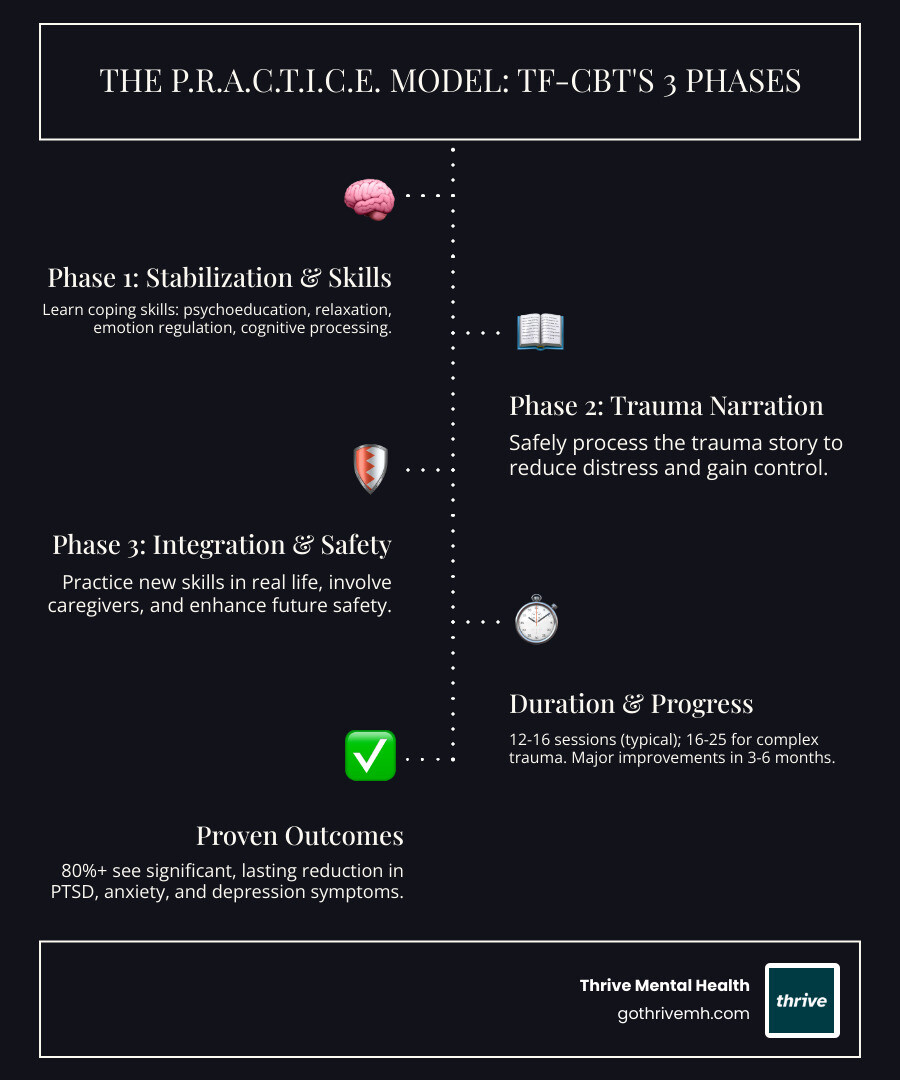
Trauma focused cognitive behavioral therapy terms at a glance:
What Is Trauma-Focused Cognitive Behavioral Therapy?
Trauma focused cognitive behavioral therapy (TF-CBT) is an evidence-based therapeutic approach specifically designed to address the unique needs of individuals, particularly children and adolescents, who have experienced traumatic life events. It’s a specialized form of cognitive behavioral therapy that integrates trauma-sensitive interventions with traditional CBT strategies.
Developed by Drs. Anthony Mannarino, Judith Cohen, and Esther Deblinger in the 1990s, TF-CBT aims to help individuals identify, cope with, and re-regulate maladaptive emotions, thoughts, and behaviors that often follow trauma. It’s not just about managing symptoms; it’s about resolving the emotional and behavioral difficulties associated with single, multiple, and even complex trauma experiences.
TF-CBT is typically a short-term treatment, generally lasting anywhere from 8 to 25 sessions, though often delivered over 12-16 sessions. Its effectiveness lies in its structured, components-based, and phase-based approach, which guides individuals through a systematic healing process. The therapy focuses on the intricate relationship among thoughts, feelings, and behaviors, and how altering patterns in one area can significantly improve functioning in others.
The theoretical underpinnings of TF-CBT draw from emotional processing theory, which suggests that trauma survivors develop associations between trauma reminders, meanings (e.g., “the world is dangerous”), and responses (e.g., fear). Changing these associations is key to recovery. Additionally, social cognitive theory highlights how individuals might integrate trauma into existing beliefs about themselves and the world, leading to unhelpful understandings and a diminished sense of control. TF-CBT helps clients reconceptualize these experiences, fostering a greater sense of self-efficacy and control over their lives. You can learn more about these theories and their impact on recovery in this article on social cognitive theory of posttraumatic recovery.
TF-CBT vs. Regular CBT: What Sets It Apart?
While general Cognitive Behavioral Therapy (CBT) is highly effective for a wide range of mental health concerns, trauma focused cognitive behavioral therapy distinguishes itself through its specific adaptations for trauma survivors, particularly children and adolescents.
Here’s how TF-CBT goes beyond traditional CBT:
-
Trauma Narrative (Safely Process the Story): Unlike general CBT, which might focus on current thought patterns, TF-CBT dedicates a core component to developing and processing a trauma narrative. This involves helping the individual, often a child, gradually and safely recount their traumatic experience in a structured way. This isn’t about forced reliving; it’s about creating a coherent story of what happened, allowing them to gain mastery over their memories and integrate the experience into their life in a healthy way.
-
Gradual Exposure (No Forced Reliving): TF-CBT incorporates gradual exposure to traumatic memories and reminders, but it’s done collaboratively and in a controlled manner. This helps desensitize individuals to triggers and reduce avoidance behaviors without overwhelming them. The goal is to recondition responses to trauma-related stimuli, enabling them to face fears and regain functionality in everyday life.
-
Caregiver Involvement (Parents Learn, Heal, and Support): A hallmark of TF-CBT, especially for children and adolescents, is the integral involvement of non-offending parents or primary caregivers. This isn’t just about providing support; caregivers actively participate in sessions, learn coping skills, receive psychoeducation about trauma, and improve their own parenting strategies. This collaborative approach strengthens the family unit and provides a consistent, supportive environment for the child’s healing. Parents are often children’s primary source of safety, and their active participation significantly improves the child’s recovery.
-
Focus on Safety, Meaning, and Future Skills: While CBT generally addresses problem-solving, TF-CBT places a strong emphasis on enhancing safety and developing skills for the future. This includes creating safety plans, rebuilding trust in relationships, and learning to steer future challenges with resilience. It’s about moving beyond simply coping to actively thriving.
TF-CBT is a components-based and phase-based treatment, meaning it follows a specific sequence of interventions custom to the trauma recovery process. This structured approach ensures that foundational skills (like relaxation and emotional regulation) are established before diving into trauma processing. For a deeper understanding of general CBT principles, you can explore our Cognitive Behavioral Therapy: Ultimate Guide.
Who Needs TF-CBT? [Symptoms, Trauma Types, and Who Benefits]

Trauma can manifest in various ways, impacting mental health and daily functioning. Trauma focused cognitive behavioral therapy is designed for individuals struggling with the aftermath of distressing experiences, offering a proven pathway to healing.
What Traumas Does TF-CBT Treat?
TF-CBT was initially developed to treat children who were victims of sexual abuse but has since expanded its application to a broad spectrum of traumatic experiences. It’s highly effective for:
- Sexual abuse: Addressing the profound psychological and emotional impact.
- Physical abuse: Helping individuals process the pain and fear associated with physical harm.
- Domestic violence: Supporting those who have witnessed or experienced violence in the home.
- Community violence: Aiding individuals affected by violence in their neighborhoods or communities.
- Traumatic loss or grief: Assisting with the complex grief reactions that follow a sudden or violent death of a loved one.
- Natural disasters: Helping survivors cope with the shock, loss, and disruption caused by events like hurricanes, earthquakes, or fires.
- War and conflict: Providing support for children and families exposed to armed conflict.
- Accidents: Addressing trauma stemming from severe accidents.
- Medical trauma: Supporting individuals who have experienced traumatic medical procedures or diagnoses.
TF-CBT is effective for children, adolescents, and adults who have experienced a single traumatic event, multiple traumas, or complex, ongoing traumatic situations. It’s particularly beneficial for those experiencing Post-Traumatic Stress Disorder (PTSD), depression, anxiety, externalizing behaviors, sexualized behaviors, and feelings of shame related to their trauma. We also see significant improvements in positive parenting skills and parent-child communication. If you’re struggling with the lingering effects of past events, our guide on Overcoming Childhood Trauma: Healing Into Adulthood offers more insights into the healing journey.
Can TF-CBT Help Complex Trauma (cPTSD)?
Yes, trauma focused cognitive behavioral therapy has been adapted and found to be effective in treating complex posttraumatic stress disorder (cPTSD). Complex trauma often arises from prolonged, repeated exposure to traumatic events, particularly in childhood, such as chronic abuse or neglect, where there is a lack of opportunity to escape or develop secure attachments.
cPTSD symptoms often go beyond the typical PTSD criteria, including difficulties with emotional regulation, distorted self-perception, relationship challenges, and a pervasive sense of shame or guilt. TF-CBT’s structured, phase-based approach is particularly well-suited to address these multifaceted issues.
Research indicates that TF-CBT can lead to significant symptom reduction in individuals with cPTSD. Some studies have even found that those with cPTSD showed a greater reduction in symptoms following TF-CBT than those with non-complex PTSD, highlighting its specific utility. While cPTSD is recognized in the ICD-11 (International Classification of Diseases, 11th Edition), it is still a developing area of diagnosis in the DSM-5-TR in the US. Our TF-CBT programs, offered across Florida, are equipped to address the unique challenges presented by complex trauma. For more detailed information, consider this research on TF-CBT for youth with complex trauma and our guide on Complex Trauma.
How TF-CBT Works: The P.R.A.C.T.I.C.E. Model Explained

Trauma focused cognitive behavioral therapy follows a structured, phase-based model, often summarized by the acronym P.R.A.C.T.I.C.E. This systematic approach ensures that individuals develop essential coping skills before processing traumatic memories, leading to more stable and lasting healing. TF-CBT is typically delivered over 8 to 25 sessions, and our programs at Thrive Mental Health, including our IOP, PHP, and Virtual Therapy options, integrate this highly effective model.
The 3 Phases of TF-CBT
TF-CBT progresses through three main phases, each building upon the last to facilitate comprehensive healing:
-
Stabilization & Skill-Building (P.R.A.C.T.I.C.E.): This initial phase focuses on establishing safety, managing distressing symptoms, and equipping individuals with crucial coping skills. It’s where the first four components of P.R.A.C.T.I.C.E. come into play:
- Psychoeducation & Parenting Skills: We provide education about common trauma reactions, normalizing experiences and reducing feelings of shame or guilt. For caregivers, this includes teaching effective, compassionate parenting strategies to support their child’s emotional regulation and behavioral challenges.
- Relaxation: Learning and practicing techniques like deep breathing, progressive muscle relaxation, and guided imagery to manage anxiety and stress responses.
- Affective Regulation: Developing skills to identify, express, and manage a wide range of emotions, moving from dysregulation to healthy emotional modulation.
- Cognitive Coping: Identifying and challenging unhelpful or distorted thoughts about the trauma and oneself, replacing them with more balanced and realistic perspectives.
-
Trauma Narration & Processing (T): Once stabilization is achieved and coping skills are in place, we move into the core of trauma processing.
- Trauma Narrative Development and Processing: This involves the individual, often guided by the therapist, gradually and safely creating a detailed account of their traumatic experience. This narrative can be written, drawn, or verbally expressed. The goal is to process the memories, integrate them, and assign new, healthier meanings, rather than remaining stuck in the past. This is done at the individual’s pace, ensuring they feel in control and supported.
-
Integration & Consolidation (I.C.E.): The final phase focuses on applying new skills to real-life situations and preparing for the future.
- In Vivo Exposure: Gradually confronting safe, real-life situations, people, or places that have been avoided due to trauma reminders. This helps individuals master their fears and regain a sense of control and freedom in their daily lives.
- Conjoint Child-Parent Sessions: For children and adolescents, these sessions are critical. They provide a safe space for the child to share their trauma narrative with their non-offending caregiver, fostering open communication, mutual understanding, and strengthening the parent-child bond. This component is integral to rebuilding trust and support within the family.
- Enhancing Safety and Future Development: Developing practical strategies for current and future safety, building self-esteem, improving social skills, and reinforcing positive coping mechanisms to prevent future trauma and promote healthy development. This often includes creating a family safety plan.
Why Caregiver Involvement Matters
For children and adolescents, caregiver involvement is not just beneficial—it’s integral to the success of trauma focused cognitive behavioral therapy. Parents or primary caregivers are often the child’s primary source of safety and support, and their active participation significantly improves the child’s healing journey.
Here’s why caregiver involvement is so crucial:
- Parents Learn Skills: Caregivers learn the same psychoeducation and coping skills as their child, enabling them to understand and respond more effectively to the child’s trauma reactions.
- Reduces Caregiver Distress: Many parents of traumatized children experience their own distress. TF-CBT sessions for caregivers help them process their feelings, reduce their own anxiety or depression, and improve their capacity to support their child.
- Supports Recovery: Caregivers become active partners in reinforcing the skills learned in therapy, creating a consistent and supportive environment at home. They learn how to respond to triggers, manage challenging behaviors, and praise positive coping.
- Improves Communication and Trust: Conjoint sessions, where the child shares their trauma narrative with their caregiver, are powerful. They foster open communication, rebuild trust, and deepen emotional connections within the family, which are often fractured by trauma.
- Long-Term Outcomes: Research consistently shows that parental participation significantly improves the beneficial impact of TF-CBT, leading to more sustained improvements in the child’s symptoms and overall well-being.
- Models Healthy Coping: When parents model healthy coping and emotional regulation, children learn by example, reinforcing the lessons from therapy.
At Thrive Mental Health, we integrate caregivers into the TF-CBT process, ensuring that the entire family unit is equipped to heal and thrive. For more on strengthening family bonds through therapeutic interventions, explore our Family Therapy for Teens: Complete Guide.
Does TF-CBT Really Work? [Success Rates, Limitations, and What to Expect]
The question isn’t if trauma focused cognitive behavioral therapy works, but how effectively. The answer is resounding: TF-CBT is one of the most rigorously tested and empirically supported treatments available for trauma-related disorders, particularly in children and adolescents.
Success Rates
- Gold Standard Evidence: TF-CBT has been tested in over 25 randomized controlled trials and many additional effectiveness studies worldwide. This extensive research consistently demonstrates its superiority over control groups and other comparison treatments.
- Significant Symptom Reduction: Studies show that TF-CBT effectively reduces symptoms of PTSD, depression, anxiety, externalizing behaviors, sexualized behaviors, and feelings of shame in children and adolescents who have experienced trauma. Many individuals, especially children who have experienced sexual abuse, see major symptom drops in 8-25 sessions, with some studies reporting over 80% showing significant improvement.
- Lasting Impact: The improvements gained through TF-CBT are often sustained long-term, preventing chronic mental health issues. It has been shown to improve positive parenting skills and support of the child through the improvement of parent-child communication.
- Broad Applicability: TF-CBT has proven effective across diverse populations, trauma types, and settings, including in our programs across Florida.
At Thrive Mental Health, we use TF-CBT within our Intensive Outpatient (IOP) and Partial Hospitalization (PHP) programs, leveraging its evidence-based framework to deliver measurable results. Our commitment to Evidence-Based Trauma Treatment ensures you receive care backed by science.
What Are the Limits?
While TF-CBT is incredibly effective, it’s important to understand its boundaries and when other interventions might be needed first:
- Acute Crisis or Instability: TF-CBT is not typically the first-line intervention for severe disruptive behaviors (e.g., aggression), active substance abuse, or severe depression with active suicidal ideation. These issues require initial stabilization and specific interventions before or concurrently with TF-CBT.
- Caregiver Involvement: For children and adolescents, the active involvement of a non-offending caregiver is crucial for the best outcomes. While adaptations exist for situations where this isn’t possible, full engagement significantly improves the therapeutic process. Parents with active psychosis or substance abuse may also be excluded from participation.
- Complex Trauma: While TF-CBT has shown effectiveness for complex trauma (cPTSD), these cases may require a longer duration of treatment (16-25 sessions) and a greater focus on the stabilization and skill-building phases before trauma narration.
- Therapist Readiness: The therapist’s comfort and training in discussing traumatic events are essential. A therapist’s discomfort can inadvertently delay the trauma-focused work.
Is TF-CBT Accessible? (Remote, Group, and Cultural Adaptations)
Accessibility is a cornerstone of modern mental healthcare, and TF-CBT has evolved to meet diverse needs:
- Remote Delivery (Telehealth): The rise of virtual care has made TF-CBT more accessible than ever. Research shows that individual TF-CBT delivered via videoconferencing can be as effective as in-person treatment. Thrive Mental Health offers secure, HIPAA-compliant virtual IOP and PHP programs in Florida, bringing expert TF-CBT directly to you. This remote option is particularly valuable for individuals in rural areas or those with scheduling challenges. For more, explore our Online Therapy for Trauma Guide.
- Group Formats: TF-CBT can be effectively delivered in a group setting, which can be beneficial for fostering peer support and reducing feelings of isolation. This format can also be a practical solution in areas with limited resources.
- Cultural Adaptations: TF-CBT has been successfully adapted for various cultures, including Latino populations, and has been implemented in numerous countries globally. The model is designed to be flexible enough to respect cultural beliefs and values, ensuring that interventions are both effective and culturally sensitive. This includes adapting materials, understanding cultural norms around discussing sensitive topics, and engaging families in a culturally appropriate manner.
- Diverse Populations: Beyond cultural adaptations, TF-CBT has been successfully applied to children in foster care, military members, veterans, and public safety personnel, demonstrating its versatility across different populations and their unique trauma experiences.
How to Find a Certified TF-CBT Therapist—And Why It Matters
Finding a qualified therapist for trauma focused cognitive behavioral therapy is paramount to effective healing. While the widespread dissemination of TF-CBT is positive, ensuring your therapist has proper training and certification is critical. At Thrive Mental Health, our clinicians are not only TF-CBT certified but also trauma-informed, ensuring you receive care from experts who understand the nuances of trauma recovery. We also make access straightforward, with services often covered by major insurance providers like Cigna, Optum, and Florida Blue.
What to Ask Before You Start
When seeking a TF-CBT therapist, don’t hesitate to ask specific questions to ensure they are the right fit for your needs:
- Are you TF-CBT certified or have you completed comprehensive TF-CBT training and supervision? This indicates specialized knowledge beyond general CBT.
- What’s your experience with my/my child’s specific type of trauma (e.g., sexual abuse, grief, domestic violence)? Experience with the particular trauma is invaluable.
- How do you involve parents/caregivers in the treatment process? For children and adolescents, this is a core component, so understanding their approach is key.
- What is your approach to the trauma narrative component, and how do you ensure it’s done safely and gradually? This is a sensitive part of treatment.
- Do you offer virtual or evening sessions? This is especially important for working professionals or those with busy schedules, which Thrive specializes in across Florida.
- How do you track progress, and what assessments do you use? A good therapist will monitor outcomes.
- Is this covered by my insurance? Understanding financial aspects upfront is crucial.
Where to Find Help
Accessing quality trauma focused cognitive behavioral therapy is easier than you think:
- Official TF-CBT Therapist Directory: The official TF-CBT website offers a directory of certified therapists, ensuring they meet specific training criteria.
- Thrive’s Virtual IOP & PHP Programs: We provide comprehensive TF-CBT within our Virtual IOP and PHP programs. Our flexible scheduling, including evening options, is designed for adults and young professionals seeking more than weekly therapy but less than inpatient care. We proudly serve clients throughout Florida.
- Verify Insurance Coverage: Don’t let cost be a barrier. You can quickly verify your insurance coverage with us in just two minutes, with no obligation. We work with major providers like Cigna, Optum, Florida Blue, and many others.
- Local Support: You can find our trusted in-person centers and virtual services across various cities in Florida, including Tampa Bay, Miami, and Orlando.
FAQs: Trauma-Focused CBT—What People Ask (and Need to Know)
How long does TF-CBT take to work?
Most people see significant improvements in their PTSD symptoms within 8–25 sessions, typically over 3-6 months. For complex trauma, it might take a bit longer, up to 25 sessions, to ensure thorough stabilization and processing.
Is TF-CBT just for kids?
No. While TF-CBT was initially developed and is highly effective for children and adolescents (ages 3-18), its principles and components can be adapted and are beneficial for adults struggling with unresolved childhood trauma or who have experienced recent traumatic events.
What is a trauma narrative?
A trauma narrative is a core component of TF-CBT where you, with the therapist’s guidance, gradually and safely recount your traumatic experience. It’s a way to process the memories, integrate them into your life story, and assign new, healthier meanings so the past stops controlling your present.
Does insurance cover TF-CBT?
Yes, trauma focused cognitive behavioral therapy is an evidence-based treatment, and most major insurance plans, including Cigna, Optum, and Florida Blue, provide coverage for it. At Thrive Mental Health, we work with a wide range of providers. You can check your benefits now to understand your coverage.
Can I do TF-CBT virtually?
Absolutely! Thrive Mental Health offers secure, HIPAA-compliant virtual TF-CBT sessions within our IOP and PHP programs. This provides flexibility and accessibility for individuals across Florida, allowing you to engage in healing from the comfort of your home.
Summary: Why Choose Trauma-Focused CBT at Thrive?
Trauma focused cognitive behavioral therapy is the fastest, most proven way to break free from PTSD, anxiety, and depression—especially for kids, teens, and families. At Thrive Mental Health, we understand the profound impact of trauma and are dedicated to providing accessible, expert-led care. We deliver TF-CBT in flexible IOP, PHP, and virtual formats, covered by major insurance, with expert therapists who get real results. Don’t let trauma steal another day. Our programs are designed for adults and young professionals, offering measurable results and the support you need to reclaim your life.
Ready for support? Thrive offers virtual and hybrid IOP/PHP programs with evening options. Verify your insurance in 2 minutes (no obligation) or call 561-203-6085. If you’re in crisis, call/text 988.