






Open enrollment for 2027 Arizona marketplace plans runs November 1, 2026 through January 15, 2027 on HealthCare.gov, and you need to choose by December 15 for coverage that starts January 1. If you see a therapist, take psychiatric medication, or think you may need more support next year, the plan you pick this fall sets what that care will cost in 2027. This guide covers what changed in Arizona for 2027 and how to read a plan for its mental health value.
Arizona’s market is shifting more than usual this year. One national carrier is leaving, premiums are set to rise, and every marketplace plan in the state was an HMO in 2026. Each of those facts changes how you should shop.
This article is informational, not clinical or financial advice. Verify benefits directly with your carrier and a licensed clinician before starting treatment.
When is open enrollment for 2027 in Arizona?
Arizona doesn’t run its own exchange, so individual and family plans are sold through the federal marketplace and the HealthCare.gov calendar is the one that counts.
- November 1, 2026: the first day to enroll, renew, or switch plans for 2027.
- December 15, 2026: the last day to pick a plan that starts January 1.
- January 15, 2027: open enrollment closes. Plans picked after December 15 start February 1.
- Employer plans: your company sets its own window, often a few weeks in October or November. Ask HR for the exact dates now.
You may have seen older articles saying enrollment would end December 15. The official calendar now lists January 15, so go by HealthCare.gov rather than a news story from last year.
Which insurers are selling Arizona marketplace plans for 2027?
Six companies filed 2027 rates for plans sold on Arizona’s marketplace, according to the federal rate review database. Cigna is not among them, because the company says it will no longer offer individual and family medical plans for 2027. Aetna already left the individual marketplace, and it doesn’t appear in the 2027 filings either.
| Carrier (as filed) | Sold in Arizona’s marketplace in 2026? | Requested average 2027 change |
|---|---|---|
| Blue Cross Blue Shield of Arizona | Yes | About 30% |
| Ambetter from Arizona Complete Health (Health Net of Arizona) | Yes | About 25% |
| Oscar Health | Yes | About 34% |
| UnitedHealthcare of Arizona | Yes | About 29% |
| Imperial Insurance Companies | Yes | About 30% |
| Antidote Health Plan of Arizona | Yes | About 3% |
| Cigna Healthcare | Yes | Leaving for 2027 |
A few cautions apply to those numbers. First, they are requests, filed in spring and summer, and Arizona’s Department of Insurance and Financial Institutions still has to review them. They are averages across all of a carrier’s plans, so your plan could move more or less. And they are prices before tax credits, which lower what many people actually pay.
If you have Cigna marketplace coverage now, you must choose a new plan. If you do nothing, you could start 2027 without coverage. Your therapist’s network status should be the first thing you check on the replacement plan. Cigna’s exit covers individual plans only; if you get Cigna through work, our Cigna Arizona coverage guide still applies.
Every Arizona marketplace plan was an HMO in 2026. What does that mean for therapy?
In the CMS plan data for 2026, all 199 individual plans sold on Arizona’s marketplace were HMOs. There were no PPO or EPO options at all. Carriers have not published 2027 plan designs yet, but you should expect the same shape.
An HMO (health maintenance organization) generally pays only for care inside its own network, except emergencies. That makes the network the single most important thing to check if you already see a therapist or psychiatrist.
- Out-of-network care is usually not covered. If your therapist is outside the plan’s network, you may pay the full fee yourself.
- Referral rules vary. Some HMOs want a primary care referral before you see a specialist. Look for the line “Do you need a referral to see a specialist?” in the plan’s summary.
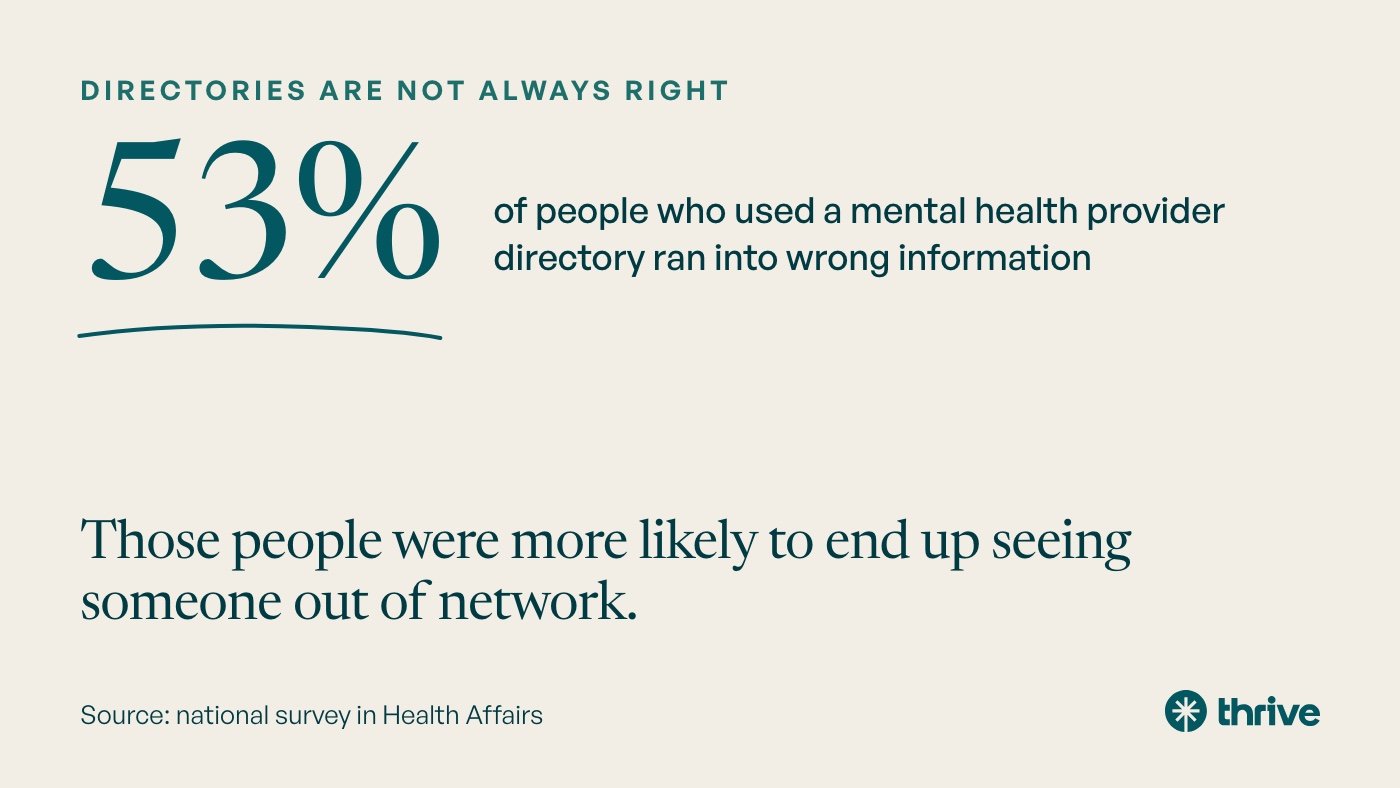
- Directories are not always right. In a national survey in Health Affairs, 53% of people who used a mental health provider directory ran into wrong information. Those people were more likely to end up seeing someone out of network.
So don’t stop at the online directory. Call the office and ask, “Are you in network with this exact plan for 2027?” Name the plan, not just the carrier. Blue Cross Blue Shield of Arizona offered 115 different marketplace plans in 2026, and networks can differ between them.

Virtual care helps with this problem, because Arizona is a big state, and a lot of it is far from Phoenix and Tucson. A plan’s list of in-network virtual programs can matter more than its list of offices near you. For how our program works day to day, see how Thrive’s virtual IOP works.
How do you do the deductible math for therapy and IOP?
Most people compare plans on the monthly premium. For anyone who expects regular mental health care, that is the wrong place to stop, and two other numbers tell you much more.
- Your worst-case year. Add 12 months of premium to the plan’s out-of-pocket maximum. That is the most you’d pay for in-network covered care in a bad year. For 2027, federal rules cap the out-of-pocket maximum at $12,000 for one person and $24,000 for a family.
- Your likely year. Estimate the care you actually expect. Then check whether that care costs you a flat copay or counts toward the deductible first.
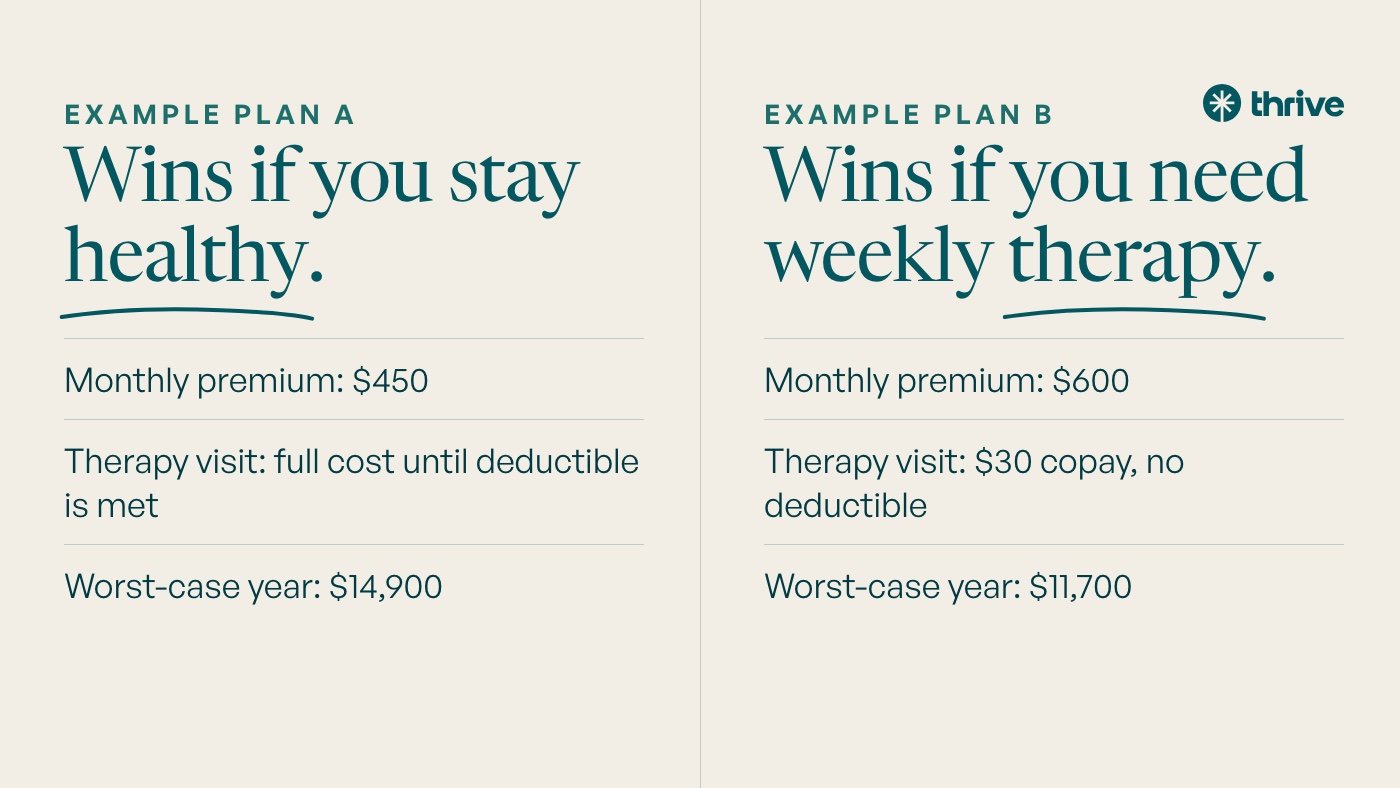
Here is how that plays out with two made-up plans. The numbers are only for illustration, so plug in the real ones from the plans you’re comparing.
| Example plan | Plan A: lower premium | Plan B: higher premium |
|---|---|---|
| Monthly premium | $450 | $600 |
| Deductible | $7,000 | $2,000 |
| Therapy visit | Full cost until deductible is met | $30 copay, no deductible |
| Out-of-pocket maximum | $9,500 | $4,500 |
| Worst-case year | $5,400 + $9,500 = $14,900 | $7,200 + $4,500 = $11,700 |
Plan A wins if you stay healthy. Plan B wins if you need weekly therapy, and it wins by thousands if you need a higher level of care. An intensive outpatient program (IOP) means nine or more hours of structured care a week, so it tends to push you toward your out-of-pocket maximum quickly. If a clinician has already raised IOP with you, compare plans on the worst-case line. Our Arizona virtual IOP cost guide walks through what shapes the bill.
What should you check during employer open enrollment in Arizona?
Many Arizonans get coverage through a job instead. Employer plans follow the same federal parity law as marketplace plans, but they can look quite different. Some include PPO or EPO options, even though the marketplace had none in 2026.
- Read the Summary of Benefits and Coverage. Every plan must give you one. The standard summary has a row for mental and behavioral health, split into outpatient and inpatient care. IOP usually falls under outpatient.
- Ask who manages behavioral health. Many carriers hand mental health to a separate company, so the network behind your card may not be the one you expect.
- Look at the HSA or FSA option. Therapy and psychiatric care count as qualified medical expenses, so you can pay for them with pre-tax money.
- Check for an EAP. An employee assistance program often includes a few free counseling sessions. It’s a useful first step, though it isn’t built for ongoing or intensive care.
If your employer offers both Blue Cross Blue Shield of Arizona and UnitedHealthcare, our guides to BCBS Arizona and UnitedHealthcare in Arizona cover how each handles virtual IOP.

A mental health checklist before you click enroll
Mental health needs are common: an estimated 23.1% of U.S. adults lived with a mental illness in 2022, and only about half of them got treatment that year, according to NIMH. Even if you feel fine now, it’s worth ten minutes to check these rows.
- Your current providers. Call your therapist and prescriber and confirm they take the exact plan for 2027.
- Outpatient mental health cost. Is it a copay, or coinsurance after the deductible?
- Referral rules. Does the HMO require a referral for behavioral health, or can you book directly?
- Higher levels of care. Check the IOP and hospital rows, and ask whether prior authorization is required.
- Telehealth. Confirm video therapy and virtual programs are covered at the same cost as in-person care.
- Your medications. Look up each one in the plan’s drug list. Tier changes can move your costs a lot.
- The out-of-pocket maximum. If next year could be a hard one, a lower maximum is often worth a higher premium.
Where can Arizonans get free help choosing or fixing a plan?
- Enrollment help: trained assisters and navigators are free. Search by ZIP code at HealthCare.gov local help.
- Plan preview: once 2027 plans post, you can compare them without logging in at HealthCare.gov’s plan tool.
- Denied claims: Arizona’s Department of Insurance and Financial Institutions explains the health care appeals process for state-regulated plans, including independent review.
- Coverage for treatment: our virtual IOP insurance page explains how we work with commercial plans.
If you need care before January, don’t wait for the new plan year. Your current plan still covers you through December 31. If you’ve already met this year’s deductible, the rest of 2026 may be a cheaper time to start treatment than January.
Common questions about open enrollment and mental health in Arizona
When does open enrollment for 2027 start and end in Arizona?
It runs November 1, 2026 through January 15, 2027 on HealthCare.gov. Pick a plan by December 15 if you want coverage to start January 1.
Is Cigna leaving the Arizona marketplace?
Yes. Cigna says it won’t offer individual and family medical plans for 2027. If you have one now, you need to choose a new plan during open enrollment.
Are there any PPO plans on Arizona’s marketplace?
Not in 2026. Every individual marketplace plan in Arizona was an HMO. Employer plans are separate, and some of them still include PPO options.
Do Arizona marketplace plans cover therapy and IOP?
Yes. Mental health care is an essential health benefit, and federal parity law says it can’t be more restricted than medical care. Costs, networks, and authorization rules still vary by plan.
Can I switch plans mid-year if I need more mental health care?
Usually not. You need a qualifying life event, like losing other coverage or moving. That’s why it pays to check the IOP and out-of-pocket rows now.
Will my premium go up in 2027?
Most Arizona marketplace carriers asked for increases of roughly 25% to 34%, with one asking for about 3%. Final rates and your tax credit will decide what you actually pay.
Next steps
If part of your plan shopping is “what would treatment actually cost me,” get that answer before enrollment closes. Thrive Mental Health is a Joint Commission accredited provider of virtual intensive outpatient care for adults in Arizona, Florida, Indiana, California, North Carolina, South Carolina, and Texas. Our admissions team can check your current plan or one you’re considering and explain the numbers in plain English.
Verify your coverage with Thrive: free, confidential benefits check. Most members receive a summary within 24 hours, and many start the same week. Prefer to talk first? Call (561) 203-6085.

This article is for informational purposes only and is not a substitute for individualized clinical advice or insurance verification.