
Therapy Tree: Uncovering the Many Branches of Mental Wellness

Types of Therapy [2025]: Which One Actually Works Faster (and Won’t Waste Your Money)?
Most people spend months in the wrong type of therapy—paying session after session with little real change. The right fit can cut recovery time, lower costs, and stop symptoms from wrecking your work, relationships, and sleep.
This guide breaks down the main types of therapy in plain language so you can decide what’s worth your time, money, and energy.
Quick Answer: Main Types of Therapy and When to Use Them
| Therapy Type | Best For | Core Focus |
|---|---|---|
| Cognitive Behavioral Therapy (CBT) | Anxiety, depression, OCD, PTSD | Changing negative thought patterns and behaviors |
| Dialectical Behavior Therapy (DBT) | Borderline personality disorder, intense emotions, self-harm | Emotion regulation, mindfulness, distress tolerance |
| Psychodynamic Therapy | Depression, relationship issues, self-esteem | Understanding unconscious patterns from the past |
| Humanistic Therapy | Personal growth, self-acceptance, existential concerns | Self-actualization, unconditional positive regard |
| EMDR | PTSD, trauma, panic attacks | Reprocessing traumatic memories through bilateral stimulation |
| Exposure Therapy | Phobias, OCD, social anxiety | Gradually facing fears in a safe environment |
| Interpersonal Therapy (IPT) | Depression, relationship conflicts | Improving communication and social functioning |
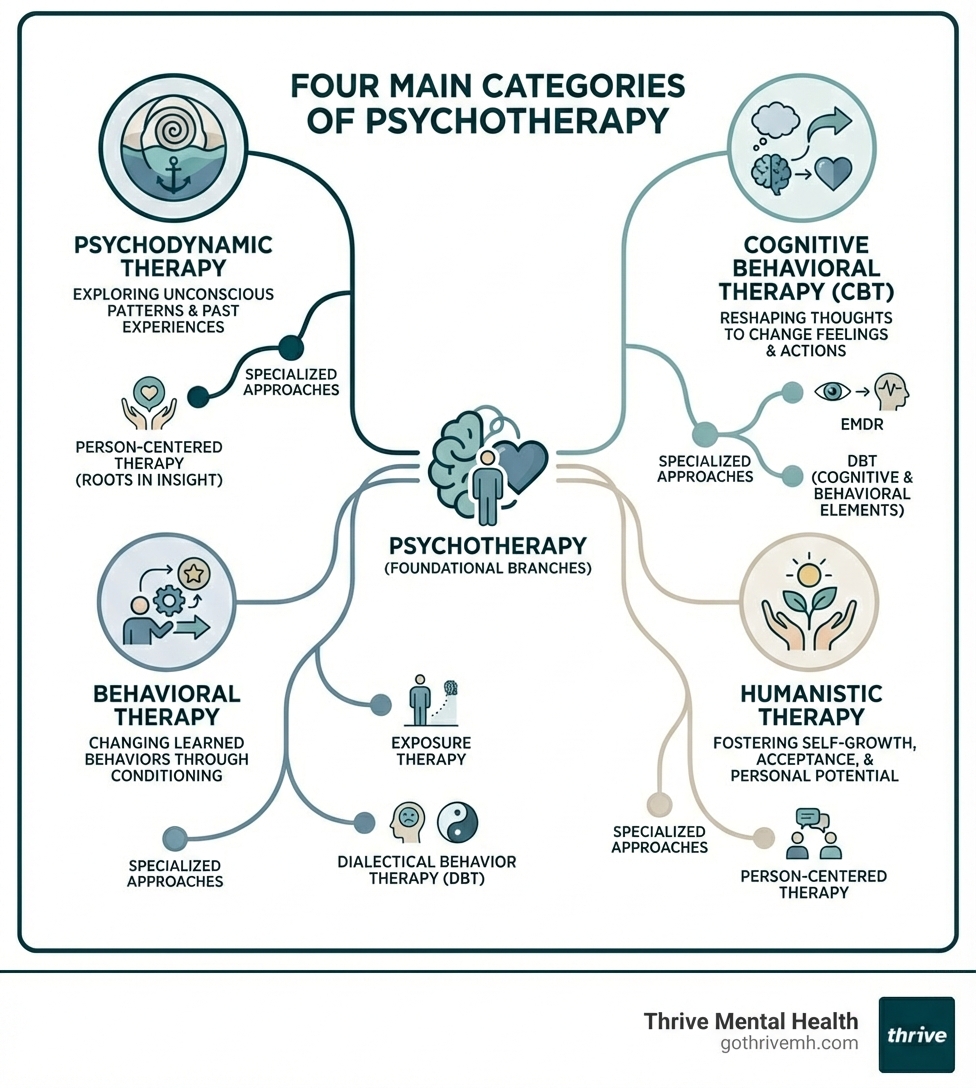
Over 400 different therapeutic modalities exist today, but most fall into four foundational branches: psychodynamic (exploring unconscious patterns), behavioral (changing actions and reactions), cognitive (reshaping thought patterns), and humanistic (fostering self-growth). Some approaches—like DBT or EMDR—are highly specialized for conditions like borderline personality disorder or trauma. Others, like CBT, are versatile and evidence-based for anxiety, depression, and more.
Research backs this up: CBT is effective for PTSD, anxiety, depression, bipolar disorder, eating disorders, and schizophrenia, according to the National Alliance on Mental Health (NAMI). A 2024 review found DBT significantly improves depressive symptoms and general well-being in people with BPD. And EMDR has been recognized by the American Psychological Association as a second-line treatment for PTSD.
But what works on paper doesn’t always work for you. Your past experiences, current symptoms, goals, and even your communication style all matter. Some people do best with structured, skills-based approaches like CBT. Others need deeper, insight-oriented work like psychodynamic therapy. Many benefit from a blend—what therapists call an integrative approach.
If you’ve tried weekly therapy in Florida and you’re still stuck, or your symptoms are wrecking work, school, or relationships, you may need more than a once-a-week session. That’s when Intensive Outpatient Programs (IOPs) and Partial Hospitalization Programs (PHPs) matter—offering multiple hours of care per week, more structure, and faster change while you still live at home.
Why This Guide Exists
This isn’t a feel-good list of buzzwords. It’s a practical map so you can:
- avoid wasting months (and money) in the wrong fit,
- know which types of therapy are proven to work,
- and see how higher levels of care like IOP and PHP can speed up recovery.
I’m Nate Raine, CEO of Thrive Mental Health. At Thrive, we integrate multiple types of therapy—from CBT and DBT to EMDR and somatic work—into personalized, outcome-focused treatment plans that actually move the needle. We work with major insurances like Cigna, Optum/UnitedHealthcare, Aetna, and Florida Blue so you can use your benefits instead of paying out of pocket.
Find more about types of therapy:
- psychotherapy
- what is cognitive behavioral therapy
- is cognitive behavioral therapy effective
- online therapy options
- how to verify your insurance benefits
The Core Four: Foundational Approaches to Psychotherapy
Psychologists use specific theories as “roadmaps” to guide therapeutic journeys. These core approaches form the foundation of many specialized types of therapy.
Cognitive Behavioral Therapy (CBT): Rewire Your Thoughts, Change Your Actions
CBT is one of the most researched and effective types of therapy. It’s based on the idea that thoughts, feelings, and behaviors are interconnected. By adjusting negative thought patterns, we can change unhealthy behaviors and improve emotional well-being.
CBT involves identifying negative thought patterns and replacing them with realistic ones through “homework” like journaling or behavioral experiments. For instance, if you believe “no one likes me,” CBT helps reframe that to “people like me, I just need to reach out more,” then encourages small steps to connect.
According to NAMI, CBT effectively treats PTSD, anxiety, depression, bipolar disorder, eating disorders, and schizophrenia. We’ve seen it help individuals manage OCD and anxiety across Florida.
Learn more: Cognitive Behavioral Therapy (CBT) Guide.
Psychodynamic Therapy: Uncover Your Past to Understand Your Present
Psychodynamic therapy explores how your unconscious mind and past experiences shape current emotions and relationships. Unlike symptom-focused approaches, it builds self-awareness by examining personal history.
A 2010 APA review found people continue improving after completing psychodynamic therapy, highlighting lasting effects. It successfully treats depression, relationship difficulties, and low self-esteem.
Learn more: Psychotherapy Guide.
Humanistic Therapy: Open up Your Potential for Personal Growth
Humanistic therapy focuses on your inherent capacity for rational choices and growth. Built on “unconditional positive regard,” therapists offer complete acceptance and empathy, creating safety for authentic self-exploration.
Subtypes include Person-Centered Therapy (client leads sessions), Gestalt therapy (“here and now” awareness), and Existential Therapy. The goal: align with your true self, increase self-acceptance, and find meaning.
Learn more: Person-Centered Therapy.
Behavioral Therapy and Its Subtypes
Behavioral therapy changes learned behaviors causing distress through conditioning principles. For phobias, therapists might use systematic desensitization—gradual exposure while teaching relaxation. Other subtypes include Aversion Therapy and Flooding.
It’s highly effective for phobias, OCD, ADHD, and oppositional behaviors.
Learn more about our approach to behavioral therapy in Florida: Psychotherapy Guide.
Specialized Types of Therapy for Complex Needs
If you are in crisis or considering self-harm, please call or text the 988 Lifeline at 988. You are not alone, and free, confidential support is available 24/7.
If you’re in crisis, call/text 988 right now. You are not alone.
For individuals facing more complex or specific mental health challenges, certain types of therapy have been developed and refined to provide targeted, evidence-based support. These specialized modalities can be the difference between cycling through the ER and finally getting a plan that works.

Dialectical Behavior Therapy (DBT): When Emotions Feel Out of Control
Dialectical Behavior Therapy (DBT) is a powerful and highly structured form of therapy that combines CBT techniques with mindfulness practices. It was originally developed to treat Borderline Personality Disorder (BPD), a condition characterized by intense emotional dysregulation, but has since proven effective for a range of other issues.
DBT operates on the principle of “dialectics”—balancing acceptance and change. It teaches clients to accept their current reality while simultaneously working to change unhelpful thoughts and behaviors. We focus on four key skill modules:
- Mindfulness: Learning to be present in the moment and observe thoughts and feelings without judgment.
- Distress Tolerance: Developing skills to cope with intense, uncomfortable emotions without resorting to destructive behaviors.
- Emotion Regulation: Understanding, identifying, and managing intense emotions.
- Interpersonal Effectiveness: Improving communication and relationship skills to steer social interactions more effectively.
A 2024 review of studies found that DBT can significantly improve depressive symptoms and increase general well-being in people with BPD, with observed improvements in mood and impulsivity, and a reduction in hospitalization. NAMI also highlights its significant and long-lasting effects. Beyond BPD, DBT is effective for eating disorders, self-harm, and managing Passive Suicidal Ideation.
At Thrive, DBT skills are a core part of our virtual Intensive Outpatient Programs (IOPs) and Partial Hospitalization Programs (PHPs) in Florida—covered by many plans from Cigna, Optum, Aetna, and Florida Blue.
Learn more about this comprehensive approach: More info about Dialectical Behavior Therapy (DBT).
Eye Movement Desensitization and Reprocessing (EMDR): Heal from Traumatic Memories
Eye Movement Desensitization and Reprocessing (EMDR) is a unique and effective therapy primarily used for healing from the impact of traumatic experiences. It’s particularly well-known for treating Post-Traumatic Stress Disorder (PTSD).
The core of EMDR involves an eight-phase approach where you recall distressing memories while simultaneously engaging in “bilateral stimulation”—typically rhythmic eye movements, but sometimes alternating sounds or taps. The theory is that this bilateral stimulation helps your brain reprocess traumatic memories, reducing their emotional intensity and allowing you to integrate them in a healthier way.
While a 2018 review of studies noted some controversy regarding which part of EMDR treatment is most beneficial (the eye movements versus the recollection itself), the American Psychological Association (APA) conditionally recommends EMDR as a second-line treatment option for PTSD. We’ve seen EMDR help individuals in our Florida programs find relief from anxiety, panic attacks, and even process complicated Grief related to loss.
Uncover more about how EMDR works: More info about Eye Movement Desensitization and Reprocessing (EMDR).
Other Key Targeted Therapies
Beyond the core four and highly specialized DBT and EMDR, several other types of therapy offer targeted support for specific challenges:
- Interpersonal Therapy (IPT): This approach focuses on improving your relationships with others. IPT helps you notice negative patterns in social interactions and then understand and interact positively with family members, close friends, and loved ones. NAMI indicates that therapists often use IPT to treat depression.
- Mentalization-Based Therapy (MBT): Primarily an effective treatment for BPD, MBT involves a technique called “mentalizing.” This helps individuals notice and understand their own thoughts and feelings, as well as those of others. Its primary aim is to give a person with BPD a stronger sense of self and help them connect more effectively with other people, as noted by a 2018 systematic review.
- Emotion-Focused Therapy (EFT): Based on attachment theory, EFT helps individuals and couples develop a better awareness of their emotions and learn to reflect, regulate, and make sense of them. A small 2018 feasibility study suggests EFT may treat generalized anxiety disorder and major depressive disorder, and researchers are also exploring its use for complex trauma.
- Exposure Therapy: A form of CBT, exposure therapy helps you confront your fears in a safe, controlled environment. Therapists help you identify your anxiety triggers and then gradually expose you to these triggers, encouraging you to sit with the anxiety until it decreases naturally, rather than avoiding it. This is highly effective for phobias, OCD, and PTSD. A 2022 review of studies found that “prolonged exposure therapy,” a form of exposure therapy for PTSD, may benefit people with a single type of trauma or those who have experienced multiple traumatic events.
If you’re dealing with intense symptoms or safety concerns, these therapies often work best inside a structured program like IOP or PHP rather than once-a-week sessions.
For a comprehensive look at MBT, check out: More info about Mentalization-Based Therapy (MBT).
Beyond the Couch: Experiential and Holistic Therapies
Not all healing happens through talk. Many types of therapy use creative, bodily, or relational approaches, recognizing mental wellness connects deeply to physical being and world interactions.
Creative and Expressive Arts Therapies
When words aren’t enough, creative arts therapies provide vital outlets:
- Art Therapy: Uses visual arts. A 2022 review found it improves mental health and relationships, especially benefiting teens in our Florida programs.
- Music Therapy: Creating, listening, or discussing music addresses physical, emotional, cognitive, and social needs.
- Dance/Movement Therapy: Uses movement for emotional, social, cognitive, and physical integration.
These therapies effectively process trauma, manage stress, improve self-esteem, and explore complex emotions for those struggling with verbal expression.
Learn more: Art Therapy Guide.
Somatic and Body-Based Therapies
Bodies hold stress and trauma, manifesting as tension, pain, or unexplained symptoms. Somatic types of therapy focus on mind-body connections for healing.
Techniques include grounding exercises, mindful movement, breathwork, and gentle touch. By addressing “fight, flight, or freeze” responses, somatic therapies help complete biological responses, creating calm and integration.
Learn more: Somatic Therapy Guide.
Other Experiential Types of Therapy
- Play Therapy: For children, uses play in safe environments. A 2019 study showed therapeutic effects for behavioral problems, stress, or trauma.
- Animal-Assisted Therapy (AAT): Involves trained therapy animals. 2019 research showed AAT minimizes stress for hospitalized people. NAMI notes benefits for cancer, heart disease, and mental health disorders.
- Group Therapy: Creates community and shared understanding. APA states it offers robust support networks and equals individual therapy effectiveness for trauma, anxiety, depression, PTSD, and ADHD.
- Family Therapy: Resolves issues by understanding negative patterns. A 2019 study found it helps families with adolescents experiencing mental health issues, substance misuse, eating disorders, and communication problems.
Learn more: Group Therapy for Teens.
How to Choose the Right Therapy for You [2025 Guide]
Navigating the many types of therapy can feel overwhelming, but choosing well can mean:
- fewer months in treatment,
- lower out-of-pocket costs, and
- faster relief from symptoms that are running your life.
Here’s a snapshot of common conditions and the evidence-based therapies often recommended:
| Condition | First-Line Evidence-Based Therapies |
|---|---|
| Anxiety | CBT, Exposure Therapy, ACT |
| Depression | CBT, Psychodynamic Therapy, IPT, ACT |
| PTSD | EMDR, Prolonged Exposure Therapy, CPT |
| BPD | DBT, MBT, Schema Therapy |
In our virtual and hybrid programs in Florida, we often blend these approaches inside IOP and PHP levels of care to speed up progress while keeping people at home, in work, or in school.
Therapist Fit and Cultural Humility: The effectiveness of therapy isn’t just about the modality; it’s profoundly influenced by your relationship with your therapist. Therapy works best when you feel seen, safe, and respected. This includes a therapist’s “cultural humility”—their commitment to listen without assumptions, honor your story, and recognize systemic influences on mental health, including your cultural background, gender identity, sexuality, neurodiversity, and lived experience. A good fit is built on trust, understanding, and mutual respect.
Integrative vs. Eclectic Approaches: Many therapists, including our experts at Thrive Mental Health, use an integrative or eclectic approach. This means they blend elements from various types of therapy to create a custom-built experience based on your unique needs and goals. For example, a therapist might use CBT to help manage anxious thinking, then incorporate psychodynamic principles to explore underlying patterns.
In-Person vs. Online Therapy: The digital age has revolutionized access to mental health support. Research consistently demonstrates that online therapy can be as effective, or even more effective, than traditional in-person approaches. Many clients report feeling a deeper personal connection with online therapists, appreciating the convenience, privacy, and familiar environment of receiving care from home. This flexibility is central to our virtual IOP/PHP programs.
Considering Cost, Location, and Insurance:
Your choice of therapy has to work with your real life. When looking for support in Florida, consider:
- Insurance coverage: Many providers (including Thrive) accept major plans such as Cigna, Optum/UnitedHealthcare, Aetna, and Florida Blue.
- Level of care: Weekly therapy vs IOP vs PHP.
- Schedule: Evening and virtual options if you work, parent, or are in school.
You can check your benefits in minutes so you’re not guessing about costs: Start benefits check.
For comprehensive guidance on finding the right mental health professional for you, visit this related article: Guide to Finding Your Ideal Behavioral Health Therapist.
When to Consider More Than Weekly Therapy
Sometimes, weekly therapy sessions, while beneficial, aren’t enough to address acute symptoms or complex challenges. If you’re not seeing significant progress, your symptoms are severely impacting your daily life, or you’re experiencing frequent crises, it might be time to consider more intensive support.
That’s where Intensive Outpatient Programs (IOPs) and Partial Hospitalization Programs (PHPs) come in. These are structured, higher-acuity types of therapy designed for people who need more than once-a-week therapy but less than 24/7 inpatient care.
- What are Intensive Outpatient Programs (IOPs)? IOPs offer several hours of therapy per day, multiple days a week, allowing you to live at home and continue with some daily responsibilities. They provide a robust blend of individual, group, and family therapy, skill-building, and support.
- What are Partial Hospitalization Programs (PHP)? PHPs are even more intensive, often providing full-day treatment for five days a week, similar to a hospital program but without an overnight stay.
At Thrive Mental Health, we offer virtual and in-person IOP/PHP programs across Florida. These programs combine clinical expertise, flexible scheduling (including evenings), and measurable results, offering faster progress, increased accountability, and comprehensive care based on your needs. Most clients use insurance from Cigna, Optum, Aetna, Florida Blue, and other major carriers.
To understand which level of care might be right for you, learn more about the differences: More info about PHP vs. IOP.
Frequently Asked Questions about Types of Therapy
What is the most common type of therapy?
Cognitive Behavioral Therapy (CBT) is one of the most common and widely practiced types of therapy. It’s popular because it’s structured, time-limited, and strongly supported by research for conditions like anxiety, depression, OCD, and PTSD.
Which type of therapy works the fastest?
For many people, CBT, exposure therapy, and EMDR tend to create faster, measurable changes—especially when combined in a structured program like an IOP or PHP, where you get several hours of therapy per week instead of just one.
How do I know which therapy is right for me?
Start with a consultation with a licensed mental health professional. They’ll look at your symptoms, history, goals, and preferences, then recommend specific types of therapy (for example, DBT for intense emotions or EMDR for trauma). It’s okay to ask directly: “What approach do you use, and why do you think it fits me?”
Does insurance cover different types of therapy?
Often, yes. Many plans from Cigna, Optum/UnitedHealthcare, Aetna, and Florida Blue cover evidence-based therapies like CBT, DBT, EMDR, and higher levels of care such as IOP and PHP—especially when they’re medically necessary. You can verify your insurance in a couple of minutes to see your options with Thrive.
Can I switch therapists or types of therapy if one isn’t working?
Absolutely. If you’re not improving or the style doesn’t fit, you can change therapists or modalities. Talk openly with your provider, or seek a new one who uses a different approach. Switching is not failure—it’s part of finding what actually works for you.
Take the Next Step on Your Wellness Journey
Exploring the many types of therapy is a meaningful step toward real change. The key takeaway: the right modality—and the right level of care—can shorten your recovery time, lower your costs, and finally give you tools that work in real life.
Ready for support? Thrive offers virtual and hybrid IOP/PHP programs with evening options. Verify your insurance in 2 minutes (no obligation) → Start benefits check or call 561-203-6085. If you’re in crisis, call/text 988.