




The anger management activities that work best for adults bring physical arousal down first, then build the thinking and communication skills that head off the next blowup. Below are 22 activities for clinicians running adult anger groups or individual sessions, organized as psychoeducation, body-based regulation, cognitive restructuring, and assertiveness rehearsal, with telehealth adaptations and safety notes.
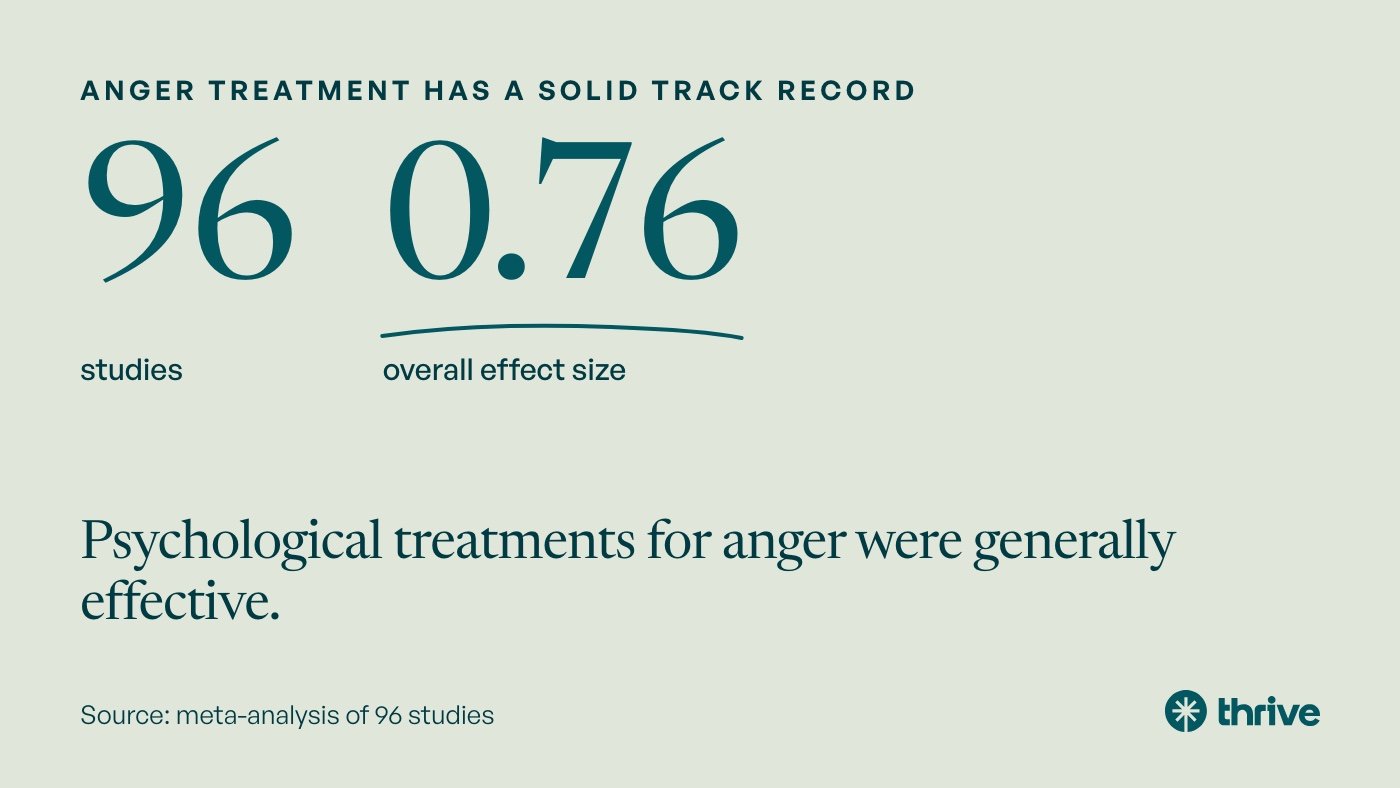
Anger treatment has a solid track record. A meta-analysis of 96 studies found psychological treatments for anger were generally effective, with an overall effect size of 0.76. A later review of meta-analyses found cognitive behavioral approaches are the most widely used, with at least moderate effects in both non-clinical and psychiatric populations.
Why calming activities beat venting
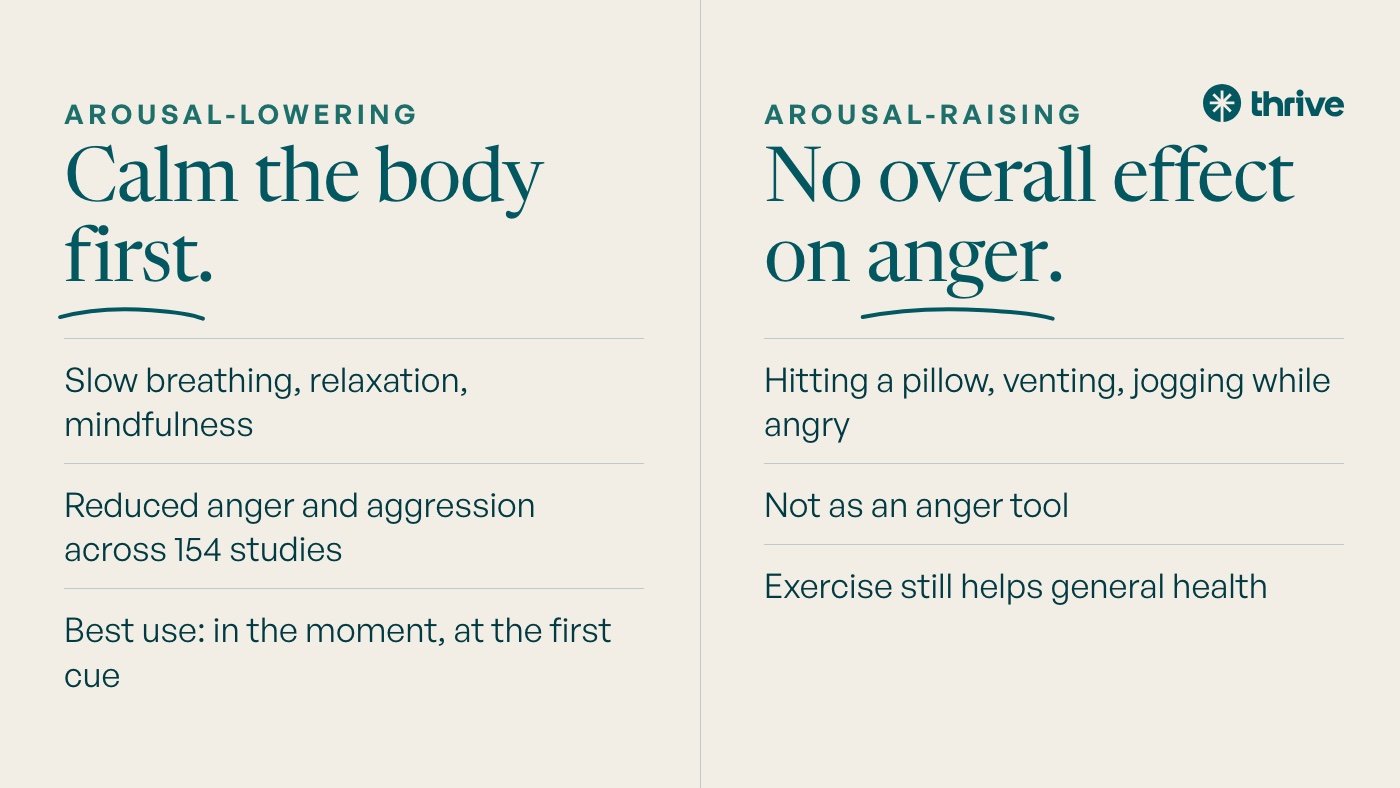
Many clients still believe anger has to come out like steam from a kettle, but the research says otherwise. A 2024 meta-analysis of 154 studies found activities that lower arousal reduced anger and aggression, in group and individual formats alike. Activities that raise arousal, like hitting a bag or going for a run, showed no overall effect.
| Approach | Examples | What the research shows | Best use |
|---|---|---|---|
| Arousal-lowering | Slow breathing, relaxation, mindfulness | Reduced anger and aggression across 154 studies | In the moment, at the first cue |
| Arousal-raising | Hitting a pillow, venting, jogging while angry | No overall effect on anger | Not as an anger tool (exercise still helps general health) |
| Relaxation training | Cue-controlled relaxation, tension release | Recommended for in-the-moment (state) anger | Early sessions, daily practice |
| Cognitive therapy | Disputing hostile thoughts, reframing | Supported for trait anger, suppressed anger, and driving anger | Between episodes, once calm |
The last two rows come from a meta-analytic review of adults with measurable anger problems. The practical order follows from both reviews: calm the body first, then work on the thoughts.
Psychoeducation activities that make anger visible
Several of these come from SAMHSA’s free, public-domain anger management participant workbook, a 12-session cognitive behavioral group curriculum.
1. Anger meter calibration. On SAMHSA’s 1 to 10 anger meter, 1 is calm and 10 is losing control, so have each member anchor a 3, a 6, and a 9 with real examples from their week. Telehealth: members type their current number in the chat at check-in.
2. Four-cue map. Members fill a four-box grid for a recent episode: physical, behavioral, emotional, and thought cues. The group then hunts for the earliest cue, because that is where intervention is cheapest.
3. The anger iceberg. Draw an iceberg with anger at the tip. Members name what sat below the waterline in their last episode, such as hurt, fear, shame, exhaustion, or feeling disrespected. The exercise reframes anger as information about what matters to the member.
4. Aggression cycle timeline. SAMHSA’s model has three phases: buildup, explosion, and aftermath. A volunteer plots a recent episode on the anger meter, and the group marks every point where an exit was possible.
5. The real cost ledger. Members list what their last blowup cost them (sleep, trust, a job, self-respect) next to what it got them. Let the gap speak for itself rather than lecturing, since clients argue with lectures and rarely with their own lists.
Body-based activities that lower arousal
6. Timeout agreement rehearsal. SAMHSA describes a formal timeout: a prearranged plan that anyone can call, with a promise to return and finish or postpone the talk. Members script the exact words and a return time, then practice calling it out loud with a partner.
7. Cue-controlled relaxation. Pair a calm word, such as “easy,” with a slow exhale and loosened shoulders, across several sessions. With daily practice between sessions, the word alone starts to bring on the relaxed state.
8. Jaw, shoulders, hands. This is a 30-second scan of the three places anger tends to hide, releasing each in turn, and it is short enough to use mid-argument. Telehealth: ask members to hold their hands up to the camera.
9. Pulse check. Members take their pulse, do two minutes of slow breathing, then take it again. Seeing a lower number on their own wrist builds buy-in faster than any explanation you could give.
10. The stroll, not the sprint. Replace “go blow off steam at the gym” with a slow walk during a timeout. Hard exercise is great for health, but it did not reduce anger in the 2024 meta-analysis.
11. Cool-down playlist. Members build a short playlist of slow, calming songs for timeouts, steering away from high-energy tracks that keep arousal up.
Cognitive restructuring activities for hostile thinking
12. A-B-C-D in real time. From the SAMHSA curriculum: activating event, belief, consequence, dispute. A volunteer names a recent trigger, and the group builds three disputes for the hottest belief. Our CBT worksheets include a thought record that works as homework.
13. Three other explanations. For any trigger, the group generates three explanations that do not involve disrespect. “He cut me off” becomes “he is late for the hospital,” and the goal is doubt, not agreement.
14. Should to prefer. Members list their “shoulds” about other people, then rewrite each as a preference, so “people should be on time” becomes “I prefer people to be on time.” Ask how each version feels in the body.
15. Cooling statement card. Each member writes three short lines to use at a 5 on the meter, such as “I don’t need to win this.” Save them as a phone lock screen.
16. The road rage scenario. Run a traffic scene through A-B-C-D as a group, since cognitive approaches have specific support for driving anger and nearly every adult has a story.
Assertiveness role-plays that replace aggression
17. Passive, aggressive, or assertive? Read nine responses to one scenario aloud, and have members sort each into a category and rewrite the aggressive ones. It is quick and low-risk, and it builds shared vocabulary.
18. Conflict Resolution Model rehearsal. SAMHSA’s five steps are to identify the problem, the feelings, and the specific impact, decide whether to resolve it, then address it. Pairs rehearse on a real, low-stakes conflict while the group observes.
19. Taking criticism without counterattack. A partner offers mild, scripted criticism, and the member acknowledges it and asks one clarifying question without defending. Debrief what the urge to defend felt like in the body.
 Hoosier Harmony Awaits with Couples Therapy in IndianaMental Health
20. Worth it or let it go. Members list ten recent irritations and sort them into “address” and “release.” This practices step four of the model, which many clients skip entirely.
Maintenance activities for the final sessions
21. Anger control plan card. Members write two lists: immediate strategies (timeout, breathing) and preventive ones (exercise, sleep, challenging old beliefs). Keep the card, or a photo of it, somewhere they will see it every day.
22. How anger worked in my family. SAMHSA devotes two sessions to anger and the family, and this exercise borrows from them. Members describe how anger was expressed growing up, then name one pattern to keep and one to change. Save this for a group with established trust.
Running anger groups over video
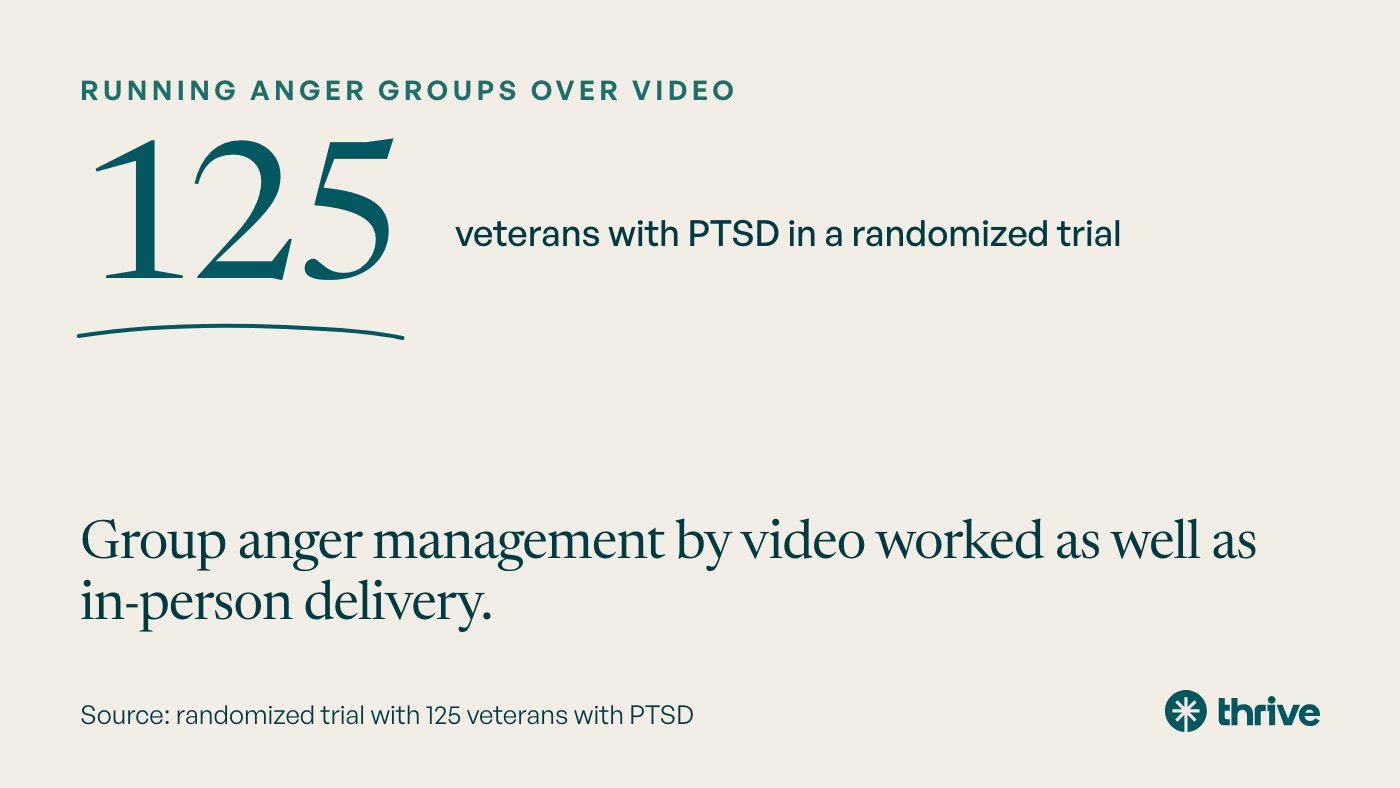
Video delivery holds up. In a randomized trial with 125 veterans with PTSD, group anger management by video worked as well as in-person delivery, meeting the trial’s test for noninferiority. A follow-up analysis of the same trial found slightly lower alliance with the group leader over video, so build it on purpose.
- Confirm each member’s location at the start of every session, along with a local emergency number.
- Run role-plays in the main room as a fishbowl rather than in unsupervised breakout rooms.
- Offer private chat for high meter readings so members can flag an 8 without saying it aloud.
- Check in by name with anyone whose camera goes off after a charged exchange.
For more on group formats, see how to start virtual group therapy and our DBT group activities for adults.
Safety notes before you start
- Screen for violence and threats. Ask directly about intimate partner violence, weapons access, and recent threats. When someone else is at risk, their safety comes first.
- Drop venting exercises. Pillow punching and rage rooms raise arousal, and the evidence does not support them.
- Look under the anger. Irritability often travels with depression, PTSD, or substance use. Our page on dual diagnosis covers co-occurring care.
- Keep the leader’s timeout. SAMHSA’s group rules let the leader call a timeout at any time. State this in session one.
- Know your state’s duty-to-warn rules, and share the 988 Suicide and Crisis Lifeline when anger turns inward.
Common questions about anger management activities for adults
How long should an adult anger management group run?
SAMHSA’s curriculum uses 12 weekly sessions. Many programs adapt that length, but a fixed arc with a graduation session helps members track progress.
Is it okay to let clients vent in session?
Telling the story is fine, but rehearsing rage is not. Research finds arousal-raising activities do not reduce anger, so steer toward calming first.
Do these activities work in individual therapy?
Yes, most translate directly, with the clinician as the role-play partner. Arousal-lowering activities worked in both group and individual formats in the 2024 meta-analysis.
What if a member escalates during a role-play?
Call a timeout, lead a brief slow-breathing reset, and debrief once the member is back near a 3, then lower the difficulty before trying again.
Can anger groups run fully online?
Yes, with a location check, a clear safety plan, and role-plays kept in the main room. A randomized trial found video delivery as effective as in-person groups.
For clinicians: when anger is a sign of something bigger
When anger sits on top of depression, trauma, or substance use, weekly groups may not be enough. An intensive outpatient program adds nine or more hours of structured care each week.
Thrive Mental Health runs adult-only virtual IOP across Florida, Indiana, Arizona, California, North Carolina, South Carolina, and Texas. We are accredited by The Joint Commission for Behavioral Health Care and Human Services, and we specialize in adults. Refer a patient here, or reach our clinical team at (561) 203-6085. Referred patients are typically assessed within days, and we coordinate care back to you at discharge.

This article is for informational purposes only and is not a substitute for individualized clinical advice or insurance verification.