






CBT (cognitive behavioral therapy) teaches you to spot unhelpful thoughts and change them, while ACT (acceptance and commitment therapy) teaches you to make room for hard thoughts and act on your values anyway. Both are evidence-based, and head-to-head trials mostly find similar results, so the better fit depends on your symptoms, your history with therapy, and how you like to work. This guide compares how each one works, what the research shows, and how the two combine inside an intensive outpatient program.
If you have already tried one approach and felt stuck, that does not mean therapy failed you. It may mean the method did not match the problem, and switching or combining approaches is common and reasonable.
This article is informational, not clinical or financial advice. Talk with a licensed clinician about which approach fits your situation.
ACT vs CBT at a glance
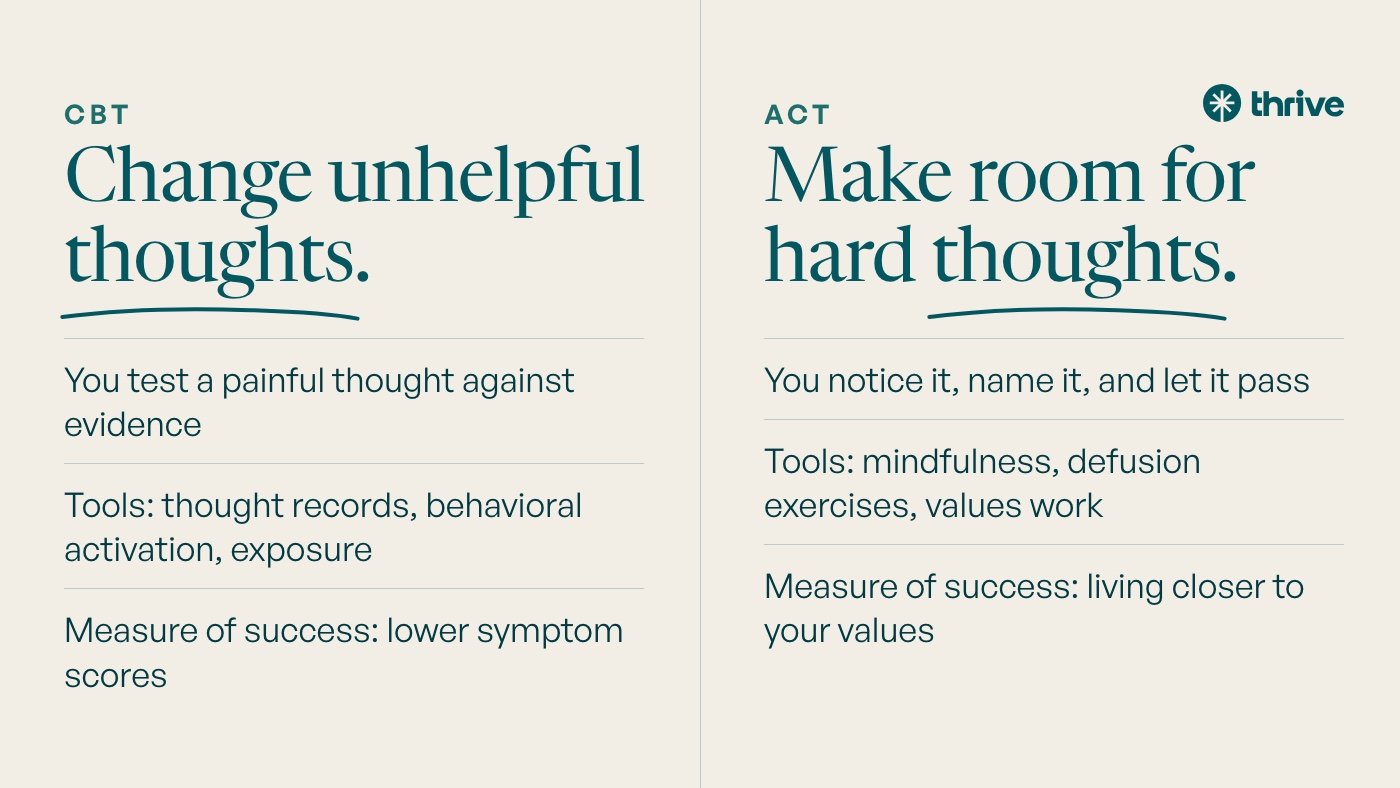
| Question | CBT | ACT |
|---|---|---|
| Core goal | Reduce symptoms by changing unhelpful thoughts and behaviors | Build psychological flexibility so symptoms get less say over your life |
| What happens to a painful thought | You test it against evidence and replace it with a more balanced one | You notice it, name it, and let it pass without arguing with it |
| Main tools | Thought records, behavioral activation, exposure, problem solving | Mindfulness, defusion exercises, values work, committed action |
| Measure of success | Lower symptom scores | Living closer to your values, even with some symptoms present |
| Strongest evidence | Anxiety disorders, depression, insomnia, stress, anger | Chronic pain, anxiety, depression, and mixed or long-standing problems |
| Structure | Highly structured, often with weekly homework | Structured but more experiential, with metaphors and exercises |
How does CBT work?
CBT starts from a simple idea: thoughts, feelings, and actions affect each other. The National Institute of Mental Health describes cognitive behavioral therapy as helping people notice inaccurate or harmful thinking habits, question them, and change self-defeating patterns. The work is active, practical, and usually time-limited.
A typical CBT course includes several of these tools:
- Thought records. You write down a trigger, the thought it sparked, and the evidence for and against that thought.
- Cognitive restructuring. You practice replacing all-or-nothing thoughts with more balanced ones.
- Behavioral activation. For depression, you schedule small, doable activities that tend to lift mood over time.
- Exposure. For anxiety, you face feared situations in planned, gradual steps.
The evidence base is large. A review of 106 meta-analyses found the strongest support for CBT in anxiety disorders, bulimia, anger control problems, and general stress, with solid support across many other conditions. You can see how we use it on our CBT in virtual IOP page.
How does ACT work?
ACT takes a different angle. It assumes some pain is part of any full life, and that the struggle to get rid of painful thoughts can keep people stuck. The goal is psychological flexibility: staying present with what you feel while still doing what matters to you. The model described by ACT’s developers rests on six skills:
- Acceptance. Making room for feelings instead of fighting them.
- Defusion. Seeing a thought as a thought, such as “I’m having the thought that I’ll fail.”
- Present-moment awareness. Mindful attention to what is happening now.
- Self-as-context. Noticing that you are more than any one thought or feeling.
- Values. Naming what you want your life to stand for.
- Committed action. Taking concrete steps toward those values.
ACT is not a fringe approach. The U.S. Department of Veterans Affairs built a national training program for ACT for depression. In its published outcomes for 745 veterans, average depression scores fell from 30 to 19 on a standard scale. That study had no control group, so it shows the approach worked in real clinics, not that it beat another therapy.
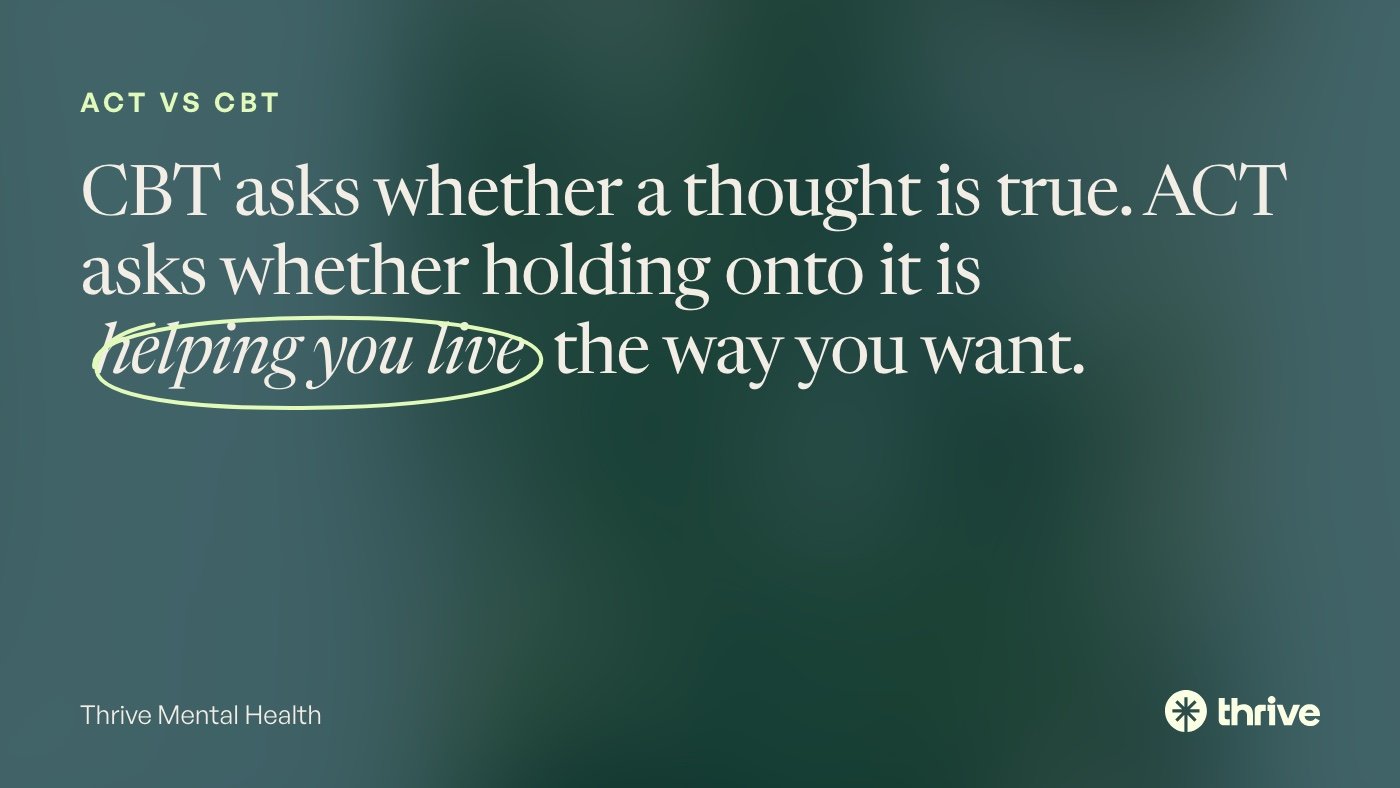
What does the research say when ACT and CBT go head to head?
The short version is that they perform about the same on average, with some differences by condition. No single study settles the question, but the pattern across several is consistent.
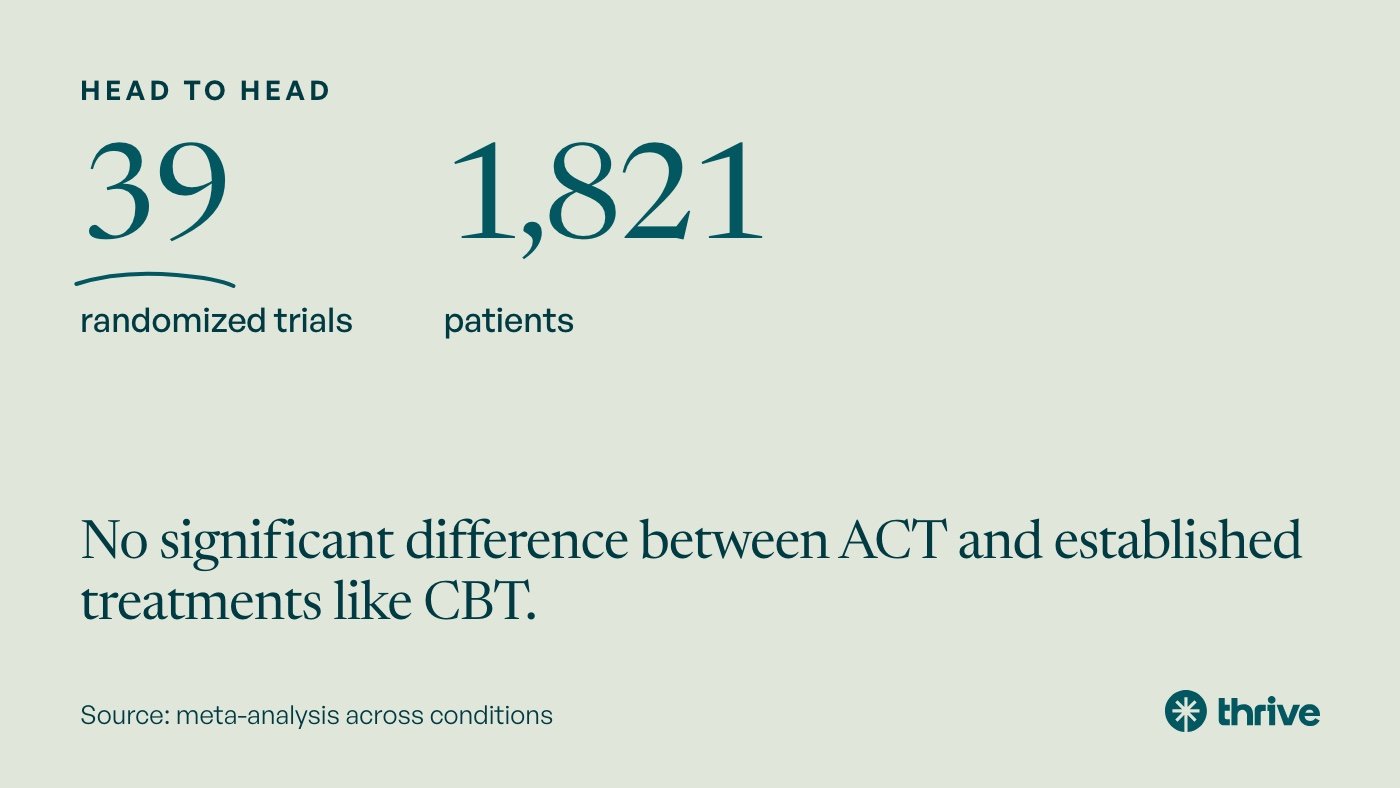
- Across conditions. A meta-analysis of 39 randomized trials with 1,821 patients found ACT beat waitlists and usual care, and found no significant difference between ACT and established treatments like CBT.
- Anxiety disorders. In a randomized trial of 128 adults with anxiety disorders, both therapies improved symptoms by a similar amount. At 12 months, ACT completers had lower clinician-rated severity, while CBT patients reported higher quality of life.
- Insomnia. A 2024 trial of 227 adults found CBT for insomnia reduced severity slightly more than ACT. By six months, response and remission rates were similar, because ACT kept making gains.
- Chronic pain. The UK’s National Institute for Health and Care Excellence recommends clinicians consider ACT or CBT for chronic primary pain in people 16 and older, treating the two as options side by side.
For most people, this means the choice is less about which therapy is stronger and more about fit. A skilled therapist delivering the approach you will actually practice matters more than the label.
Who tends to do well with CBT?
CBT often suits people who like structure and clear, measurable goals. It may be a strong first choice if any of these sound familiar:
- You have a specific, well-defined problem. Panic attacks, a phobia, or insomnia respond well to CBT’s targeted tools.
- You want to test your thoughts. Some people feel relief when they can check a fear against real evidence.
- You like homework and tracking. CBT rewards people who fill in the worksheets between sessions.
- You want symptom relief first. CBT aims straight at reducing symptom scores.
Our CBT worksheets guide shows what that between-session practice looks like.
Who tends to do well with ACT?
ACT often suits people who have spent years arguing with their own thoughts and losing. It may fit better in these situations:
- Challenging thoughts has stopped helping. If thought records turn into more rumination, defusion may work better.
- Some pain is not going away. Chronic pain, chronic illness, and grief are areas where acceptance can help more than disputing.
- You feel stuck, not just symptomatic. Values work helps people who ask, “Better for what?”
- You respond to metaphor and experience. ACT uses exercises and images more than logic.
How ACT and CBT work together in an intensive outpatient program
You do not have to pick one forever. Many clinicians blend techniques, and an intensive outpatient program (IOP) gives enough hours each week to practice more than one approach. An IOP means structured treatment several days a week, usually nine or more hours in total, while you keep living at home.

In practice, a blended plan often looks like this:
- CBT skills for acute symptoms. Exposure for panic, or behavioral activation for low mood.
- Mindfulness and acceptance skills for the rest. Tools for thoughts that keep coming back no matter how often they are challenged.
- Values work for motivation. A clear reason to keep going when progress feels slow.
At Thrive, our virtual IOP draws on CBT, dialectical behavior therapy (DBT), and mindfulness and meditation, which shares acceptance skills with ACT. Delivering this care by video is not a compromise: research on intensive treatment found telehealth outcomes comparable to in-person care for adults. If you are unsure whether you need that level of support, our guide to virtual IOP vs weekly therapy walks through the signs.
How to choose between ACT and CBT
You can use a few plain questions to narrow it down. Bring them to your first appointment.
- What is the main problem? A specific fear or sleep problem often points to CBT, while long-standing struggle or pain may point to ACT.
- What have you tried? If you did CBT and it helped, more of it is reasonable. If it felt like arguing with yourself, try ACT.
- How do you learn best? Worksheets and logic fit CBT, while exercises and metaphors fit ACT.
- Is weekly therapy enough? If symptoms are getting in the way of work or home life, ask about a higher level of care.
- Is the therapist trained in it? Ask where they trained and how often they use the approach.
If you are in crisis or thinking about suicide, call or text 988 to reach the Suicide and Crisis Lifeline right away.
Common questions about ACT vs CBT
Is ACT a type of CBT?
ACT grew out of the behavioral tradition and is often called a third-wave behavioral therapy. It shares CBT’s focus on action but handles thoughts very differently.
Which is better for anxiety, ACT or CBT?
Both work. CBT has the larger evidence base for anxiety, and a randomized trial found ACT performed about as well, with some longer-term advantages for people who finished treatment.
Which is better for depression?
CBT is a long-established option for depression, and ACT has shown real improvement in large clinical programs, including the VA. Fit and therapist skill matter more than the label for most people.
Can I do ACT and CBT at the same time?
Yes. Many therapists blend them, especially in intensive programs where there is time to practice several kinds of skills each week.
How long does each therapy take?
Both are usually structured and time-limited, but length varies with the problem and how you respond. Ask your therapist how they will track progress.
Does insurance cover ACT and CBT?
Most commercial plans cover psychotherapy, and insurers usually pay for the session rather than the specific method. Check your plan documents for copays and visit limits.
Next steps
If weekly therapy is not moving the needle, whichever method it uses, a more intensive level of care may help. Thrive Mental Health offers adult-only virtual IOP and is accredited by The Joint Commission for Behavioral Health Care and Human Services. We serve adults in Florida, Indiana, Arizona, California, North Carolina, South Carolina, and Texas. Thrive is in-network with most major insurance providers. Learn more about insurance for virtual IOP.
Verify your coverage with Thrive: free, confidential benefits check. Most members receive a summary within 24 hours, and many start the same week. Prefer to talk first? Call (561) 203-6085.

This article is for informational purposes only and is not a substitute for individualized clinical advice or insurance verification.