




Out of network mental health coverage in Indiana depends mostly on your plan type. PPO and POS plans usually pay part of the cost when you see a provider outside the network, while HMO and EPO plans usually pay nothing except in an emergency. Even when a plan pays, you often face a separate deductible, higher coinsurance, and a possible bill for the gap between the provider’s charge and what the plan allows.
This guide explains how out of network benefits work on Indiana commercial plans, what the No Surprises Act does and doesn’t cover, and the options worth asking about before you pay out of pocket.
This article is informational, not clinical or financial advice. Verify your benefits with your plan documents and, where needed, a licensed professional.
Which Indiana plans pay for out of network mental health care?
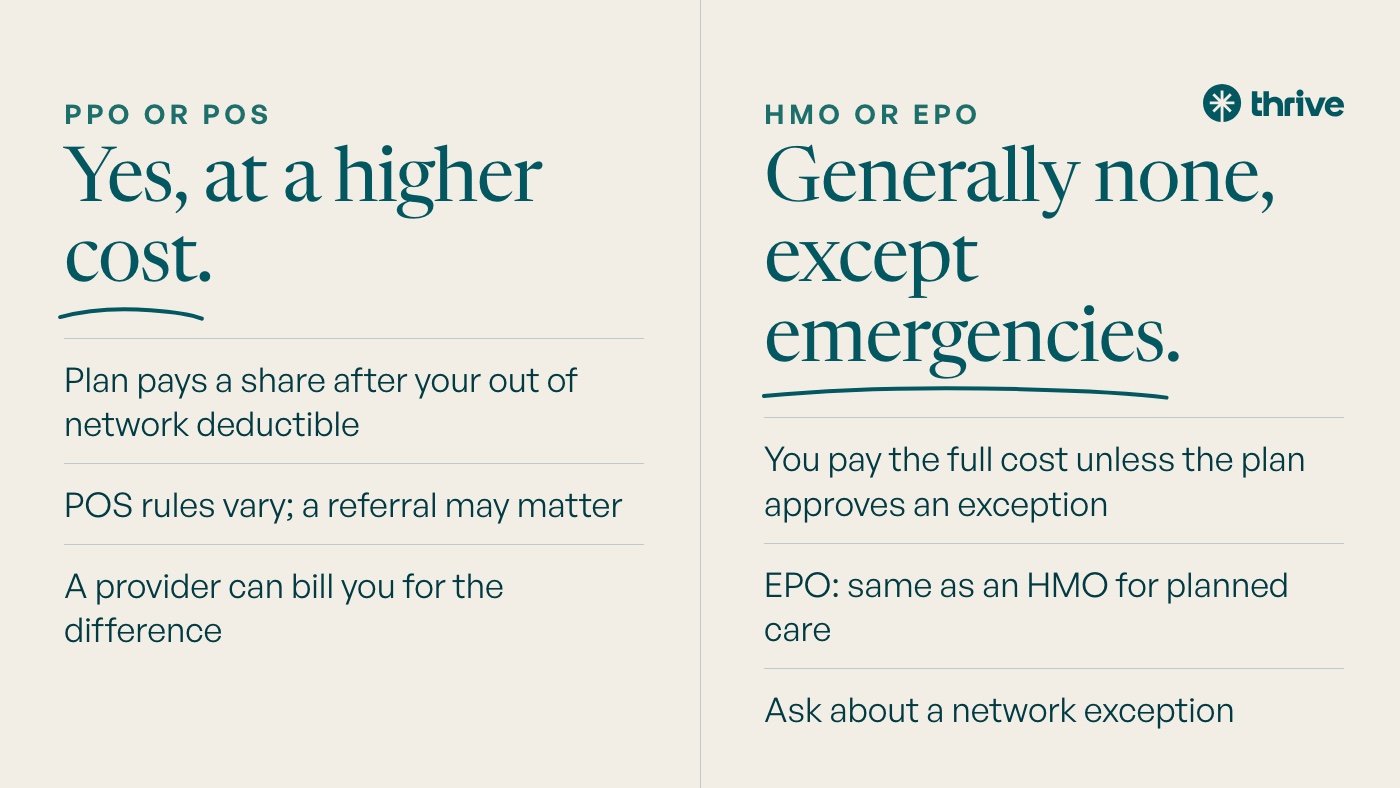
Start with the plan type printed on your card or in your Summary of Benefits and Coverage. The letters tell you most of what you need to know.
| Plan type | Out of network coverage | What it means for therapy or IOP |
|---|---|---|
| HMO | Generally none, except emergencies | You pay the full cost unless the plan approves an exception |
| EPO | Generally none, except emergencies | Same as an HMO for planned care |
| PPO | Yes, at a higher cost | Plan pays a share after your out of network deductible |
| POS | Often yes, at a higher cost | Rules vary; a referral may matter |
HealthCare.gov’s glossary backs up the basics. An HMO generally won’t cover out of network care except in an emergency. An EPO covers services only inside its network, emergencies aside. A PPO lets you go outside the network for an additional cost.
Many Indiana employers offer more than one plan from the same carrier. So two coworkers with Anthem cards may have very different out of network rights. Our guide to Anthem HMO versus PPO in Indiana walks through one example.
What will you actually pay out of network?
Out of network costs stack in layers. Knowing each layer helps you ask the right questions before care starts.
- A separate deductible. Many PPOs have one deductible for in-network care and a second, higher one for out of network care. Spending on one often doesn’t count toward the other.
- Higher coinsurance. After the deductible, you pay a larger percentage out of network than in network.
- The allowed amount. Your plan pays based on its allowed amount, the maximum it will pay for a covered service. That figure can sit well below the provider’s charge.
- The balance bill. An out of network provider can bill you for the difference between its charge and the allowed amount.
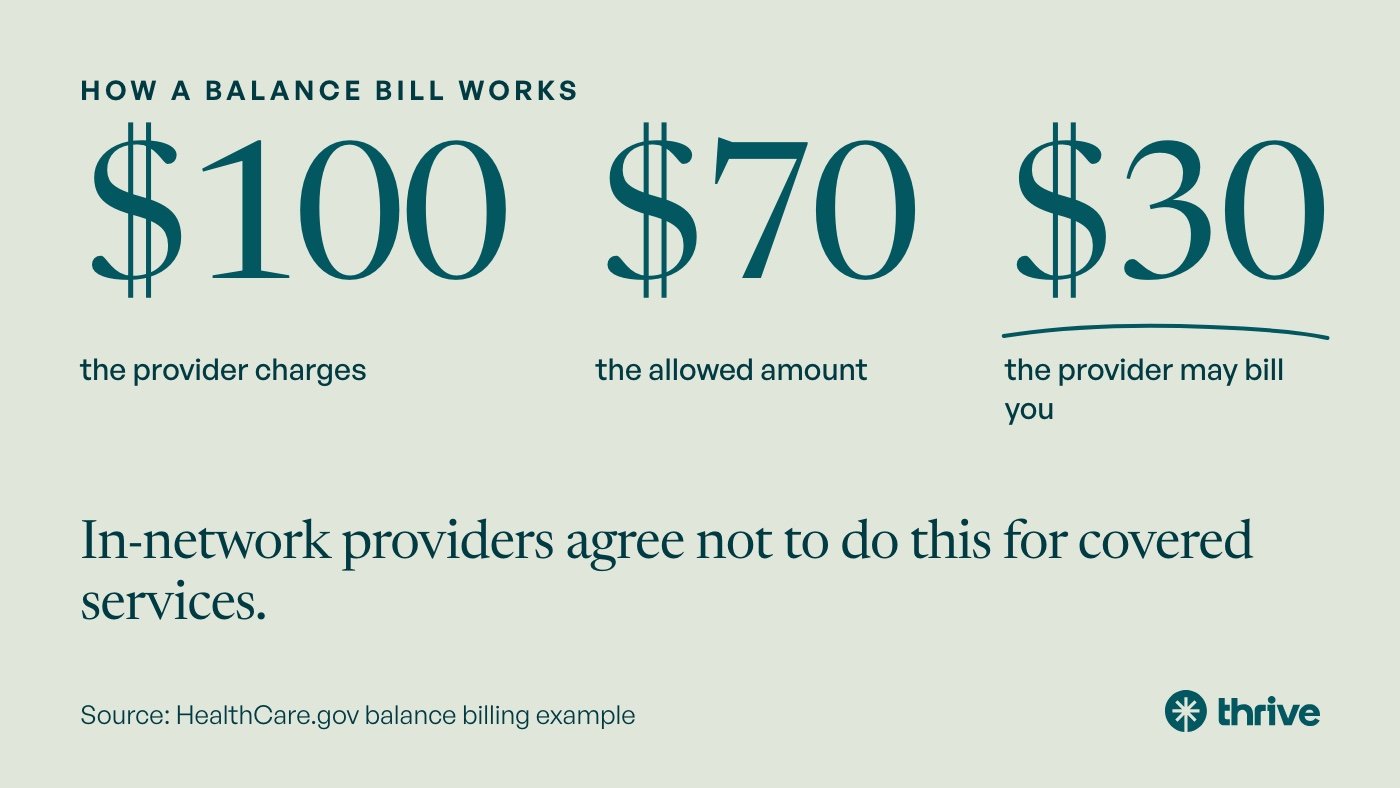
HealthCare.gov gives a simple example of balance billing. If a provider charges $100 and the allowed amount is $70, the provider may bill you the remaining $30. In-network providers agree not to do this for covered services. That is the main reason in-network care usually costs less.
Your out of network spending may also have its own out-of-pocket maximum, or none at all. Balance bills typically don’t count toward any limit. Check the “out-of-network” column of your plan summary for each of these numbers.
Does the No Surprises Act protect you?
Only in specific situations. The federal No Surprises Act took effect for plans starting in 2022. Indiana’s state guide to the No Surprises Act says it covers emergency care and non-emergency services from out of network providers at in-network facilities. The same page notes the federal government enforces it in Indiana.
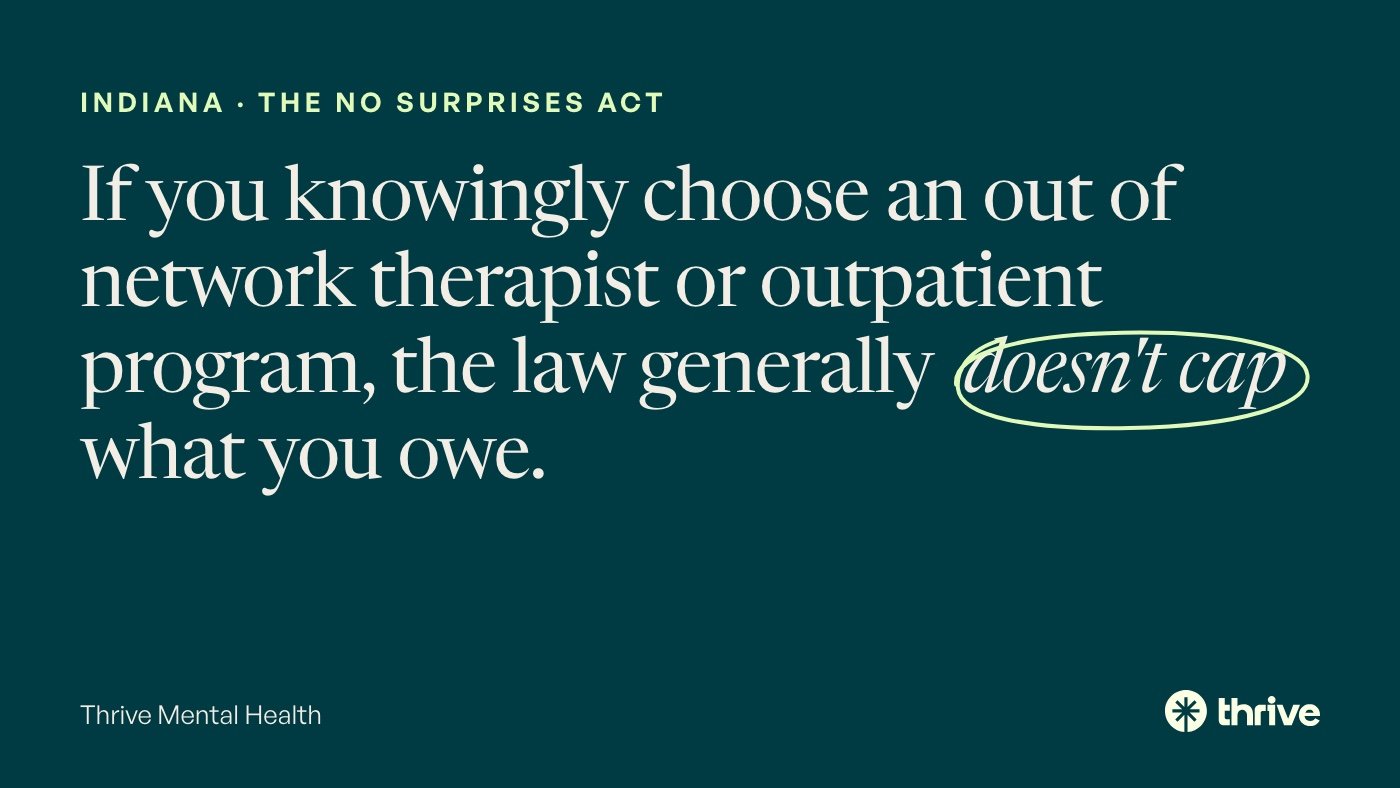
That leaves a big gap for mental health care. If you knowingly choose an out of network therapist or outpatient program, the law generally doesn’t cap what you owe. You get the plan’s out of network benefits, if any, plus any balance bill.
- Emergency mental health care is protected. You owe in-network cost sharing only.
- A planned outpatient program you choose usually isn’t protected. Ask for costs in writing before you start.
- Self-pay without insurance brings a different right. Under federal rules from CMS’s No Surprises program, uninsured and self-pay patients can get a good faith estimate before scheduled care.
Indiana’s page also points out that state surprise billing laws don’t apply to self-insured employer plans. The federal law does cover them.
Does parity law apply to out of network benefits?
Yes. The federal Mental Health Parity and Addiction Equity Act sorts benefits into groups called classifications. One of them is outpatient, out-of-network care. If a plan covers mental health care at all, it generally must cover it in each classification where it covers medical care.
Put simply, a plan with out of network benefits for medical office visits can’t drop them for therapy. It also can’t set a steeper deductible or coinsurance for out of network mental health care than for comparable medical care. Look for differences like these:
- A higher out of network coinsurance for behavioral health than for medical specialists.
- Prior authorization for out of network therapy when medical office visits don’t need it.
- A visit cap on out of network mental health care with no matching cap on medical care.
If you spot one, raise it in writing with the plan. Federal agencies paused enforcement of newer parts of a 2024 parity rule in May 2025, but the core law and older rules still apply.
What if no in-network IOP is available to you?
Sometimes the plan’s network simply has no program that fits. The nearest in-network IOP may be hours away, full, or not the right specialty. In that case, two options are worth asking about.
- A network exception. Many insurers will cover an out of network provider at in-network cost sharing when no suitable in-network option exists. Ask the plan what its process is and what proof it wants.
- A single case agreement. This is a one-time contract between the insurer and a specific provider for your care. It can set a rate and limit balance billing. The provider usually negotiates it, often with your help.
Neither is a legal right in every case, and insurers decide case by case. Ask for any approval in writing, with the dates and number of sessions it covers. Virtual care also widens your in-network choices, because location matters less. A virtual IOP licensed in Indiana can serve you anywhere in the state.
If you believe your insured plan’s network can’t reasonably serve you, the Indiana Department of Insurance accepts consumer complaints about coverage problems. Self-funded employer plans go to the U.S. Department of Labor instead, at 1-866-444-3272.
How do you file an out of network claim in Indiana?
When a provider is out of network, you usually pay up front and file the claim yourself. A clean claim gets paid faster. Ask the provider for a superbill, an itemized receipt built for insurance claims.
 Where to Find Help for PTSD: A Comprehensive Service DirectoryMental Health
- Check the superbill. It should list the provider’s name, license and tax ID, your diagnosis code, the service codes, dates, and charges.
- Get the plan’s claim form. Most carriers post it in the member portal. Some accept uploads.
- Send it promptly. Plans set a deadline for filing claims. Check your plan documents for it.
- Track the explanation of benefits. Compare the allowed amount and your share with what you expected.
- Keep copies. Save every superbill, form, and explanation of benefits in one folder.
For intensive programs, ask about prior authorization before day one. An out of network PPO benefit may still require it. Skipping it can shrink or erase what the plan pays.
What should you ask Anthem, UnitedHealthcare, Aetna, or Cigna?
Call the member services number on your card and ask these questions. Write down the date, the rep’s name, and a reference number.
- “Does my plan have out of network benefits for outpatient mental health and intensive outpatient care?”
- “What are my out of network deductible, coinsurance, and out-of-pocket maximum? How much of the deductible have I met?”
- “How do you set the allowed amount for out of network claims?”
- “Does out of network IOP need prior authorization?”
- “If no in-network program can see me soon, how do I request a network exception?”
Carrier details vary by plan, not just by company. For Indiana specifics, see our guides to Anthem BCBS in Indiana and UnitedHealthcare and Optum in Indiana.
What if your out of network claim is denied?
You can appeal. Indiana’s insurance rules call an internal appeal a grievance. The Department of Insurance’s grievance procedures page explains the internal and external steps for insured plans. HealthCare.gov’s internal appeals guide covers the federal basics. Check your plan’s denial letter for the deadline.
Read the reason closely. A denial for “no out of network benefits” is a coverage question. A denial for “not medically necessary” is a clinical question, and those often go to an independent reviewer if internal appeals fail. If you are choosing a plan for next year, our Indiana open enrollment guide covers what to compare.
Common questions about out of network mental health coverage in Indiana
Does an Indiana HMO ever pay for an out of network therapist?
Usually only in an emergency or when the plan approves an exception. Ask the plan about its exception process if no in-network option fits your needs.
Is out of network therapy always more expensive?
Usually, because of the separate deductible, higher coinsurance, and possible balance bills. A single case agreement can narrow the gap.
Does the No Surprises Act stop balance bills from my therapist?
Not when you knowingly choose an out of network provider for planned care. It mainly protects emergency care and care from out of network providers at in-network facilities.
What is a superbill?
An itemized receipt with the codes your insurer needs. You submit it with a claim form to get reimbursed for out of network care.
Can my plan charge more for out of network therapy than for out of network medical visits?
Federal parity law generally says no. Out of network mental health benefits can’t be more restrictive than comparable medical benefits.
Who do I complain to about my Indiana plan?
The Indiana Department of Insurance handles insured plans. The U.S. Department of Labor handles self-funded employer plans.
Next steps
Out of network math is easier when someone checks it for you. Thrive Mental Health is a Joint Commission accredited provider of virtual intensive outpatient care for adults in Indiana, Florida, Arizona, California, North Carolina, South Carolina, and Texas. If we are not in network with your plan, we check your out of network benefits and tell you what care would cost before you decide. If it is not a fit, we help you find a program that is. See how insurance works with Thrive.
Verify your coverage with Thrive: free, confidential benefits check. Most members receive a summary within 24 hours, and you can start as soon as you are ready. Prefer to talk first? Call (561) 203-6085.

This article is for informational purposes only and is not a substitute for individualized clinical advice or insurance verification.