






Cigna and UnitedHealthcare both cover mental health care, including virtual intensive outpatient programs (IOP), on most commercial plans. The real differences in 2026 are who manages the behavioral side, how each handles authorization for IOP, and whether you can still buy the plan next year. Cigna routes behavioral care through Evernorth, while UnitedHealthcare routes it through Optum.
If you buy your own coverage, one fact matters more than the rest. Cigna says it will no longer offer Individual and Family medical plans for 2027. Employer plans are a separate story, and we cover both below.
This article is informational, not clinical or financial advice. Verify benefits directly with your carrier and a licensed clinician before starting treatment.
Cigna vs UnitedHealthcare at a glance
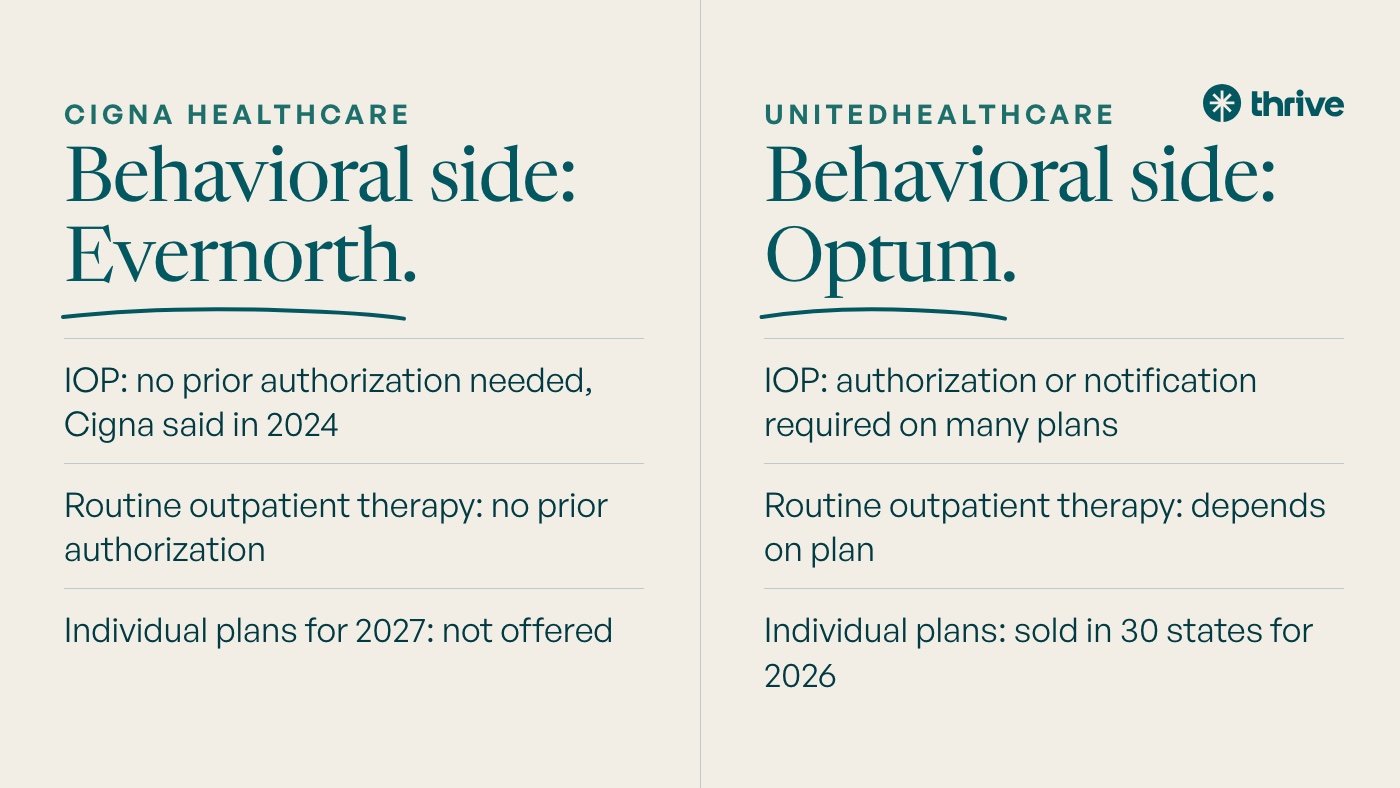
| Question | Cigna Healthcare | UnitedHealthcare |
|---|---|---|
| Parent company | The Cigna Group | UnitedHealth Group |
| Who manages behavioral health | Evernorth Behavioral Health, a Cigna Group subsidiary | Optum Behavioral Health, a UnitedHealth Group company |
| Prior authorization for IOP | Cigna said in 2024 it is no longer needed to enroll in IOP | Optum requires authorization or notification for specialty outpatient care, which includes IOP on many plans |
| Routine outpatient therapy | No prior authorization, per Cigna’s 2024 announcement | Depends on plan; check your documents |
| Individual plans for 2027 | Not offered, per Cigna | Sold in 30 states for 2026; 2027 lineup posts at open enrollment |
| Virtual IOP coverage | Covered on most commercial plans when medically necessary | Covered on most commercial plans when medically necessary |
Who actually manages your mental health benefits?
Both carriers hand mental health to a specialty company, an arrangement the industry calls a behavioral health carve-out. The company on the back of your card is not always the one that approves your therapy.
- Cigna uses Evernorth Behavioral Health. Cigna’s own behavioral health page for employers names Evernorth Behavioral Health as one of the subsidiaries that provides its services. It also lists intensive outpatient treatment among covered outpatient services.
- UnitedHealthcare uses Optum Behavioral Health. Optum runs the provider network, reviews authorizations, and operates the Provider Express site that clinicians use to request approval.
Why this matters for you: a clinician can be in network with a carrier’s medical plan and still be out of network for behavioral care. When you call, ask for the behavioral health line by name, Evernorth or Optum. That one habit prevents a lot of the surprise bills people get for therapy.
For carrier-specific detail, see our guides to Cigna virtual IOP coverage and UnitedHealthcare virtual IOP coverage.
Does either carrier require prior authorization for virtual IOP?
This is the sharpest difference between the two in 2026. Prior authorization means the plan reviews your case before care starts, which can add days to your wait.
In June 2024, The Cigna Group said it had removed prior authorization for routine outpatient mental health care. It also said prior authorization is no longer needed to enroll patients in intensive outpatient programs. Self-funded employer plans can set their own rules, so confirm yours still follows that policy.
Optum takes a different approach, and its provider site states that plans it administers require authorization or notification for specialty outpatient services. IOP usually falls in that group, and the program you choose normally handles the request for you.
UnitedHealthcare’s Gold Card program lets qualifying behavioral providers skip medical necessity review for IOP starting October 1, 2026. Those providers file a shorter advance notification instead, so ask any program you’re considering whether it qualifies.
What both carriers have to cover under parity law
Neither carrier gets to treat mental health as second class. The federal Mental Health Parity and Addiction Equity Act requires plans to cover mental health much like medical care. That rule reaches copays, deductibles, visit limits, and the approval steps a plan puts in front of care.
Marketplace plans add another layer, because HealthCare.gov lists mental health and substance use services as essential health benefits. Those plans can’t set yearly or lifetime dollar limits on them.
IOP sits between weekly therapy and hospital care, and SAMHSA’s treatment protocol on intensive outpatient care describes structured treatment several days a week while you live at home. A 2022 study in the Journal of Psychiatric Research found telehealth and in-person intensive care produced similar drops in depression symptoms. You can read more about the level of care on our intensive outpatient program page.
The need is real: NIMH estimates 23.1% of American adults lived with a mental illness in 2022, and only about half of them received treatment that year.
Buying your own plan? Cigna’s 2027 exit changes the math
If you get coverage through work, you can skip ahead, because this section is for people who buy a plan on HealthCare.gov or directly from a carrier.
Cigna’s shopping page says it will no longer offer Individual and Family medical plans for 2027. It sold them in 11 states in 2026, so members in those states will need a new plan for January.
UnitedHealthcare went the other way for 2026 and announced Individual Exchange plans in 30 states, with expanded service areas in 11 of them. Its 2027 plans will show up on the marketplace when shopping opens.
| State | Cigna individual plans, 2026 | UnitedHealthcare exchange plans, 2026 |
|---|---|---|
| Florida | Sold in 11 counties, including Miami-Dade, Broward, Palm Beach, and Orange | Offered |
| Indiana | Sold in 15 counties, including Marion, Hamilton, and Vanderburgh | Offered |
| Arizona | Sold in Maricopa, Pima, and Yavapai counties | Offered, with an expanded service area |
| 2027 | No individual medical plans | Check HealthCare.gov after November 1 |
County lists come from Cigna’s 2026 footprint flyer. Open enrollment for 2027 plans runs November 1, 2026 to January 15, 2027. Per HealthCare.gov’s deadlines page, enroll by December 15 for coverage that starts January 1.
If you’re already in treatment, ask your program which 2027 plans it’s in network with before you pick one. A plan switch in the middle of treatment is manageable when you plan it ahead.
Florida, Indiana, and Arizona: what changes by state
Your carrier’s national policies apply everywhere, but networks, plan designs, and regulators are local.

- Florida. Networks differ by county. Compare their Florida networks in our Cigna behavioral health Florida guide and UnitedHealthcare Florida guide. For complaints, Florida’s Division of Consumer Services takes insurance questions.
- Indiana. Cigna’s 2026 individual plans cover central and southwest Indiana counties. Our Cigna Indiana virtual IOP guide has the details. The Indiana Department of Insurance handles plan complaints.
- Arizona. Cigna’s individual footprint is three counties, so many Arizonans only see UnitedHealthcare on the marketplace. See our UnitedHealthcare Arizona coverage guide. The Arizona Department of Insurance and Financial Institutions is the regulator.
For virtual care, licensure matters more than office locations. The treating clinician generally needs a license in the state where you are during sessions.
Which carrier fits which situation
- You need to start IOP soon: Cigna’s no-authorization policy for IOP can shorten the wait. With UnitedHealthcare, ask whether the program is a Gold Card provider.
- Your employer offers both: compare the behavioral deductible, coinsurance, and out-of-pocket maximum side by side. Those numbers move your costs more than the logo does.
- You buy your own plan and have Cigna now: plan to switch during open enrollment. Check which 2027 plans your current clinicians accept first.
- You already have a program you trust: its network status with Evernorth or Optum should drive the choice.
The five questions to ask on one call
Call the behavioral health number on your card, not the general line. Ask these in order:
- “Does my plan cover virtual intensive outpatient programs for mental health?”
- “Is my behavioral benefit managed by Evernorth or Optum?”
- “Is prior authorization or notification required for IOP on my plan?”
- “What is my deductible, and how much have I met this year?”
- “What coinsurance or copay applies, and can I get a reference number for this call?”
Write down the date, the representative’s name, and the reference number. If a claim is questioned later, that record gives you and your provider something concrete to point to. A program’s admissions team can also run this check for you.
Common questions about Cigna vs UnitedHealthcare mental health coverage
Is Cigna or UnitedHealthcare better for mental health?
Neither one wins everywhere. Cigna has a simpler path into IOP because it dropped prior authorization in 2024. UnitedHealthcare offers its national Optum network and sells individual plans in more states for 2026. In the end, your own plan’s cost sharing usually decides which is better for you.
Does Cigna require prior authorization for IOP?
The Cigna Group said in 2024 that prior authorization is no longer needed to enroll patients in intensive outpatient programs. Self-funded employer plans can differ, so confirm with Evernorth.
Does UnitedHealthcare cover virtual IOP?
Yes, on most commercial plans when a clinician documents medical necessity. Optum usually requires authorization or notification first, and the program typically files it.
Is Evernorth the same as Cigna?
Evernorth Behavioral Health is part of The Cigna Group, and it manages the behavioral network and reviews for Cigna members. Your plan is still a Cigna plan.
What happens to my Cigna individual plan in 2027?
Cigna says it won’t offer Individual and Family medical plans for 2027. Choose a new plan between November 1, 2026 and January 15, 2027, and enroll by December 15 for January 1 coverage.
Can I switch carriers in the middle of treatment?
Usually only at open enrollment or after a qualifying life event. If you switch, ask your program which new plans it accepts so your care isn’t interrupted.
Next steps
If you have Cigna or UnitedHealthcare and weekly therapy isn’t enough, get a benefits check for your exact plan first. Thrive Mental Health is a Joint Commission accredited provider of virtual IOP for adults. We serve Florida, Indiana, Arizona, California, North Carolina, South Carolina, and Texas. Our IOP is nine or more hours of structured care a week.
Verify your coverage with Thrive: free, confidential benefits check. Most members get a summary within 24 hours, and many start the same week. Prefer to talk first? Call (561) 203-6085.

This article is for informational purposes only and is not a substitute for individualized clinical advice or insurance verification.