






Most people return to work after IOP in stages: a set start date, lighter hours or duties for the first few weeks, and outpatient care that keeps going after the program ends. The smoothest returns are planned with your treatment team before discharge, so your first week back already has a shape. This guide covers how to tell if you are ready, what a gradual return looks like, what to say to your manager, and which workplace rights apply.
Some people take leave during an intensive outpatient program (IOP). Others keep working part of the week and scale back up afterward. Either way, the same questions come up: how fast, how much to share, and what to do if things start slipping.
This article is informational, not clinical, legal, or financial advice. Talk with your treatment team, your HR department, or an employment attorney about your specific situation.
How do you know you are ready to go back?
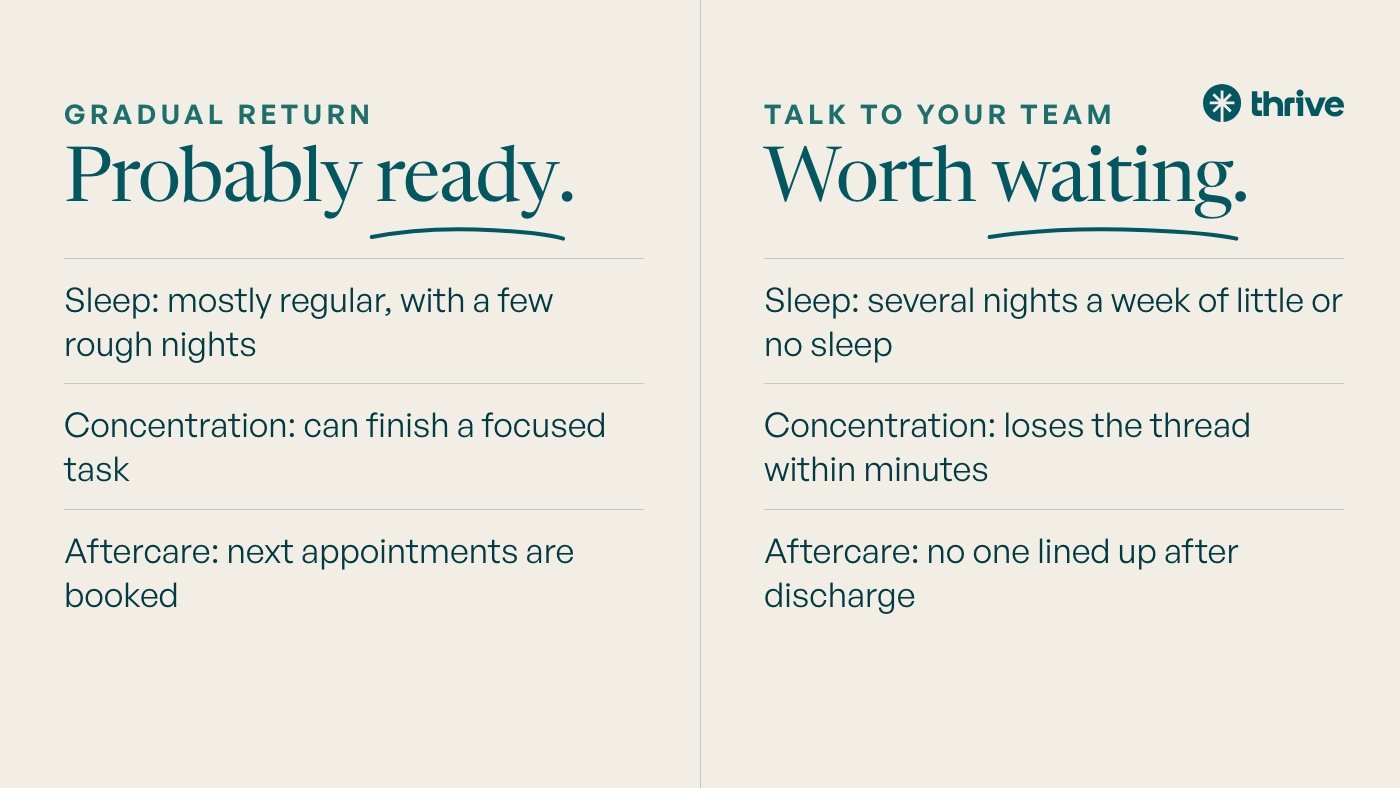
Readiness is less about feeling fully recovered and more about having enough stability to handle a normal workday. Your treatment team can help you judge this, because they have watched your symptoms week to week. Programs that use measurement-based care, like ours, track symptom scores through treatment, which gives you something firmer than a gut feeling.
Signs you are likely ready to start a return plan:
- Your sleep is fairly steady. Not perfect, but predictable enough to wake up for work most days.
- You can focus for a few hours at a stretch. Reading, planning, or problem-solving no longer falls apart after twenty minutes.
- You have used your coping skills under stress. You have tested them on a hard day, not only in session.
- You have an aftercare plan. You know who you will see after IOP ends and how often.
- Thinking about work brings nerves, not dread. Some anxiety about returning is normal and expected.
| Area | Probably ready for a gradual return | Worth waiting or talking to your team first |
|---|---|---|
| Sleep | Mostly regular, with a few rough nights | Several nights a week of little or no sleep |
| Concentration | Can finish a focused task | Loses the thread within minutes |
| Mood | Low days pass within a day or two | Low mood most of the day, most days |
| Safety | No thoughts of self-harm, or a clear safety plan your team knows about | New or worsening thoughts of self-harm |
| Aftercare | Next appointments are booked | No one lined up after discharge |
If you are in the right-hand column, that does not mean you have failed. It means the plan needs another week or two, or a different level of support.
What does a gradual return to work look like?
A phased return means you rebuild hours or duties over a few weeks instead of going straight back to your full load. The evidence favors pairing work changes with ongoing clinical care, rather than relying on either one alone. The World Health Organization describes return-to-work programmes as a mix of work-directed steps, like reasonable accommodations or phased re-entry, and continued treatment.
Research backs that combination. A 2020 Cochrane review of return-to-work interventions for depression found that combining a work-directed step with a clinical one probably reduces sick days. It also found improved clinical care, on its own, probably lowers sickness absence and depression levels compared with usual care.
Here is one example of a four-week phased plan. Yours will depend on your job, your symptoms, and what your employer can offer.
- Week 1: half days, familiar tasks. Catch up on email, meet with your manager, and pick up work you know well. Skip big deadlines.
- Week 2: longer days, one new responsibility. Add a meeting-heavy day or a project you paused. Keep your therapy appointment protected.
- Week 3: close to full hours. Test a normal week with some slack built in. Notice which parts drain you most.
- Week 4: review. Meet with your manager or HR to decide whether to go to full duties or extend the phase-in.
What should you tell your manager?
You can usually keep your diagnosis private. According to the U.S. Equal Employment Opportunity Commission, an employer can ask medical questions only in limited situations, such as when you request an accommodation. If you do share medical information, the employer must keep it confidential, even from co-workers.
Most people find it helps to separate what each person needs to know:
| Who | What they usually need | What you can keep private |
|---|---|---|
| HR or a leave administrator | Leave dates, any required paperwork, accommodation requests | Session content and therapy details |
| Your manager | Your start date, schedule, and any changes to duties | Your diagnosis and treatment |
| Co-workers | That you are back and how to reach you | Everything else |
A short script for your manager can sound like this: “I’m glad to be back. I dealt with a health issue and I’m on a plan to ramp back up over the next few weeks. Here’s what my schedule looks like, and I’ll check in with you at the end of week two.” That is a complete answer, and you do not owe anyone more.
For co-workers who ask where you were, “I was out on medical leave, and I’m doing better, thanks” works well. Say it the same way each time and move on to work.
Which accommodations help most after IOP?
The Americans with Disabilities Act (ADA) requires covered employers to provide reasonable accommodations. A reasonable accommodation is a change to how or when you work that helps you do your job, as long as it does not cause the employer undue hardship. Mental health conditions such as depression, anxiety, and PTSD can qualify.
The Job Accommodation Network, a free service funded by the U.S. Department of Labor, lists accommodation ideas for mental health conditions. These are the ones most relevant after intensive treatment:
- A flexible or modified schedule. Useful for keeping weekly therapy or a step-down group on the calendar.
- Periodic rest breaks. A few minutes to reset during a long day.
- Telework for part of the week. Cuts commute stress while you rebuild stamina.
- Changes in supervision. Written instructions, regular one-on-ones, or clearer priorities.
- A quiet workspace. Fewer interruptions when concentration is still coming back.
To ask, tell your manager or HR that you need a change at work because of a medical condition. The EEOC notes you do not need special words and you do not need a specific accommodation in mind. Your employer may ask for a note from your provider. Your treatment team can usually write one that describes your limits and needs without listing your diagnosis.
What if your employer asks for a doctor’s note to come back?
This depends on why and how you took leave. If your time off was FMLA leave for your own health condition, federal rules allow an employer to require a fitness-for-duty certification, but only under a policy that applies to everyone in a similar situation. Under 29 CFR 825.312, the note can only address the condition you took leave for. The employer must tell you ahead of time if the note needs to cover specific job duties.
A few details from that rule are worth knowing:
- No second opinions. Your employer cannot require a second or third opinion on a fitness-for-duty note.
- Intermittent leave is different. An employer is not entitled to a new note for each intermittent absence.
- You usually pay for it. The cost of the certification falls on the employee, so ask your provider in advance.
Outside of FMLA, the EEOC’s guidance on medical inquiries of employees says questions after medical leave must be limited to what is needed to judge your current ability to work. If you have not set up your leave yet, our guide to FMLA and virtual IOP covers eligibility and paperwork.
 Beyond the Screen: Navigating Virtual Behavioral CareMental Health
How do you keep treatment going once you are back at work?
Finishing IOP is a step down in intensity, not the end of care. Most people move to weekly therapy, a lighter group schedule, medication follow-up, or some mix of the three. The key is booking those appointments before your first day back, when your calendar is still open.
Think about timing. Evening or early-morning sessions protect your workday. A lunch-hour video session can work if you have a private space. If you need regular time off for appointments, that can be part of an accommodation request.
At Thrive, discharge includes a personalized plan with local resources, and our wraparound care adds alumni and group events and a 24/7 crisis line. For more on the handoff, see what happens after IOP and our guide to discharge planning from virtual IOP.
What warning signs at work mean you need more support?
Work tends to show early signs of a setback before you notice them anywhere else. Catching a slide in week two is far easier than recovering from one in month three. The National Institute of Mental Health lists trouble concentrating, fatigue, sleep changes, and loss of interest among common depression symptoms. At work, those often look like this:
- You reread the same email three times and still cannot answer it.
- You start avoiding meetings or calls you used to handle easily.
- Sunday night dread returns and lasts into the week.
- You skip therapy because work feels too busy.
- Irritability spikes with co-workers or at home after work.
- Old coping habits creep back, like drinking more to wind down.
If two or more of these last longer than a week or two, tell your therapist. You might add sessions, adjust your schedule at work, or go back to a more intensive level of care for a short time. Stepping back up for a while is a normal part of treatment.
If you ever have thoughts of harming yourself, call or text 988, the Suicide and Crisis Lifeline, any time.
Common questions about returning to work after IOP
How long after IOP should I wait to go back to work?
There is no set waiting period. Many people plan a start date with their treatment team near discharge, and some keep working through IOP. The right timing depends on your symptoms, your job, and your aftercare plan.
Do I have to tell my boss I was in an intensive outpatient program?
No. You can say you were on medical leave. Employers can ask medical questions only in limited cases, such as when you request an accommodation, and must keep that information confidential.
Can I ask to come back part time?
Yes. A modified or part-time schedule is a common reasonable accommodation under the ADA. Ask HR in writing and include a note from your provider if they request one.
Can my employer make me get a doctor’s note before I return?
Sometimes. After FMLA leave for your own condition, an employer with a uniform policy can require a fitness-for-duty certification limited to that condition. Other medical questions must stick to your current ability to do the job.
What if I start struggling again after a few weeks back?
Tell your therapist early. Options include more frequent sessions, a schedule change at work, or a short return to a more intensive level of care.
Will going back to work undo my progress?
Not usually. Work often adds structure and purpose that support recovery. The risk rises when people return at full speed without aftercare, which is why a phased plan and continued treatment matter.
Next steps
If you are still deciding whether you need an IOP, or you want a program that fits around a job, start with the facts about your coverage. Thrive Mental Health is a Joint Commission accredited provider of virtual IOP for adults, with nine or more hours of structured care a week and flexible scheduling that includes evening and weekend options. We serve adults in Florida, Indiana, Arizona, California, North Carolina, South Carolina, and Texas.
Verify your coverage with Thrive: free, confidential benefits check. Most members receive a summary within 24 hours, and many start the same week. Prefer to talk first? Call (561) 203-6085.

This article is for informational purposes only and is not a substitute for individualized clinical advice or insurance verification.


