






The best group therapy topics for adults are concrete enough to answer in one sentence and open enough to get members talking to each other. Below are 40 topics we use in adult groups, sorted into six themes (coping, relationships, identity, work stress, grief, and self-esteem), each with an opening prompt in quotes and a one-line facilitation note. They are written for clinicians and facilitators, and every prompt works on video.
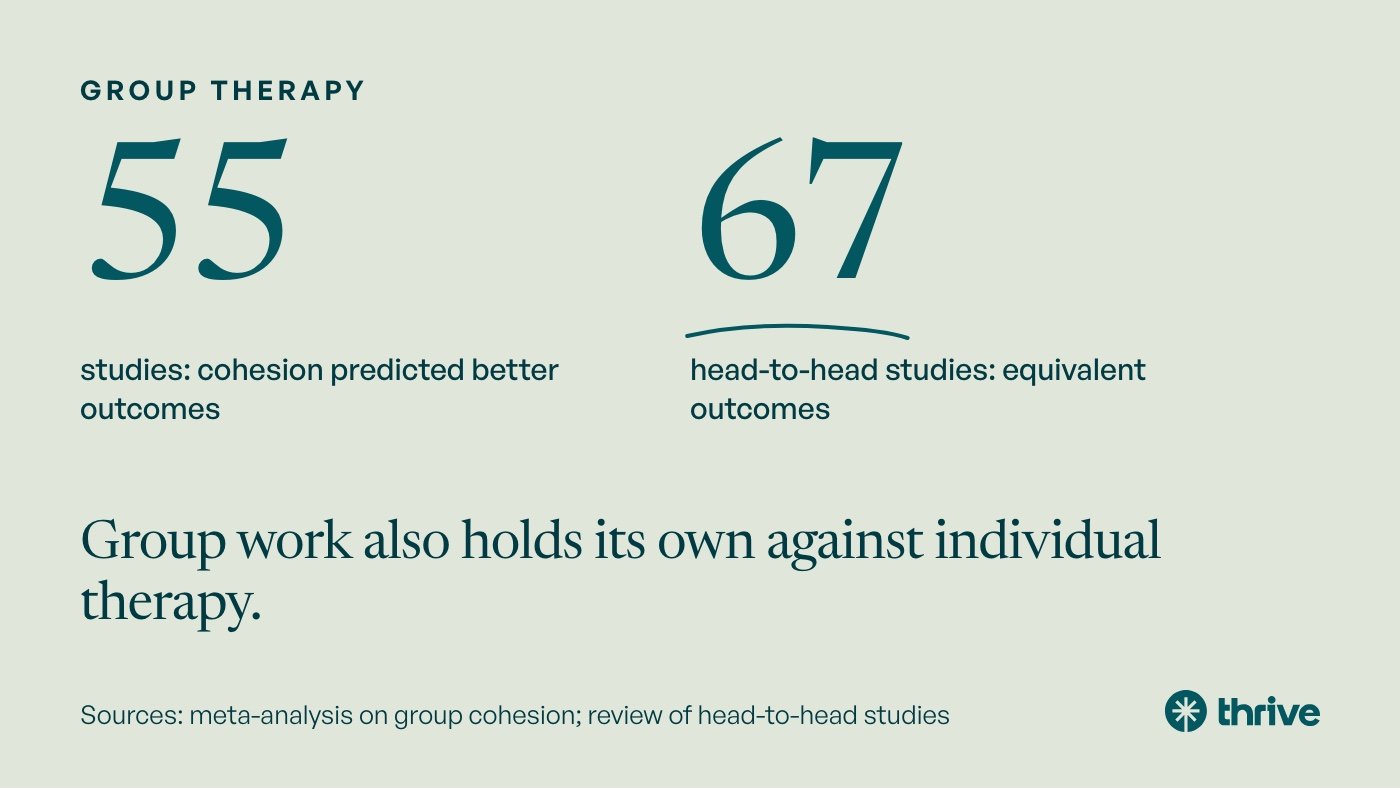
A topic is only the vehicle; the real goal is members responding to each other instead of to you. In a meta-analysis of 55 studies on group cohesion, cohesion predicted better outcomes, and the link was stronger when leaders built it on purpose and emphasized member interaction.
Which coping and stress topics open a group up quickly?
1. My early warning signs. “What is the first sign that your stress is building?” List answers where all can see, and members will spot shared signs themselves.
2. Coping that stopped working. “What used to help you that doesn’t anymore?” Frame old strategies as having made sense at the time, which keeps shame out of the room.
3. Relief tonight, cost next week. “What do you do that helps in the moment but costs you later?” Stay descriptive, then share our guide to healthy and unhealthy coping as a handout.
4. The hardest hour. “Which hour of your day is hardest, and why that one?” Unlike “how was your week,” it yields something to plan around.
5. Asking for help. “What makes asking for help harder than it should be?” Expect burden and pride, and reflect them back to the group instead of answering each one.
6. Rest or hiding? “How do you tell the difference between resting and avoiding?” The group usually builds better criteria than any handout.
7. One small plan. “What stressor this week could you plan for today?” It ends the theme on action.
What relationship topics work without forcing disclosure?
8. Roles I play. “Are you usually the fixer, the joker, the listener, or the peacekeeper?” Then ask whether that role is showing up here, today.
9. The conversation I keep avoiding. “Without names, what conversation have you been putting off?” Keep it at the level of pattern and save scripting for a skills session.
10. How conflict looked growing up. “How did the adults in your home handle disagreement?” This one goes deep, so hold it for a group that has met several times.
11. Lonely in a full life. “When do you feel lonely even with people around?” A meta-analysis of 148 studies tied stronger social relationships to a 50% higher likelihood of survival.
12. What a real apology sounds like. “Describe an apology that actually worked on you.” Useful right before members attempt a repair at home.
13. Giving and taking. “Where do you give more than you get, or the reverse?” If members rush to reassure, slow the group down.
14. Something that stayed with me. “What did someone in this group say that stuck with you?” This shifts the group from talking about relationships to having one.
Which identity and values topics go beyond the diagnosis?
15. More than the reason I’m here. “What should we know about you that has nothing to do with treatment?” Strong early, because it builds the “we” before clinical content.
16. Values in action. “When did you last act on something you care about?” The gap between value and action is the material.
17. Who I was before. “What part of yourself do you miss?” It can touch grief, so watch affect closely.
18. Labels I carry. “What label has someone given you that you disagree with?” Let the group test the label against what they have seen.
19. What my family taught me about help. “What did your family or community believe about getting mental health care?” Let members be the experts on their own culture.
20. A year from now. “What would you like to be true twelve months from today?” A forward-looking close.
How do you run work stress and burnout topics?
The World Health Organization estimates that 12 billion working days are lost every year to depression and anxiety worldwide.
21. When the workweek starts. “When does Monday start in your head?” Light enough for a first session.
22. After-hours rules. “What is your rule, spoken or not, about messages after work?” Members often realize they have no rule at all.
23. Without the job title. “If your title disappeared tomorrow, what would be left?” Check in afterward with members who are on leave.
24. What I’ve told work. “What have you told your employer, and how did you decide?” Keep it to experiences and route legal questions elsewhere.
25. Good enough. “Where does ‘good enough’ scare you?” Ask what the fear predicts will happen.
26. The critic at the desk. “Whose voice judges your work when no one is watching?” Pairs well with topic 34 in a later session.
27. Going back. “What would make returning to work easier, and what are you dreading?” Useful for members stepping down from a higher level of care.
How do you handle grief and loss topics safely?
The American Psychiatric Association estimates that 4% to 15% of bereaved adults develop prolonged grief disorder, which in adults requires a loss at least a year old. If a member’s grief looks stuck, follow up one-on-one.
28. Losses nobody noticed. “What loss have you had that others didn’t treat as a loss?” Divorce, a lost job, health, and estrangement all count.
29. What I still carry. “What object, habit, or phrase do you still carry from someone you lost?” Concrete objects make hard feelings easier to speak.
30. The hard dates. “Which dates are hardest, and how do you get through them?” Close with each member naming one plan for the next one.
31. Grief and anger. “What are you angry about in your grief?” Give explicit permission, since many adults believe anger means they are grieving wrong.
32. What helped, what hurt. “What did someone say that helped, and what made it worse?” The group ends up writing its own guide to support.
33. How the bond continues. “How is your relationship with that person still going?” Avoid pushing “closure,” which many members find alienating.
 Your Schedule, Your Health: Finding Flexible Mental Health Support in St. PeteMental Health
What self-esteem topics get past the inner critic?
34. The critic’s greatest hits. “What does your inner critic say most often?” Have members read the line aloud in a flat, bored voice to get some distance from it.
35. The evidence file. “What did you do well this week that your critic would dismiss?” Push for specifics, because “I was fine” does not count.
36. Comparison traps. “Who do you compare yourself to, and what does the comparison leave out?” Steer past social media toward the members’ own lives.
37. Taking a compliment. “What do you do when someone compliments you?” Practice live: one member gives a specific compliment, and the other may only say thank you.
38. What I’d tell a friend. “What would you say to a friend in your exact situation?” Then ask why that answer doesn’t apply to them.
39. The mistake I still punish. “What mistake do you keep making yourself pay for?” Save it for a later stage and protect time to close it well.
40. Proof of change. “What can you do now that you couldn’t when you started this group?” Built for final sessions and graduations.
How do you match a topic to the group’s stage?
Depth should follow trust. SAMHSA’s treatment protocol on group therapy (TIP 41) sets out phase-specific tasks for leaders and separates fixed groups from revolving-membership groups. Most adult IOP groups are revolving, so re-check depth whenever someone joins.
| Group stage | What members need | Topics that fit | Your focus as leader |
|---|---|---|---|
| First sessions, or a new member joins | Safety and predictability | 1, 4, 15, 21 | Model the first answer and keep turns short |
| Working phase | Connection and challenge | 5, 8, 9, 25, 34 | Link one member’s answer to another’s |
| Established group | Depth and honesty | 10, 17, 31, 39 | Process what is happening in the room |
| Closing sessions | Consolidation | 20, 33, 40 | Name progress and plan next steps |
Your bond with each member matters as much as the room’s. A 2026 meta-analysis of alliance and cohesion found both uniquely predicted outcome, at statistically indistinguishable strength. Group work also holds its own against individual therapy: a review of 67 head-to-head studies found equivalent outcomes.
How do you run topic discussions in a virtual room?
A systematic review of 40 studies found video groups feasible, with outcomes similar to in-person groups. Alliance dipped slightly where it was measured, so build connection on purpose.
- Name the speaking order. Silence feels longer on video, and a named order removes the guessing.
- Use a chat waterfall for risky prompts. Everyone types, then hits enter together, so nobody goes first.
- Bridge answers out loud. On camera, members miss the nods that link them in person, so say the link yourself.
- Check privacy at the start. Ask members to confirm they can speak freely before any grief or family topic.
For openers, use our group therapy icebreakers for adults, and for skills sessions, see DBT group activities for adults.
Common questions about group therapy topics for adults
How many topics should one session cover?
Usually one, since a single well-chosen prompt can carry 30 to 45 minutes if you bridge answers between members.
Should members choose the topics?
Choose for them early on, then let the group vote from a short menu once cohesion forms.
What if a topic falls flat?
Name it lightly and ask what would make it more useful, because that question often becomes the better topic.
How do I keep one member from taking over?
Use a named speaking order and short turns, then redirect warmly: “Hold that thought. How is this landing for others?”
Are grief and family topics safe for mixed groups?
Yes, with sequencing: save them for sessions after trust has formed, and screen for recent losses first.
For clinicians: when a member needs more than a weekly group
Some members need more than a weekly group, because the days between sessions keep undoing the progress. That is the gap an intensive outpatient program fills, with nine or more hours of structured care each week.
Thrive Mental Health runs adult-only virtual IOP across Florida, Indiana, Arizona, California, North Carolina, South Carolina, and Texas. We are accredited by The Joint Commission for Behavioral Health Care and Human Services, and we specialize in adults. Refer a patient here, or reach our clinical team at (561) 203-6085. Referred patients are typically assessed within days, and we coordinate care back to you at discharge.

This article is for informational purposes only and is not a substitute for individualized clinical advice or insurance verification.