





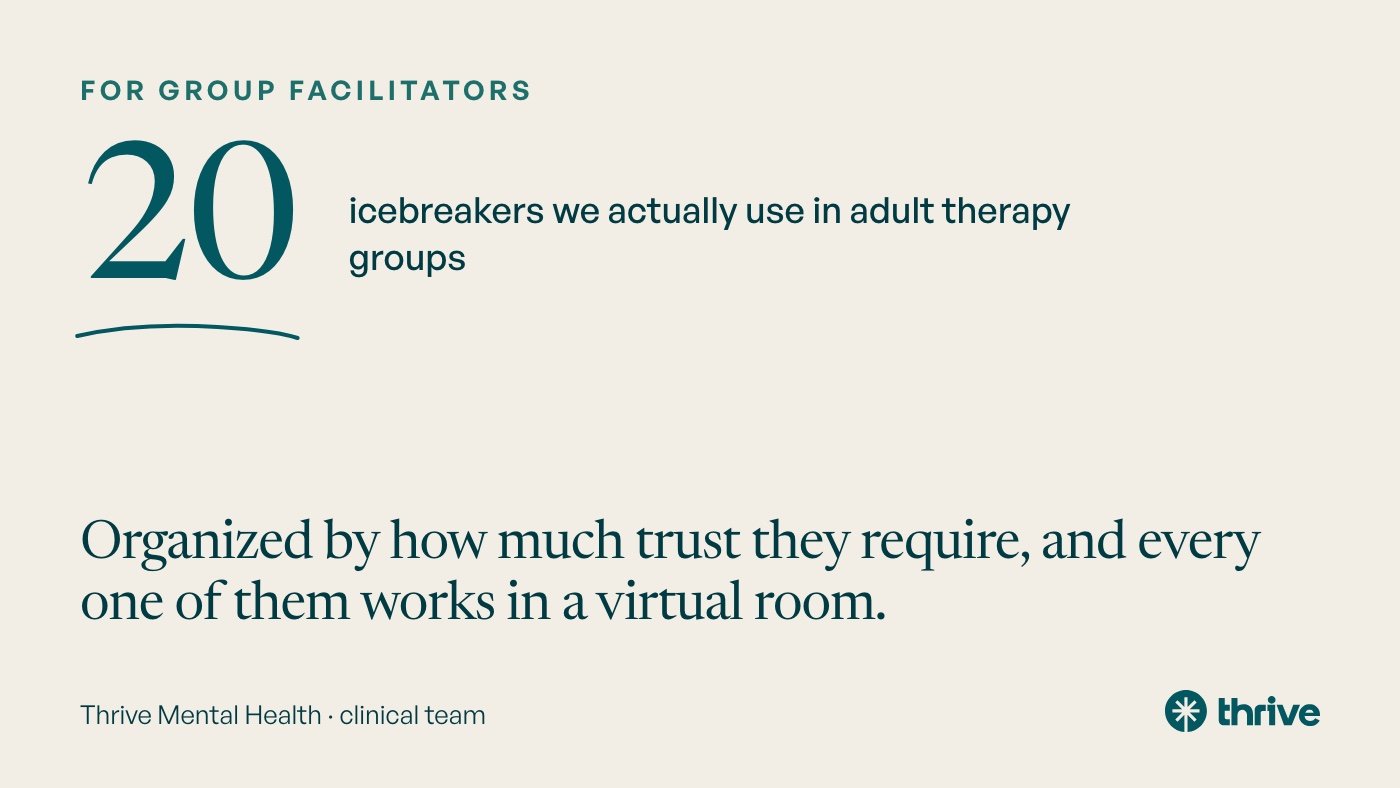
The best group therapy icebreakers for adults lower anxiety without demanding vulnerability the group has not earned yet. Below are 20 icebreakers we actually use in adult therapy groups, organized by how much trust they require, with facilitation notes and telehealth adaptations. They are written for clinicians, group facilitators, and program staff, and every one of them works in a virtual room.
Icebreakers are not filler. Early comfort predicts retention, and connectedness is measurable treatment leverage: a meta-analysis of 55 studies found group cohesion relates to outcomes at nearly the strength of the therapeutic alliance in individual therapy. The first ten minutes of a new group are where cohesion starts or stalls.
Ground rules that make icebreakers therapeutic
- Nothing diagnostic in round one. Early prompts should be answerable by any adult without disclosing why they are in treatment.
- Model first, then invite. The facilitator always answers the prompt first, briefly and honestly. It calibrates depth and shrinks the risk of going first.
- Pass is always allowed. Announce it every time. Choice is what makes participation meaningful.
- Debrief in one line. “What was it like to do that?” turns a game into group process without belaboring it.
Low-risk openers (session one, or any new member)
1. Two truths and a preference. A gentler cousin of two-truths-and-a-lie: two true facts plus one preference (“I would always pick mountains over beach”). No deception element, which suits therapy settings better.
2. The unremarkable favorite. Share a favorite completely ordinary thing: a mug, a road, a sandwich. Low stakes, surprisingly revealing, and reliably funny.
3. Common ground hunt. In pairs or as a whole group, find three things members share that have nothing to do with treatment. Builds the “we” before any clinical content.
4. One-word weather report. Each member describes their current internal state as weather (“partly cloudy,” “fog lifting”). Introduces feeling-talk with a built-in metaphor shield. Works as a standing check-in ritual for the life of the group.
5. Desert island, three items. A survival item, an entertainment item, a luxury item. Old for a reason: everyone has an answer and answers spark conversation.
6. Name story. “What is the story behind your first name, or a nickname?” Personal without being clinical, and it helps names stick, which matters for cohesion.
Medium-trust builders (weeks two through four)
7. The advice I would give my younger self. One sentence, any age. Signals reflection without requiring disclosure of what prompted it.
8. Proud-of-this-week round. One small win since last session, defined loosely. Trains the group to notice progress, which most members’ attention filters delete.
9. Playlist question. “What song do you play when you need to reset?” Collect answers into a shared group playlist over the weeks. Telehealth: drop titles in the chat; the facilitator compiles.
10. The skill I fake well. Members name something they appear confident doing but find hard. A first, structured step into imperfection talk.
11. Values card sort, lightning round. Read ten values aloud; members claim the one that fits them best this month and say why in a sentence. Surfaces motivation material clinicians can use for months.
12. Gratitude with a twist. Name something you are grateful for that cost nothing. Positive-affect openers shift group tone measurably, and the constraint keeps answers fresh.
Movement and creativity options
13. Line-up without words. Members order themselves by birthday month using only gestures. Laughter plus cooperation, no disclosure. Telehealth: type your month in chat simultaneously on a count of three, then sort verbally.
14. Draw your morning. Ninety seconds to sketch this morning in stick figures, then a one-line caption. No art skill required; see our art therapy group activities for deeper creative work once the group is warm.
15. Object show-and-tell. Bring or grab one object within arm’s reach that says something about your week. Native to telehealth, where every member sits in their own environment full of props.
16. Box-breathing together. One minute of guided box breathing as the opener. Not a conversation starter; a nervous-system starter. Pairs well with any prompt that follows and introduces skills culture from day one.
Openers for hard days and returning groups
17. Rose, thorn, bud. One good thing, one hard thing, one thing you are looking forward to. The most durable check-in format we know; it survives years of weekly use.
 Virtual IOP for Eating Disorders: Therapy Without the Waiting RoomMental Health
18. Percent battery. “What is your battery percentage today, and one thing that charges you?” Fast, quantified, and it flags depleted members for the facilitator without singling anyone out.
19. Question in a hat. Members submit anonymous light questions week one; each session opens by drawing one. The group interviews itself, and anonymity keeps the floor level. Telehealth: collect via private chat messages to the host.
20. The re-introduction. Mid-cycle, members reintroduce themselves as if new, including one thing the group still does not know. Refreshes cohesion when attendance has churned.
Facilitation notes, especially for virtual groups
- Keep openers under ten minutes total. The icebreaker serves the session, not the reverse.
- Name the order in telehealth rounds. “Maria, then James, then Priya.” Silence ambiguity is the number one killer of virtual participation.
- Use the chat deliberately. Simultaneous chat answers (“everyone type on three”) equalize airtime and delight groups.
- Watch for members who always pass. Two passes is a preference; five is a conversation to have individually, kindly.
Structured group work rests on solid evidence: the American Psychological Association’s review of the group therapy literature finds group treatment as effective as individual therapy across most conditions, and intensive virtual group treatment shows outcomes comparable to in-person care. SAMHSA’s Treatment Improvement Protocol on intensive outpatient treatment treats well-run groups as the backbone of the IOP level of care. For skills-module formats to run after the ice is broken, see our DBT group activities for adults.
Common questions about group therapy icebreakers
Do adults actually need icebreakers, or is that a teen thing?
Adults need them more, in our experience. Adult clients arrive with more social armor and more fear of judgment, and structured low-stakes openers dissolve both faster than waiting.
How long should an icebreaker take?
Five to ten minutes including debrief. If it regularly runs longer, the group loves it; rotate it into a ritual and shorten the rest.
What if someone refuses to participate?
Honor the pass immediately and move on. Follow up individually only if passing becomes a pattern across weeks.
Which icebreakers work best over video?
Object show-and-tell, chat-based simultaneous answers, weather reports, and battery percentage. Anything that uses the member’s own environment turns telehealth from a limitation into material.
Can icebreakers harm group process?
Only when they demand more vulnerability than the group has earned or when they eat clinical time. Sequence by trust level and keep them short.
For clinicians: when a client needs more than a weekly group
If a group member’s symptoms are outpacing what weekly sessions can hold, the next step on the continuum is an intensive outpatient program: nine-plus structured hours a week built around exactly this kind of group work.
Thrive Mental Health runs adult-only virtual IOP across Florida, Indiana, Arizona, California, North Carolina, South Carolina, and Texas. We are accredited by The Joint Commission for Behavioral Health Care and Human Services, and we treat adults exclusively. Refer a patient here, or reach the clinical team at (561) 203-6085. We assess referred patients quickly and coordinate care back to you at discharge.

This article is for informational purposes only and is not a substitute for individualized clinical advice or insurance verification.