



Use your Employee Assistance Program (EAP) for fast, free, short-term counseling, and use your health insurance for ongoing therapy or more intensive care like an intensive outpatient program (IOP). Most people with both benefits can use both, and federal rules generally stop an EAP from being a hurdle you have to clear before your health plan pays. The right choice depends on how long your symptoms have lasted and how much they’re getting in the way.
An EAP is a quick, private front door with a short hallway. Your health plan is the building behind it, with room for longer care. This guide shows when each one fits and how to move from one to the other without losing momentum.
This article is informational, not clinical or financial advice. Verify benefits directly with your employer, your carrier, and a licensed clinician before starting treatment.
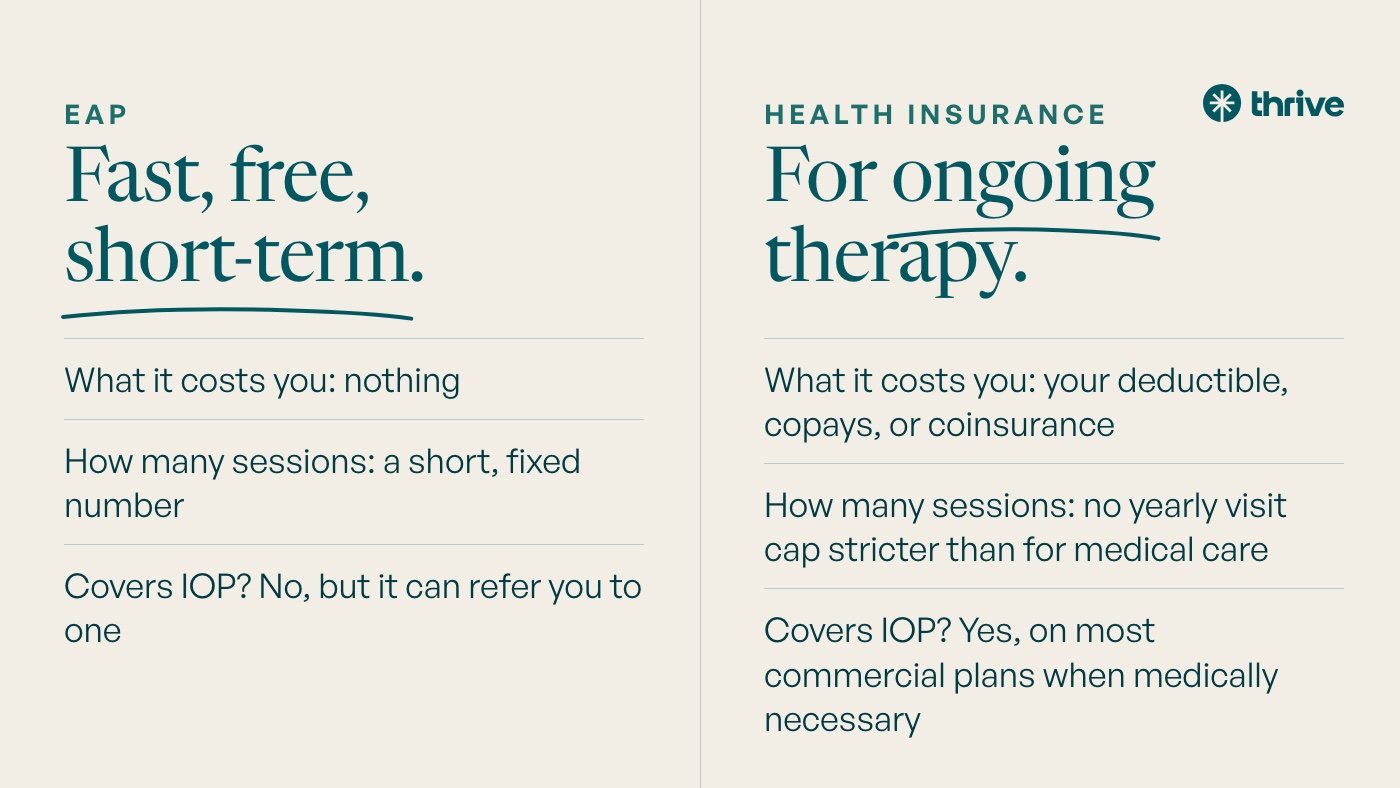
EAP vs health insurance for therapy at a glance
| Question | Employee Assistance Program | Health insurance |
|---|---|---|
| What it costs you | Nothing: no premium and no cost sharing | Your deductible, copays, or coinsurance |
| How many sessions | A short, fixed number set by your employer’s program | No yearly visit cap stricter than for medical care |
| Diagnosis needed? | Usually not | Usually yes, to bill the plan |
| Who you see | An EAP counselor, often for assessment and referral | Any in-network therapist, psychiatrist, or program |
| Covers IOP? | No, but it can refer you to one | Yes, on most commercial plans when medically necessary |
| Best for | A recent, specific problem you want help with fast | Symptoms that have lasted months or keep coming back |
What an EAP is, and what it isn’t
The U.S. Office of Personnel Management defines an EAP as a voluntary, work-based program with free and confidential assessments, short-term counseling, referrals, and follow-up. It’s a benefit your employer pays for, and it sits outside your health plan. People use it for stress, grief, family strain, substance use concerns, and work problems.
Federal rules explain why an EAP is free at the point of use. For an EAP to stay separate from your health plan, the federal excepted benefits rule sets four conditions:
- No significant medical care. The program can’t provide significant benefits in the nature of medical care, judged by the amount, scope, and length of services.
- Not a gatekeeper. You can’t be required to use up EAP benefits before your group health plan covers you.
- No premiums. You don’t pay anything to join.
- No cost sharing. No copays, coinsurance, or deductibles for EAP services.
That first condition is the key limit. An EAP is built to be brief, so it isn’t designed to carry you through months of treatment.
How many sessions does an EAP actually cover?
Each employer’s program sets its own number, so check your plan summary or ask HR. For federal agencies, OPM’s guide to EAPs describes brief counseling as roughly 1 to 6 sessions. It adds that agency philosophy or budget often sets the number.
The same guide covers what happens when you need more. If counseling is needed beyond the sessions provided, the EAP counselor is expected to refer you out and help connect you with the new clinician. That handoff is one of the most useful things an EAP does.
Research hints at the same limit. A 2024 study in the Journal of Occupational Health Psychology found EAP counseling improved health-related productivity at work at 4 weeks and 6 months. In an exploratory analysis, people who needed many sessions early on had worse productivity outcomes, which suggests the brief model fits some problems better than others.
Is EAP counseling confidential from your employer?
EAPs are designed to be confidential, and that is a big part of why people trust them. OPM describes EAP services as free and confidential. Its guide also says federal EAP clients get a written statement at the first session describing the limits of confidentiality.
Ask for that statement, or ask the counselor to explain the limits, before you share details. Private employers often contract with outside EAP vendors, and the specifics live in that vendor’s policies. A good counselor will walk you through them without hesitation.
Using your health plan is private too, since claims go between your provider and your insurer rather than through your manager. If privacy at work is on your mind, our guide to confidential online mental health care covers more questions people ask.
When the EAP is the right first step
An EAP works best when the problem is recent, specific, and you want help this week without touching your deductible. Good fits include:
- A new stressor: a breakup, a loss, a hard stretch at work, or a family change.
- Not sure where to start: an EAP counselor can assess what’s going on and point you to the right level of care.
- Cost is a barrier right now: EAP sessions carry no cost sharing, so they won’t eat into your deductible.
- You want a referral you can trust: the counselor can help you find in-network help for longer care.
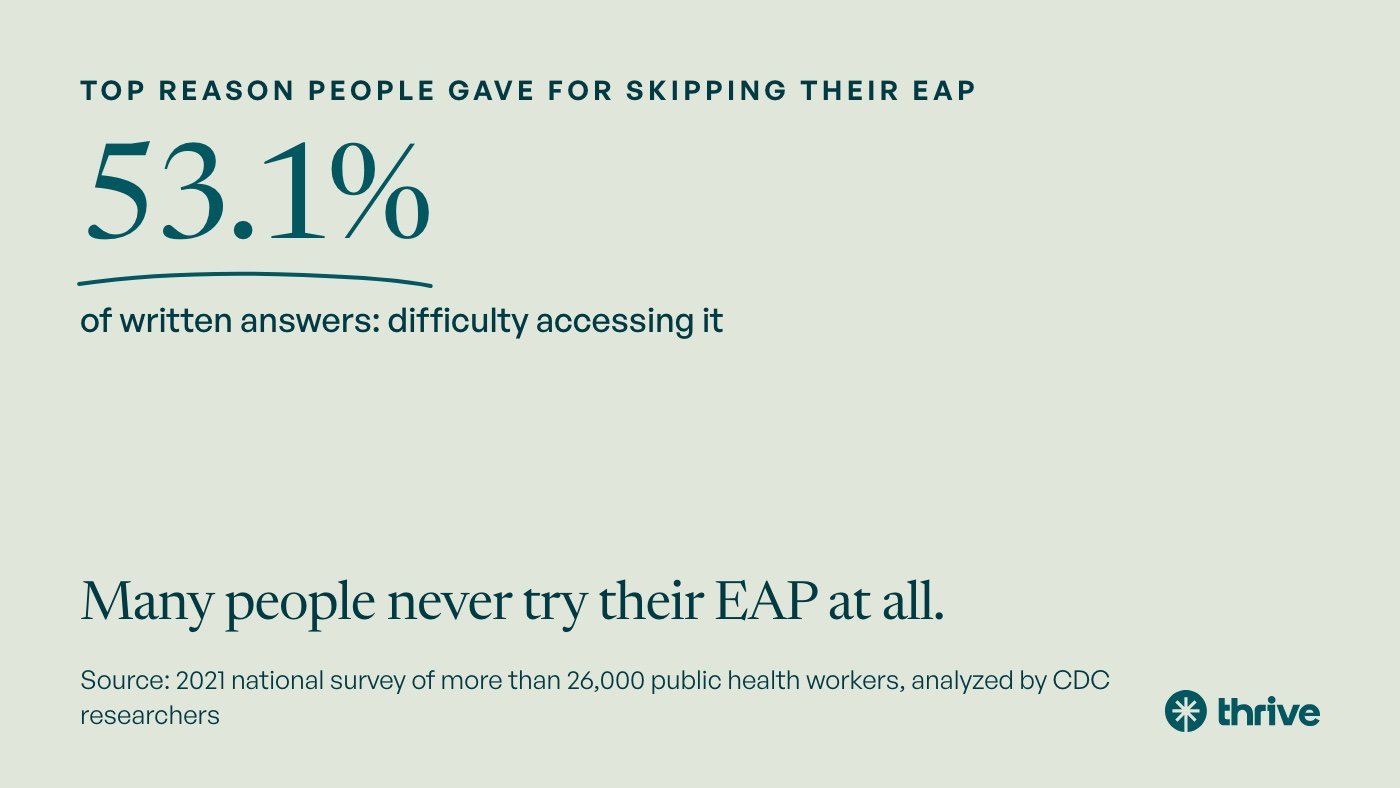
Many people never try their EAP at all. In a 2021 national survey of more than 26,000 public health workers, analyzed by CDC researchers, the top reason people gave for skipping their EAP was difficulty accessing it, at 53.1% of written answers. If yours feels hard to reach, ask HR for the direct phone number and the vendor’s name.
When you need your health insurance instead
Some situations call for more than a handful of sessions. Go straight to your health plan when symptoms have lasted for months, keep coming back, or are making it hard to work, sleep, or keep up at home. You may also need it when weekly therapy hasn’t been enough.
Your health plan has protections an EAP doesn’t. Under the federal Mental Health Parity and Addiction Equity Act, mental health benefits can’t be more restrictive than comparable medical benefits. Marketplace plans must also cover mental health services as essential health benefits, with no yearly or lifetime dollar limits.
Insurance is also how most people reach higher levels of care. IOP means structured treatment several days a week while you keep living at home, as SAMHSA’s intensive outpatient treatment protocol describes. Our virtual IOP vs weekly therapy guide explains how to tell which one you need.
You wouldn’t be alone in needing it. NIMH estimates 23.1% of American adults lived with a mental illness in 2022, and only about half received treatment that year.
 Finding Your Way: Best Mental Health Programs for Young AdultsMental Health
Do you have to use your EAP before your insurance?
Generally, no. Under the federal excepted benefits rule, a standalone EAP can’t require you to use up its sessions before your group health plan covers care. You can go straight to an in-network therapist or program if that’s what you need.
You also don’t have to choose one forever. Plenty of people start with the EAP, then move to insurance-covered care when the sessions run out. Others use the EAP for a spouse or a specific stressor while their main treatment runs through the health plan.
How to use both without losing momentum
The gap between the last EAP session and the first insurance-covered one is where people stall. Plan the handoff early:
- Call the EAP and ask how many sessions you get and whether they reset each year or per issue.
- At your first session, ask for an assessment of your level of care. The counselor may suggest weekly therapy or something more intensive.
- Before your last EAP session, ask for referrals to in-network clinicians or programs.
- Call the behavioral health number on your insurance card to confirm coverage, your deductible, and any prior authorization for IOP.
- Sort out time off if you need it. Our guide to FMLA intermittent leave and virtual IOP explains how people protect their job during treatment.
Employers can make this easier too. Our piece on adding virtual IOP to a company EAP shows how some teams connect the two benefits.
Common questions about EAP vs health insurance for therapy
Is it better to use my EAP or my insurance for therapy?
Use the EAP for a recent, specific problem and quick, free support. Use your insurance when symptoms have lasted months, keep returning, or need weekly therapy or IOP.
Does using my EAP affect my health insurance deductible?
Generally, no. EAP services have no cost sharing and sit outside your health plan, so they don’t count toward or use up your deductible.
Will my employer know I used the EAP?
EAPs are designed to be confidential. Ask the counselor to explain the limits of confidentiality at your first session, since each program spells them out in writing.
How many free sessions does an EAP give?
It depends on your employer’s program. OPM’s guide for federal EAPs describes roughly 1 to 6 sessions, and private programs set their own numbers.
Do I have to use my EAP before my insurance will cover therapy?
Generally, no. Federal rules say a standalone EAP can’t require you to use up its sessions before your group health plan covers care.
Can an EAP refer me to an intensive outpatient program?
Yes. Referral is a core EAP service, and counselors can point you toward IOP when brief counseling isn’t enough. Your health insurance then typically covers the program when it’s medically necessary.
Next steps
If your EAP sessions are running out, or weekly therapy isn’t enough, check what your health plan covers before you decide anything. Thrive Mental Health is a Joint Commission accredited provider of virtual IOP for adults, with nine or more hours of structured care a week. We serve Florida, Indiana, Arizona, California, North Carolina, South Carolina, and Texas, and we work with commercial insurance.
Verify your coverage with Thrive: free, confidential benefits check. Most members get a summary within 24 hours, and many start the same week. Prefer to talk first? Call (561) 203-6085.

This article is for informational purposes only and is not a substitute for individualized clinical advice or insurance verification.