




Understanding Compulsions: When Behaviors Take Control
Compulsions are repetitive behaviors or mental acts that people feel driven to perform, often in response to distressing thoughts or to prevent feared outcomes. Unlike habits or preferences, compulsions are time-consuming, cause significant distress, and interfere with daily activities, yet people feel unable to stop them.
Quick Answer: What Are Compulsions?
- Repetitive behaviors or mental acts performed to reduce anxiety
- Feel “driven” to perform them, not by choice
- Time-consuming (often over 1 hour daily)
- Cause distress and interfere with life
- Temporary relief but anxiety returns
- Different from habits, compulsions feel urgent and distressing
Whether it’s washing hands until they’re raw, checking the stove dozens of times, or mentally repeating phrases to “cancel out” disturbing thoughts, compulsions create a cycle that can feel impossible to break. The relief they provide is only temporary, leading to more anxiety and more compulsive behaviors.
For many Floridians, compulsions can make an already demanding schedule feel overwhelming. You might find yourself running late because you had to check your work email 15 times, or struggling to focus during important meetings because intrusive thoughts demand mental rituals.
The good news? Compulsions are highly treatable with the right approach. Understanding what drives these behaviors is the first step toward breaking free from their grip.
I’m Dr. Ryan, a licensed psychologist at The Psychology Group, where I’ve spent years helping people in Fort Lauderdale and across Florida understand and overcome compulsions through evidence-based treatment approaches. My experience in behavioral health has shown me that with proper support, people can regain control over these challenging behaviors and get back to living their lives fully.
Key compulsions vocabulary:
Defining Compulsions: More Than Just a Habit
When we talk about compulsions, we’re often talking within the context of Obsessive-Compulsive Disorder (OCD), where they are a core symptom. In OCD, compulsions are repetitive behaviors or mental acts that a person feels driven to perform in response to an obsession. They are not done for pleasure or gratification, but rather to prevent or reduce distress, or to prevent some dreaded event or situation. The relief they offer is only temporary.
The American Psychological Association defines a compulsion as “a repetitive, intentional, and seemingly purposeful behavior or mental act performed in response to an obsession or according to rigidly applied rules, that the individual feels driven to perform in order to reduce anxiety or distress or to prevent some dreaded event or situation; however, these behaviors or mental acts are not connected in a realistic way with what they are designed to neutralize or prevent, or are clearly excessive.”
While people with OCD recognize these behaviors are often excessive or irrational, they feel unable to stop them. They don’t want to perform these actions, and they don’t get pleasure from them. The drive comes from a desperate need to alleviate intense anxiety. If you’re experiencing symptoms like these, you can find more info about OCD Symptoms.
Compulsions vs. Habits: What’s the Difference?
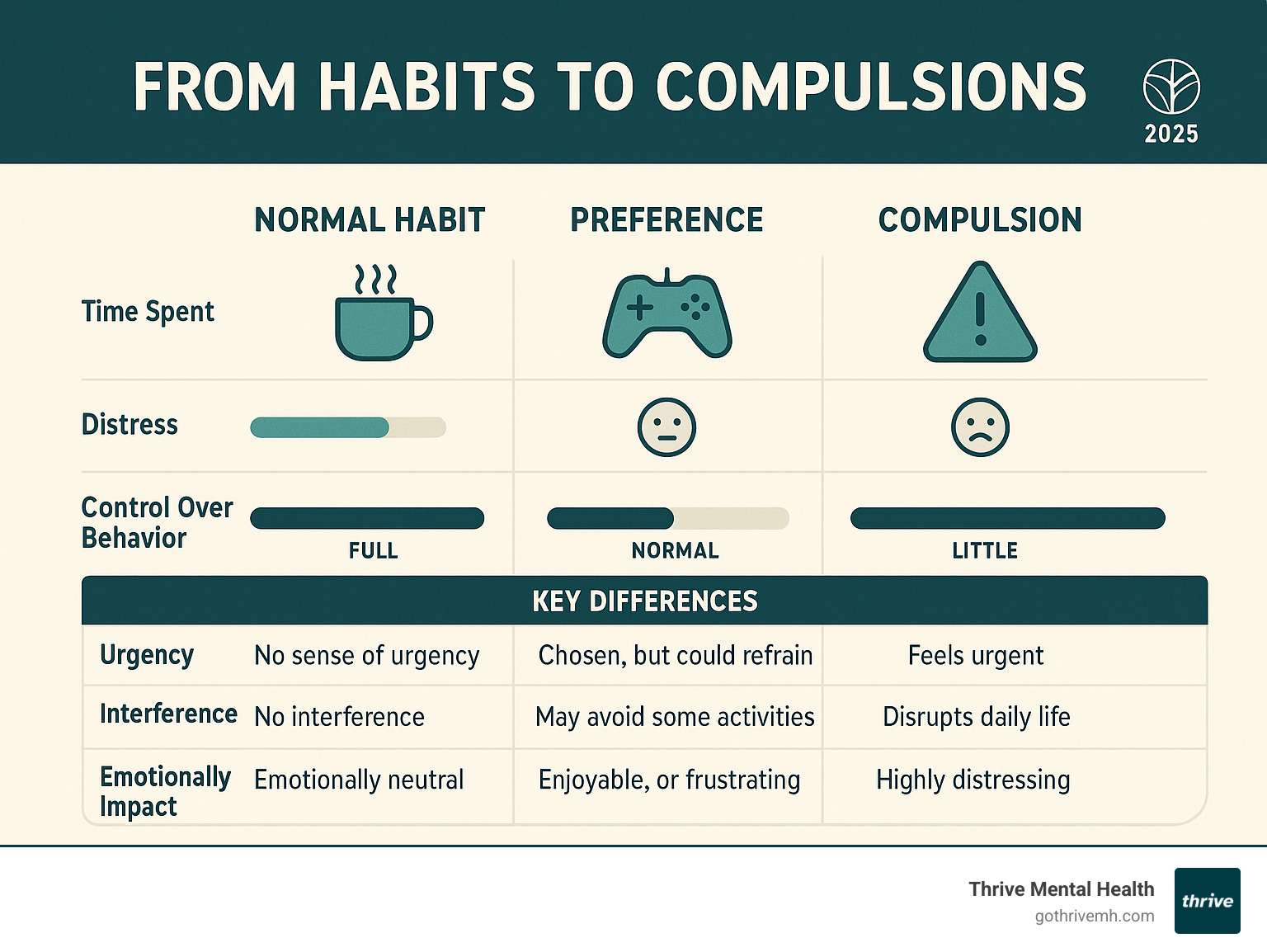
We all have habits, from brushing our teeth in a specific order to always grabbing coffee on the way to work. So, how do we tell the difference between a harmless habit and a challenging compulsion? It boils down to a few key distinctions:
| Feature | Compulsions |
|---|---|
| Motivation | Driven by anxiety and a need to prevent a feared outcome. |
| Control | Feels involuntary and difficult to resist, even when you know it’s irrational. |
| Emotional Impact | Causes significant distress, anxiety, and guilt. |
| Functionality | Disrupts daily life, relationships, and responsibilities. |
| Time | Can be very time-consuming, taking up hours of the day. |
| Insight | The person often recognizes the behavior is excessive or irrational. |
Are Compulsions Always Physical Actions?
Not at all. While we often think of compulsions as visible behaviors like hand-washing or repeatedly checking locks, many people experience what we call mental compulsions or covert compulsions. These are cognitive rituals that happen entirely in your mind, invisible to others but just as demanding and distressing.
Mental counting is one common example, maybe you feel compelled to count to a specific number before leaving a room, or you have to count objects until it “feels right.” Repeating phrases silently, whether they’re prayers, reassuring statements, or specific words, can become just as rigid and necessary as any physical ritual.
Some people engage in compulsive visualization, where they have to mentally picture certain images or scenarios to neutralize disturbing thoughts. Others use neutralizing thoughts, specific mental phrases or ideas designed to “cancel out” unwanted or frightening thoughts that pop into their head.
These mental acts can be just as time-consuming and exhausting as physical compulsions. Someone might appear to be sitting quietly, but internally they’re trapped in a cycle of mental rituals that can last for hours. The invisible nature of these compulsions can make them particularly isolating. While others might notice when someone is washing their hands for the twentieth time, mental rituals often go completely unrecognized, leaving the person struggling alone with their internal battles.
Whether physical or mental, all compulsions share that same driven quality, they feel necessary in the moment, even when the person knows they don’t actually make sense. If you’re in Florida and struggling with these kinds of thoughts or behaviors, know that help is available. Our team of therapists in Fort Lauderdale specializes in treating OCD and related disorders, offering support to help you regain control.
Defining Compulsions: More Than Just a Habit
When we talk about compulsions in mental health, we’re usually discussing them within the context of Obsessive-Compulsive Disorder (OCD), where they represent one of the disorder’s core symptoms. Think of compulsions as repetitive behaviors or mental acts that feel absolutely necessary to perform, not because they bring joy or satisfaction, but because not doing them creates overwhelming anxiety.
The American Psychological Association defines a compulsion as “a repetitive, intentional, and seemingly purposeful behavior or mental act performed in response to an obsession or according to rigidly applied rules.” What makes these behaviors particularly challenging is that the person feels driven to perform them to reduce distress or prevent some feared outcome, even though these actions aren’t realistically connected to what they’re trying to prevent.
Here’s what makes compulsions so difficult: people experiencing them usually know the behaviors are excessive or don’t make logical sense. They don’t want to spend two hours checking locks or washing their hands until they’re raw. They don’t enjoy these rituals, in fact, they often hate them. But the anxiety that builds when they try to resist feels unbearable, creating a cycle that’s hard to break.
The relief that compulsions provide is temporary at best. You might feel better for a few minutes after completing a ritual, but the anxiety inevitably returns, often stronger than before. If you’re recognizing these patterns in your own life, you can find more info about OCD symptoms to better understand what you might be experiencing.
Compulsions vs. Habits: What’s the Difference?
We all have habits, maybe you always put on your left shoe first, or you grab coffee from the same place every morning. These routines can actually make life easier and more efficient. So how do we distinguish between a harmless habit and a problematic compulsion?
The key differences come down to motivation, distress, and control. Habits typically happen automatically and serve a practical purpose. You might brush your teeth the same way every night because it’s efficient, and skipping it occasionally doesn’t cause major anxiety.
Compulsions, on the other hand, are driven by anxiety rather than convenience. They feel urgent and necessary, not optional. Missing or changing a compulsion creates significant distress that can last for hours. While habits tend to be neutral or beneficial to your daily life, compulsions are time-consuming and disruptive, often interfering with work, relationships, and other important activities.
Perhaps most importantly, habits maintain a realistic connection to their intended outcome, brushing your teeth actually prevents cavities. Compulsions often involve an irrational connection between the behavior and the feared consequence. Checking the stove 47 times won’t actually prevent a fire any more than checking it once, but the anxiety says otherwise.
The sense of urgency around compulsions is also different. With habits, you can usually delay or modify them without much trouble. With compulsions, the feeling that “something terrible will happen” if you don’t perform the ritual right now can be overwhelming.
Are Compulsions Always Physical Actions?
Not at all. While we often think of compulsions as visible behaviors like hand-washing or checking locks, many people experience what we call mental compulsions or covert compulsions. These are cognitive rituals that happen entirely in your mind, invisible to others but just as demanding and distressing.
 BCBS Texas (BCBSTX): Mental Health and Virtual IOP CoverageInsurance
Mental counting is one common example, maybe you feel compelled to count to a specific number before leaving a room, or you have to count objects until it “feels right.” Repeating phrases silently, whether they’re prayers, reassuring statements, or specific words, can become just as rigid and necessary as any physical ritual.
Some people engage in compulsive visualization, where they have to mentally picture certain images or scenarios to neutralize disturbing thoughts. Others use neutralizing thoughts, specific mental phrases or ideas designed to “cancel out” unwanted or frightening thoughts that pop into their head.
These mental acts can be just as time-consuming and exhausting as physical compulsions. Someone might appear to be sitting quietly, but internally they’re trapped in a cycle of mental rituals that can last for hours. The invisible nature of these compulsions can make people feel even more isolated, since others can’t see the struggle they’re experiencing.
Understanding that compulsions aren’t always visible helps us recognize the full scope of how OCD can impact someone’s life, even when everything looks normal from the outside.
Defining Compulsions: More Than Just a Habit
When we talk about compulsions, we’re often talking within the context of Obsessive-Compulsive Disorder (OCD), where they are a core symptom. In OCD, compulsions are repetitive behaviors or mental acts that a person feels driven to perform in response to an obsession. They are not done for pleasure or gratification, but rather to prevent or reduce distress, or to prevent some dreaded event or situation. The relief they offer is only temporary.
The American Psychological Association defines a compulsion as “a repetitive, intentional, and seemingly purposeful behavior or mental act performed in response to an obsession or according to rigidly applied rules, that the individual feels driven to perform in order to reduce anxiety or distress or to prevent some dreaded event or situation; however, these behaviors or mental acts are not connected in a realistic way with what they are designed to neutralize or prevent, or are clearly excessive.”
While people with OCD recognize these behaviors are often excessive or irrational, they feel unable to stop them. They don’t want to perform these actions, and they don’t get pleasure from them. The drive comes from a desperate need to alleviate intense anxiety. If you’re experiencing symptoms like these, you can find more info about OCD Symptoms.
Compulsions vs. Habits: What’s the Difference?
We all have habits, from brushing our teeth in a specific order to always grabbing coffee on the way to work. So, how do we tell the difference between a harmless habit and a challenging compulsion? It boils down to a few key distinctions:
Defining Compulsions: More Than Just a Habit
Think about the last time you double-checked that you locked your front door. Maybe you even went back a second time, just to be sure. For most of us, that’s where it ends. But for people experiencing compulsions, that checking doesn’t stop, it becomes a relentless cycle that can consume hours of their day.
Compulsions are repetitive behaviors or mental acts that feel impossible to resist. Unlike the habits we choose to develop, these actions are driven by an overwhelming urge to prevent something terrible from happening or to reduce intense anxiety. The person performing them doesn’t enjoy these behaviors, they feel trapped by them.
The American Psychological Association defines a compulsion as behaviors or mental acts that someone feels driven to perform, usually in response to disturbing thoughts. These actions might seem purposeful from the outside, but they’re either completely unconnected to what they’re supposed to prevent, or they’re clearly excessive.
Here’s what makes compulsions particularly challenging: even when people recognize that their behaviors don’t make logical sense, they still feel compelled to continue. The relief these actions provide is only temporary, which means the cycle starts all over again within minutes or hours.
In the context of Obsessive-Compulsive Disorder (OCD), compulsions are one of the core symptoms that can significantly disrupt daily life. If you’re noticing patterns like these in your own experience, you can learn more about recognizing OCD symptoms.
Compulsions vs. Habits: What’s the Difference?
We all have our routines, maybe you always put on your left shoe first, or you have a specific way you organize your workspace. These habits often make our lives more efficient and comfortable. But compulsions operate in a completely different way.
The key difference lies in how these behaviors feel. Habits are typically automatic and neutral, you might not even think about them. Compulsions, on the other hand, are driven by anxiety and feel urgent, almost desperate. When someone tries to resist a compulsion, their anxiety skyrockets until they give in and perform the behavior.
Time and disruption also set them apart. A habit might take a few seconds or minutes and fits seamlessly into your day. Compulsions can be incredibly time-consuming, sometimes taking hours, and they interfere with work, relationships, and other important activities.
Perhaps most importantly, compulsions are goal-directed in an irrational way. The person believes (even if they know it doesn’t make sense) that performing the behavior will prevent something bad from happening. There’s often an unrealistic connection between the action and the feared outcome, like believing that not arranging items in a specific order could somehow harm a loved one.
Compulsions also come with a sense of urgency that habits simply don’t have. Missing your morning coffee might be inconvenient, but resisting a compulsion feels genuinely distressing and anxiety-provoking.
Are Compulsions Always Physical Actions?
When most people think of compulsions, they picture visible behaviors like excessive hand washing or repeatedly checking locks. But compulsions can also be completely mental, happening entirely inside someone’s head where others can’t see them.
These mental acts, sometimes called covert compulsions, can be just as time-consuming and distressing as physical ones. Someone might spend hours mentally counting, repeating specific phrases or prayers, or going through elaborate mental rituals to “neutralize” disturbing thoughts.
Mental compulsions might include reviewing conversations over and over to make sure nothing offensive was said, mentally retracing steps to ensure no one was accidentally harmed, or repeating “good” thoughts to cancel out “bad” ones. These cognitive rituals can be exhausting and make it nearly impossible to focus on anything else.
The invisible nature of mental compulsions can make them particularly isolating. While others might notice when someone is washing their hands for the twentieth time, mental rituals often go completely unrecognized, leaving the person struggling alone with their internal battles.
Whether physical or mental, all compulsions share that same driven quality, they feel necessary in the moment, even when the person knows they don’t actually make sense.

This article is for informational purposes only and is not a substitute for individualized clinical advice or insurance verification.