



The best boundaries activities for adults get a client from knowing what they need to saying it out loud and holding it when someone pushes back. Below are 15 activities and worksheet ideas for individual and group work, organized by skill: naming boundary types, mapping where boundaries break, scripting and role-play, values work, and workplace limits. Each one includes a facilitation note, and most include a telehealth adaptation.
Most adults who struggle with boundaries already understand the idea, and the gap is usually rehearsal. A systematic review of assertiveness training found mixed results overall, but programs that gave people real practice, through role-play or simulation, improved how often they spoke up. So the activities below lean on practice more than worksheets alone.
Which boundary types should adults practice first?
Start by giving clients words for the different kinds of limits they can set. Most people only think of emotional boundaries, so naming the other types widens the map quickly. Use this table as a handout or a whiteboard prompt.
| Boundary type | What it protects | Example statement | Common warning sign |
|---|---|---|---|
| Physical | Personal space, touch, rest | “I’m not a hugger. A handshake works for me.” | Going along with touch you dislike |
| Emotional | Your feelings and energy | “I can listen for ten minutes, then I need to stop.” | Feeling responsible for others’ moods |
| Time | Schedule and commitments | “I can’t take that on this month.” | Saying yes, then resenting it |
| Digital | Availability by text, email, and social media | “I answer texts after work, not during.” | Checking messages in bed |
| Material | Money and belongings | “I’m not able to lend money right now.” | Covering costs you can’t afford |
| Work | Role, hours, and workload | “If I take this project, which one moves back?” | Unpaid hours that keep growing |
Mapping activities: where do your boundaries break down?
1. The boundary inventory: Clients rate each boundary type from the table on a 1 to 10 scale for strength. Then they name one relationship where that score drops, and the pattern usually shows up within a few minutes. Telehealth: share the table on screen and let members type ratings in the chat.
2. Relationship circles: Draw three circles inside each other: the inner ring holds people who get full access, the middle ring gets partial access, and the outer ring gets polite distance. Clients place real people in the rings, then notice who sits closer than they should. Keep names private in groups, since initials work fine for this.
3. The resentment audit: Resentment often points to a boundary that was crossed or never set. Clients list three recent moments of resentment, then write the unspoken limit behind each one. The facilitation note: stay curious, since the point is to find the need, not to blame the other person.
4. The boundary log worksheet: Give a simple four-column sheet for homework: situation, what I wanted to say, what I said, what happened. After a week, the completed log becomes useful data for the next session. Clients tend to see that the feared outcome happened far less often than they predicted.
Scripts and role-plays that build the actual skill
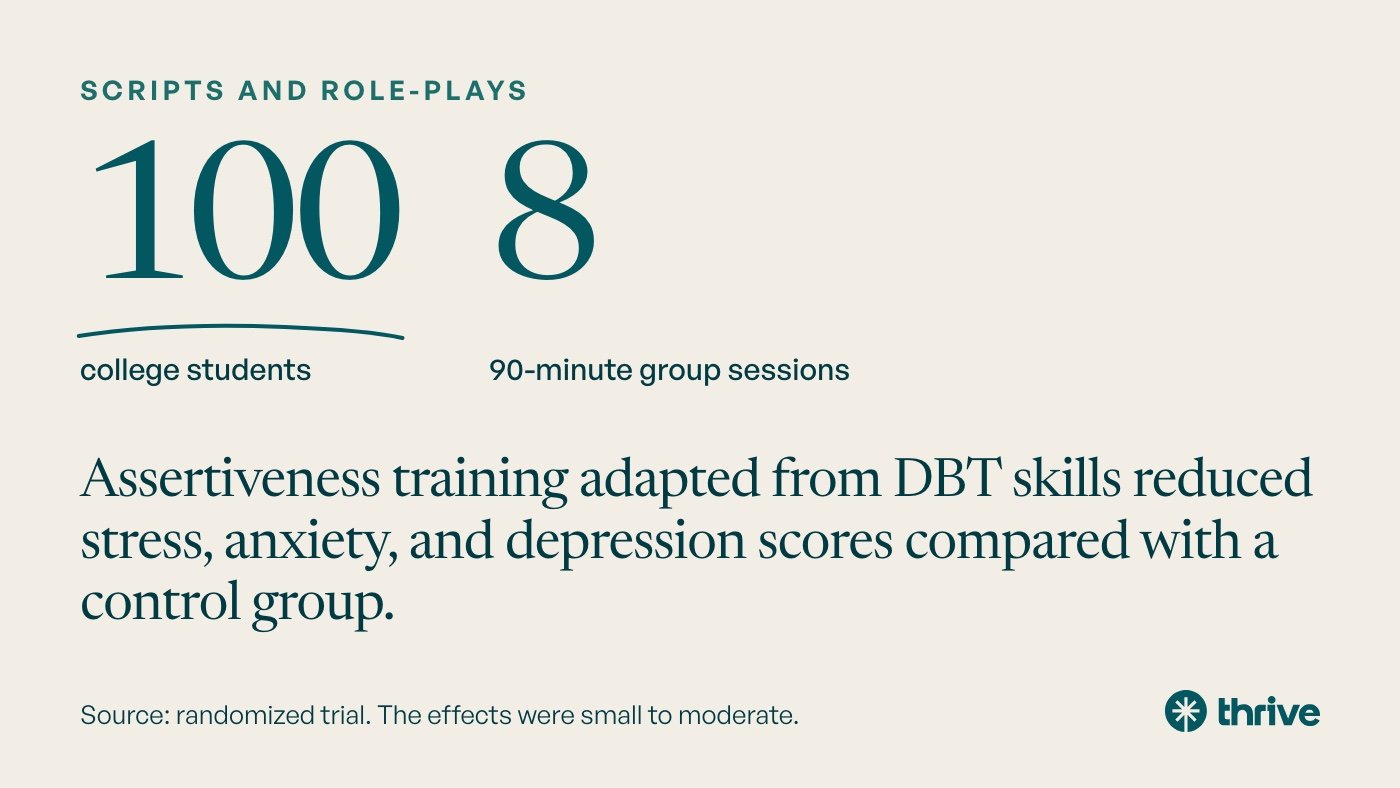
This is where most of the change tends to happen. Scripts give clients words, and role-play lets them practice using those words while a little anxious. In a randomized trial with 100 college students, eight 90-minute group sessions of assertiveness training adapted from DBT skills reduced stress, anxiety, and depression scores compared with a control group. The effects were small to moderate, and the sample was young, so treat it as encouraging rather than settled.
5. DEAR MAN scripting: DEAR MAN is the DBT interpersonal effectiveness skill for asking for something or saying no: Describe, Express, Assert, Reinforce, stay Mindful, Appear confident, Negotiate. Clients write a full script for one real situation. Skills training looks like one of DBT’s active ingredients, based on a component analysis trial published in JAMA Psychiatry. Our DBT overview covers the other three modules and how they fit together.
6. The three-tier role-play: Pairs practice the same boundary three times: first the partner accepts it easily, next they push back once, and on round three they push back twice, with guilt. Clients learn to repeat the boundary calmly, which is often called the broken record technique. Debrief on which round felt hardest and what the client noticed in their body.
7. The pause script: Many adults say yes because they feel pressure to answer right away. Teach one stock phrase: “Let me check and get back to you.” Practice it in rapid rounds until it sounds natural. This small delay protects a lot of time boundaries.
8. Soft, clear, firm: Clients write the same boundary three ways, from gentle to direct, then decide which version fits which relationship. It helps people who believe setting a limit means being harsh.
9. Guilt rehearsal: Before practice, clients predict their guilt level from 0 to 100, and after the role-play they rate it again. Guilt usually peaks early and then fades as the conversation goes on. Seeing that curve helps clients treat guilt as a passing feeling rather than proof they did something wrong.
Values work: why is a boundary worth the discomfort?
Boundaries feel risky when clients can’t say what they protect. Values work gives them a reason to tolerate the discomfort of saying no. This comes from acceptance and commitment therapy (ACT), which a meta-analysis of 39 randomized trials found more effective than usual care and comparable to established treatments.
10. Values card sort: Clients sort a stack of value words (health, honesty, family, rest, creativity) into very important, somewhat important, and less important piles. Then they link one current boundary problem to a top value. Telehealth: use a shared digital board or a typed list.
11. The yes and no pairing: Every no protects a yes, so clients write what they would say yes to if they declined one request this week. “No to the extra shift” becomes “yes to my kid’s game.” This reframe lowers guilt for many people.
12. Future self letter: Clients write a short letter from themselves one year from now, describing life with steadier boundaries. Keep it concrete: what their mornings look like, who they see, how they feel on Sunday nights. Members read their letters aloud only if they choose to.
Workplace boundary activities for adults
Work is where many adults struggle most, since the power gap is real. The World Health Organization describes burnout as an occupational phenomenon tied to chronic workplace stress that has not been managed well. Boundary skills are one piece of that picture, not the whole fix.
13. The priority question: Instead of refusing a task outright, clients practice asking, “Which of these should come first?” It sets a limit while staying cooperative. Role-play it with a partner playing a demanding manager.
14. Off-hours plan: Clients pick one concrete rule, such as no email after 7 p.m., and write what they will do if an urgent message comes. Planning the exception ahead of time is what lets the rule survive it.
15. Coworker scripts: Practice short lines for common situations: a colleague who vents daily, one who delegates up, one who interrupts. Keep each script under 20 words, because shorter scripts are easier to remember under stress.
 Choosing the Right Neurologist for Autism Diagnosis: A Comprehensive GuideCoping Strategies
How to run boundaries work in telehealth groups
Virtual groups can do all of this with small changes. Intensive treatment delivered by video has shown outcomes comparable to in-person care in adults, so the format itself is not a barrier.
- Use breakout rooms for role-plays. Pairs or trios work best, with a timer and a one-line prompt.
- Check privacy first. Some clients are practicing boundaries with people in the next room. Offer headphones, the chat box, or a pass.
- Put scripts on screen. Reading from a shared script lowers anxiety during the first round.
- Name the next speaker. Video delays make open turn-taking slow, so call on people by name.
For more warm-ups and structure ideas, see our group therapy icebreakers for adults and DBT group activities.
Safety notes before assigning boundary homework
Boundary setting is usually low risk for clients, with one clear exception. If a client may be in an abusive or controlling relationship, a new boundary can raise their danger. The CDC counts psychological aggression and control as forms of intimate partner violence, not only physical harm.
- Screen before assigning home practice. Ask how the other person usually reacts to a no.
- Shift to safety planning when needed. In those cases, boundary scripts come second.
- Watch for trauma responses. Freezing or fawning during role-play is data, so slow down and ground.
Pair these activities with the skills in our guide to healthy coping for clients who need regulation tools alongside assertiveness.
Common questions about boundaries activities for adults
How long should a boundaries activity take in group?
Plan 15 to 25 minutes, including the debrief. Role-plays need the most time, so keep the teaching portion short and let rehearsal fill the rest.
Are boundaries worksheets enough on their own?
Worksheets help clients notice patterns, but change tends to come from practice. Pair every worksheet with a role-play or a real-world homework step.
What if a client feels guilty after setting a boundary?
That is common and usually temporary, so track guilt before and after practice so the client can see it rise and fall.
Can I teach DEAR MAN outside a full DBT program?
Yes, many clinicians teach it as a standalone skill. Be clear with clients that one skill is not comprehensive DBT.
How do I adapt boundaries work for someone in an abusive relationship?
Screen first. When a new limit could raise risk, focus on safety planning before any boundary homework.
For clinicians: when boundary work needs more structure
Some clients know every script and still can’t use them, because depression, anxiety, or trauma symptoms keep pulling them under. Weekly sessions may not give them enough practice time to change the pattern. An intensive outpatient program adds nine or more hours of structured care each week, with skills practice built into the schedule.
Thrive Mental Health runs adult-only virtual IOP across Florida, Indiana, Arizona, California, North Carolina, South Carolina, and Texas, including for patients in Florida. We specialize in adults and are accredited by The Joint Commission for Behavioral Health Care and Human Services. Refer a patient here, or call our clinical team at (561) 203-6085. Referred patients are usually assessed within days, and we coordinate care back to you at discharge.

This article is for informational purposes only and is not a substitute for individualized clinical advice or insurance verification.