




To appeal a denied mental health claim in Indiana, file an internal appeal with your insurer before the deadline on the denial letter, which is usually 180 days. If the insurer still says no, you can ask for an independent external review, and the insurer has to follow that reviewer’s decision. Which rulebook applies depends on one fact: whether your plan is insured under Indiana law or self-funded by your employer.
This guide walks through both paths step by step, with the Indiana timelines, the parity arguments that carry weight, and how to move fast when intensive outpatient care can’t wait.
This article is informational, not clinical, legal, or financial advice. Verify your rights with your plan documents and, where needed, a licensed professional.
Who regulates your plan? Find out before you file anything
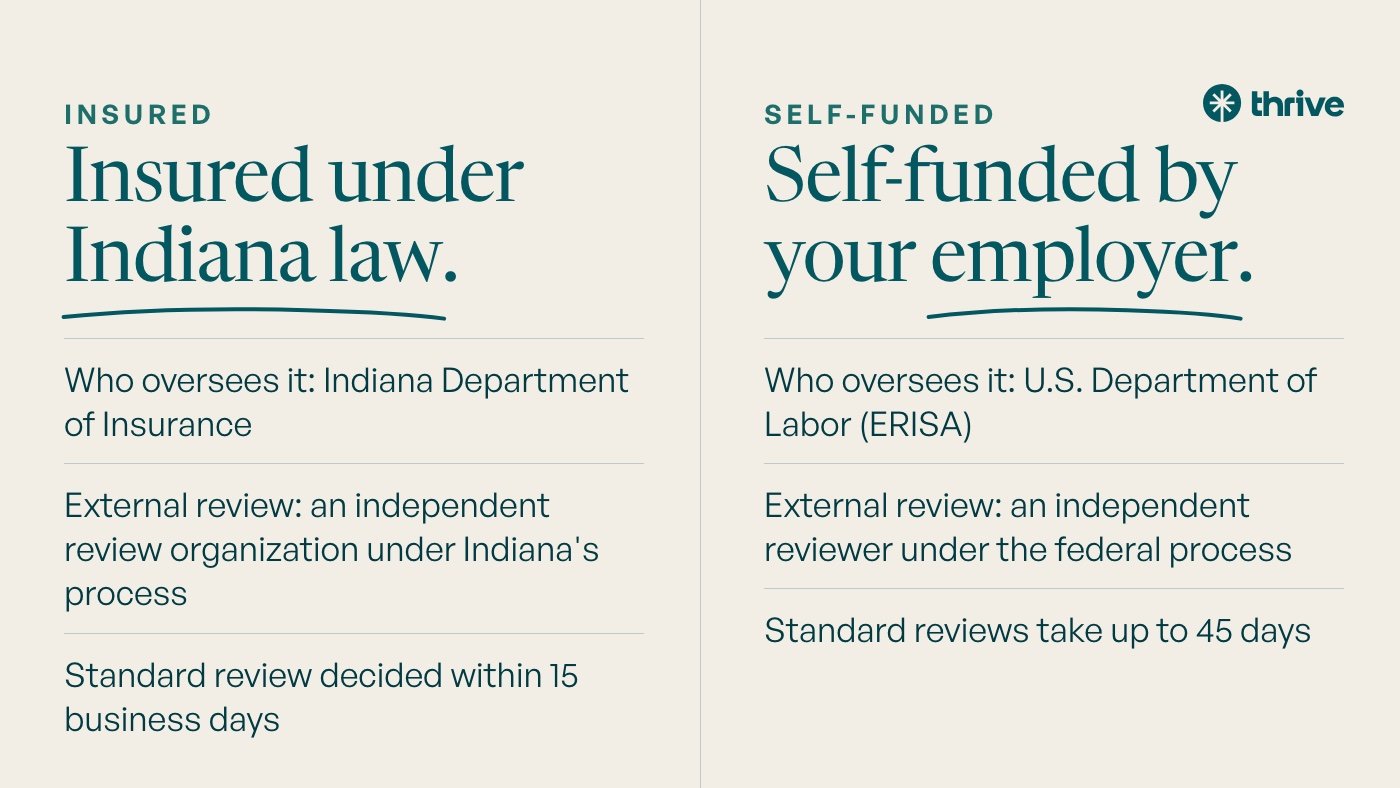
Indiana’s insurance laws cover plans that an insurer sells and carries the risk on. Many large employers pay claims out of their own funds instead. Those self-funded plans follow federal law, and the Indiana Department of Insurance can’t step in on them.
| Your plan | Who oversees it | Where external review goes |
|---|---|---|
| Marketplace plan or individual policy | Indiana Department of Insurance | An independent review organization under Indiana’s process |
| Fully insured employer plan | Indiana Department of Insurance | An independent review organization under Indiana’s process |
| Self-funded employer plan | U.S. Department of Labor (ERISA) | An independent reviewer under the federal process |
To find out which you have, ask HR one question: “Is our health plan fully insured or self-funded?” The answer is often in the plan document too. In a self-funded plan, the insurance company usually just processes claims for your employer. Your card may still say Anthem or UnitedHealthcare either way.
What should you look for in the denial letter?
The denial letter is your map, so read it twice and highlight these items before you do anything else.
- The exact reason. “Not medically necessary” is a common reason for mental health denials. It is also one of the more winnable ones, because it turns on clinical facts.
- The criteria they used. For mental health benefits, your plan has to give you the criteria for medical necessity decisions if you ask. Ask in writing.
- The deadline. Circle it. Missing it can end your appeal before it starts.
- What was denied. Was it the whole program, a set number of days, or payment for care you already got?
- How to appeal. The letter should list the address, fax, or portal, plus the phone number for questions.
Also request your full claim file. Under the Labor Department’s claims rules for job-based plans, you can get the documents behind the decision free of charge. The reviewer’s notes often show exactly which box your records didn’t check.
Step one: the internal appeal (Indiana calls it a grievance)
Indiana’s insurance rules use the word “grievance” for what most people call an appeal. The Department of Insurance’s grievance page explains that insured Hoosiers can file a grievance and then appeal the grievance decision. So you may see two internal rounds before an outside review.
| Stage | Typical deadline or timeline |
|---|---|
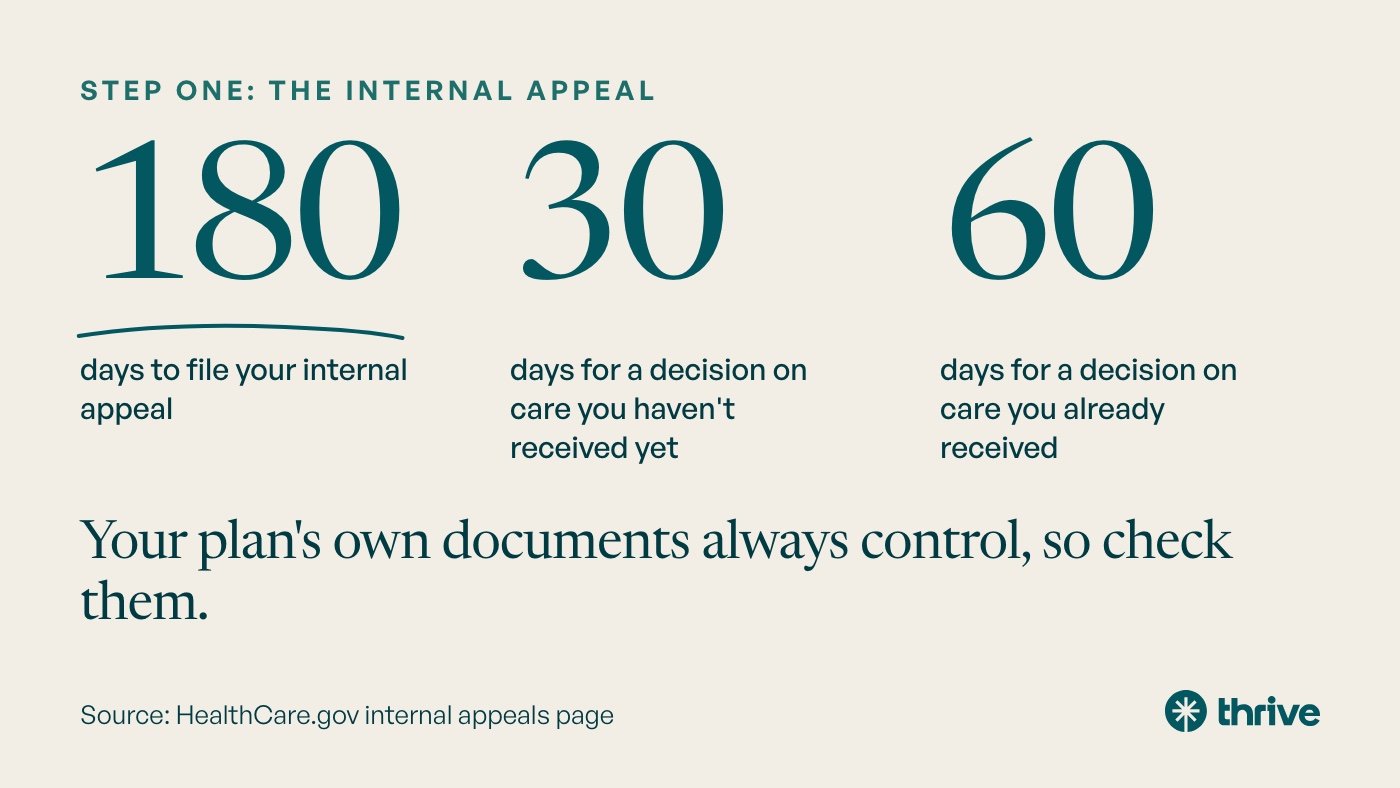
| File your internal appeal | Within 180 days of the denial notice |
| Decision on care you haven’t received yet | Within 30 days |
| Decision on care you already received | Within 60 days |
| Urgent care appeal | As fast as your condition requires, no more than 72 hours for job-based plans |
| Request external review (Indiana insured plans) | Often 120 days after the final internal decision |
| External review decision in Indiana | 15 business days standard; 72 hours expedited |
The 180-day, 30-day, and 60-day figures come from HealthCare.gov’s internal appeals page. Indiana insurers file their own procedures with the state, and some run faster. Anthem’s Indiana procedure, for example, sets most grievance decisions within 20 business days or 30 calendar days, whichever comes first. Your plan’s own documents always control, so check them.
What goes in a strong appeal letter?
Short and specific beats long and emotional, because reviewers are checking your records against criteria, so give them what they need to find a yes. Here is an outline you can adapt.
- Header. Your name, member ID, claim or reference number, date of service, and the date of the denial letter.
- The ask. One sentence: “I am appealing the denial of intensive outpatient treatment and request that it be approved.”
- The clinical picture. Your diagnosis, current symptoms, and how they affect work, sleep, relationships, or safety.
- What’s been tried. Weekly therapy, medication changes, or other care, with dates. This shows why a lower level of care isn’t enough.
- Why this level of care. An intensive outpatient program provides nine or more hours of structured care a week while you live at home. Explain why that intensity fits right now.
- A point-by-point answer. Match each criterion the plan cited with the part of your record that meets it.
- Attachments. A letter of medical necessity from your treating clinician, recent assessment scores, and your claim file.
If the denial questioned virtual care itself, you can cite research. A matched study of 2,384 adults in intensive treatment published in the Journal of Psychiatric Research found no significant difference in depression improvement between telehealth and in-person care.
How do you use mental health parity in an appeal?
The federal Mental Health Parity and Addiction Equity Act says a plan can’t make mental health care harder to get than comparable medical care. That covers cost sharing, visit limits, and rules like prior authorization. Parity arguments work best when they point to specific differences.
- Ask how the medical side is treated. Does the plan require the same prior authorization, the same reviews, and the same paperwork for comparable medical services? If mental health gets extra hurdles, name them in your appeal.
- Request the comparison. Since 2021, federal law requires plans to analyze how they apply these rules to mental health versus medical care. You can ask the plan for it, and regulators can require the plan to produce it.
- Quote the denial reason back. Plans also have to tell you the reason for any mental health denial. A vague reason is itself worth pointing out.
One recent update matters here: in May 2025, federal agencies said they would pause enforcement of the new parts of a 2024 parity rule. The statute and the earlier 2013 rules still apply, and so do the protections above.
What if you need IOP now and can’t wait weeks?
Ask for an expedited appeal right away. If waiting could seriously harm your health, the claim counts as urgent. For job-based plans, the Labor Department’s rules give the plan no more than 72 hours to decide an urgent appeal.
- Let your clinician lead. For urgent claims, federal rules let a health care professional who knows your condition act on your behalf. Ask them to call the plan and request a peer-to-peer talk with the reviewer, which many plans offer.
- Watch for mid-treatment cutoffs. If a job-based plan approved a course of treatment and then cuts it short, that counts as a denial. The plan must tell you early enough to appeal before the care stops.
- Use the expedited external route. In Indiana, an independent reviewer must decide an expedited external review within 72 hours, according to the state’s independent review organization requirements.
If you’re in crisis or thinking about harming yourself, call or text 988, or go to the nearest emergency room. Appeals can wait, but your safety can’t.
 Artful Connections: Group Activities to Boost Mental HealthMental Health
Step two: external review in Indiana
Once internal appeals are done, you can take the case to an independent review organization (IRO). An IRO is an outside company with its own clinical reviewers. It has no stake in the insurer’s decision.
- Insured Indiana plans: the IRO must be certified by the Department of Insurance. Anthem’s Indiana procedure gives you 120 days after the final internal decision to ask. Other plans may allow more time, so check yours.
- Timing: a standard review is decided within 15 business days of filing. An expedited one is decided within 72 hours.
- Self-funded plans: the federal process applies. You generally have four months to request external review, and standard reviews take up to 45 days.
Either way, the result carries weight. HealthCare.gov notes that insurers are required by law to accept the external reviewer’s decision. External review isn’t open for every denial, though. It covers disputes about medical judgment, such as medical necessity, which is where many mental health denials land.
Where can you get help if you’re still stuck?
- Insured plans: the Indiana Department of Insurance takes consumer complaints about coverage and claim disputes. Its grievance page lists a toll-free line, 800-622-4461.
- Self-funded plans: the Labor Department’s Employee Benefits Security Administration answers questions at 1-866-444-3272.
- Your treatment program: an admissions or billing team often handles prior authorization and can help assemble records for an appeal.
For more on how Indiana carriers handle intensive care, see our guides to Anthem BCBS in Indiana and Optum Behavioral Health in Indiana. If the plan itself is the problem, our Indiana open enrollment guide shows what to check before you pick next year’s coverage.
Common questions about appealing a mental health denial in Indiana
How long do I have to appeal a denied mental health claim in Indiana?
Usually 180 days from the denial notice for the internal appeal. Your denial letter lists the exact deadline for your plan, so go by that.
Can the Indiana Department of Insurance help with my employer plan?
Only if the plan is fully insured. Self-funded employer plans fall under federal law, and the U.S. Department of Labor handles questions about them.
Can my therapist file the appeal for me?
Often, yes. You may need to sign a form naming them as your representative. For urgent claims, federal rules let a clinician who knows your condition act for you.
Why does my Indiana plan call it a grievance?
Indiana’s insurance rules use “grievance” for an internal appeal and “external grievance” for independent review. The rights are the same; only the label differs.
Can I keep going to IOP while the appeal is pending?
You can, but you may owe the bill if the appeal fails. Ask your program about options, and request an expedited appeal if the care is urgent.
What if the external reviewer sides with me?
The insurer has to accept the decision and cover the care. Keep copies of everything in case a later claim is processed wrong.
Next steps
If a denial is standing between you and care, get a clear read on your benefits before you decide what to do. Thrive Mental Health is a Joint Commission accredited provider of virtual intensive outpatient care for adults in Indiana, Florida, Arizona, California, North Carolina, South Carolina, and Texas. Our team handles prior authorization for our program and can explain what your insurance covers.
Verify your coverage with Thrive: free, confidential benefits check. Most members receive a summary within 24 hours, and many start the same week. Prefer to talk first? Call (561) 203-6085.

This article is for informational purposes only and is not a substitute for individualized clinical advice or insurance verification.