






AZ Blue and UnitedHealthcare both cover mental health care for Arizona adults, including intensive outpatient programs (IOP), on most commercial plans. The real difference is less about the brand and more about who manages the behavioral network, how each plan type handles referrals, and whether your preferred program is in that network. AZ Blue is Arizona’s own nonprofit Blue plan. UnitedHealthcare is a national carrier whose behavioral health side is commonly run through Optum.
This guide compares the two where it matters for mental health: networks, plan types, prior authorization for IOP, marketplace options for 2027, and the questions to ask before you choose or start care.
This article is informational, not clinical or financial advice. Verify benefits directly with your carrier and a licensed clinician before starting treatment.
AZ Blue vs UnitedHealthcare at a glance
| Question | AZ Blue | UnitedHealthcare |
|---|---|---|
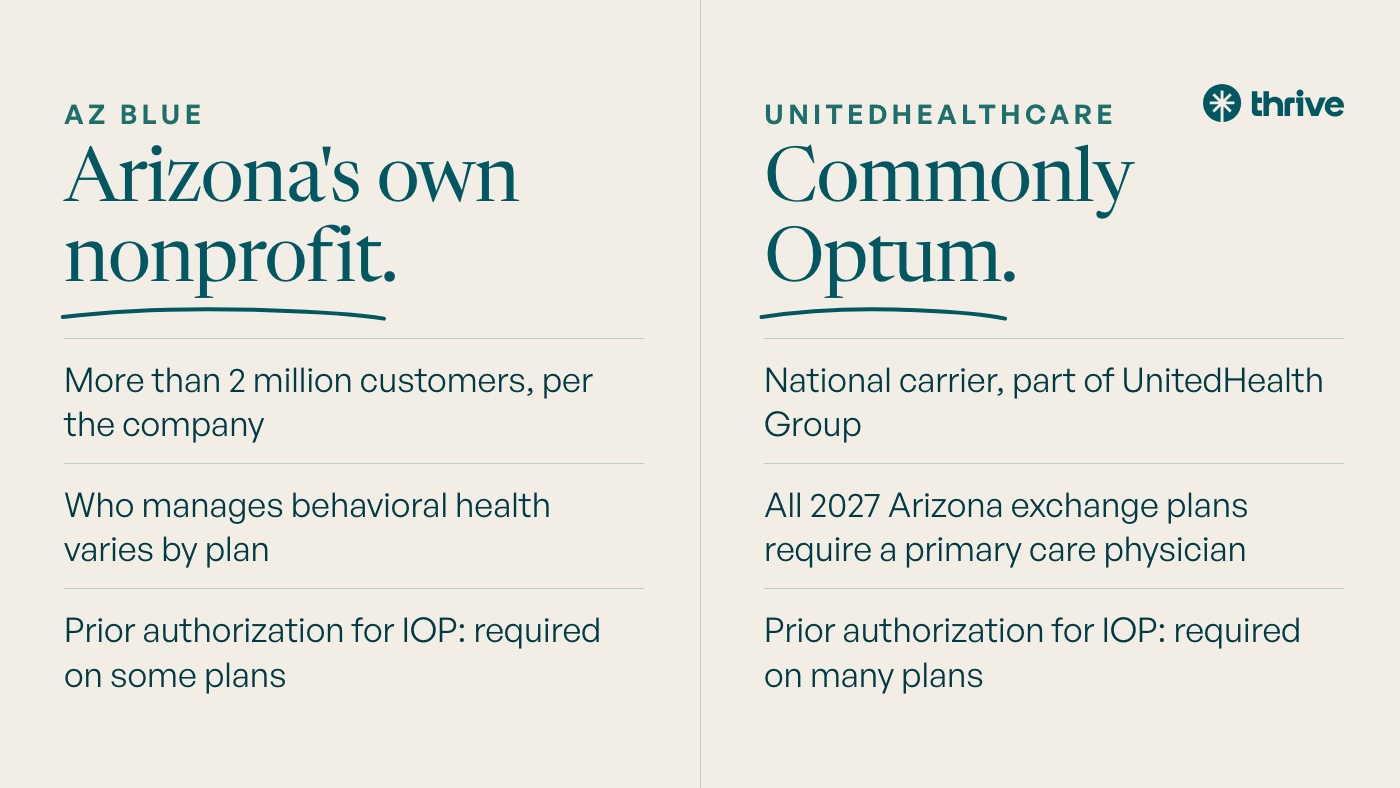
| Who they are | Blue Cross Blue Shield of Arizona, a nonprofit independent Blue licensee with offices in Phoenix, Tucson and Flagstaff | National carrier, part of UnitedHealth Group |
| Size in Arizona | More than 2 million customers, per the company | Sells employer and individual exchange plans in Arizona |
| Who manages behavioral health | Varies by plan; check the behavioral number on your card | Commonly Optum, UnitedHealth’s behavioral health arm |
| Individual plans for 2027 | Sells individual and family plans; confirm 2027 options on HealthCare.gov | Offering 2027 Individual Exchange plans in Arizona |
| Primary care rules on exchange plans | Depends on plan type | All 2027 Arizona exchange plans require a primary care physician |
| Virtual IOP coverage | Generally covered when medically necessary | Generally covered when medically necessary |
| Prior authorization for IOP | Required on some plans | Required on many plans |
Your plan document beats every row in this table. Two AZ Blue plans, or two UnitedHealthcare plans, can differ more from each other than the two carriers differ on average.
Who is behind each card?
According to its own company page, Blue Cross Blue Shield of Arizona now goes by AZ Blue. It is a nonprofit, an independent licensee of the Blue Cross Blue Shield Association, and has served Arizona for over 80 years. That local footing shapes its networks, which are built around Arizona providers.
UnitedHealthcare is national. Its plans run on shared systems across many states, and behavioral health is commonly handled by Optum. Optum’s behavioral health provider site is where therapists and programs in its network manage credentialing and authorizations.
For you, the practical point is this: the mental health network can be separate from the medical network. A hospital or doctor in your plan’s medical network tells you nothing about which therapists or programs are in its behavioral network. Ask about each separately.
How the behavioral health networks differ
With UnitedHealthcare, the behavioral health phone number on your card often routes to Optum. Optum reviews authorizations for higher levels of care, such as IOP, and keeps its own directory.
With AZ Blue, how behavioral health is managed can vary by plan. AZ Blue’s member guide for individual and exchange plans points members to the Find a Doctor tool in their MyBlue account to search for in-network providers.
Either way, the same checks apply:
- Search the behavioral directory, not the medical one. Filter for mental health or intensive outpatient care.
- Call the behavioral number on your card. Directories go stale. A phone confirmation with a reference number is stronger.
- Ask about telehealth. Confirm virtual IOP is covered at the same cost share as in-person care.
Thrive is in network with AZ Blue through Carelon Behavioral Health. Thrive also works with UnitedHealthcare and Optum plans. As our insurance page notes, networks vary by plan and by state, so we confirm your exact coverage before you start.
Plan types: HMO, PPO and the referral question
Both carriers sell several plan types through employers. The type shapes how easily you can reach a mental health program.
- HMO plans usually limit you to in-network providers and may require a primary care physician. Some require referrals for specialty care.
- PPO plans let you see out-of-network providers at a higher cost and rarely need referrals.
- EPO plans sit in between: in-network only, often without a primary care gatekeeper.
UnitedHealthcare’s 2027 Arizona exchange guide for providers states that all its Arizona Individual Exchange plans require a primary care physician. Some carry a referrals-required marker on the member ID card. It also describes Sanitas plans in Maricopa County, where members are assigned to a Sanitas primary care clinic.
If your card shows a referral requirement, ask whether behavioral health care needs one. Mental health benefits often follow their own rules, but only your plan can confirm that.
Prior authorization for IOP under each carrier
An IOP is a step up from weekly therapy. SAMHSA’s treatment protocol on intensive outpatient care describes it as structured treatment several days a week for people who need more than an hour a week but not 24-hour care.
Because IOP is more intensive, many plans from both carriers ask for prior authorization. That is approval from the plan before services start. In practice:
- A clinician assesses you and documents why IOP is the right level of care.
- The program sends that information to the carrier, or to its behavioral health manager.
- The plan approves a set number of days or weeks, then reviews progress to extend.
You should not have to handle this alone. At Thrive, our admissions team requests and tracks prior authorization for you as part of admission, so you do not have to call your insurer.
The parity rules both carriers must follow
Commercial plans from both carriers fall under the federal Mental Health Parity and Addiction Equity Act. In plain terms, a plan cannot make mental health benefits harder to use than comparable medical benefits. That covers copays, visit limits and authorization rules.
HealthCare.gov also lists mental health and substance use services as essential health benefits on marketplace plans. So if you buy your own plan from either carrier, mental health care is part of the package.
Virtual care counts too. A study in the Journal of Psychiatric Research found telehealth outcomes for adults in intensive treatment were comparable to in-person care. In a state as big as Arizona, that opens the same programs to Flagstaff, Yuma and Kingman as to Phoenix.
Buying your own plan for 2027
If you buy coverage yourself, Open Enrollment for 2027 plans runs from November 1, 2026 to January 15, 2027. Enroll by December 15 for coverage that starts January 1.

UnitedHealthcare has published provider materials for its 2027 Arizona exchange plans. AZ Blue sells individual and family plans as well. Which plans are offered depends on your county, so compare the actual list on HealthCare.gov.
 5 Tips to Find IOP Art Therapy for OC AdolescentsMental Health
When you compare, look past the premium:
- Deductible. What you pay before the plan starts sharing costs.
- Cost share for intensive outpatient care. A copay or coinsurance, listed in the Summary of Benefits.
- Out-of-pocket maximum. The most you would pay in a year for covered in-network care.
- Behavioral network. Whether the program you want is in it.
Our Arizona open enrollment guide walks through those steps, and our Arizona virtual IOP cost guide covers what people typically pay.
Which carrier fits which situation?
- Your employer offers both. Compare plan documents side by side. Check behavioral cost share, the deductible, and whether your preferred program is in each behavioral network.
- You want an Arizona-built network. AZ Blue’s networks are organized around Arizona providers, which some people prefer.
- You travel or split time between states. UnitedHealthcare’s national footprint may make out-of-state care simpler on some plans. Check your plan’s rules.
- You are on an exchange plan with a PCP requirement. Find out early whether behavioral care needs a referral, so it does not delay treatment.
- You have an AHCCCS or Medicare plan. This guide covers commercial plans only. Thrive does not accept AHCCCS, Medicaid or Medicare plans, and our admissions team can point you toward programs that do.
What to do if either carrier denies IOP
A denial is not the end of the road. The steps are the same with both carriers:
- Get the denial in writing, with the specific reason and the criteria used.
- Ask your clinician for a letter of medical necessity explaining why IOP is the right level of care.
- File the internal appeal within your plan’s deadline.
- Request an external review by an independent reviewer if the appeal fails.
- Contact the Arizona Department of Insurance and Financial Institutions if you think a parity rule was broken.
Keep a log of every call: date, name and reference number. It makes each later step faster.
Common questions about AZ Blue vs UnitedHealthcare
Does AZ Blue or UnitedHealthcare cover virtual IOP in Arizona?
Both generally cover virtual IOP on commercial plans when a clinician documents medical necessity. What you pay depends on your deductible, copay or coinsurance, and out-of-pocket maximum.
Is AZ Blue the same as Blue Cross Blue Shield of Arizona?
Yes. AZ Blue is the name Blue Cross Blue Shield of Arizona uses. It is a nonprofit, independent licensee of the Blue Cross Blue Shield Association.
Who handles mental health for UnitedHealthcare plans?
Many UnitedHealthcare plans manage behavioral health through Optum. Call the behavioral health number on your card to confirm how your plan works.
Is Thrive in network with AZ Blue?
Yes. Thrive is in network with AZ Blue through Carelon Behavioral Health. We check your specific plan for free before you start.
Do I need a referral for mental health care?
It depends on your plan. Some HMO and exchange plans require a primary care physician or referrals. Ask whether that applies to behavioral health before you book.
When can I switch carriers for 2027?
On HealthCare.gov, Open Enrollment runs November 1, 2026 to January 15, 2027. Employer plans follow your employer’s own enrollment window.
Next steps
If a clinician has suggested more support than weekly therapy, start with a benefits check on the plan you have now. Thrive Mental Health is a Joint Commission accredited provider of virtual IOP for adults in Arizona, plus Florida, Indiana, California, North Carolina, South Carolina, and Texas. AZ Blue members can see how coverage works on our AZ Blue page.
Verify your coverage with Thrive: free, confidential benefits check. Most members receive a summary within 24 hours, and you can start as soon as you are ready. Prefer to talk first? Call (561) 203-6085.

This article is for informational purposes only and is not a substitute for individualized clinical advice or insurance verification.