




Mental health parity means your Indiana health plan can’t make mental health care harder to get, or more expensive, than comparable medical care. Under the federal parity law, copays, visit limits, and rules like prior authorization for therapy or an intensive outpatient program (IOP) must be no more restrictive than what the plan applies to medical benefits. Parity doesn’t force a plan to cover mental health care, but most Indiana commercial plans must cover it anyway, and once they do, parity applies.
This guide explains which Indiana plans the law protects, the red flags worth spotting in your own coverage, and how to push back when you find one.
This article is informational, not clinical, legal, or financial advice. Verify your rights with your plan documents and, where needed, a licensed professional.
What does mental health parity law actually require?
The core law is the federal Mental Health Parity and Addiction Equity Act of 2008, often shortened to MHPAEA. CMS’s overview of the parity law says it stops plans from putting less favorable limits on mental health and substance use benefits than on medical and surgical benefits.
In plain terms, the law looks at three kinds of limits:
- Money rules. Copays, coinsurance, and deductibles for mental health care can’t be stricter than the main ones for medical care. Plans also can’t create a separate deductible that applies only to mental health.
- Number limits. Visit caps and day limits on therapy or IOP can’t be tighter than those on comparable medical care.
- Rules that aren’t numbers. These include prior authorization, step therapy, and how the plan builds its network. The plan’s process for mental health must be comparable to, and applied no more strictly than, its process for medical care.
The law compares benefits within six groups, such as outpatient in-network and outpatient out-of-network care. If a plan covers mental health care at all, it must cover it in every group where it covers medical care. The CMS overview also notes that deductibles and out-of-pocket limits must combine medical and mental health spending in each group.
Does parity law cover your Indiana plan?
Most Indiana commercial plans are covered, but a few are not. Use this table, then confirm with your plan documents.
| Your plan | Parity applies? | Who enforces it |
|---|---|---|
| Marketplace or individual plan | Yes | Indiana Department of Insurance, with federal backup |
| Fully insured plan, employer with more than 50 workers | Yes | Indiana Department of Insurance and federal agencies |
| Self-funded plan, employer with more than 50 workers | Yes | U.S. Department of Labor |
| Small employer plan, 50 or fewer workers | Usually, through the Affordable Care Act’s benefit rules | Depends on whether the plan is insured; older grandfathered plans may differ |
The small employer row needs a word of explanation. CMS says the parity regulation doesn’t apply to small employer group plans on its own. But the Affordable Care Act makes mental health an essential health benefit in non-grandfathered individual and small group plans, and it applies parity to them that way. If your small employer plan has been around since before 2010, check your plan documents.
Indiana insurance law can add its own requirements for plans the state regulates. Those rules don’t reach self-funded employer plans, which follow federal law. If you are not sure which you have, ask HR: “Is our health plan fully insured or self-funded?”
What are the parity red flags for therapy and IOP?
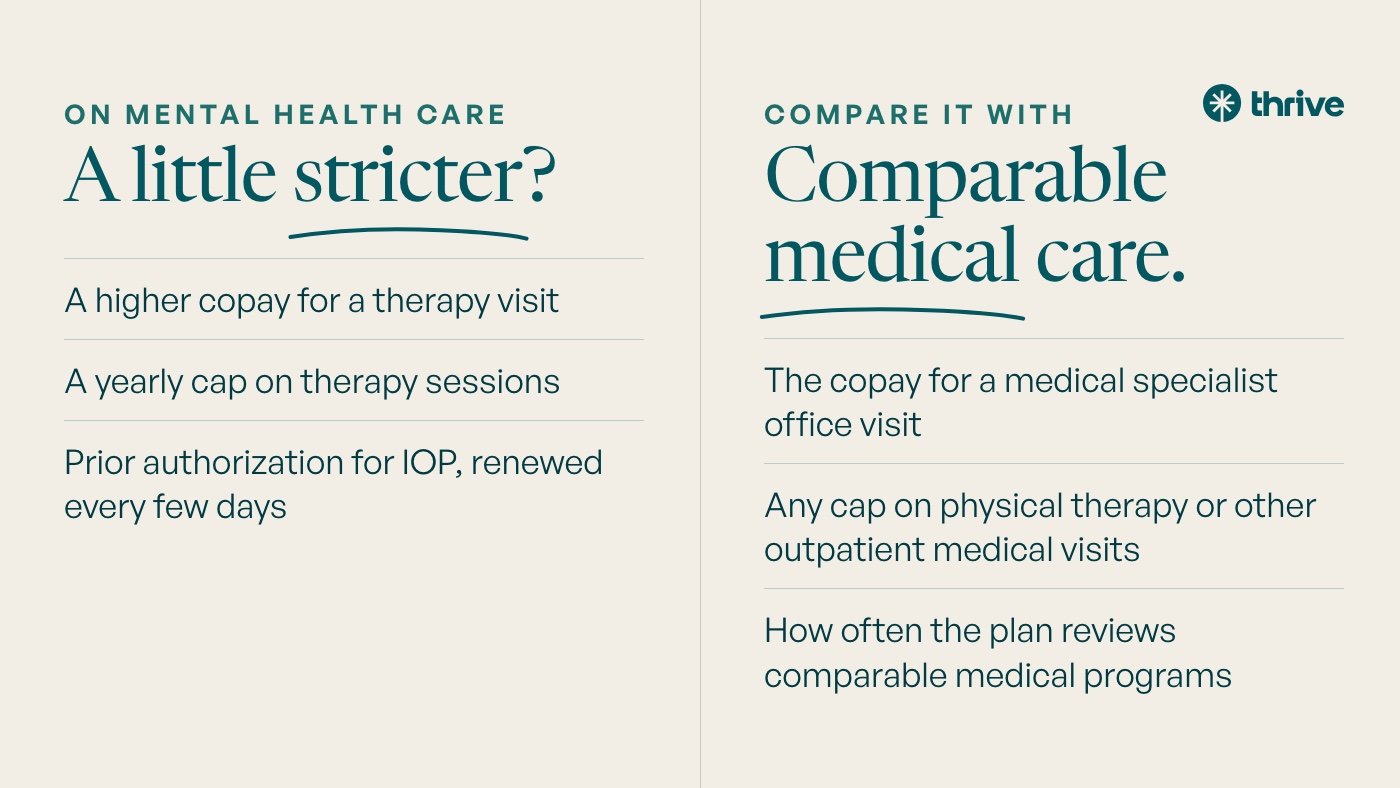
Parity problems rarely announce themselves. They show up as a rule that seems a little stricter for mental health care than for anything else. Here are the patterns worth checking against your own plan.
| What you see on mental health care | What to compare it with |
|---|---|
| A higher copay for a therapy visit | The copay for a medical specialist office visit |
| A yearly cap on therapy sessions | Any cap on physical therapy or other outpatient medical visits |
| Prior authorization for IOP, renewed every few days | How often the plan reviews comparable medical programs, like outpatient rehab |
| A rule that you must “fail” weekly therapy first | Whether medical care faces the same step-by-step requirement |
| A thin network with no in-network IOP nearby | How the plan builds and checks its medical networks |
| Very low out of network payments for therapy | How it sets out of network rates for medical providers |
CMS lists prior authorization, network composition standards, and the way plans set out of network rates as examples of the limits parity covers. A difference alone doesn’t prove a violation, because plans can justify some differences. It does give you a specific, fair question to ask.
An intensive outpatient program gives nine or more hours of structured care a week while you live at home. Because it costs more than weekly therapy, IOP is where these limits tend to show up first.
What can you ask your plan to show you?
Parity law comes with disclosure rights, and they are your best tool. You don’t need a lawyer to use them.
- The medical necessity criteria. Federal parity rules require plans to share their criteria for mental health medical necessity decisions when you ask. These are the standards a reviewer used to approve or deny your care.
- The reason for any denial. The same rules say plans must make the reason for a mental health denial available. A vague reason is itself worth pointing out.
- Your claim file. For job-based plans, the Labor Department’s guide to filing a claim for your health benefits says you can get the records behind a decision free of charge.
- The plan’s parity comparison. Since 2021, plans must perform and document a comparison of how their non-number limits apply to mental health versus medical care. CMS says plans must make these analyses available to federal or state regulators on request. Ask the plan for it in writing, and mention it in any complaint.
Put every request in writing, keep a copy, and note the date. If the plan doesn’t answer, that silence becomes part of your complaint.
What changed with the 2024 parity rule?
In September 2024, federal agencies issued a new parity rule with stronger requirements. Then, in May 2025, the Departments of Labor, Health and Human Services, and the Treasury put out a joint statement pausing enforcement of the new parts of that rule.
Here is what that pause means for you:
- The law itself still applies. The statement says the parity law’s obligations, including the 2021 comparison requirement, continue to have effect.
- The older rules still apply. The pause covers only the parts of the 2024 rule that are new compared with the 2013 rule.
- The rules may change again. The agencies said they are reconsidering the 2024 rule, so check for updates if you are reading this later.
The practical takeaway is simple. Every protection described above came from the law and the 2013 rule, so you can still rely on it.
How do you push back on a parity problem?
Start with the plan, then move up. Most problems get fixed at the first or second step, especially when you are specific.
 How to Find San Diego CBT & EMDR Trauma TherapistsMental Health
- Call member services. Ask them to explain the limit and whether the same rule applies to comparable medical care. Write down the answer, the date, and the name of the person you spoke with.
- Request the documents. Ask in writing for the criteria, the denial reason, and the parity comparison described above.
- Appeal any denial. If the plan denied care, file an internal appeal and name the parity concern in it. Our guide to appealing a denied mental health claim in Indiana covers deadlines, external review, and a letter outline.
- File a complaint. For insured plans, the Indiana Department of Insurance takes consumer complaints about coverage problems. For self-funded employer plans, call the U.S. Department of Labor at 1-866-444-3272.
A complaint works best when it is short and concrete. Name the limit, name the medical benefit you are comparing it with, and attach what the plan sent you. For example: “My plan reviews IOP every five days, but I can find no similar review schedule for outpatient medical rehab.”
If you are in crisis or thinking about harming yourself, call or text 988, or go to the nearest emergency room. A coverage dispute can wait.
How does parity affect your choice of Indiana plan?
Parity sets a floor, not a price. Two plans can both follow the law and still cost you very different amounts, because parity compares each plan with itself. A plan with a high medical copay can charge the same high copay for therapy.
So when you compare plans, look past the word “covered.” Check the outpatient mental health cost share, the network for your providers, and whether IOP needs prior authorization. Our guide to Anthem HMO versus PPO in Indiana shows how plan type changes your options, and our Indiana IOP cost guide walks through the math.
Virtual care can also help with network gaps. A virtual IOP licensed in Indiana can serve you anywhere in the state, which matters if no in-network program is close to home.
Common questions about mental health parity in Indiana
Does parity law require my plan to cover therapy?
Not by itself. But the Affordable Care Act requires most individual and small group plans to cover mental health care, and once a plan covers it, parity applies.
Can my plan charge more for therapy than for a doctor visit?
Generally not more than the main copay or coinsurance it applies to comparable medical visits. Compare the rows in your Summary of Benefits and Coverage.
Is prior authorization for IOP a parity violation?
Not on its own. It becomes a concern when the plan’s process for IOP is stricter than for comparable medical programs.
Does parity apply to self-funded employer plans in Indiana?
Yes, for employers with more than 50 workers. The U.S. Department of Labor enforces it, not the Indiana Department of Insurance.
Did the 2025 enforcement pause end parity protections?
No. The pause covers only new parts of the 2024 rule. The law and the 2013 rule still apply.
How do I get my plan’s parity comparison?
Ask the plan in writing. If it won’t share it, mention that in a complaint to the Indiana Department of Insurance or the U.S. Department of Labor.
Next steps
Knowing your rights is easier when someone can read your benefits with you. Thrive Mental Health is a Joint Commission accredited provider of virtual intensive outpatient care for adults in Indiana, Florida, Arizona, California, North Carolina, South Carolina, and Texas. We work with commercial insurance plans, request and track prior authorization as part of admission, and explain how your insurance works with Thrive.
Verify your coverage with Thrive: free, confidential benefits check. Most members receive a summary within 24 hours, and you can start as soon as you are ready. Prefer to talk first? Call (561) 203-6085.

This article is for informational purposes only and is not a substitute for individualized clinical advice or insurance verification.