





Values clarification activities help adults name what matters most to them, then check how closely their daily actions match. Below are 15 activities drawn from acceptance and commitment therapy (ACT), each with steps, a facilitation note, and a virtual adaptation where one is needed. They are written for clinicians and group facilitators working with adults in individual or group therapy.
In ACT, values are one of six core processes, alongside acceptance, defusion, and committed action. A 2006 review of the ACT model in Behaviour Research and Therapy lays out how these processes fit together. Values give the hard work of therapy a direction, which is why clarifying them early pays off later.
What is the difference between values and goals?
This distinction shapes every activity below, so teach it first. A value is a chosen direction, like heading west. A goal is a place you can reach on the way, like a town on the map. You can finish a goal, but you never finish a value.
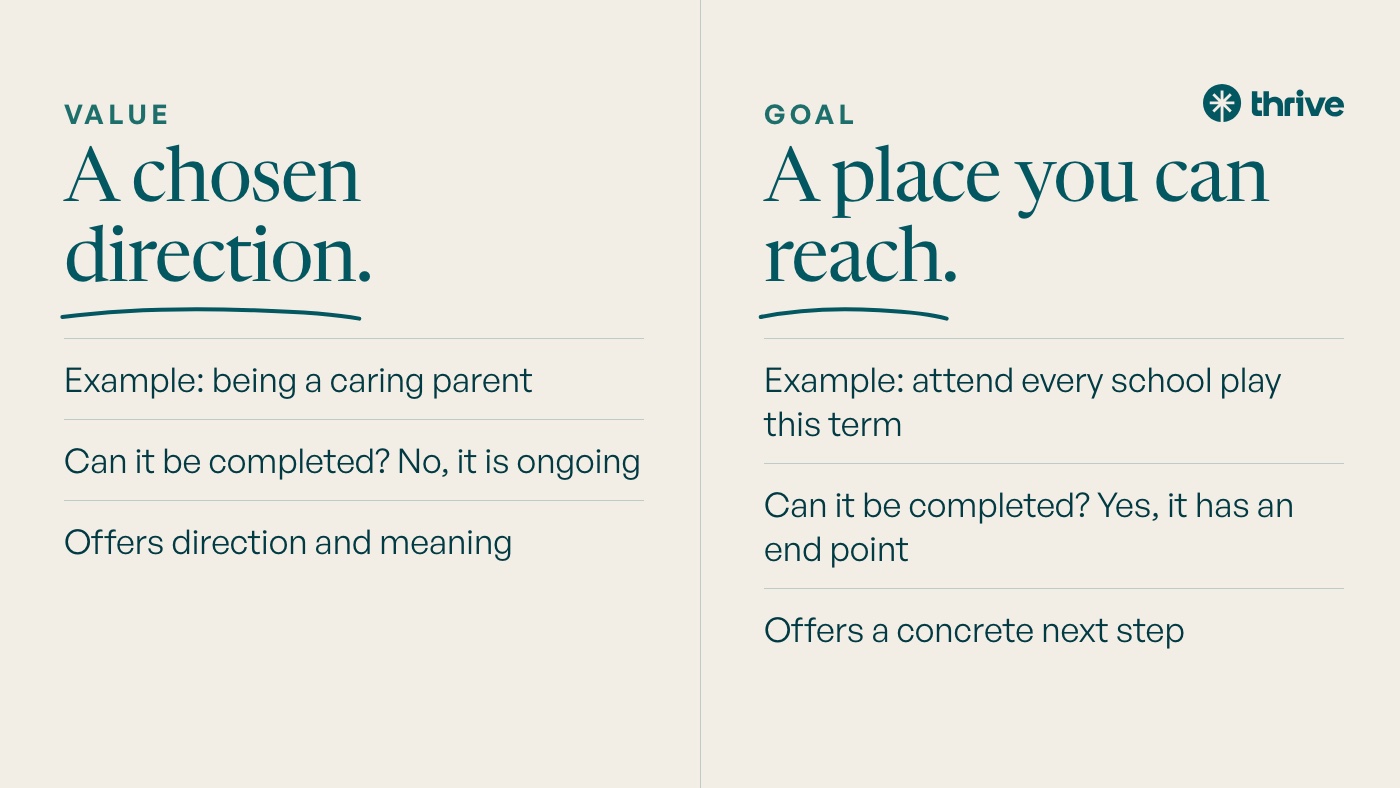
| Value | Goal | |
|---|---|---|
| Example | Being a caring parent | Attend every school play this term |
| Can it be completed? | No, it is ongoing | Yes, it has an end point |
| Who controls it? | You, in this moment | Partly you, partly circumstances |
| What it offers | Direction and meaning | A concrete next step |
1. Values or goals sort. Read a list of 12 statements aloud. Members sort each into “value” or “goal,” then turn every goal into the value behind it. Facilitation note: expect debate. It shows the idea is landing.
Values identification activities
2. Values card sort. Give members a deck of 30 to 50 value words, such as honesty, adventure, or family. They sort cards into very important, important, and not important. Then they narrow the first pile to five. Virtual: use a shared document or a printable list members sort at home.
3. Sweet spot memory. Members recall a moment when life felt rich and meaningful, even if brief. They describe it in detail, then name the values present in it. Memories often reveal values better than lists do.
4. The pain and values link. Ask members what hurts most right now. Then ask what that pain says about what they care about. Loneliness often points to connection, and guilt often points to responsibility. Facilitation note: go slowly, and let members choose a milder example.
5. Admired person exercise. Members name someone they admire and list three qualities that draw them to that person. Those qualities often mirror the member’s own values.
6. The 80th birthday speech. Members imagine a friend giving a toast at their 80th birthday. What would they hope the friend says about how they lived? This is a gentler version of the classic eulogy exercise and suits most groups better. Facilitation note: offer it in place of the eulogy for anyone recently bereaved.
Values mapping activities
7. The values bullseye. Draw a target with four quadrants: work and education, relationships, personal growth and health, and leisure. Members write a value in each quadrant. Then they mark how close their recent actions came to the center. Virtual: share a blank bullseye image members can draw on paper and hold to the camera.
8. Life domains rating. List ten life areas, from family to community. Members rate each one twice from 1 to 10: how important it is, and how consistently they acted on it this week. The biggest gaps show where to start.
9. Life compass. Members draw a compass with one value at each point. In the center, they write the obstacles that pull them off course. It turns abstract values into a picture they can keep.
Values work appears to add something on its own. A meta-analysis of laboratory component studies found that individual ACT components, including values, produced measurable effects. For a wider look at the approach, see our comparison of ACT and CBT.
Values in action activities
10. Choice point. Draw a fork. At the bottom, members write a hard situation and the feelings it brings. On one branch, they list “away moves” that ease pain fast but cost them. On the other, they list “toward moves” that fit their values.
11. Smallest next step. Members pick one value and name the smallest action they could take this week that fits it. It should take under ten minutes. Small steps build momentum and lower the stakes of falling short.
12. Values-based weekly plan. Members schedule three small valued actions in their calendar for the coming week. The next session opens with what happened, including what got in the way.
13. Values affirmation writing. Members write for ten minutes about why one chosen value matters to them. Research on self-affirmation, reviewed in the Annual Review of Psychology, suggests brief values writing can reduce defensiveness under stress in some settings.
Group sharing and closing activities
14. Values witness round. Each member names one value and one action they took toward it. Others respond only with what they noticed, not advice. Being witnessed tends to strengthen commitment.
15. Values postcard. At the end of a module, members write a postcard to themselves naming their top values and one promise. Collect them and return them in a month. Virtual: members email the note to themselves with a scheduled send.
Shared work like this also builds cohesion. A meta-analysis of group therapy research links cohesion to better outcomes. For more group formats, see our mindfulness group activities for adults and DBT group activities for adults.
How should you sequence values work across a group module?
Order matters more than any single exercise. A four-session arc works well for most adult groups, and each step builds on the last.
 Beginner’s Guide to Understanding TraumaMental Health
- Session one: define and identify. Teach values versus goals, then run the sort (1) and the card sort (2). Members leave with a short list of five values.
- Session two: deepen. Use the sweet spot memory (3) and the 80th birthday speech (6). These add personal meaning to the words on the list.
- Session three: map the gap. Run the bullseye (7) or the life domains rating (8). Members see where daily life and values drift apart.
- Session four: act. Use the choice point (10) and the smallest next step (11). Members leave with one concrete action to try that week.
After the arc, return to values briefly in every session. A two-minute check on last week’s valued action keeps the work alive. Without that check, values work tends to fade into a pleasant exercise that members forget by the next month.
How do you facilitate values work safely?
- Keep values chosen, not assigned. Members may feel pulled to name the values family or culture expects. Ask, “If no one would ever know, would you still choose this?”
- Expect grief. Seeing the gap between values and actions can hurt. Normalize it as a sign of caring, not failure.
- Skip ranking contests. No value is better than another. Keep the focus on each member’s own list.
- Pair values with willingness. Valued action often brings discomfort. Link these activities to acceptance skills taught earlier.
- Structure virtual rooms tightly. Name the next speaker, use chat for sorts, and keep rounds short.
Virtual delivery holds up well. A study of adults in intensive treatment found telehealth outcomes comparable to in-person care.
What does the evidence say about ACT and values work?
ACT has a solid research base. A 2015 meta-analysis in Psychotherapy and Psychosomatics found ACT outperformed control conditions for a range of mental and physical health problems. The National Institute of Mental Health lists ACT among common types of psychotherapy.
The honest limit: most trials test full ACT protocols, not single exercises. Use these activities as parts of a treatment plan, not as stand-alone treatments.
Common questions about values clarification activities
How long does a values clarification activity take?
Most take 15 to 25 minutes with debrief. The card sort and bullseye can fill a full session if you let them.
Which activity should I start with?
Start with the values or goals sort, then the card sort. Both are low risk and build shared language.
What if a member says they have no values?
That is common during depression. Try the sweet spot memory or the admired person exercise, which work from experience instead of lists.
Can values change over time?
Yes. Revisit the card sort every few months. Shifts are normal and worth discussing.
Do these activities work outside ACT?
Yes. They fit well alongside CBT, DBT, and motivational interviewing, wherever direction and motivation matter.
For clinicians: when weekly sessions are not enough
Some clients know what they value but cannot act on it while symptoms keep rising. When weekly sessions are not holding, an intensive outpatient program adds nine or more hours of structured care each week. You can see how our virtual IOP works here.
Thrive Mental Health runs adult-only virtual IOP across Florida, Indiana, Arizona, California, North Carolina, South Carolina, and Texas, including our Florida program. We specialize in adults and are accredited by The Joint Commission for Behavioral Health Care and Human Services. Refer a patient here, or reach our clinical team at (561) 203-6085. Referred patients are typically assessed within days, and we coordinate care back to you at discharge.

This article is for informational purposes only and is not a substitute for individualized clinical advice or insurance verification.