





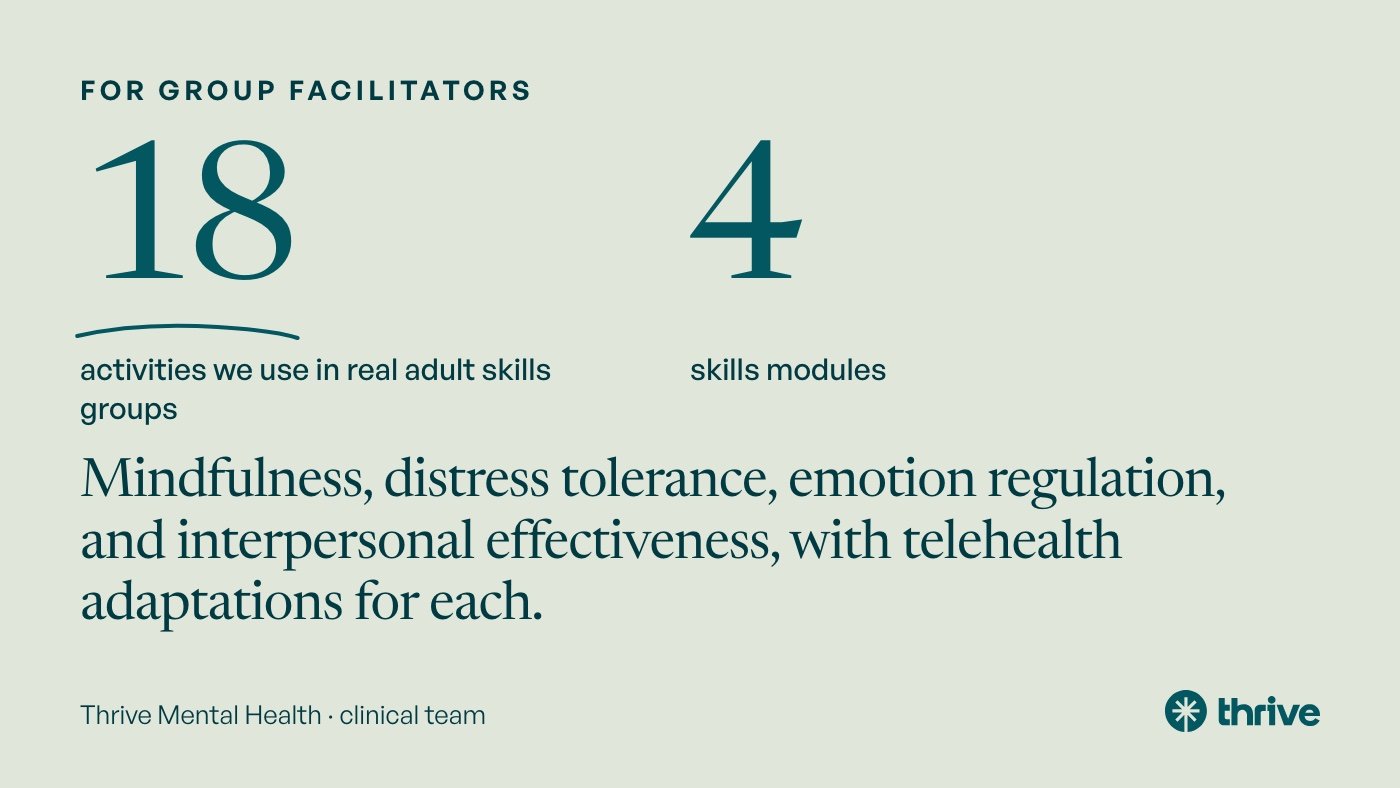
Good DBT group activities for adults turn the four skills modules (mindfulness, distress tolerance, emotion regulation, and interpersonal effectiveness) into something experiential rather than a lecture. Below are 18 activities we use in real adult skills groups, organized by module, with facilitation notes and telehealth adaptations for each. They are written for clinicians, group facilitators, and counselors-in-training, and they work in both in-person and virtual rooms.
Skills training is not decoration on top of DBT; it is one of the treatment’s active ingredients. A component-analysis randomized trial led by Marsha Linehan found that interventions including skills training outperformed versions without it. The activities below exist to make those skills stick, not to fill a session block.
Mindfulness activities
1. The observe-and-describe object pass. Pass an ordinary object (stone, key, orange) around the group. Each member states only observable facts, no judgments. When someone slips into evaluation (“this is ugly”), the group gently flags it. Teaches the observe/describe split faster than any handout. Telehealth: each member grabs any object within reach.
2. One-mindful tea or coffee. Three minutes of drinking a warm beverage with full attention: temperature, weight of the cup, steam, taste. Debrief on where the mind went. Normalizes wandering as data, not failure.
3. Sound inventory. Sixty seconds of silence; members list every sound they heard. In virtual groups the differences between homes become the teaching point: same exercise, different data, zero “right” answers.
4. Wise mind check-in round. Open each session by asking members to name whether they arrived in emotion mind, reasonable mind, or wise mind, with one sentence of evidence. Builds the module vocabulary through repetition without re-teaching it.
Meditation-based practice has evidence beyond DBT itself: a JAMA Internal Medicine systematic review and meta-analysis found mindfulness programs produce small to moderate reductions in anxiety and depression across diverse adult populations.
Distress tolerance activities
5. TIP demonstration with ice. Members hold an ice cube (or run cold water over wrists) while rating distress before and after. A live demonstration that physiology can be steered. Screen for contraindications first, and make participation optional. Telehealth: ask members to bring a cup of ice to session.
6. Build-your-own crisis kit. Each member lists five concrete items for a distress-tolerance box: a photo, a scent, a playlist, a phone number, a written card. Share one item aloud. Homework is assembling the physical kit before next session.
7. Pros-and-cons grid on a real urge. On a shared whiteboard, run the four-quadrant grid (acting on the urge vs riding it out, short term vs long term) on a member-volunteered example. The group fills the quadrants together.
8. Distraction relay (ACCEPTS). Go around the circle; each member names one distraction strategy per letter of ACCEPTS. Fast, competitive, and it surfaces strategies quieter members already use.
Emotion regulation activities
9. Emotion-model walk-through. Take one recent, low-stakes emotional event from a volunteer and map it on the DBT model: prompting event, interpretation, body sensations, urges, action. The group predicts each next box before the volunteer reveals it.
10. Opposite action theater. Pairs draw an emotion card (anger, shame, fear, sadness) and role-play the action urge, then the opposite action. The group guesses both. Playful format, serious rehearsal.
11. PLEASE audit. Members self-score the vulnerability factors (physical illness, eating, substances, sleep, exercise) for the past week, then pick the single cheapest improvement. Revisit scores weekly; the trend line becomes its own motivator.
12. Emotion granularity ladder. Start with “bad” and ladder it: bad, upset, hurt, dismissed, unseen. Research on emotion regulation strategies, including a meta-analysis across psychopathology, supports the value of precise labeling and flexible strategy use over suppression.
For more body-based and creative options that pair well with this module, see our art therapy activities for adults and mentalization-based therapy activities.
Interpersonal effectiveness activities
13. DEAR MAN rehearsal with escalation. One member scripts a real ask using DEAR MAN. A partner plays the other person at three difficulty levels: receptive, distracted, hostile. Debrief what held up under pressure. The most-requested activity in our adult groups.
14. Boundary line-up. Read scenarios aloud (“a friend asks to borrow money for the third time”). Members place themselves on an imaginary line from “always yes” to “always no” and defend their spot in one sentence. Makes values visible and disagreement safe. Telehealth: use a 1-10 chat vote instead of a physical line.
15. GIVE feedback fishbowl. Two volunteers hold a two-minute conversation on a neutral prompt while the group scores GIVE elements (gentle, interested, validate, easy manner) with concrete examples. Rotate so everyone gets observed once over the course of the module.
16. Repair-attempt drafting. Each member writes the first two sentences of a repair message for a real, named rupture. Volunteers read theirs; the group strengthens them using the skills vocabulary. Homework is sending it, if wise mind agrees.
Closing and cohesion activities
17. Skill-of-the-week testimony. End sessions with one concrete story of a skill used since last group, told in under a minute. Cohesion is not a nicety: a meta-analysis of 55 studies ties group cohesion to outcomes at nearly the same strength as the therapeutic alliance in individual work.
 How to Book Virtual Therapy Online: A Clear, Simple ProcessTherapy
18. Diary card bingo. A light-touch accountability game: a bingo grid of skills; members mark squares as they report real uses from their diary cards. First line wins nothing but applause. Attendance on diary-card review improves anyway.
Facilitation notes for adult groups
- Teach less, rehearse more. Adults in skills groups have usually heard the concepts. The gap is practice under mild pressure, which is what these formats supply.
- Keep participation invitational. Every activity above works with pass-outs allowed. Coerced vulnerability damages cohesion faster than silence does.
- Debrief with the model, not just feelings. “Which skill was that, and when would you use it this week?” turns a fun exercise into transfer.
- Virtual rooms need tighter structure. Name the next speaker, use the chat for votes, and keep rounds short. Well-run telehealth groups perform: intensive virtual treatment shows outcomes comparable to in-person care.
If you want printable companions for these modules, our DBT worksheets collection and DBT overview pair with everything above. For creative warm-ups that open a brand-new group, our art therapy group activities collection works well.
Common questions about DBT group activities
How long should a DBT group activity run?
Ten to twenty minutes including debrief, inside a 90-minute skills session. Protect time for diary-card review and homework assignment.
Do these activities work in virtual groups?
Yes, with adaptations noted above: household objects, chat-based votes, cups of ice. Structure and named turns replace the physical room’s cues.
Can I use DBT activities outside a full DBT program?
Skills-informed groups are common and useful, but be transparent that a skills group alone is not comprehensive DBT, which also includes individual therapy and coaching.
What group size works best for adults?
Six to ten members. Below six, role-plays thin out; above ten, rehearsal time per member collapses.
What if a member escalates during a distress tolerance exercise?
Screen first, keep exercises optional, and have a grounding protocol ready. Any activity that touches live distress needs a licensed clinician in the room.
For clinicians: when a skills group is not enough
Some group members need more than a weekly skills hour: symptoms are escalating, functioning is slipping, and the week between sessions keeps undoing the work. That is the gap an intensive outpatient program fills, with DBT skills embedded in nine-plus hours of weekly structure.
Thrive Mental Health runs adult-only virtual IOP across Florida, Indiana, Arizona, California, North Carolina, South Carolina, and Texas. We are accredited by The Joint Commission for Behavioral Health Care and Human Services, and we specialize in adults. Refer a patient here, or reach our clinical team directly at (561) 203-6085. Referred patients are typically assessed within days, and we coordinate care back to you at discharge.

This article is for informational purposes only and is not a substitute for individualized clinical advice or insurance verification.