




To appeal a denied mental health claim in Arizona, start with an initial appeal to your insurer, which Arizona law lets you request in writing or by phone. If the insurer still says no, you can ask for an external independent review run by the Arizona Department of Insurance and Financial Institutions (DIFI), and the insurer must follow a decision in your favor. One thing changes the whole path: whether your plan is insured in Arizona or self-funded by your employer.
This guide covers both paths, the Arizona timelines written into state law, the documents worth requesting, and the fast track for when intensive outpatient care can’t wait.
This article is informational, not clinical, legal, or financial advice. Verify your rights with your plan documents and, where needed, a licensed professional.
Does Arizona’s appeal law cover your plan?
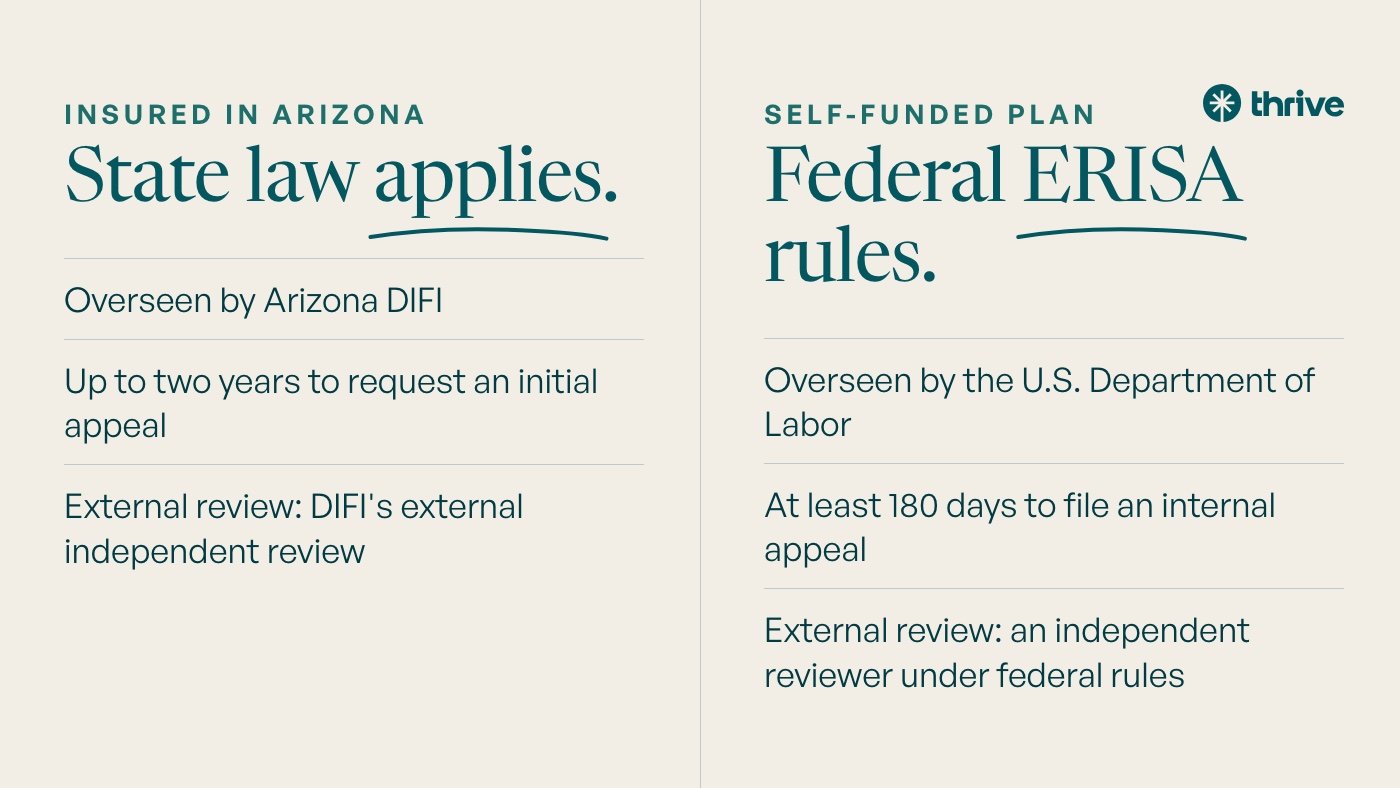
Arizona’s health care appeals law sits in Title 20 of the Arizona Revised Statutes. It applies to insurers operating in the state. It does not apply to self-insured or self-funded employer plans governed by the federal ERISA law. It does apply when an insurance company carries the risk for an employer plan.
| Your plan | Who oversees it | Where external review goes |
|---|---|---|
| Individual or Marketplace plan sold in Arizona | Arizona DIFI | DIFI’s external independent review |
| Fully insured employer plan | Arizona DIFI | DIFI’s external independent review |
| Self-funded employer plan | U.S. Department of Labor (ERISA) | An independent reviewer under federal rules |
Your insurance card won’t settle this. A self-funded plan often uses a big carrier’s name and network, so the card can look identical. Ask HR or the plan administrator one direct question: “Is our plan fully insured or self-funded?” The answer decides which deadlines below apply to you.
What should you pull from the denial letter first?
Arizona law requires insurers to explain their decisions. Each written decision must include the basis, criteria used, clinical reasons and rationale. Read your letter with a pen and mark these items.
- The reason. Is it medical necessity, or a question of whether the plan covers the service at all? Arizona sends these two kinds of disputes to different reviewers later on.
- The criteria. Note the name of any guideline the plan cites. You will want the full text.
- What was denied. The whole program, a number of days, or a bill for care you already received.
- The appeal contact. The letter or your plan’s appeal packet names the person, address, and fax or email to use.
- The deadline. If your letter shows a date, write it on your calendar today.
Next, request the rules the plan used. Under A.R.S. 20-2532, you or your treating provider can ask in writing for the parts of the insurer’s review plan that apply to your request. Send that request to the insurer, not to DIFI. Insurers must also post their approved appeals information packet on their website, so look there for forms and contacts.
Step one: the initial appeal and the optional second round
Arizona calls the first internal level the initial appeal. You can request it orally or in writing. The statute gives you up to two years after the denial to ask. Even so, filing fast is the better move when care is on hold.
Some group plans add a second internal level called a voluntary internal appeal. If your plan has one, you must file it in writing within 60 days of the initial appeal decision. Individual plans that aren’t grandfathered skip this step.
| Arizona stage (insured plans) | Timeline under state law |
|---|---|
| Request an initial appeal | Up to two years after the denial |
| Decision, care not yet received (one internal level) | Within 30 days |
| Decision, claim for care already received (one internal level) | Within 60 days |
| Plans with a voluntary internal appeal | 15 days per level for future care; 30 days per level for past care |
| File a voluntary internal appeal | Within 60 days, in writing |
| Request external independent review | Within four months of the final internal denial |
| Reviewer’s decision | 21 days after the reviewer gets the case, plus up to 10 days if extended |
When the question is medical necessity, Arizona requires a qualified provider to review the appeal. The statute spells out that medical necessity includes “level of care” and “health care setting.” That language fits most IOP denials, where the plan agrees you need help but disputes how much.
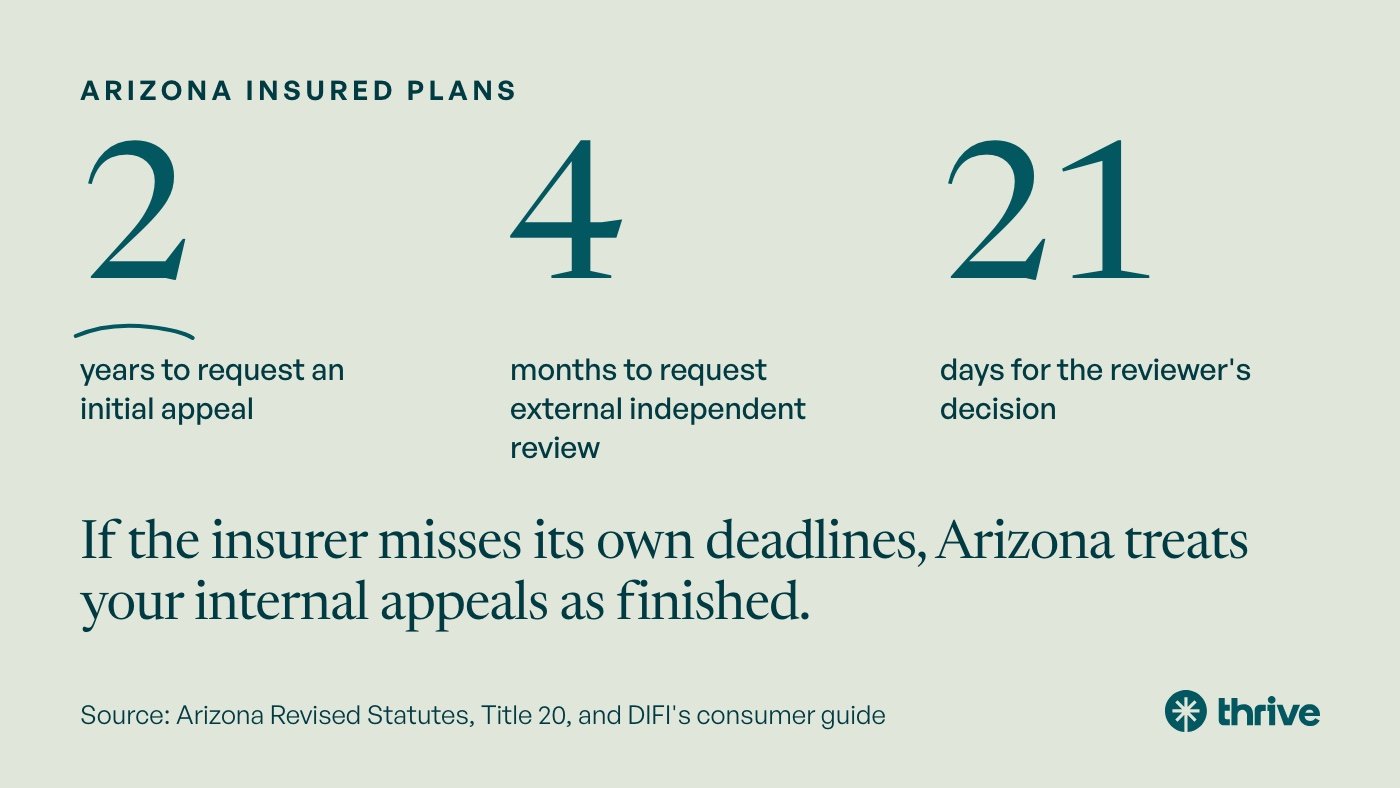
If the insurer misses its own deadlines, Arizona treats your internal appeals as finished. You can then move straight to an expedited external review, unless you agreed to the delay.
What makes an Arizona appeal letter persuasive?
Reviewers compare your records with the plan’s criteria. A letter that does that comparison for them is easier to approve. Arizona’s appeals packet rules also warn members to send supporting documents when they file, so don’t hold anything back for later.
- Identify the claim. Name, member ID, claim or reference number, service dates, and the date of the denial.
- State the request in one line. “I am appealing the denial of intensive outpatient treatment and ask that it be approved.”
- Describe current symptoms and impact. Sleep, work, relationships, safety, and daily functioning, with recent examples.
- List what you already tried. Weekly therapy, medication changes, or past programs, with rough dates.
- Explain the level of care. An intensive outpatient program gives at least nine hours of structured care a week while you live at home. Say why weekly therapy is not enough right now.
- Answer the criteria one by one. Quote each criterion and point to the record that meets it.
- Attach evidence. A letter of medical necessity from your clinician, recent symptom scores, and treatment notes.
Some denials question virtual care itself. Research can help there. A matched study of 2,384 adults in intensive treatment, published in the Journal of Psychiatric Research, found telehealth and in-person care produced similar improvement in depression.
Can you speed things up when IOP can’t wait?
Yes. Arizona has an expedited track for care you haven’t received yet. Your treating provider starts it by certifying in writing that the normal timeline is likely to cause a significant negative change in your condition. The insurer cannot challenge that certification.
- Expedited medical review: the insurer has 72 hours to decide and notify you and your provider.
- Expedited appeal: if the denial stands, your provider can appeal at once, and the insurer has three business days to decide.
- Expedited external review: after an expedited denial, the independent reviewer has 72 hours from receiving the case to decide.
The expedited external track also covers mid-treatment cutoffs. Under A.R.S. 20-2537, it applies when a plan ends coverage for a course of treatment before the number of sessions your provider recommended. That matters in IOP, where plans often approve care in short blocks and review it again.
The expedited track does not apply to bills for care you already received. Those go through the standard path.
If you are in crisis or thinking about harming yourself, call or text 988, or go to the nearest emergency room. The appeal can wait. Your safety can’t.
Step two: external independent review through DIFI
Once internal appeals are done, you have four months from the final written denial to ask for external independent review. You send the written request and any supporting documents to your insurer. The insurer then has five business days to acknowledge it and forward your whole file to DIFI.
That acknowledgment matters. It gives you five business days to send DIFI any extra written evidence for the reviewer. Use that window for a fresh clinician letter or updated scores.
From there, Arizona splits cases into two tracks, as DIFI’s consumer guide to the health care appeals process explains:
 Feeling Stressed? CBT Techniques to the Rescue!Mental Health
- Medical necessity cases: DIFI sends the case to an independent review organization (IRO) within five days. The IRO uses a provider who typically manages your condition. It decides within 21 days, which DIFI can extend by up to 10 days for good cause.
- Coverage cases: when the only question is what your policy covers, DIFI itself decides within 15 business days of getting the full file.
A decision for you is binding. The insurer must provide the service or pay the claim without delay, even if it seeks court review. The state also bills your insurer for the reviewer’s fee, not you. One limit applies: no reviewer can order coverage for a service your contract clearly excludes.
What if your plan is self-funded?
Self-funded plans follow federal ERISA rules, and the Department of Labor oversees them. The steps look similar, but the clocks differ.
- Internal appeal: you have at least 180 days to file. The plan decides within 30 days for care you haven’t had, and 60 days for past care, per the Labor Department’s guide to filing a claim for your health benefits.
- Urgent appeals: decided within 72 hours. For urgent claims, your treating clinician can act for you without a form.
- External review: HealthCare.gov says standard reviews take no more than 45 days and expedited ones no more than 72 hours. Check your plan’s denial letter for the deadline to request one.
For questions about a self-funded plan, the Labor Department’s Employee Benefits Security Administration takes calls at 1-866-444-3272.
How does mental health parity help an Arizona appeal?
The federal Mental Health Parity and Addiction Equity Act bars plans from making mental health care harder to get than comparable medical care. It covers both insured and self-funded plans. It reaches cost sharing and treatment limits, plus rules like prior authorization and review frequency.
- Ask for the criteria. Federal rules require plans to share their medical necessity criteria for mental health benefits on request.
- Compare the hurdles. If IOP is reviewed every few days but similar medical programs are not, say so.
- Request the plan’s comparison. Plans must analyze how their rules apply to mental health versus medical care. You can ask for it.
Federal agencies paused enforcement of newer parts of a 2024 parity rule in May 2025. The core law and the older rules still apply.
Arizona carriers handle IOP reviews in their own ways. Our guide to virtual IOP with Arizona Blue explains one carrier’s approach. If the plan itself is the problem, our Arizona open enrollment guide shows what to check before you choose next year’s coverage.
Common questions about appealing a mental health denial in Arizona
How long do I have to appeal a denied mental health claim in Arizona?
For insured plans, state law allows up to two years to request the initial appeal and four months to request external review. Self-funded plans follow federal rules, so check your plan’s denial letter for the deadline.
Does it cost anything to use Arizona’s external review?
Arizona law has the state bill your insurer for the independent reviewer. There is also no minimum claim amount to appeal.
Can my therapist file the appeal for me?
Often, yes. Arizona’s law counts your treating provider as someone who can pursue the appeal. Your provider also starts the expedited track by certifying that waiting would harm you.
Can DIFI help with my employer plan?
Only if an insurer carries the risk. Self-funded employer plans fall under federal law, and the U.S. Department of Labor handles them.
Can I stay in IOP while I appeal?
You can, but you may owe the bill if the appeal fails. If coverage ended mid-treatment, ask about Arizona’s expedited external review.
What happens if the reviewer agrees with me?
The insurer has to cover the care or pay the claim without delay. Keep copies of every letter in case a later claim is processed wrong.
Next steps
A denial is stressful, and it can stall care you need. A clear view of your benefits helps you decide what to do next. Thrive Mental Health is a Joint Commission accredited provider of virtual intensive outpatient care for adults in Arizona, Florida, Indiana, California, North Carolina, South Carolina, and Texas. Our team requests and tracks prior authorization as part of admission, and we explain how your insurance works with Thrive before you commit.
Verify your coverage with Thrive: free, confidential benefits check. Most members receive a summary within 24 hours, and you can start as soon as you are ready. Prefer to talk first? Call (561) 203-6085.

This article is for informational purposes only and is not a substitute for individualized clinical advice or insurance verification.