




Good journal prompts for adults in therapy are specific, tied to a treatment goal, and short enough to finish in ten minutes. Below are 50 therapy journal prompts grouped by goal (anxiety, low mood, relationships, values, self-compassion, and between-session practice), with notes on how to assign them and when journaling can feed rumination instead of easing it. They are written for therapists, counselors, and group facilitators working with adults, in person or on video.
Writing about feelings has decades of research behind it, but the effects are smaller than most prompt lists suggest. Use these prompts as structured homework that links back to session, not as free-floating self-help.
What does the research say about therapeutic journaling?
Most of the evidence comes from expressive writing, the method James Pennebaker began testing in the 1980s. Here is the honest summary.
- The original finding was striking. In Pennebaker and Beall’s 1986 study, students who wrote about a traumatic event for a few days made fewer health center visits in the months that followed.
- Early pooled results looked strong. A 1998 meta-analysis of written emotional expression found meaningful benefits across health and well-being outcomes.
- Later reviews found smaller effects. A 2006 meta-analysis of 146 studies found a small overall benefit that varied with how, where, and for whom the writing was done.
- It may help with brooding. One randomized trial of expressive writing found lower depressive symptoms over six months, partly by reducing brooding.
- Doing the homework matters. A meta-analysis of homework in CBT linked both the amount and the quality of homework completion to better outcomes.
The takeaway: journaling is a modest, low-cost add-on. It works best when it is structured and reviewed in session.

Journal prompts for anxiety
- What am I worried about right now, in one sentence?
- What is the worst outcome, the best outcome, and the most likely outcome?
- What evidence supports this worry? What evidence does not?
- What would I tell a friend who had this exact worry?
- What part of this situation can I control today?
- When did I last feel this anxious, and how did it turn out?
- Where do I feel this anxiety in my body, and what does it feel like?
- What am I avoiding, and what is avoidance costing me?
- What is one small step toward the thing I fear this week?
How to assign: pair prompts 2 and 3 with a CBT thought record. Ask the client to write for no more than ten minutes, then stop. Our page on CBT in a virtual IOP covers the skills these prompts support.
Journal prompts for low mood
- What did I do today, even if it felt small?
- What gave me even a little energy this week?
- What activity used to matter to me that I have stopped doing?
- What is one thing I could do tomorrow that past me would have enjoyed?
- What thought kept coming back today? Is it a fact or a feeling?
- Who could I contact this week, even briefly?
- What is one moment from today I would keep if I could?
- How did my mood change across the day?
- What do I need right now that I am not asking for?
How to assign: link prompts 12 and 13 to behavioral activation. Ask the client to plan, not just reflect. See our depression care page for how these skills fit into structured treatment.
Journal prompts for relationships
- Which relationship takes most of my energy right now?
- What do I need from this person that I have not said out loud?
- When did I last feel truly heard? What made it work?
- What pattern keeps repeating in my conflicts?
- What boundary do I want to set, and what makes it hard?
- How might the other person describe our last argument?
- Who do I feel safest with, and why?
- What is one repair I could make this week?
How to assign: prompt 24 is a mentalizing exercise. Review it carefully in session, because clients can drift into blame or self-blame.
Journal prompts for values and direction
- What matters most to me, in three words?
- When did I last act in line with those values?
- What would I want people to say about me at 80?
- What am I doing out of habit that no longer fits who I am?
- What would a meaningful week look like, not a perfect one?
- What fear keeps me from moving toward what I value?
- What small action this week would reflect my values?
- What am I proud of that nobody else knows about?
How to assign: these fit ACT values work. Ask for one concrete behavior at the end of each entry.
Journal prompts for self-compassion
- What would I say to a friend who made the mistake I made today?
- What am I being hard on myself about this week?
- What is something I handled better than I would have a year ago?
- What does my inner critic sound like? Whose voice is it?
- What would a kinder voice say instead?
- What does rest look like for me, and do I allow it?
- What part of my story deserves more understanding?
- What am I carrying that is not mine to carry?
How to assign: prompts 38 and 39 work as a pair. Write the critic first, then the kinder voice, on facing pages.
Prompts for between-session practice
- What from last session stuck with me this week?
- What skill did I try, and what happened?
- When did I want to use a skill and did not? What got in the way?
- What do I want to make sure we talk about next time?
- What felt different this week, even slightly?
- What was the hardest moment of the week, and how did I get through it?
- What question do I have for my therapist?
- On a scale of 1 to 10, how was my week, and why that number?
How to assign: these keep homework connected to the work. Start the next session by asking which prompt the client chose.
How should you assign journal prompts?
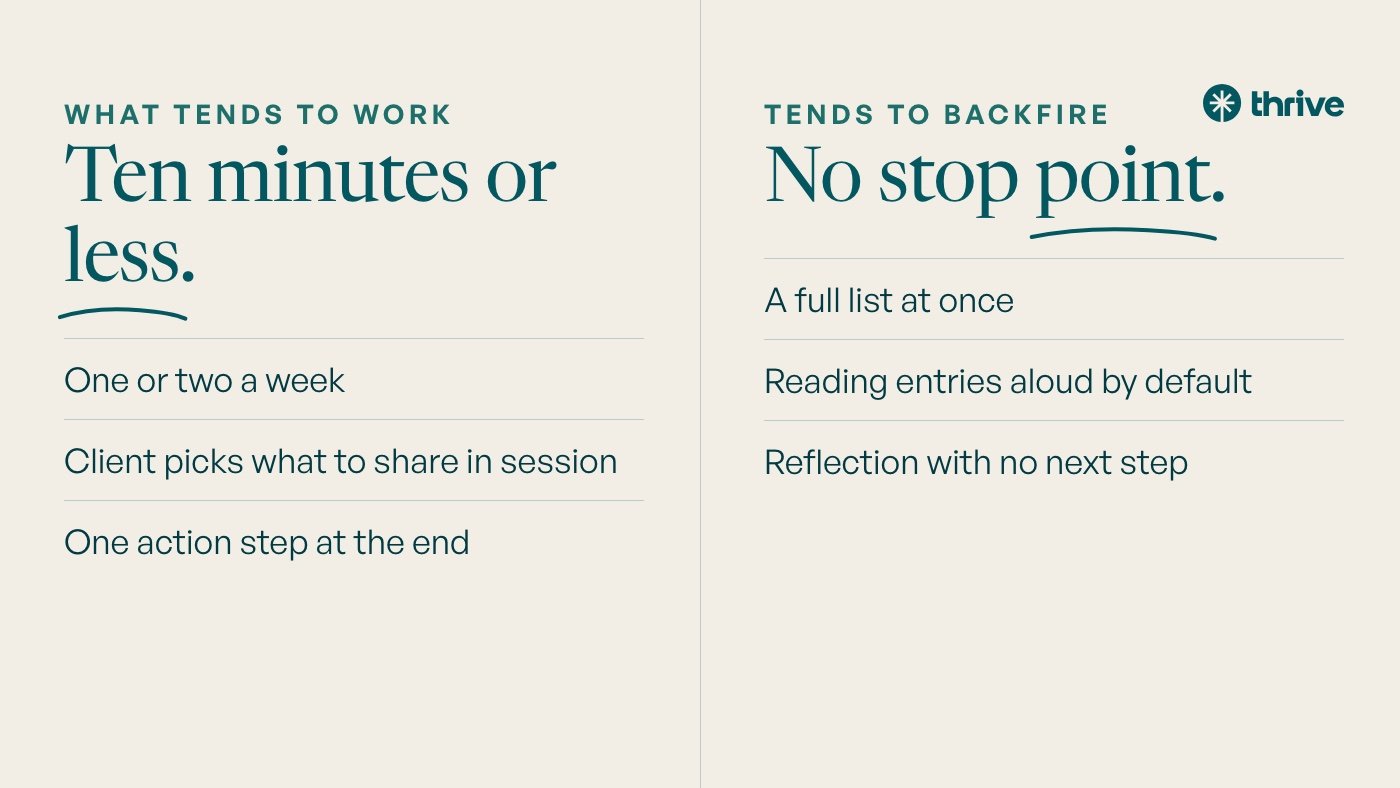
| Assignment choice | What tends to work | What tends to backfire |
|---|---|---|
| Number of prompts | One or two a week | A full list at once |
| Length | Ten minutes or less | Open-ended writing with no stop point |
| Format | Paper, notes app, or voice memo | One required format |
| Review | Client picks what to share in session | Reading entries aloud by default |
| Follow-up | One action step at the end | Reflection with no next step |
Telehealth tips: ask clients to hold an entry up to the camera or paste a line into the chat. Keep the journal off shared devices if privacy at home is a concern. Virtual care holds up for structured work; a study of adults in intensive treatment found telehealth outcomes comparable to in-person care.
 Passive Suicidal Ideation in ADHD: Why Your Brain Might Feel This WayMental Health
When should a client not journal?
Journaling can turn into rumination: going over the same problem without moving toward a solution. Research on rumination and repetitive thought shows that abstract, “why me” thinking tends to keep low mood going. Concrete, “what next” thinking tends to help.

Pause or change the assignment if:
- Entries repeat the same loop week after week, with no new detail.
- Mood drops after writing and stays low for hours.
- Trauma memories flood in without the support to process them. Keep that work in session.
- Writing becomes avoidance, a way to think about change instead of making it.
Fixes are simple: shorten the time, switch to “what next” prompts, add an action line, or move the topic into session. If a client writes about thoughts of self-harm, follow your safety plan and share the 988 Suicide and Crisis Lifeline.
Common questions about journal prompts for adults in therapy
How often should a client journal between sessions?
Two or three short entries a week is a good start. Consistency matters more than length.
Should therapists read a client’s journal?
Only what the client chooses to share. A sense of privacy tends to make the writing more honest.
Is expressive writing evidence-based?
Yes, with modest effects. Large reviews find small average benefits that vary by person and method.
Can journaling make anxiety or depression worse?
It can when it turns into rumination. Short, concrete prompts with an action step lower that risk.
Do journal prompts work for clients who dislike writing?
Yes. Voice memos, bullet points, or a single sentence all count.
For clinicians: when homework is not enough
Some clients do the homework and still slide. Symptoms rise, functioning slips, and a weekly hour cannot hold the gains. That is when an intensive outpatient program can help, with nine or more hours of structured care each week. Learn how our virtual IOP works.
Thrive Mental Health runs adult-only virtual IOP in Florida, Indiana, Arizona, California, North Carolina, South Carolina, Texas, and Georgia. See our Florida and Texas pages. We are accredited by The Joint Commission for Behavioral Health Care and Human Services, and we specialize in adults. Refer a patient here, or reach our clinical team at (561) 203-6085. Referred patients are typically assessed within days, and we coordinate care back to you at discharge.

This article is for informational purposes only and is not a substitute for individualized clinical advice or insurance verification.