


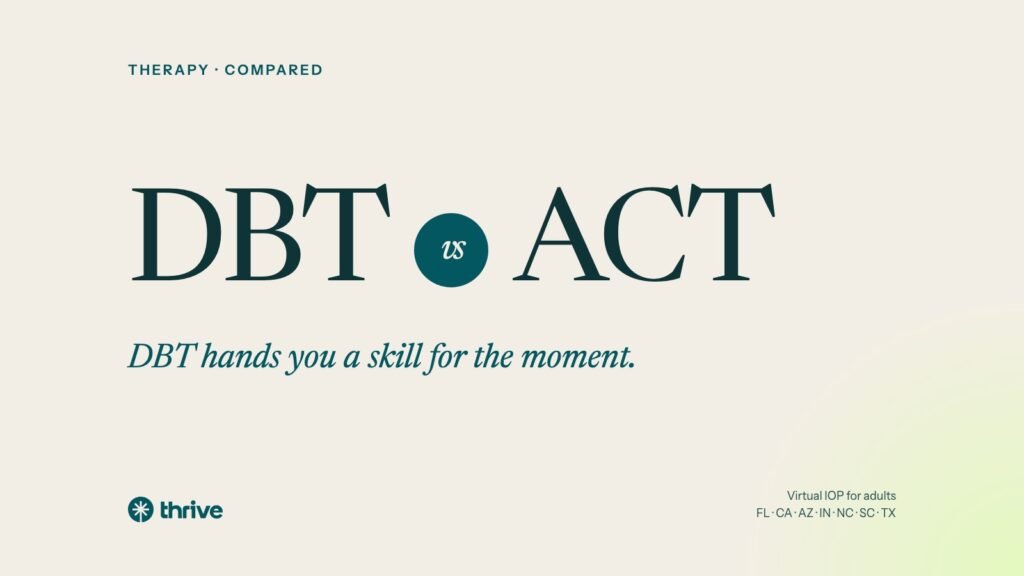

DBT and ACT are both acceptance-based talk therapies, but they aim at different problems. Dialectical behavior therapy (DBT) teaches concrete skills for intense emotions and urges, while acceptance and commitment therapy (ACT) helps you loosen the grip of painful thoughts so you can act on what you value. If your hardest moments feel like emotional floods, DBT is usually the closer fit. If you feel stuck, avoidant or tangled in your own thinking, ACT often is.
This guide compares the two side by side: where each came from, what you actually practice, what the research supports, and how intensive programs use them. We already compared ACT with CBT, so here the focus stays on DBT and ACT.
This article is informational, not clinical advice. A licensed clinician who knows your history is the right person to recommend a specific therapy.
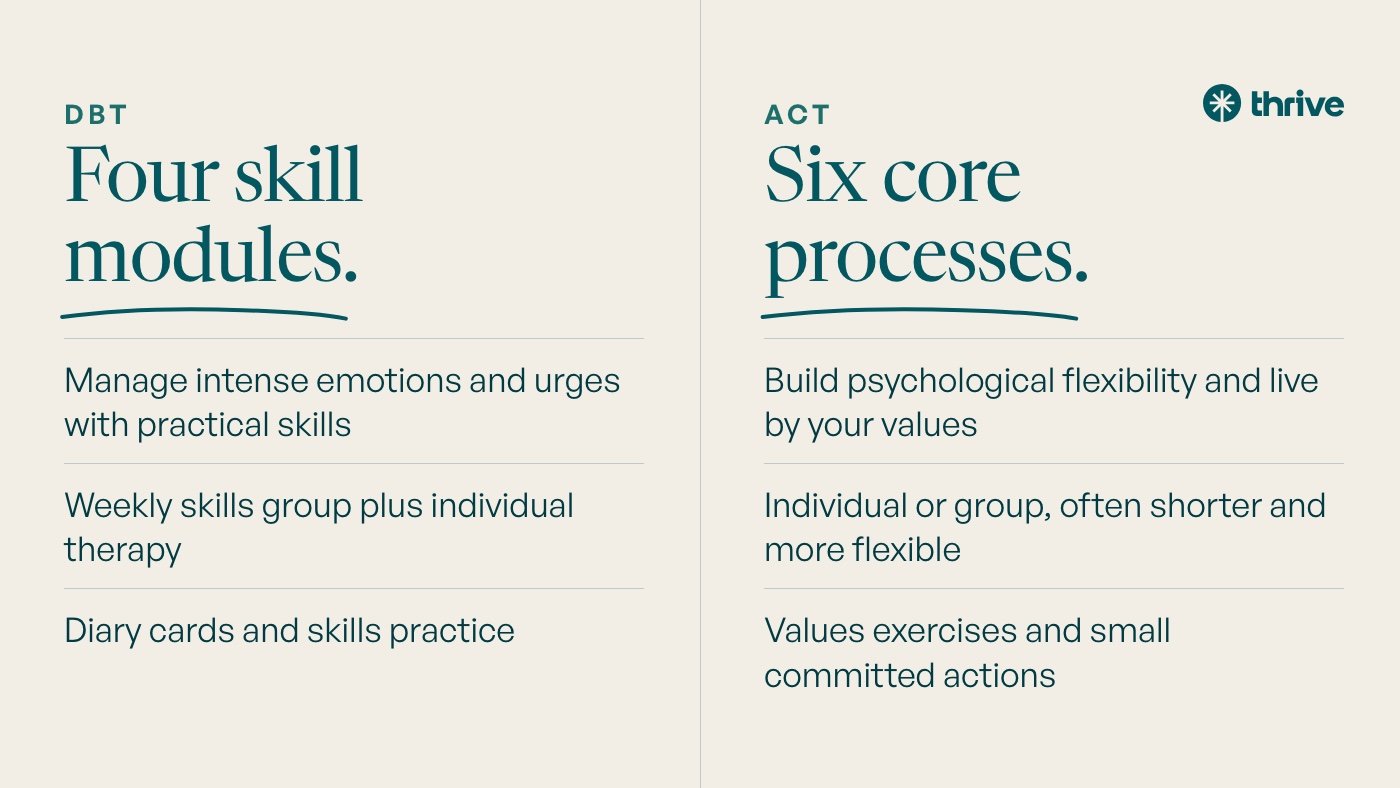
DBT vs ACT at a glance
| Question | DBT | ACT |
|---|---|---|
| Main goal | Manage intense emotions and urges with practical skills | Build psychological flexibility and live by your values |
| Developed by | Marsha Linehan, late 1980s and early 1990s | Steven Hayes and colleagues, 1980s and 1990s |
| Core content | Four skill modules | Six core processes |
| Typical format | Weekly skills group plus individual therapy | Individual or group, often shorter and more flexible |
| Homework | Diary cards and skills practice | Values exercises and small committed actions |
| Strongest evidence | Borderline personality disorder, self-harm, emotion dysregulation | Anxiety, depression, chronic pain, and a wide mix of conditions |
| Feel in session | Structured, skills-teaching, step by step | Experiential, metaphor-heavy, values-led |
Both belong to the “third wave” of behavioral therapy. That label covers approaches that add acceptance and mindfulness to classic behavior change. The overlap is real, but the daily practice feels quite different.
Where did DBT and ACT come from?
DBT started with a hard clinical problem. Psychologist Marsha Linehan was treating women with repeated self-harm and found that standard cognitive behavioral therapy felt invalidating to them. Pushing only for change made people feel unheard. So she paired change strategies with acceptance practices drawn from mindfulness.
Her first randomized trial, published in 1991, tested this approach in women with borderline personality disorder and chronic self-harm. That study in the Archives of General Psychiatry reported fewer self-harm episodes and fewer hospital days than usual care. It set the template DBT still follows.
ACT grew out of a different question. Steven Hayes and colleagues asked why trying to control painful thoughts often makes them louder. Their answer was to change your relationship to thoughts rather than argue with them. A 2006 review in Behaviour Research and Therapy laid out the ACT model, its processes and early outcomes.
What do you actually learn in DBT?
DBT is organized around four skill modules. You learn them one at a time, usually in a weekly group, then apply them with an individual therapist.
- Mindfulness. Noticing what is happening, inside and around you, without judging it. This is the base for every other skill.
- Distress tolerance. Getting through a crisis without making it worse. Skills like TIPP use temperature, movement and paced breathing to calm the body fast.
- Emotion regulation. Naming feelings, checking whether they fit the facts, and using opposite action when a feeling pushes you the wrong way.
- Interpersonal effectiveness. Asking for what you need and saying no while keeping your self-respect. DEAR MAN is the best-known script.
Between sessions you fill in a diary card. It is a short daily log of feelings, urges and the skills you tried. Patterns show up on paper that are hard to see in the moment. Our DBT page describes how these modules run inside a virtual program.
What do you actually learn in ACT?
ACT has no fixed module order. Instead it works on six linked processes that together build psychological flexibility. That means staying in contact with the present moment, even when it hurts, and still choosing actions that matter to you.
- Acceptance. Making room for painful feelings instead of fighting them.
- Cognitive defusion. Seeing a thought as a thought. “I am a failure” becomes “I am having the thought that I am a failure.”
- Present-moment awareness. Paying attention to now rather than replaying the past or rehearsing the future.
- Self-as-context. Noticing that you are bigger than any single thought, feeling or story about yourself.
- Values. Naming what you want your life to stand for, in work, love, health and community.
- Committed action. Taking small, concrete steps toward those values, even with discomfort along for the ride.
ACT sessions lean on metaphors and short experiential exercises. A therapist might ask you to picture your thoughts as passengers on a bus you are driving. The aim is not to feel better first and act later, but to act well while still feeling what you feel.
What does the research say about each?
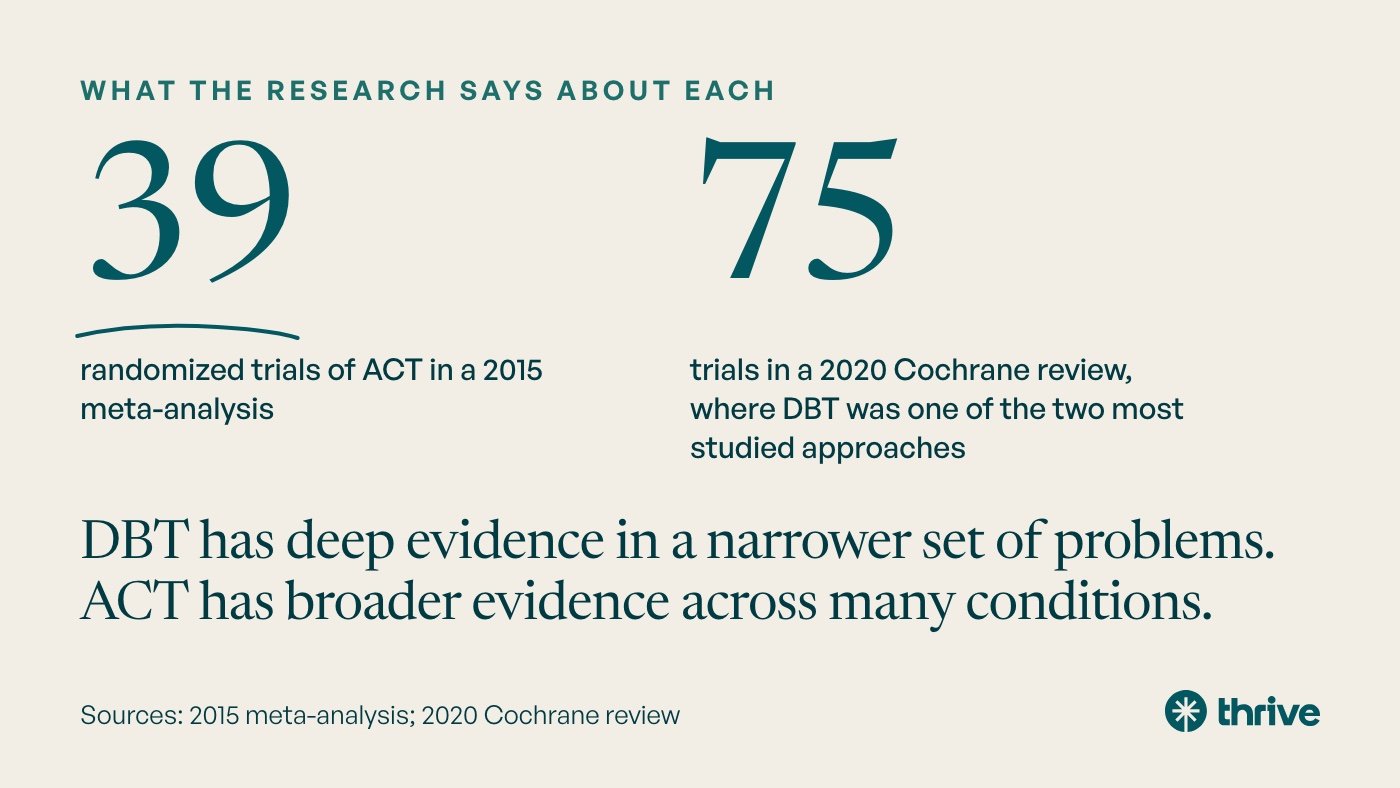
The two evidence bases look different. DBT has deep evidence in a narrower set of problems. ACT has broader evidence across many conditions, with more variation in study quality.
DBT, the core findings:
- A two-year randomized trial compared DBT with therapy from community experts for people with borderline personality disorder. DBT led to fewer suicide attempts and fewer psychiatric hospital admissions.
- A later JAMA Psychiatry trial pulled DBT apart to test its pieces. Versions that included skills training did better on self-harm and depression than individual therapy alone. That points to the skills group as a key ingredient.
- A 2020 Cochrane review of 75 trials found psychotherapy reduced borderline symptom severity compared with usual care. DBT was one of the two most studied approaches, though evidence certainty was often low to moderate.
- DBT skills also travel beyond borderline personality disorder. In a pilot trial of anxious or depressed adults with high emotion dysregulation, a DBT skills group reduced dysregulation and anxiety more than a support group.
ACT, the core findings:
- A 2015 meta-analysis of 39 randomized trials found ACT beat waitlist, placebo and usual care. It performed about as well as established treatments such as CBT for anxiety, depression, addiction and physical health problems.
- A 2025 meta-analysis of ten trials in people diagnosed with depression found ACT reduced depressive and anxiety symptoms. Group ACT appeared more effective than individual ACT, though the authors rated some of the evidence as low certainty.
Federal research agencies treat DBT as an established treatment. The National Institute of Mental Health notes it is funding research on established treatments such as DBT for borderline personality disorder. Neither therapy works for everyone, and fit with your clinician matters in both.
Who tends to do well with DBT?
DBT suits people whose emotions arrive fast, hit hard and take a long time to settle. It also suits people who act on urges and regret it later. Signs it may fit:
- Feelings go from zero to overwhelming in seconds.
- You act on urges you later wish you had not, like lashing out, bingeing or shutting down.
- Relationships feel stormy, confusing or all-or-nothing.
- You want a clear, written skill for hard moments, not just insight.
- You have tried weekly talk therapy and still lack tools for a crisis.
The structure helps when life feels chaotic. Each week has a skill, a practice plan and a diary card. Many people find that predictability calming in itself.
If self-harm or suicidal thoughts are part of the picture, DBT was built for exactly that, and a clinician should guide it. If you are in crisis right now, call or text 988 for the Suicide and Crisis Lifeline.
Who tends to do well with ACT?
ACT tends to suit people whose pain shows up as avoidance, rumination or a sense of being stuck. Signs it may fit:
 Don’t Get Zapped by Zoom Bills: Insuring Your Online Counseling SessionsMental Health
- You spend a lot of energy trying not to feel anxious, and life keeps shrinking.
- Your mind replays the same worries or self-criticism on a loop.
- You live with something that will not fully go away, such as chronic pain or a long illness.
- You feel disconnected from what you care about and want direction more than coping tools.
- Arguing with your thoughts in therapy has started to feel like a dead end.
ACT is also flexible in format. It works in short courses, in groups and alongside other treatments. That flexibility is a strength, and it also means ACT varies more from one therapist to another.
How intensive outpatient programs use DBT and ACT
An intensive outpatient program (IOP) offers nine or more hours of structured care a week. That is far more practice time than weekly therapy allows. Skills-based therapies fit this setting well, because groups meet several times a week and there is room to rehearse.
Programs often blend approaches rather than pick one. A common pattern looks like this:
- DBT skills groups for distress tolerance and emotion regulation, especially early on when symptoms are loud.
- Mindfulness practice threaded through every group, which both DBT and ACT draw on.
- Values and acceptance work, from ACT or similar approaches, as people stabilize and plan for life after treatment.
- Individual therapy to apply whatever tools fit the person’s own week.
At Thrive, DBT, CBT and mindfulness skills are built into every week of our virtual IOP. Skills groups teach one skill at a time, and your individual therapist helps you apply them to what is hardest for you. See how our virtual IOP works and our mindfulness approach. Clinicians looking for group material can browse our DBT group activities for adults.
How to choose between DBT and ACT
You do not need to choose alone. Still, a few questions can sharpen the conversation with a clinician:
- What is the main problem right now? Overwhelming emotion and risky urges point toward DBT. Avoidance, rumination and feeling stuck point toward ACT.
- How much structure do you want? DBT is a set curriculum with homework. ACT is looser and more conversational.
- Is safety a concern? If self-harm or suicidal thoughts are present, DBT has the strongest track record, and the level of care matters as much as the therapy.
- How intense does care need to be? If weekly sessions are not enough, a higher level of care such as IOP gives more practice time for either approach.
- What will your insurance cover? Coverage is usually tied to the level of care, not the therapy brand. Our insurance guide explains how that works.
Many people end up using both. DBT skills can steady the ground, and ACT can help decide where to walk once it holds.
Common questions about DBT vs ACT
Is DBT or ACT better for anxiety?
Both can help. ACT has more trials in anxiety disorders, and DBT skills reduced anxiety in adults with high emotion dysregulation. If your anxiety comes with intense emotional swings, DBT skills may be the better start.
Is DBT only for borderline personality disorder?
No. DBT was first tested in borderline personality disorder, but its skills are now used for depression, anxiety and other conditions where emotions feel hard to manage.
Can you do DBT and ACT at the same time?
Yes. They share mindfulness and acceptance, so they combine well. Many intensive programs use DBT skills groups alongside values work drawn from ACT.
Which one works faster?
It depends on the person and the problem. DBT skills can give quick tools for a crisis, while ACT may shift how you relate to thoughts within a short course. Neither has a set timeline.
Is ACT a type of CBT?
ACT grew out of the behavioral tradition and is often grouped with third-wave CBT approaches, alongside DBT. Our ACT vs CBT guide covers how it differs from classic CBT.
Does insurance cover DBT or ACT?
Most commercial plans cover outpatient therapy and IOP when it is medically necessary. Plans rarely name a specific therapy, so check the level of care your plan covers.
Next steps
If weekly therapy is not giving you enough tools, a structured program can add the practice time DBT and other skills need. Thrive Mental Health is a Joint Commission accredited provider of virtual IOP for adults, serving Florida, Indiana, Arizona, California, North Carolina, South Carolina, and Texas.
Verify your coverage with Thrive: free, confidential benefits check. Most members receive a summary within 24 hours, and you can start as soon as you are ready. Prefer to talk first? Call (561) 203-6085.

This article is for informational purposes only and is not a substitute for individualized clinical advice or insurance verification.