



Most Indiana commercial health plans require prior authorization before they will pay for an intensive outpatient program (IOP), and in most cases the program submits that request for you. For job-based plans under federal rules, the plan has up to 15 days to decide a standard request and no more than 72 hours for an urgent one. Approval usually covers a set block of days, so expect your plan to review progress again before that block runs out.
This guide explains how prior authorization for IOP works on Indiana commercial plans, which rules apply to your plan, what reviewers look for, and what to do if the answer is no.
This article is informational, not clinical, legal, or financial advice. Verify your benefits with your plan documents and, where needed, a licensed professional.
What is prior authorization, and why do plans require it for IOP?
Prior authorization is your plan’s advance decision that a service is medically necessary. HealthCare.gov’s glossary calls it preauthorization and lists other names, including prior approval and precertification. It also says approval isn’t a promise that the plan will cover the cost, because your deductible, coinsurance, and eligibility still apply.
Plans use it most for higher levels of care. An intensive outpatient program provides nine or more hours of structured care a week while you live at home and keep up with work or family. That costs more than weekly therapy, so plans want to confirm the fit before they pay.
Not every Indiana plan requires it, and rules can differ between plans from the same carrier. Your Summary of Benefits and Coverage or member services can tell you whether IOP needs approval on your plan.
Which rules apply to your Indiana plan?

Before anything else, find out who regulates your plan. The answer decides which deadlines and which helpers apply to you.
| Your plan | Main rules for prior authorization | Who to call for help |
|---|---|---|
| Marketplace or individual plan sold in Indiana | Indiana insurance law plus federal Marketplace rules | Indiana Department of Insurance |
| Fully insured employer plan | Indiana insurance law plus federal claims rules | Indiana Department of Insurance |
| Self-funded employer plan | Federal ERISA claims rules | U.S. Department of Labor |
Your card won’t settle this, because a self-funded plan often carries a big carrier’s name and network. Ask HR one direct question: “Is our health plan fully insured or self-funded?” Many large Indiana employers self-fund.
Who requests prior authorization, you or the program?
In most cases, the program does. The IOP team gathers your clinical information, sends the request, and answers the plan’s follow-up questions. Your part is smaller, but it still matters a great deal.
- Share your history. Past therapy, medications, hospital stays, and what has or hasn’t helped.
- Complete the intake assessment. The scores and notes from this visit often form the core of the request.
- Sign releases if asked. Records from your therapist or psychiatrist can strengthen the case.
- Keep your plan details handy. Your member ID, group number, and the name of any company that manages behavioral health for your plan.
Indiana has pushed insurers toward a common request form for years. The Indiana Department of Insurance’s Bulletin 214 on prior authorization encourages insurers, HMOs, and administrators to use a standard form. It also says requests and approvals should be made in writing, which helps avoid disputes over what someone said on the phone.
What do reviewers look for in an IOP request?
Each plan uses written medical necessity criteria. The wording varies, but most IOP reviews come back to the same handful of questions.
| Question the reviewer asks | What helps answer it |
|---|---|
| Are symptoms affecting daily life? | Specific effects on work, sleep, relationships, or self-care |
| Is weekly therapy not enough right now? | Dates and results of past outpatient care or medication changes |
| Is IOP safe and enough? | A safety assessment showing a higher level of care isn’t needed |
| Can the person take part? | Ability to attend sessions and engage, plus some support at home |
| Is there a clear plan? | Treatment goals and how progress will be measured |
You have the right to see the standard. Federal parity rules require plans to share their medical necessity criteria for mental health benefits when you ask. Seeing the exact wording makes it far easier to show how your situation meets it.
How long does prior authorization take in Indiana?
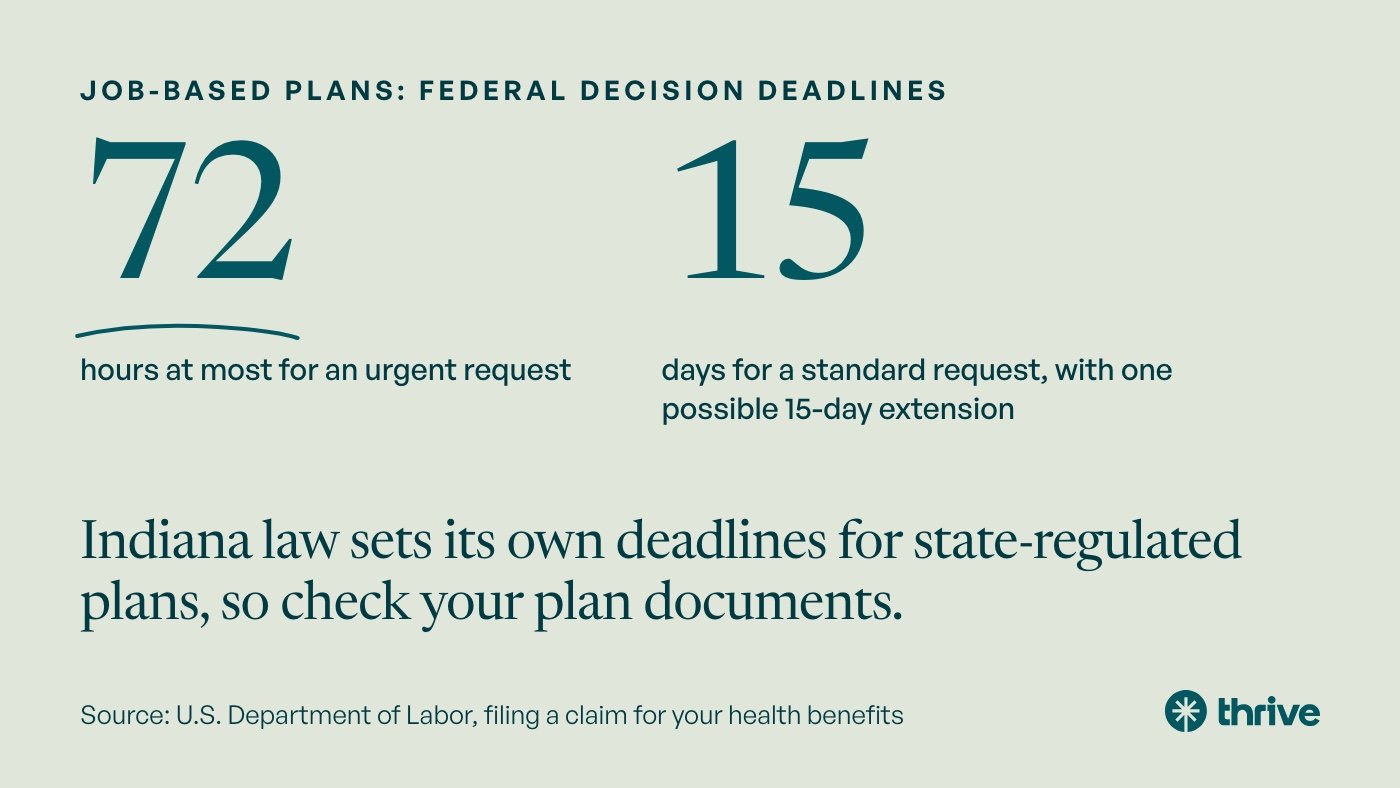
It depends on your plan type. For most job-based plans, the deadlines come from the Labor Department’s guide to filing a claim for your health benefits.
| Type of request | Federal decision deadline |
|---|---|
| Urgent request, job-based plan | As soon as possible, no more than 72 hours |
| Standard request before care starts, job-based plan | No later than 15 days, with one possible 15-day extension if the plan tells you first |
| Marketplace or individual plan | Written notice within 15 days for prior authorization, 72 hours if urgent, per HealthCare.gov |
Indiana adds its own layer for state-regulated plans. The state’s prior authorization chapter, Indiana Code 27-1-37.5, sets decision deadlines for insurers and HMOs, and lawmakers have changed it in recent sessions. Because the exact timeline depends on your plan and when the request was filed, check your plan documents or ask member services for the current deadline in writing.
A request counts as urgent when waiting could seriously harm your health. For urgent claims, the Labor Department says your treating physician can act as your authorized representative without a signed form.
What is concurrent review, and why does it matter?
Concurrent review is the plan’s check-in while you are already in treatment. The first approval often covers a block of days. Before it ends, the program sends an update, and the plan decides whether to approve more.
Reviewers look for progress and a continued need. Updated symptom scores, attendance, and goals met so far all help. Federal rules protect you here as well. If a job-based plan cuts short a course of treatment it already approved, that cut counts as a denial. Under the federal claims procedure rule, the plan must tell you early enough to appeal before the care stops.
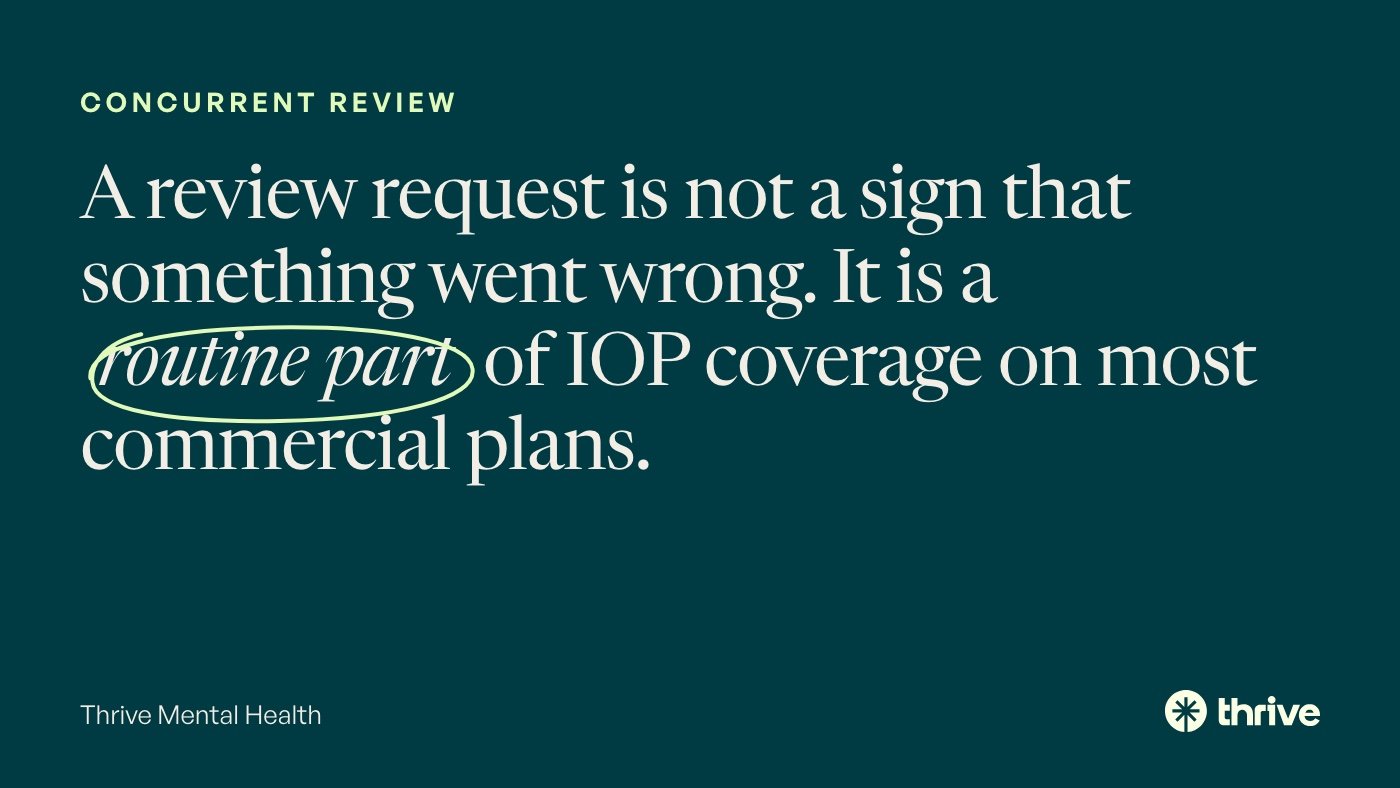
A review request is not a sign that something went wrong. It is a routine part of IOP coverage on most commercial plans.
What happens if prior authorization is denied?
A denial is not the end of the road. You have several ways to push back, and the fastest one often comes first.
 Aetna vs Cigna for Mental Health Coverage in Florida (2026)Insurance
- Peer-to-peer review. Many plans let the program’s clinician talk directly with the plan’s reviewer. These calls can resolve a denial quickly.
- Internal appeal. HealthCare.gov’s internal appeals guide says you generally have 180 days to file. Plans must decide within 30 days for care you haven’t received yet.
- Indiana grievance. For insured plans, the state’s grievance procedures page explains that you can file a grievance and then appeal the grievance decision. Each insurer files its procedure with the Department of Insurance.
- External review. If the plan still says no, an independent reviewer can decide. HealthCare.gov says the insurer is required by law to accept that reviewer’s decision.
Our full guide to appealing a denied mental health claim in Indiana walks through each step, with a letter outline.
Parity can help, too. The federal Mental Health Parity and Addiction Equity Act bars plans from applying stricter prior authorization to mental health care than to comparable medical care. If IOP faces more frequent reviews than similar medical programs, point that out in writing.
For insured plans, the Indiana Department of Insurance helps with grievance questions at 800-622-4461. Self-funded employer plans go to the U.S. Department of Labor at 1-866-444-3272.
If you are in crisis or thinking about harming yourself, call or text 988, or go to the nearest emergency room.
What should you ask Anthem, UnitedHealthcare, or your carrier?
Each carrier sets its own process, and it can differ from plan to plan. Rather than rely on a general rule, call member services and ask these questions:
- “Does my plan require prior authorization for intensive outpatient mental health care?”
- “Which company reviews behavioral health requests for my plan?”
- “How many days does a first approval usually cover, and when is the next review?”
- “Is virtual IOP covered the same way as in-person IOP?”
- “Is my plan fully insured or self-funded?”
For carrier details, see our guides to Anthem BCBS and virtual IOP in Indiana and Optum Behavioral Health in Indiana.
Common questions about prior authorization for IOP in Indiana
Do I have to get prior authorization myself?
Usually not. The IOP program typically submits the request and handles follow-up with the plan. Your intake information supports it.
How long does IOP prior authorization take in Indiana?
For job-based plans under federal rules, up to 15 days for a standard request and 72 hours for an urgent one. Indiana law sets its own deadlines for state-regulated plans, so check your plan documents.
Does approval mean my plan will pay?
Not always. Approval confirms medical necessity, but your deductible, coinsurance, and eligibility still apply.
Why does my plan keep reviewing my IOP care?
Plans often approve IOP in blocks of days. Concurrent review checks your progress before the plan approves more.
What if my plan denies prior authorization?
Ask about a peer-to-peer review, then file an internal appeal or grievance. If that fails, you can request an external review.
Can the Indiana Department of Insurance help with my employer plan?
Only if the plan is fully insured. Self-funded employer plans fall under federal law, and the U.S. Department of Labor handles them.
Next steps
Prior authorization shouldn’t be your job when you are trying to feel better. Thrive Mental Health is a Joint Commission accredited provider of virtual intensive outpatient care for adults in Indiana, Florida, Arizona, California, North Carolina, South Carolina, and Texas. Many plans require prior authorization for IOP, and our team requests and tracks it for you as part of admission. Learn more about how your insurance works with Thrive.
Verify your coverage with Thrive: free, confidential benefits check. Most members receive a summary within 24 hours, and you can start as soon as you are ready. Prefer to talk first? Call (561) 203-6085.

This article is for informational purposes only and is not a substitute for individualized clinical advice or insurance verification.