




Without insurance, an intensive outpatient program (IOP) in Indiana is usually priced per day of programming or per week, so your total depends on how many days a week you attend and how many weeks you stay. Few Indiana programs publish a self-pay price, so the number that matters is the written Good Faith Estimate every program must give you before care starts.
Before you plan to pay on your own, check whether you really have no coverage. In Indiana, Thrive is in network with Anthem, UnitedHealthcare (including Oscar), Cigna, Aetna and TRICARE East, so members pay their in-network share, not out-of-network rates. Many people who search “without insurance” actually have one of these plans, or a high deductible plan they assume will not help. A free benefits check answers that question first.
This article is informational, not clinical or financial advice. Confirm costs in writing with any program and talk with a clinician about the right level of care before you start.
The short answer: what sets the price of IOP without insurance
IOP is a structured level of care. You attend therapy several days a week, usually for a few hours at a time, and you keep living at home. At Thrive, IOP means nine or more hours of structured care a week. Because the program is a bundle of sessions, the price is a bundle too.
Five things move the total more than anything else:
| Cost driver | Why it changes your total | What to ask |
|---|---|---|
| Pricing unit | Programs charge per program day or per week | “Is your rate per day or per week?” |
| Days per week | A per-day rate multiplies by every day you attend | “How many days a week will I attend?” |
| Program length | Length is set by your progress, not a fixed calendar | “How long do most people stay, and who decides?” |
| What is bundled | Psychiatry or extra sessions may be billed separately | “Does the rate include individual therapy and psychiatry?” |
| Discounts | Some programs offer income-based help or prompt-pay pricing | “Do you have a scholarship or sliding scale?” |
Length usually matters most. A modest per-day price over many weeks can cost more than a higher price over fewer weeks. Ask for the estimate to show the full expected course, not one week.
Do you really have no coverage? Check before you pay
Self-pay is sometimes the right choice. Often, though, people pay cash for care their plan would have covered. Look for coverage in these places first:
- A plan you forgot. A new job, a COBRA offer, or a plan through a union or school.
- A spouse’s or partner’s plan. Many employer plans cover family members.
- TRICARE. Service members, retirees and many military families have it. Thrive accepts TRICARE East in Indiana; see our TRICARE virtual IOP guide.
- A high deductible plan. Even before you meet the deductible, in-network rates are usually lower than a self-pay quote, and every dollar counts toward your yearly limit.
If you have a plan, our guide to Indiana virtual IOP costs with insurance walks through deductibles, coinsurance and out-of-pocket limits. If a program turns out to be out of network with your plan, ask it to check your out-of-network benefits before you decide.
How IOP is usually billed when you pay yourself
Most programs set one rate for a program day or a program week. That rate covers the group therapy that makes up most of IOP. Some programs fold individual therapy and family sessions into the same rate. Others bill them on their own.
Psychiatric care is the item most likely to sit outside the bundle. If you see a psychiatrist or nurse practitioner for medication, ask whether that visit has its own fee. Ask the same about any testing or assessments.
The estimate should also say what happens if your plan changes. Your clinical team may recommend more weeks, or fewer. A good program tells you how a change in length changes the price before it happens. You can learn more about what the level of care involves on our intensive outpatient program page, and how it compares with a more intensive option in IOP vs PHP.
Your right to a Good Faith Estimate
The federal No Surprises Act protects people who pay for care on their own. According to CMS guidance for people without insurance, providers usually must give you a Good Faith Estimate when you schedule care at least 3 business days ahead, or when you ask for one. This applies whether you have no insurance or choose not to use it.
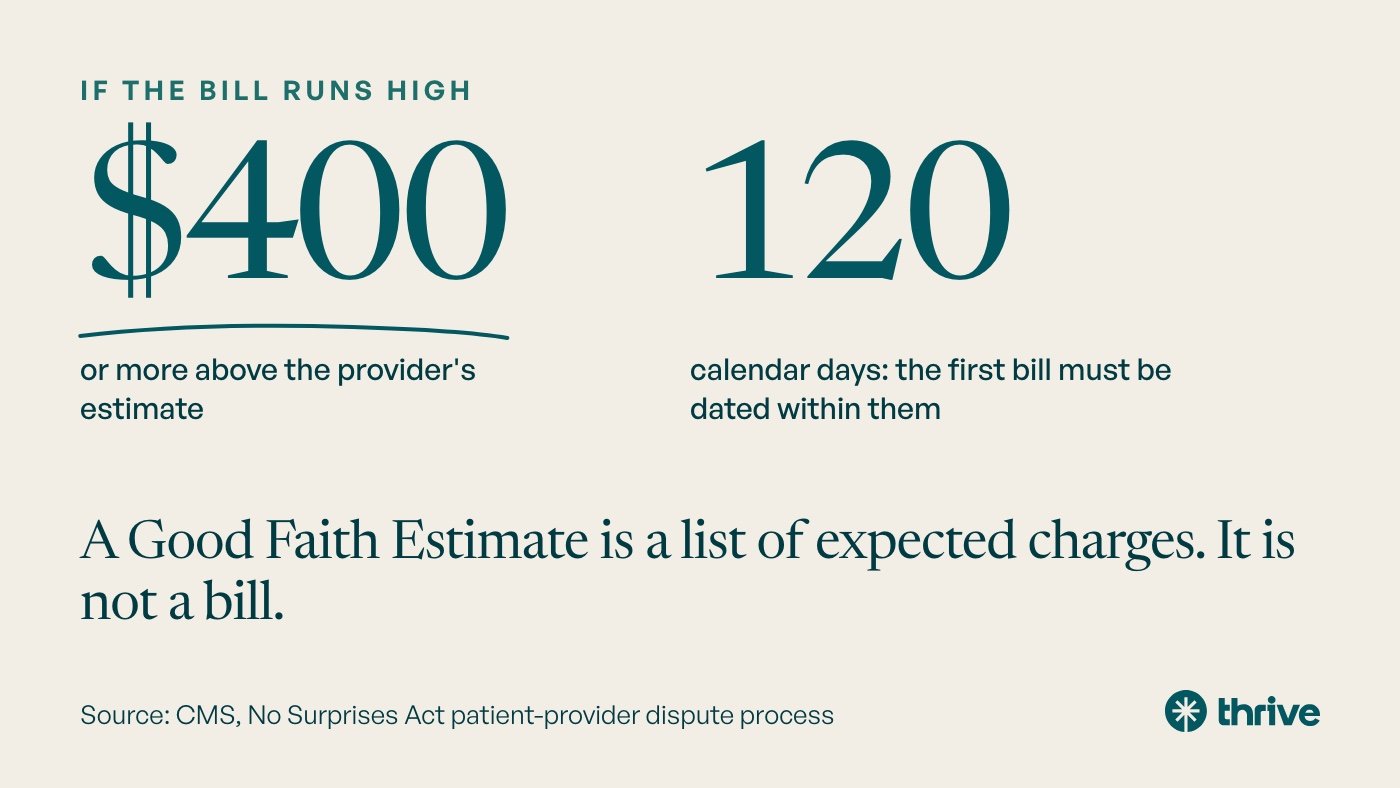
A Good Faith Estimate is a list of expected charges. It is not a bill. CMS notes that each estimate covers a single provider or facility, so ask every provider involved in your care for their own.
If your bill comes in high, you have a way to push back. Under the CMS patient-provider dispute process, you may dispute a bill that is at least $400 more than that provider’s estimate. Key points from CMS:
- The first bill must be dated within the last 120 calendar days.
- You need a copy of your estimate and your bill.
- There is a $25 non-refundable fee to start the dispute.
- An independent third party reviews the bill and decides what you owe.
Keep every estimate and bill in one folder. That habit makes a dispute much easier if you ever need one.
What Thrive charges if you pay on your own
Thrive offers self-pay, and income-based scholarships are available. Start with the free benefits check, so you know whether your plan covers care before you think about paying on your own.
If you do choose self-pay, here is what to expect:
- A written Good Faith Estimate before care begins, as the No Surprises Act requires.
- A scholarship program based on household income. Ask about it during your benefits check.
One caution from our insurance page: if you pay first and ask your insurer to reimburse you later, we cannot promise your plan will cover it. That is another reason to check coverage before you start. Our virtual IOP FAQ answers other common payment questions.
Can you use an HSA or FSA for IOP?
Often, yes. IRS Publication 969 says qualified medical expenses for health savings accounts and flexible spending arrangements are generally those that would qualify for the medical expense deduction. IRS Publication 502 lists what qualifies, and it includes psychiatric care, payments to a psychologist, and therapy received as medical treatment.
A few practical notes:
- Your own plan sets the final rules, so check with your HSA or FSA administrator.
- Ask the program for an itemized receipt. Administrators often want one.
- If you itemize, Publication 502 says you can deduct only the part of medical and dental expenses above 7.5% of your adjusted gross income.
Using pre-tax money does not lower the price. It does lower what the care costs you after taxes.
Getting coverage: open enrollment and special enrollment
If you are uninsured now, coverage may be closer than it looks. Per HealthCare.gov’s dates and deadlines, Open Enrollment for 2027 Marketplace plans starts November 1, 2026 and ends January 15, 2027. Enroll by December 15 for coverage that starts January 1.
Outside that window, you may still qualify for a Special Enrollment Period. Common triggers include losing job-based coverage, getting married, or having a baby. In most cases you have 60 days after the event to enroll.
 Art Therapy Activities for AnxietyMental Health
Marketplace plans matter for mental health. HealthCare.gov says all Marketplace plans cover mental health services, and they cannot deny you or charge you more for a pre-existing mental health condition. Before you pick a plan, check which IOP programs are in its network.
Lower cost options in Indiana
If IOP is out of reach right now, Indiana has public options worth knowing.
- Community Mental Health Centers. The state’s Division of Mental Health and Addiction provider finder says Indiana has 24 Community Mental Health Centers certified by the division, listed by county. Call your local center and ask about fees and a sliding scale.
- Certified Community Behavioral Health Clinics. SAMHSA says these clinics must serve anyone who asks for mental health care, regardless of ability to pay. Indiana’s provider finder lists them too.
- Community health centers. HealthCare.gov notes that at a community health center, what you pay depends on your income. They also offer referrals to mental health care.
These options may not offer the same intensity as IOP. They can be a safe place to start, and a source of referrals. For more on care across the state, see our Indiana virtual IOP page.
If you are in crisis, call or text 988 any time for the 988 Suicide and Crisis Lifeline.
Questions to ask any program about price
Use this checklist on every call. Write down the answers and the name of the person you spoke with.
| Ask this | Why it matters |
|---|---|
| “Is your self-pay rate per day or per week?” | Lets you compare programs on the same unit |
| “How many days a week, and for how many weeks, do you expect?” | Turns a rate into a realistic total |
| “What does the rate include?” | Finds separate fees for psychiatry or individual sessions |
| “Can I get a written Good Faith Estimate?” | It is your right, and it protects you if the bill runs high |
| “Do you offer a scholarship or sliding scale?” | Income-based help can change the math |
| “Can you check my insurance first?” | You may have coverage you did not expect |
| “How do payments work, and when are they due?” | Avoids surprises in the first week |
Have a question first? Contact our admissions team.
Common questions about IOP cost without insurance in Indiana
How is IOP priced without insurance?
Most programs charge per program day or per week. Your total depends on how many days a week you attend and how many weeks you stay. Ask for a written estimate of the full course.
Do I have a right to know the price before I start?
Yes. Under the No Surprises Act, providers usually must give a Good Faith Estimate to people who are not using insurance. If a bill is at least $400 more than that provider’s estimate, you may be able to dispute it through CMS.
Can I use my HSA or FSA for IOP?
Often, yes. IRS Publication 502 includes psychiatric care and therapy received as medical treatment. Check your own plan’s rules and keep itemized receipts.
Does Thrive offer a scholarship?
Yes. Thrive has a scholarship program based on household income. Ask about it during your free benefits check.
Which insurance plans is Thrive in network with in Indiana?
In Indiana, Thrive is in network with Anthem, UnitedHealthcare (including Oscar), Cigna, Aetna and TRICARE East. Members pay their in-network share, not out-of-network rates.
When can I get Marketplace coverage for 2027?
Open Enrollment runs November 1, 2026 to January 15, 2027. Enroll by December 15 for coverage that starts January 1. A life change like losing job-based coverage may qualify you sooner.
Next steps
If weekly therapy is not enough and cost is the worry, start by finding out what you would actually pay. Thrive Mental Health is a Joint Commission accredited provider of virtual IOP for adults, accredited for Behavioral Health Care and Human Services. We serve adults across Indiana, plus Florida, Arizona, California, North Carolina, South Carolina and Texas.
Verify your coverage with Thrive: free, confidential benefits check. It is worth doing even if you think you have no coverage. Most members receive a summary within 24 hours, and you can start as soon as you are ready. Prefer to talk first? Call (561) 203-6085.

This article is for informational purposes only and is not a substitute for individualized clinical advice or insurance verification.