



A mental health intensive outpatient program (IOP) is a depression treatment program for adults who need more than weekly therapy but do not need a hospital stay. In Indiana, you can find one through the state’s provider finder, a hospital or health system, or a virtual program that serves the whole state, but you have to check that it treats depression and anxiety first, not addiction. This guide explains what a mental health IOP is, who it fits, and how to tell it apart from a substance use program in a few minutes.
That last step matters more in Indiana than most people expect. Search “IOP” here and most of what comes back is addiction treatment. Both kinds of program are real care, but they are built for different problems.
This article is informational, not clinical or financial advice. Talk with a licensed clinician about your own symptoms, and verify benefits with your plan before starting treatment.
What is a mental health IOP?
An IOP gives you nine or more hours of structured care a week while you keep living at home. Most programs meet three days a week for about three hours at a time. You still sleep in your own bed, and many people keep working.
A typical week mixes a few kinds of care:
- Group therapy, where you learn and practice skills with the same small group.
- Individual therapy with one primary therapist, usually once a week.
- Psychiatric care for medication questions, when you need it.
- Family sessions, often optional, to help the people at home support you.
IOP sits in the middle of the care ladder. It is more than a weekly therapy hour and less than a partial hospitalization program or an inpatient stay. Our guide to IOP vs PHP vs inpatient care walks through each level. For the basics in one place, see what an intensive outpatient program is.
Mental health IOPs lean on talk therapies with solid research behind them. The National Institute of Mental Health describes cognitive behavioral therapy (CBT) and dialectical behavior therapy (DBT) among the main evidence-based approaches. CBT helps you notice and change thought patterns. DBT teaches skills for strong emotions and hard moments.
How common are depression and anxiety in Indiana?
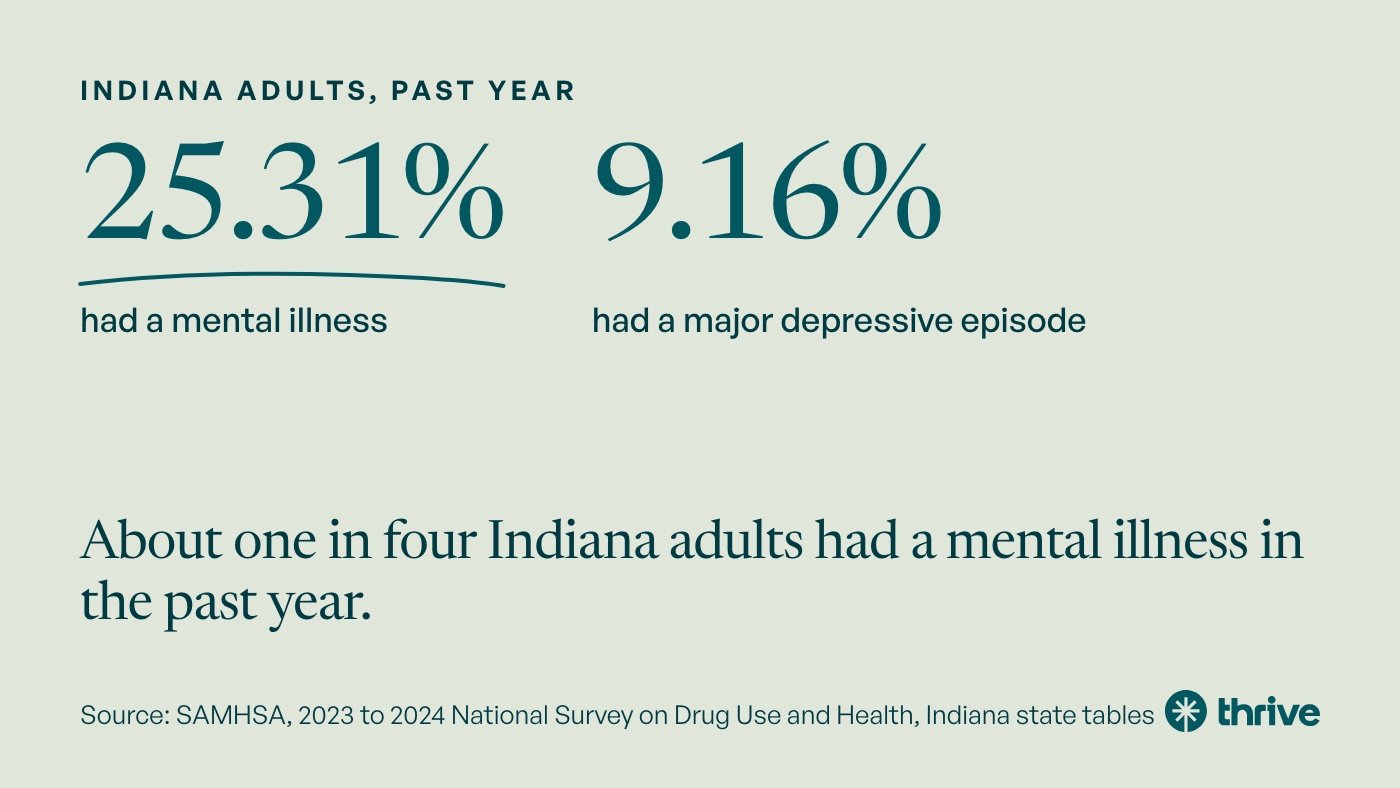
About one in four Indiana adults had a mental illness in the past year. The federal 2023 to 2024 National Survey on Drug Use and Health state tables put the figure at 25.31% of adults, roughly 1.32 million people. The same tables estimate that 9.16% of Indiana adults, about 478,000 people, had a major depressive episode in the past year.
Finding care is a separate problem. About 6 million Indiana residents live in a federally designated mental health shortage area. That figure comes from KFF’s summary of federal shortage area data, as of December 31, 2025. The same data show Indiana meeting 39.9% of its need for psychiatrists in those areas.
So if you have waited weeks for an appointment, you are not imagining it. A shortage is one reason virtual programs have become a real option for people outside the Indianapolis metro.
Signs weekly therapy is not enough
The clearest sign is time: you have been in weekly therapy for months, and your symptoms are the same or worse. Depression and anxiety are both treatable, according to the NIMH overview of depression and its page on anxiety disorders. But some people need more hours of care than one session a week can give.
Other signs a higher level of care may help:
- You are missing work or calling out more often because of how you feel.
- Panic, worry or low mood is shaping most of your day, not just part of it.
- You have stopped doing things you used to manage, like errands, meals or replying to people.
- Your therapist has suggested more support, or you are stepping down from a hospital stay.
- Skills that worked before no longer seem to work between sessions.
Our comparison of virtual IOP vs weekly therapy goes deeper on the trade-offs. If you are thinking about suicide or feel unsafe right now, call or text 988, the Suicide and Crisis Lifeline. An IOP is not a crisis service.
Why searching “IOP” in Indiana mostly shows addiction programs
In Indiana, “IOP” and “rehab” often show up as the same thing in search results. When we looked at live Google results for Indianapolis IOP searches in October 2026, the map listings at the top were mostly addiction treatment centers. That held even for searches that included the words “mental health”.
There is a reason for this. The IOP model grew up in substance use treatment, and many centers still use “IOP” mainly for that. Addiction programs also tend to advertise heavily in local search.
None of this makes those programs bad. It just means a person with depression can click the first result, call, and end up in a group built around sobriety. Checking fit before the first call saves you time and a lot of frustration.
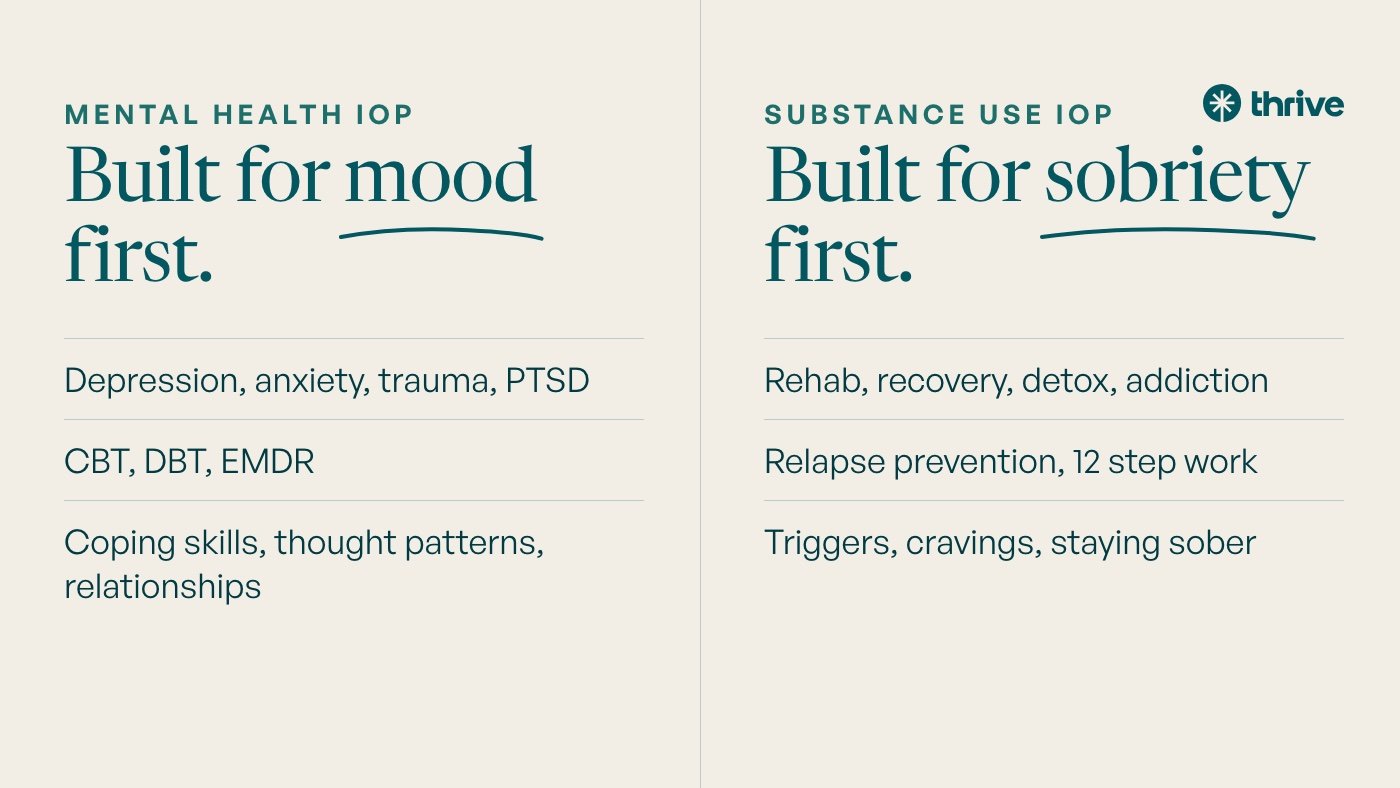
How to tell a mental health IOP from a substance use IOP
You can usually tell in five minutes on a program’s website. Look for these signals:
| What to check | Mental health IOP | Substance use IOP |
|---|---|---|
| Words on the home page | Depression, anxiety, trauma, mood, PTSD | Rehab, recovery, sobriety, detox, addiction |
| Primary diagnosis | A mental health condition is the main reason for care | Alcohol or drug use is the main reason for care |
| Therapies listed | CBT, DBT, EMDR, mentalization based treatment | Relapse prevention, 12 step work, motivational groups |
| Medication focus | Antidepressants and other psychiatric medication | Medication for alcohol or opioid use disorders |
| Intake questions | Mood, sleep, worry, daily functioning, safety | Drinking or drug history, last use, withdrawal |
| Group topics | Coping skills, thought patterns, relationships | Triggers, cravings, staying sober |
Some programs do both, so read the program page, not just the logo. A center may run a substance use IOP and a separate mental health track. Ask which group you would actually join.
When substance use is the main concern, a substance use program is the right fit. Thrive can point you toward one. You can also search FindTreatment.gov or call the free, confidential SAMHSA National Helpline at 1-800-662-4357.
Questions to ask on the first call
A short call answers most of what a website leaves out. Keep this list open while you talk:
| Ask this | A good answer sounds like |
|---|---|
| What is the main diagnosis most of your clients come in with? | Depression, anxiety or trauma, said plainly |
| Which therapies do your groups use? | Named methods such as CBT or DBT, not just “support groups” |
| How many hours a week, and on which days? | Nine or more hours, with a set schedule you can plan around |
| Will I have my own therapist? | Yes, one primary therapist with regular individual sessions |
| Is psychiatric care available? | Yes, with a clear way to start or review medication |
| Are your clinicians able to treat me in Indiana? | Yes, and you must be in Indiana during virtual sessions |
| Is the program accredited? | A named accrediting body, such as The Joint Commission |
| Will you check my benefits before I start? | Yes, in writing, at no cost |
Write down the date, the name of the person you spoke with, and what they told you. If a program cannot answer the first question clearly, keep looking.
Where Indiana adults can look for a mental health IOP
You have more options than the first page of search results suggests:
 Beyond the Buzz: Demystifying EMDR TherapyMental Health
- The state provider finder. Indiana’s Division of Mental Health and Addiction keeps a Find a Local Service Provider tool. It lists certified community providers by county.
- Hospital and health system programs. Several Indiana health systems run outpatient behavioral health programs, including some IOPs. Most are in larger cities, and wait times vary.
- Virtual programs that serve the whole state. A virtual IOP can reach you in a small town as easily as in Indianapolis. If you search “mental health IOP Indianapolis”, it is worth widening to statewide virtual options too.
- Your insurance plan’s directory. Search for “intensive outpatient” under behavioral health, then use the table above to confirm fit.
- Your current therapist or doctor. A referral can speed up the intake and the insurance review.
Is virtual care as good as in person at this level? A 2022 study in the Journal of Psychiatric Research compared telehealth with in-person care for adults in intensive treatment. It found the two produced comparable improvements in symptoms. One study does not settle it for everyone, but it is a useful data point if you live far from a program.
How Thrive’s virtual IOP works in Indiana
Thrive Mental Health runs a virtual IOP for adults anywhere in Indiana, and its primary focus is mental health. Groups meet Monday, Wednesday and Thursday evenings, starting at 6 PM Eastern. You also meet your own therapist once a week, at a time set with you at intake.
Groups draw on CBT, DBT skills and mentalization based treatment, a method for understanding your own mind and other people’s. Psychiatric care and optional family sessions are part of the program. You join by video from home, or from any private space in Indiana. You do need to be in the state during each session.
Thrive is accredited by The Joint Commission for Behavioral Health Care and Human Services. You can read the full week, step by step, on how our virtual IOP works, or see Thrive’s virtual IOP in Indiana for local details.
Will insurance cover a depression treatment program in Indiana?
In Indiana, Thrive is in network with Anthem, UnitedHealthcare (including Oscar), Cigna, Aetna and TRICARE East, so members pay their in-network share, not out-of-network rates. Thrive works with commercial plans and TRICARE.
Most commercial health plans cover IOP when a clinician documents that you need that level of care. Plans often ask for prior authorization, and your costs depend on your deductible and coinsurance.
The fastest way to know your actual cost is a benefits check before you start. See the plans listed on our insurance page, or use the free check at the end of this article.
Common questions about IOP for depression and anxiety in Indiana
Is an IOP only for people coming out of the hospital?
No. Some people step down to IOP after a hospital stay, but many come straight from weekly therapy that was not helping enough. Others are referred by a doctor or therapist.
Can I keep working while I attend an IOP?
Often, yes. Many programs, including evening virtual programs, are built around a work day. Ask about the schedule before you enroll.
How do I know if an Indiana IOP treats depression and not addiction?
Check the words on the website, the main diagnosis they treat, and the therapies they list. Then ask on the first call which group you would join and what most members come in for.
Can a virtual IOP serve me if I live in a rural part of Indiana?
Yes, as long as the program can treat people in Indiana and you are in the state during sessions. You need a private space and a steady internet connection.
What if my main problem is drinking or drug use?
A substance use program is the better fit. FindTreatment.gov and the SAMHSA National Helpline at 1-800-662-4357 can help you find one, and Thrive can point you in the right direction too.
How long does an IOP usually last?
It depends on your progress and your plan. Length is set with your care team and reviewed as you go, rather than fixed on day one.
Next steps
If you live in Indiana and weekly therapy is not enough for your depression or anxiety, start by checking what your plan covers. If you have Anthem, UnitedHealthcare, Cigna, Aetna or TRICARE East, Thrive is in network. Thrive Mental Health is a Joint Commission accredited provider of virtual IOP for adults in Florida, Indiana, Arizona, California, North Carolina, South Carolina and Texas.
Verify your coverage with Thrive: free, confidential benefits check. Most members receive a summary within 24 hours, and you can start as soon as you are ready. Prefer to talk first? Call (561) 203-6085.

This article is for informational purposes only and is not a substitute for individualized clinical advice or insurance verification.