





When you join an intensive outpatient program (IOP), your outside therapist and psychiatrist stay involved through three things: your written permission to share information, updates while you are in treatment, and a discharge summary with a clear handoff when you finish. At Thrive, care coordination is built into our wraparound care, and when a clinician refers you, we coordinate your care back to that clinician at discharge. This article explains how IOP care coordination with outside providers works, what gets shared, what stays private, and what you and your providers can expect from us.
It is written for two readers: people starting IOP who want to keep the therapist or prescriber they already trust, and clinicians deciding whether to refer. Both want care that moves between providers without gaps or repeated work.
Who is on your care team during IOP?
An IOP adds a team alongside the one you already have. The goal is for everyone to know who is responsible for what, so nothing falls between them. The table below shows how roles are usually divided. Your own arrangement depends on your needs, your providers, and your insurance.
| Provider | Typical role during IOP | Typical role after IOP |
|---|---|---|
| IOP primary therapist | Leads your treatment plan, individual and family sessions, and coordination | Hands off with a discharge summary and plan |
| IOP group clinicians | Run skills and process groups several times a week | Alumni or step-down groups, if offered |
| Your outside therapist | Stays informed; may pause or keep sessions depending on the plan | Resumes as your main clinician |
| Your outside psychiatrist or prescriber | Often keeps managing medication, with updates from the IOP | Continues medication care |
| Your primary care provider | Receives relevant updates, especially on medication and physical health | Stays your medical home |
At Thrive, you are matched with a primary therapist for weekly individual and family sessions, alongside group sessions. Your personalized treatment plan sets out how your outside providers fit in.
What do you sign, and what does privacy law actually require?
You will usually be asked to sign a release of information for each outside provider. A release of information (often called an ROI) is a form that names who can share your records, with whom, for what purpose, and for how long. You can limit it, and you can revoke it in writing.
Here is what federal privacy law says, in plain terms:
- Treatment sharing is allowed. Under the HIPAA Privacy Rule, a provider may share health information with another provider for treatment. Many programs still ask for a signed release, because it is clearer for everyone and some state laws set stricter rules.
- Psychotherapy notes get extra protection. HIPAA requires your written authorization for almost any sharing of these notes.
- Some substance use records have their own rules. Records from federally assisted substance use programs fall under 42 CFR Part 2, which generally requires your written consent before they are shared.
- You can see your own records. HIPAA’s right of access requires a provider to act on your request within 30 days.
Thrive’s site notes that patients have the right to access their medical records, and that records of care may be shared with your primary care provider through a secure electronic health record system unless you choose to opt out.
What gets shared, and what stays private?
Coordination works best when the right information moves and the rest stays put. HIPAA defines psychotherapy notes narrowly, as a therapist’s separate notes on the content of sessions. According to the federal definition, they exclude things like medications, diagnosis, the treatment plan, symptoms, and progress to date.
| Usually shared with your outside providers | Usually kept private |
|---|---|
| Admission and discharge dates | Detailed psychotherapy notes |
| Diagnosis and treatment plan | What other group members say |
| Symptom scores and progress | Anything outside the scope of your release |
| Medication changes or concerns | Substance use records without your Part 2 consent |
| Safety concerns and the aftercare plan | Details you ask to limit, where the law allows |
If something feels sensitive, say so at intake. You can ask what will be shared, with whom, and when. A good program will walk you through it before you sign.

How do your outside therapist and psychiatrist stay involved during IOP?
Programs like ours typically reach out to your outside providers early in treatment, once your release is signed. From there, the rhythm of updates depends on your plan and what your providers want. Some clinicians prefer a short update at key points. Others want to hear about any change in medication or safety right away.
A few questions tend to come up:
- Should I keep seeing my therapist during IOP? Some people pause weekly sessions while in the program. Others continue at a lower frequency. Your plan’s rules on overlapping services can shape this, so check your benefits.
- Who manages my medication? In many programs, your current prescriber keeps that role. The IOP shares what it observes, like side effects or sleep changes, so your prescriber can adjust. See how medication and IOP work together for more.
- What if my provider has concerns? Outside clinicians can usually call the program’s team directly. A quick call often solves more than a stack of faxes.
At Thrive, we use measurement-based care. You complete validated symptom scales at intake and on a fixed schedule, and you see your own trend lines. With your consent, that trend data can be shared with your referring therapist. Read more on how we measure outcomes.
How does coordination work at Thrive, step by step?
Here is the sequence, based on what our program pages describe.
- Referral or first contact. A clinician can refer through our secure form or by phone, or you can reach out yourself. Our team reviews it and begins intake right away.
- Assessment and coordination. We contact you promptly, verify insurance, and assess your clinical needs to confirm the right level of care. Referred patients are typically assessed within days.
- Treatment plan. You get a personalized plan and a primary therapist. Your outside providers are part of that plan once you authorize contact.
- During treatment. IOP means nine or more hours of structured care a week, with flexible scheduling that includes evening and weekend options. Symptom measures run throughout, and our wraparound care includes care coordination and a 24/7 crisis line.
- Discharge. You leave with a personalized discharge plan that includes local resources. The step-down plan, usually back to weekly therapy, travels with your outcome data.
- Handoff. If a clinician referred you, we coordinate your care back to them. They get their patient back with a record of what changed, not just a discharge date.
For a fuller picture of the week-to-week experience, see our virtual IOP overview.
Why the discharge handoff matters so much
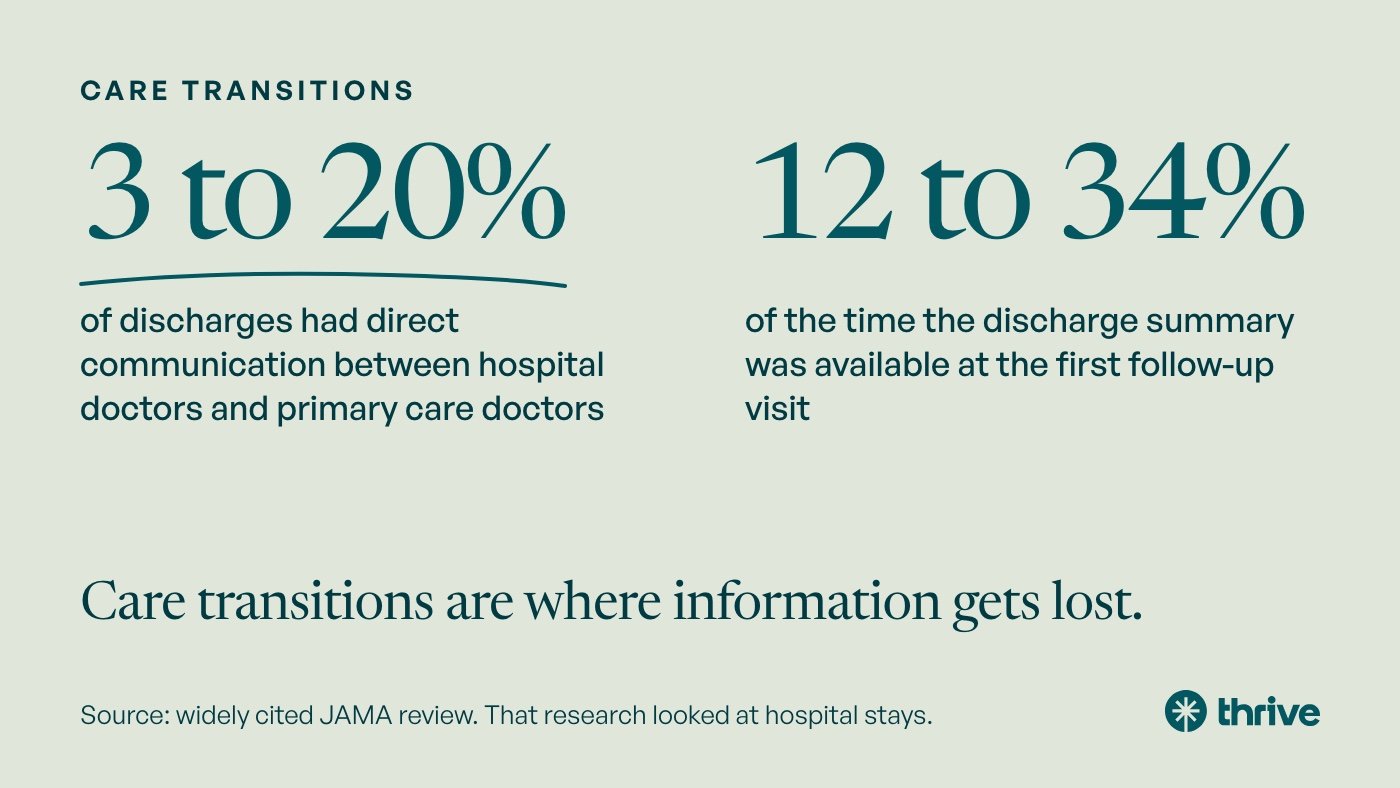
Care transitions are where information gets lost. A widely cited JAMA review found direct communication between hospital doctors and primary care doctors happened in only 3 to 20 percent of discharges. The discharge summary was available at the first follow-up visit only 12 to 34 percent of the time. That research looked at hospital stays, but the same weak point exists whenever someone steps down from any intensive level of care.
A useful discharge summary for your outside providers usually covers:
- What you were treated for and how symptoms changed, ideally with scores.
- What helped. The skills and approaches that worked best for you.
- Medication notes. Changes, side effects, and open questions for your prescriber.
- Warning signs. Your personal early signs of a setback and the plan if they show up.
- Next appointments. Who you are seeing and when, with dates booked before you leave.
Ask for your own copy. You are the one person who will be at every appointment. Our guide to what happens after IOP covers the step-down in more detail.
 Mentalization-Based Group Therapy: Because Mentalizing is Better with FriendsMental Health
Does coordinated care actually improve outcomes?
The evidence says it helps. The Agency for Healthcare Research and Quality describes care coordination as deliberately organizing care and sharing information among everyone involved, to make care safer and more effective. Structured teamwork between providers has measurable benefits for depression and anxiety.
A Cochrane review of 79 randomized trials found collaborative care, where providers share a plan and track progress together, led to greater improvement in depression and anxiety than usual care. Those gains held in the short, medium, and long term, though the review did not find them lasting into the very long term.
That research studied a specific model in primary care, not IOPs. The lesson still carries over: shared plans and shared measurement tend to beat parallel care where no one talks.
What should referring clinicians send, and what do they get back?
If you are a therapist, psychiatrist, or physician considering a referral, a few details speed things up. Most programs ask for similar information.
- Send: the patient’s contact details, insurance, state of residence, current medications, and the reason you think a higher level of care is needed.
- Tell us your preferences: how you want updates, and whether you plan to keep seeing the patient during IOP.
- Expect back: confirmation of the assessment, a discharge summary with outcome data, and a step-down plan that returns the patient to you.
Our clinician referral guide walks through the process in more detail.
Common questions about IOP care coordination with outside providers
Can I keep my own therapist while I am in IOP?
Usually, yes. Many people pause or reduce outside sessions during IOP and return to their therapist at discharge. With your permission, the program keeps your therapist informed throughout.
Will my therapist see everything I say in group?
No. Coordination usually covers dates, diagnosis, the treatment plan, progress, medication, and safety concerns. Detailed psychotherapy notes and what other group members share stay private.
Do I have to sign a release of information?
HIPAA allows providers to share information for treatment, but many programs ask for a signed release so everyone is clear. You can limit what it covers and revoke it in writing.
Who prescribes my medication during IOP?
In many programs your current prescriber keeps managing medication, and the IOP shares what it observes. Ask about this at intake so the plan is clear from day one.
What does my psychiatrist get when I finish?
Typically a discharge summary covering how symptoms changed, medication notes, and the aftercare plan. At Thrive, the step-down plan travels with your outcome data.
Does Thrive share information with my primary care provider?
Records of care may be shared with your primary care provider through a secure electronic health record system, unless you choose to opt out.
Next steps for patients and referring clinicians
Thrive Mental Health is a Joint Commission accredited provider of virtual IOP for adults, accredited for Behavioral Health Care and Human Services. We serve adults in Florida, Indiana, Arizona, California, North Carolina, South Carolina, and Texas.
For clinicians: Refer a patient here, or reach our clinical team at (561) 203-6085. Referred patients are typically assessed within days, and we coordinate care back to you at discharge.
For patients and families: Verify your coverage with Thrive: free, confidential benefits check. Most members receive a summary within 24 hours, and many start the same week.

This article is for informational purposes only and is not a substitute for individualized clinical advice or insurance verification.