



An intensive outpatient program (IOP) gives you nine or more hours of structured mental health treatment a week while you keep living at home, and residential treatment means living at a facility with staff on hand around the clock. Residential care is for people who need 24-hour structure to stay safe or stable, and IOP fits people who are safe at home but need far more support than weekly therapy. This guide explains how clinicians and insurers decide between the two, what the research shows, and how people move from one level to the other.
Most people facing this choice are worried, and many are deciding for someone they love. The right level of care is the least restrictive one that can keep a person safe and help them improve. That principle guides clinicians, and it also shapes what insurance will approve.
This article is informational, not clinical or financial advice. A licensed clinician should assess the right level of care, and your plan documents decide coverage.
IOP vs residential treatment at a glance
| Question | Intensive outpatient (IOP) | Residential treatment |
|---|---|---|
| Where you live | At home | At the treatment facility |
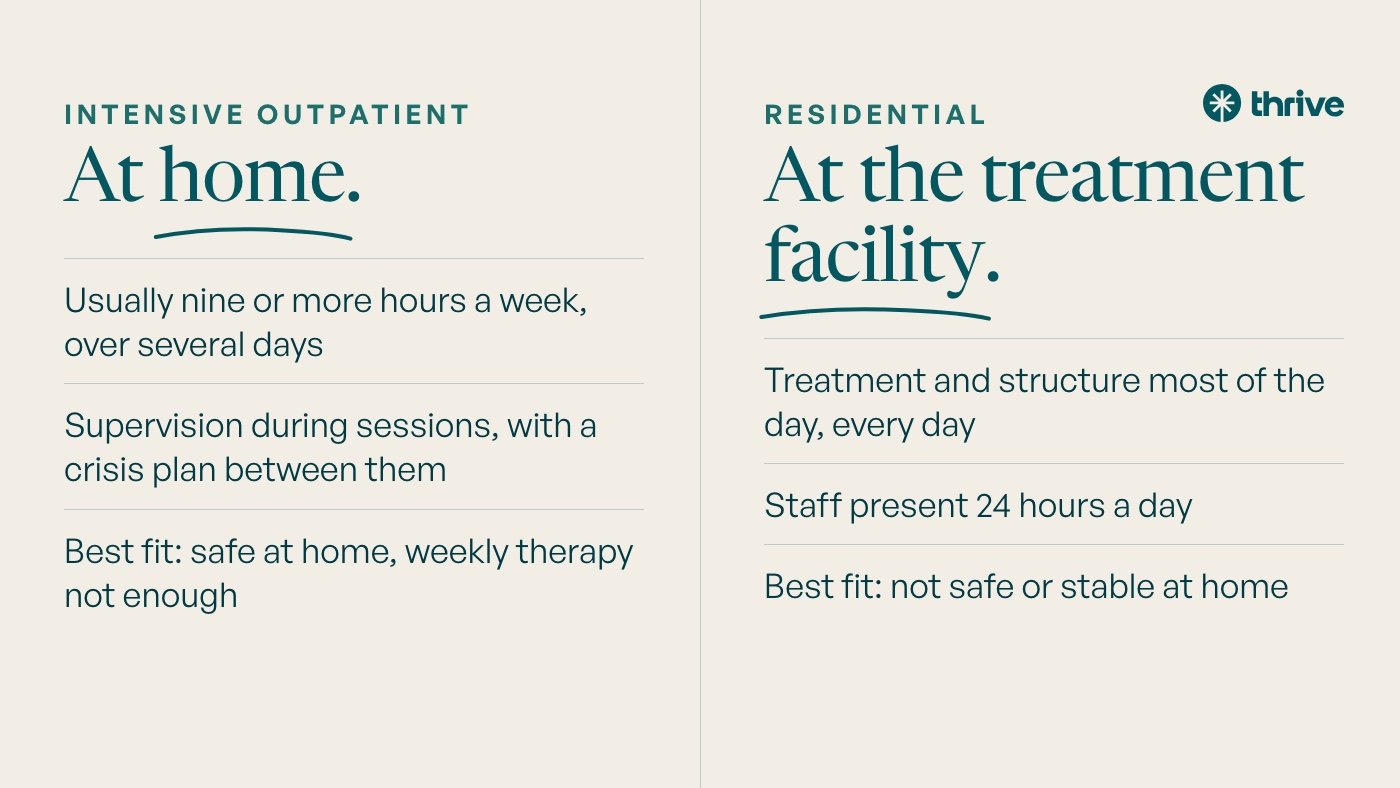
| Treatment time | Usually nine or more hours a week, over several days | Treatment and structure most of the day, every day |
| Supervision | During sessions, with a crisis plan between them | Staff present 24 hours a day |
| Work, school, family | Often possible, with scheduling changes | Usually paused while you are in treatment |
| Main cost drivers | Therapy and group sessions | Therapy plus room, meals, and round-the-clock staff |
| Insurance approval | Usually needs prior authorization | Usually needs prior authorization, with ongoing reviews |
| Best fit | Safe at home, struggling to function, weekly therapy not enough | Not safe or stable at home, or lower levels have not worked |
| Virtual option | Yes, widely available | No, by definition in person |
Where IOP and residential sit on the continuum of care
Mental health care runs from light to intensive. Each step adds hours, structure, and supervision:
- Outpatient therapy. Usually one session a week.
- Intensive outpatient program (IOP). Several sessions a week, often group and individual therapy combined.
- Partial hospitalization program (PHP). Most of the day, most weekdays, while you still sleep at home.
- Residential treatment. You live on site in a structured, nonhospital setting.
- Inpatient hospitalization. A locked or medically staffed unit for acute crises.
SAMHSA’s treatment protocol on intensive outpatient care describes IOP as structured treatment several days a week for people who do not need 24-hour supervision. Residential and IOP are two steps apart, and PHP often sits between them. Our guide to PHP vs IOP for mental health covers that middle step in detail.
Clinicians use standard tools to match people to a level. For mental health, one common tool is the Level of Care Utilization System, or LOCUS. Its developers found in early reliability testing that it helped clinicians make consistent placement decisions across several dimensions of need. For substance use, the ASAM Criteria play a similar role.
Who needs 24-hour residential care?
Residential care makes sense when a person’s safety or basic stability depends on constant structure. A clinician will usually consider residential or hospital care when one or more of these is true:
- Safety is uncertain at home. Ongoing thoughts of suicide with intent, or a recent attempt, often call for a higher level of care first.
- Basic self-care has broken down. The person cannot reliably eat, sleep, or take medication without help.
- The home setting works against recovery. Conflict, substance use in the home, or no safe place to live can undo outpatient progress.
- Lower levels have not worked. Symptoms keep worsening despite a real trial of IOP or PHP.
- Symptoms need close monitoring. Severe symptoms may require observation that sessions a few times a week cannot provide.
If you or someone you love is in immediate danger, call 911. For suicidal thoughts or a mental health crisis, call or text the 988 Suicide and Crisis Lifeline.
Who is IOP a good fit for?
IOP is built for adults who are safe at home but whose symptoms have outgrown weekly therapy. Many people are surprised to learn they may not need to leave home to get intensive care. IOP is often a fit when:
- Weekly therapy is not enough. Depression, anxiety, or trauma symptoms keep getting worse between sessions.
- Daily life is slipping. Work, parenting, or relationships are suffering, but you can still manage basic self-care.
- You have a safe home and some support. A partner, family member, or friend can help between sessions.
- You are stepping down. You are leaving residential, inpatient, or PHP care and need a structured bridge.
Our article on needing intensive therapy but not inpatient care walks through these signs in more depth.
What does the research say about IOP and residential outcomes?
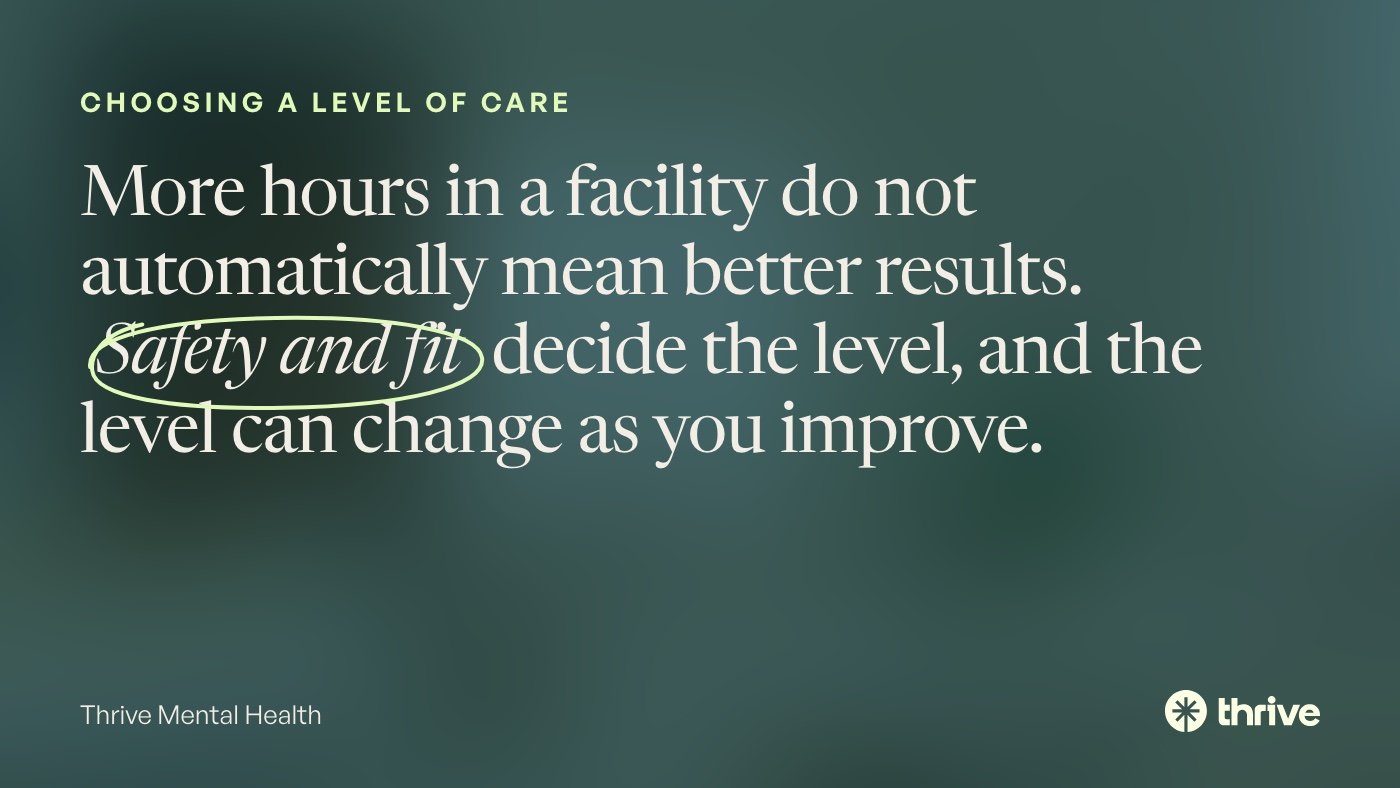
The research is strongest for substance use, and thinner for mental health alone. Still, the pattern suggests more hours in a facility do not automatically mean better results for people who can safely stay home.
- IOP compared with inpatient and residential care. A review in Psychiatric Services rated the evidence for substance use IOPs as high and found several trials showing outcomes comparable to inpatient or residential care for most people.
- Residential treatment on its own. A companion review rated the evidence for residential substance use treatment as moderate, with mixed results when compared with other types of care.
- Mental health alternatives to hospital wards. A systematic review in the British Journal of Psychiatry found limited early evidence that community-based residential crisis services may cost less and satisfy people more than standard acute wards.
- Virtual IOP. A study of adults in intensive treatment found telehealth outcomes comparable to in-person care.
None of this means residential care is unnecessary. For people who meet the criteria above, 24-hour care can be the step that makes outpatient treatment possible later.
How insurance decides between IOP and residential care
Commercial plans cover both levels in many cases, but they approve them based on medical necessity. That means a clinician has to document why this level of care is needed now, and the plan reviews that record before and during treatment.
- Mental health is an essential health benefit. HealthCare.gov confirms that all Marketplace plans cover mental health services, including behavioral health treatment and inpatient care.
- Parity rules apply. Under the federal Mental Health Parity and Addiction Equity Act, mental health benefits generally cannot be more restrictive than comparable medical benefits.
- Some states go further. California’s SB 855 requires state-regulated plans to base level-of-care decisions on criteria from nonprofit clinical associations, and it names LOCUS and ASAM as examples.
- Reviews continue during treatment. A plan may approve a set number of days and then review the case again, so ask how often reviews happen.
Residential care usually costs more because the plan is paying for housing, meals, and 24-hour staff, not only therapy. What you pay depends on your deductible, coinsurance, and whether the program is in network. Our virtual IOP insurance guide explains the terms to check.
How stepping down from residential to IOP works
Levels of care are not a one-way door. Many people move down as they stabilize, and some move up for a period if symptoms return. A planned step-down from residential to IOP helps protect the progress made in 24-hour care.
 Therapist Hunting Made Easy with United Healthcare’s DirectoryMental Health
- Plan before discharge. The residential team and the IOP should talk before your last day.
- Keep the gap short. Starting IOP soon after leaving residential care keeps structure in place during a fragile stretch.
- Bring your records. Discharge summaries help the new team pick up where the last one stopped.
- Know the step-up signs. Agree in advance on what would mean returning to more intensive care.
For more on this transition, read our guides to mental health care after residential treatment and step-down care after inpatient treatment.
Questions to ask before choosing a level of care
- “Which level of care do you recommend, and why?” Ask the assessing clinician to name the specific risks or needs behind the answer.
- “What criteria does my plan use?” Ask your insurer which level-of-care guidelines it applies.
- “Is the program licensed and accredited?” Look for state licensure and independent accreditation.
- “What happens if I need more or less care?” A good program explains how it steps people up or down.
- “How will you coordinate with my current providers?” Your therapist and psychiatrist should stay in the loop.
Common questions about IOP vs residential treatment
Is IOP as effective as residential treatment?
For people who can stay safely at home, research in substance use care found IOP outcomes comparable to inpatient or residential care for most patients. Residential care is still the better fit for people who need 24-hour structure.
Can I go straight to IOP without residential treatment first?
Yes. Many adults start at the IOP level when a clinician finds they are safe at home and weekly therapy is not enough.
How long does IOP last compared with residential?
Both vary with your needs and your plan’s reviews. At Thrive, the average virtual IOP stay is nine weeks.
Will insurance pay for residential treatment for mental health?
Many commercial plans cover it when it is medically necessary, usually with prior authorization and ongoing reviews. Check your plan documents for the details.
Can I keep working during IOP?
Many people do, especially in programs with flexible scheduling. Some take a short leave during the first weeks.
What if IOP is not enough?
Your team can recommend stepping up to PHP or residential care. Moving between levels is a normal part of treatment.
Next steps
If you are safe at home but weekly therapy is not enough, IOP may be the right level to start. Thrive Mental Health offers adult-only virtual IOP with flexible scheduling, including evenings and weekends, and is accredited by The Joint Commission for Behavioral Health Care and Human Services. We serve adults in Florida, Indiana, Arizona, California, North Carolina, South Carolina, and Texas.
Verify your coverage with Thrive: free, confidential benefits check. Most members receive a summary within 24 hours, and many start the same week. Prefer to talk first? Call (561) 203-6085.

This article is for informational purposes only and is not a substitute for individualized clinical advice or insurance verification.