




If you have already met your deductible this year, care you get before your plan resets usually costs you less than the same care after the reset. On most calendar year plans that reset happens on January 1, so starting intensive outpatient care in November or December can lower what you pay, as long as the care is clinically right for you now.
This guide explains how the reset works, walks through a worked example with made up numbers, and lists what to check before you decide. It also covers HSA and FSA timing, and the cases where waiting or rushing would be a mistake.
This article is informational, not clinical or financial advice. Verify benefits directly with your carrier and a licensed clinician before starting treatment.
Why does meeting your deductible change what IOP costs?
Your deductible is the amount you pay for covered care before your plan starts to share the cost. Once you meet it, you usually pay only a copay or coinsurance, a percentage of each covered service.
There is a second ceiling above that. Your out of pocket maximum is the most you pay for covered in-network care in a plan year. After you reach it, your plan pays 100% of covered in-network benefits for the rest of that year. Premiums and out-of-network care do not count toward it.
An intensive outpatient program (IOP) involves several sessions a week, so the costs add up faster than weekly therapy. That is exactly why the timing of the reset matters more for IOP than for a single appointment.
When does your plan actually reset?
Not every plan resets on January 1. HealthCare.gov defines a plan year as a 12 month period of benefits that may not match the calendar year. Many employer plans start on July 1 or October 1 instead.
- Calendar year plans: deductibles and out of pocket totals go back to zero on January 1. Most individual plans bought on the Marketplace work this way.
- Plan year plans: the reset happens on whatever date your employer chose. A plan that renews in July makes a December start no cheaper than a January one.
- Not sure which you have? Your plan documents, your benefits portal, or HR can tell you in one question.
Check your reset date before anything else. The rest of this guide only applies if the reset is coming soon.
A worked example (hypothetical numbers only)
Every number in this section is invented to show the math. These are not Thrive’s prices, and they are not the terms of any real plan. Your own plan will differ.
Imagine a plan with a $3,000 deductible, 20% coinsurance after the deductible, and a $6,000 out of pocket maximum. By November you have already paid $4,800 toward that maximum, so $1,200 is left. Imagine the plan’s negotiated rate for one week of IOP is $1,200, and the course runs six weeks.
| Hypothetical start | Weeks before the reset | Weeks after the reset | What you would pay |
|---|---|---|---|
| Mid November | All 6 weeks | None | $1,200 (you hit the out of pocket maximum, then the plan pays the rest) |
| Early December | 4 weeks | 2 weeks | $960 in December, then $2,400 in January toward the new deductible: $3,360 |
| Early January | None | All 6 weeks | $3,000 deductible plus $840 coinsurance: $3,840 |
Two lessons come out of this. First, the savings can be real when most of the course fits before the reset. Second, any weeks that spill into January start counting toward the new deductible. A December start helps less than people expect if most of the program lands in the new year.
Should cost decide when you start treatment?
No. Cost can shape the timing at the edges, but clinical need comes first. If a clinician thinks IOP is right for you, the best time to start is usually when you need it, whatever the calendar says.
- Do not start care only to use up benefits. IOP is a real time commitment. It works best when you need the structure and can show up for it.
- Do not delay needed care to wait for a better month. If you are struggling in February, waiting until next November to save money is a poor trade.
- Do use the reset as a nudge. If you have been putting off a step you already knew you needed, a met deductible is a fair reason to stop putting it off.
SAMHSA’s treatment protocol on intensive outpatient care describes IOP as structured treatment several days a week while you keep living at home. It is often the next step when weekly therapy is not enough. That clinical question should be settled first.
What should you check before starting in November or December?
One call to the member services number on your card answers most of this. Ask, and write down the answers:
- “When does my plan year reset?”
- “How much of my deductible and my out of pocket maximum have I met so far?”
- “Are those amounts shared with my family, or tracked for me alone?”
- “Does my plan cover intensive outpatient mental health care, and what do I pay after the deductible?”
- “Is prior authorization required, and how long does it usually take?”
- “Is my plan changing on January 1, and will this program still be in network?”
Get a reference number for the call. Our guide to reading your mental health benefits explains the terms you will hear.
Federal parity law also helps here. Under the Mental Health Parity and Addiction Equity Act, most plans cannot make mental health cost sharing stricter than comparable medical care. Your mental health care generally counts toward the same deductible and maximum as your medical bills.
What if your plan changes on January 1?
Open Enrollment for 2027 Marketplace plans runs November 1, 2026 to January 15, 2027, with December 15 as the last day to enroll for coverage starting January 1. Many employers run their own enrollment in the fall too.
A new plan can mean a new network, a new deductible, and a new authorization. If you start IOP in December and switch plans in January, ask three things:
- Is the program in network with the new plan?
- Does the new plan need its own prior authorization before your first January session?
- Who will handle that paperwork, you or the program?
An in-network virtual IOP can usually run these checks for you. It is worth doing before the holidays, when insurer phone lines get slower.
 How to Stop Thinking About the Past: 5 Methods That Guarantee ResultsMental Health
How do HSA and FSA timing fit in?
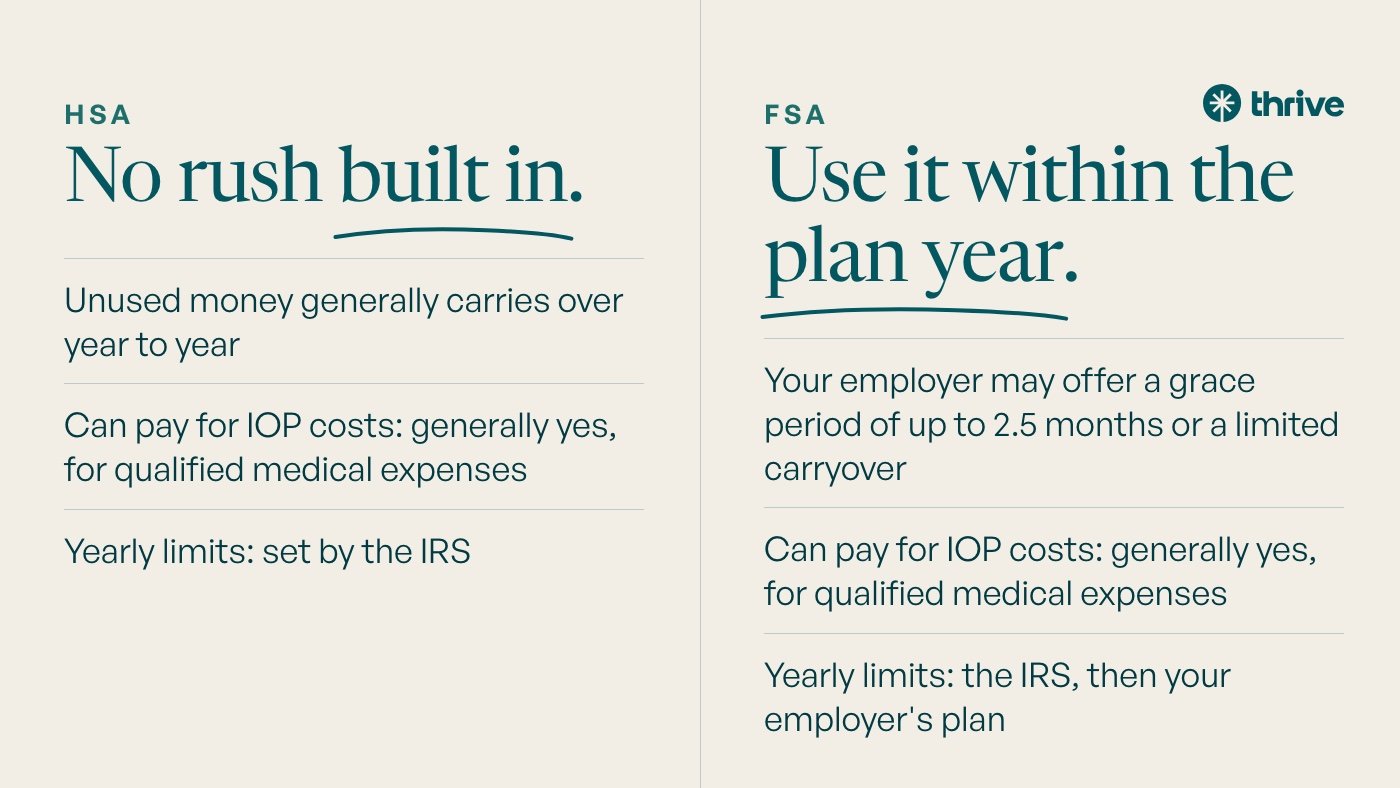
The two accounts behave very differently at year end. Mixing them up is one of the most common money mistakes in December.
| Question | Health Savings Account (HSA) | Flexible Spending Account (FSA) |
|---|---|---|
| Does the balance roll over? | Yes, unused money generally carries over year to year | Generally no, you must use it within the plan year |
| Any extra time? | Not needed | Your employer may offer a grace period of up to 2.5 months or a limited carryover, not both |
| Can it pay for IOP costs? | Generally yes, for qualified medical expenses | Generally yes, for qualified medical expenses |
| Who sets the yearly limits? | The IRS | The IRS, then your employer’s plan |
HealthCare.gov’s FSA page explains the grace period and carryover rules. If your employer offers neither, money left at the end of the plan year is lost. So an FSA balance in December is a second reason some people choose to start care before the year ends.
An HSA has no rush built in. IRS Publication 969 says leftover HSA money generally carries over, and that expenses from before you opened the account do not qualify. IRS Publication 502 lists psychiatric care and psychologists among deductible medical expenses. Confirm the details with your plan administrator before you spend.
Common mistakes to avoid
- Assuming January 1. Check the reset date. Employer plans often use another one.
- Counting only the deductible. The out of pocket maximum is often the bigger lever. Once you reach it, covered in-network care costs you nothing more that year.
- Forgetting out-of-network rules. Out-of-network care usually has its own deductible, and it does not count toward the in-network maximum.
- Starting too late in December. Prior authorization and intake take time. A start date a week before the reset leaves little room to benefit.
- Ignoring the holiday calendar. Ask any program how holiday weeks work before you assume every week is a full week of care.
For a broader look at what drives the bill, see our virtual IOP cost guide.
Common questions about meeting your deductible and starting IOP
If I met my deductible, is IOP free for the rest of the year?
Usually not. After the deductible you typically still pay coinsurance or copays. Covered in-network care becomes fully paid only after you reach your out of pocket maximum.
Does my deductible always reset on January 1?
No. Calendar year plans reset on January 1, but many employer plans run on a different plan year. Your plan documents or HR will tell you the exact date.
What happens if my IOP runs past December 31?
Sessions after the reset count toward the new year’s deductible and maximum. You pay the lower cost only for care received before the reset.
Can I use my FSA money for intensive outpatient therapy?
Mental health treatment is generally a qualified medical expense under IRS rules. Check with your FSA administrator, and use the money within your plan year or grace period.
Should I start IOP early just to save money?
Only if a clinician agrees IOP is the right level of care for you now. Saving money is a good reason to stop delaying needed care. It is not a reason to start care you do not need.
Does mental health care count toward the same deductible as medical care?
On most plans, yes. Federal parity law generally stops plans from making mental health cost sharing stricter than comparable medical care. Confirm with your plan.
Next steps
If you have met your deductible and you have been weighing more support than weekly therapy, find out what your plan would cost before the reset. Thrive Mental Health is a Joint Commission accredited provider of virtual IOP for adults, with nine or more hours of structured care a week. We work with commercial insurance plans and TRICARE in seven states: Florida, Indiana, Arizona, California, North Carolina, South Carolina, and Texas.
Verify your coverage with Thrive: free, confidential benefits check. Most members receive a summary within 24 hours, and you can start as soon as you are ready. Prefer to talk first? Call (561) 203-6085.

This article is for informational purposes only and is not a substitute for individualized clinical advice or insurance verification.