



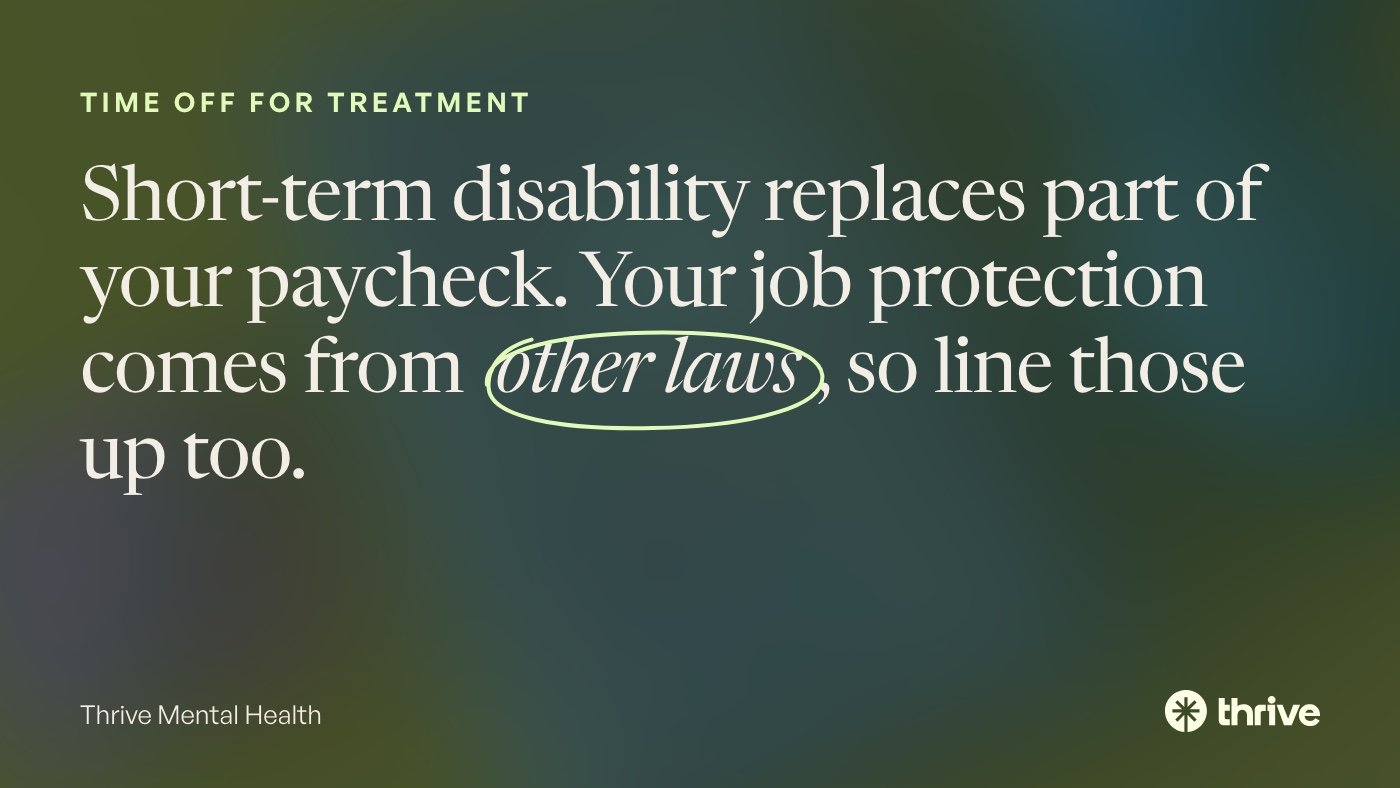
Yes, short-term disability insurance can pay part of your income while you get treatment for a mental health condition, including an intensive outpatient program (IOP), if your plan covers mental health and your clinician documents that you cannot do your job. It replaces a share of your paycheck for a limited time. It does not protect your job, so most people pair it with FMLA leave or ADA rights. This guide explains how short-term disability works for mental health, which states run their own programs, what a strong claim includes, and what to ask HR.
The biggest surprise for most people is how much depends on one document: the plan’s own definition of disability. Read that definition before you assume you qualify, or assume you don’t.
This article is informational, not legal, clinical, or financial advice. Your plan documents, your HR team, and an employment attorney can speak to your specific situation.
How does short-term disability work for a mental health condition?
Short-term disability (STD) is income insurance. If a covered illness keeps you from working, the plan pays you a percentage of your wages for a set number of weeks. Many plans treat mental health conditions like depression, anxiety disorders, bipolar disorder, and PTSD the same way they treat physical illness, but some limit or exclude them. Check your plan.
Every STD plan has a few moving parts:
- Elimination period. The unpaid waiting time before benefits start. State programs, for example, start paying around the eighth day of disability.
- Benefit amount. A percentage of your pay, usually with a weekly cap. Federal FMLA rules use a plan that pays two-thirds of salary as an example.
- Maximum duration. Often a few months. After that, long-term disability may take over if you have it.
- Definition of disability. Usually whether you can perform the main duties of your own job. This is where mental health claims are won or lost.
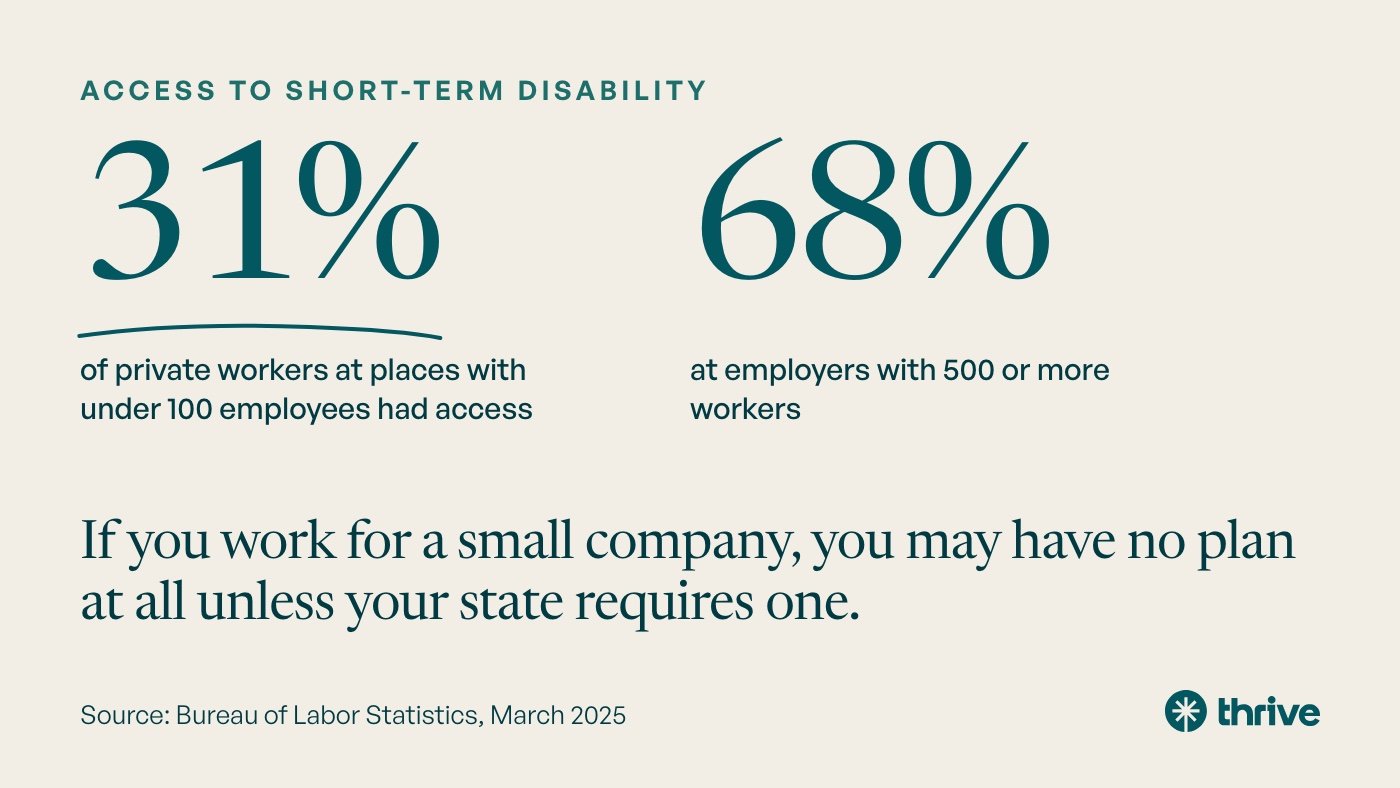
Access is uneven. In March 2025, the Bureau of Labor Statistics found 31 percent of private workers at places with under 100 employees had access to short-term disability. That rose to 68 percent at employers with 500 or more workers. If you work for a small company, you may have no plan at all unless your state requires one.
Does your state have its own disability program?
Five states run temporary disability insurance for off-the-job illness. If you live in one of them, you may qualify even if your employer offers nothing extra.
| State | Program | What it pays | Maximum length |
|---|---|---|---|
| California | State Disability Insurance (EDD) | 70 to 90 percent of prior wages, up to a weekly cap | Up to 52 weeks |
| New Jersey | Temporary Disability Insurance | 85 percent of average weekly wage, up to a weekly cap | Up to 26 weeks |
| New York | Disability Benefits | 50 percent of average weekly wage, capped at $170 a week | 26 weeks in any 52 |
| Hawaii | Temporary Disability Insurance | 58 percent of average weekly wage, up to a cap | Up to 26 weeks |
| Rhode Island | Temporary Disability Insurance | Set by state formula | Check with the state |
| Florida, Indiana, Arizona, North Carolina, South Carolina | No state disability program | Employer plan or a private policy only | Set by your plan |
California’s EDD defines covered conditions as physical or mental illness or injury. New Jersey’s program names mental health conditions directly. California is the only one of Thrive’s six service states with a state program, so readers in our other five states rely on employer or private coverage.
Separately, the U.S. Department of Labor reports that 13 states and Washington, D.C. have paid family and medical leave laws. Some of those include paid leave for your own serious health condition. Check your state labor department if you live outside the table above.
Can you collect short-term disability while you are in IOP?
It depends on whether you are working. IOP is part-time treatment: at Thrive it means nine or more hours of structured care a week, often scheduled around a job. If you keep working during treatment, most plans will not consider you disabled, because you are still doing your job.
STD tends to fit these situations:
- Symptoms have already stopped you from working. You cannot focus, sleep, or function well enough to do your duties, and IOP is how you get back.
- You are stepping down from a hospital stay. Your clinician documents that you need time before returning, with IOP as the next level of care.
- Your plan pays partial disability benefits. A few plans pay reduced benefits if you work reduced hours. Ask HR whether yours does.
Be careful with side work. New York’s program, for one, says you are not eligible for any week you do paid work, even from home. Other plans have similar rules. Tell the insurer about any work you do while on a claim.
What does a strong mental health disability claim include?
Thin paperwork is a common problem in mental health claims. The insurer wants to see how your symptoms stop you from doing specific parts of your job, not just a diagnosis. Your treating clinician’s statement carries a lot of weight, so give them what they need to write a clear one.
- A diagnosis and current symptoms. Stated plainly, with dates of onset.
- Functional limits tied to your duties. For example, “cannot sustain concentration for more than 20 minutes” matters more than “has depression.” Bring your job description to the appointment.
- The treatment plan and schedule. Level of care, frequency, and expected length. At Thrive, the average IOP admission is nine weeks, though each plan is set by the person’s progress.
- Objective measures when available. Symptom scores from validated scales such as the PHQ-9, repeated over time, show change on paper.
- An expected return date. Estimates are fine. Your clinician can extend it later with updated notes.
- Proof you are following treatment. Attendance records help. Gaps in care can lead an insurer to question a claim.
Programs that use measurement-based care, like ours, track symptom scales on a fixed schedule, which is useful documentation for exactly this purpose. Read more on how Thrive measures outcomes.
How does short-term disability fit with FMLA and paid time off?
These benefits do different jobs, and they often run at the same time. Under 29 CFR 825.207, leave under a disability plan can also count as FMLA leave if it meets the FMLA’s serious health condition criteria. That means your job-protected weeks and your disability payments can use up the same calendar time.
| Benefit | What it does | What it does not do |
|---|---|---|
| Short-term disability | Replaces part of your pay | Protect your job |
| FMLA | Protects your job and health coverage for up to 12 weeks | Pay you |
| ADA accommodations | Can include leave or schedule changes | Pay you |
| Sick leave and PTO | Pays you at your normal rate | Extend your FMLA time |
One rule surprises people. Because disability pay is not unpaid leave, neither you nor your employer can force the use of PTO during those weeks. You and your employer can agree to top up disability pay with PTO, where state law allows. That can bring a two-thirds benefit closer to a full check.
If you do not qualify for FMLA, the ADA may still help. The EEOC’s guidance on mental health conditions at work lists unpaid leave and schedule changes among possible reasonable accommodations. For how FMLA works with an IOP schedule, see our guide to FMLA and virtual IOP.
What can you do if your claim is denied?
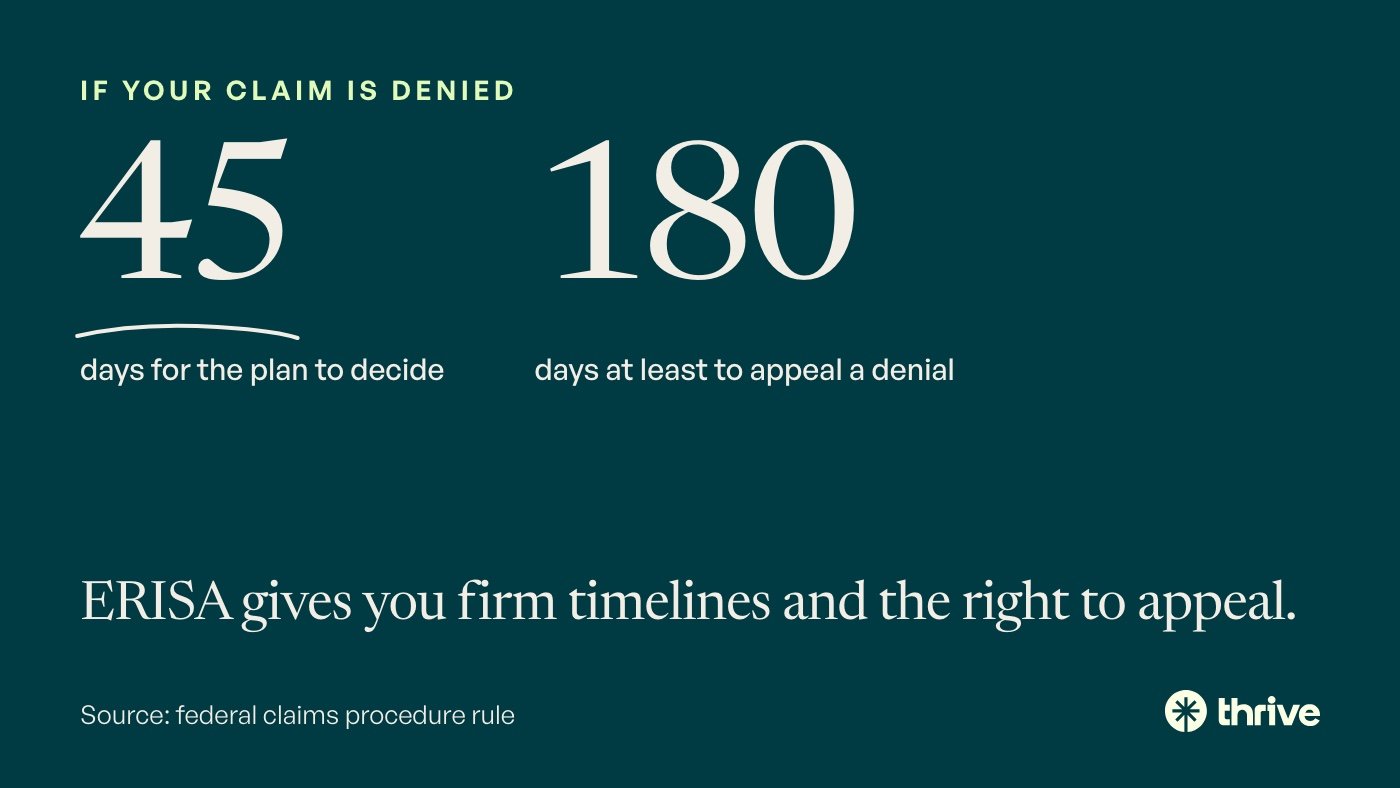
Most employer disability plans at private companies fall under ERISA, the federal law on employee benefit plans. ERISA gives you firm timelines and the right to appeal. Under the federal claims procedure rule:
- The plan has 45 days to decide. It can extend twice, by up to 30 days each time, if it tells you why.
- You get at least 180 days to appeal a denial. Use the time to gather stronger records.
- The denial must explain disagreements with your clinicians. If the plan rejects your treating providers’ views, it must say why.
- You can ask for the claim file. Request everything the plan relied on, including reviewer reports.
Government and church plans follow different rules. So do individual policies you bought yourself, which are regulated by your state’s insurance department. An attorney who handles disability appeals can review a denial before you file.
 Navigating Therapy Coverage: How Medical Insurance Can Help Your Mental HealthMental Health
What should you ask HR before you apply?
A short conversation with HR saves weeks of back-and-forth. Keep it about benefits and dates. You do not need to share your diagnosis with HR to ask these questions.
- “Do we offer short-term disability, and who administers it?”
- “Does the plan cover mental health conditions the same as physical ones?”
- “What is the elimination period, the benefit percentage, and the weekly cap?”
- “Does the plan pay partial benefits if I work reduced hours?”
- “Will this leave also be designated as FMLA, and can I use PTO to top up the benefit?”
- “Can I get a copy of the summary plan description?”
Write down names, dates, and claim numbers. If you are also checking what your health plan pays for treatment, our virtual IOP insurance guide covers the questions to ask your insurer.
What happens when your benefits end?
Plan the return before the last payment. Your clinician will usually need to confirm you can go back, and some employers ask for a fitness-for-duty note. A phased return, with lighter hours at first and outpatient care that continues, is common and often easier to sustain.
The stakes are real on both sides. The World Health Organization estimates that 12 billion working days are lost each year to depression and anxiety. For many people, time off for treatment is part of how they keep their careers.
If symptoms return after you go back, talk to your therapist early. Some plans let a related relapse within a short window count as the same claim, so check yours.
Common questions about short-term disability for mental health
Does short-term disability cover depression and anxiety?
Many plans do, along with other mental health conditions, but some limit or exclude them. Read your plan’s definition of disability and any mental health limits before you file.
Can I get short-term disability for an intensive outpatient program?
Possibly, if your symptoms keep you from doing your job and your clinician documents that. If you keep working during IOP, most plans will not treat you as disabled unless they pay partial benefits.
Does my employer find out my diagnosis?
Claims usually go to a third-party administrator or insurer. Your employer typically learns that you are on approved leave and for how long, not the medical details.
Does Florida, Indiana, or Arizona have state disability insurance?
No. In those states, and in North Carolina, South Carolina, and Texas, short-term disability comes from an employer plan or a private policy.
Can I use short-term disability and FMLA at the same time?
Yes. They often run together. FMLA protects your job while the disability plan pays part of your wages.
How long does a short-term disability decision take?
For most employer plans covered by ERISA, the plan must decide within 45 days, with up to two 30-day extensions if it notifies you.
Next steps
If you are weighing time off for treatment, find out what your health plan covers first, since that shapes every other decision. Thrive Mental Health is a Joint Commission accredited provider of virtual IOP for adults, with flexible scheduling that includes evening and weekend appointments. We serve adults in Florida, Indiana, Arizona, California, North Carolina, South Carolina, and Texas.
Verify your coverage with Thrive: free, confidential benefits check. Most members receive a summary within 24 hours, and many start the same week. Prefer to talk first? Call (561) 203-6085.

This article is for informational purposes only and is not a substitute for individualized clinical advice or insurance verification.