


A virtual intensive outpatient program (IOP) lets college students get roughly nine hours of structured mental health treatment per week without withdrawing from school, moving home, or sitting on a campus counseling waitlist. For students 18 and older whose symptoms have outgrown what a counseling center can provide, virtual IOP fills the gap between weekly sessions and a medical leave of absence. Sessions run over secure video in morning or evening blocks, which is why a full course of treatment can coexist with a class schedule.
This guide covers when a step up in care makes sense during college, how virtual IOP fits around coursework, what happens with insurance as a student, and how to decide between treating now and taking a leave. It is written for adult students and the parents helping them think it through.
The gap between campus counseling and a leave of absence
College counseling centers do real work, but they are built for short-term support: session caps, waitlists, and generalist scope are the norm. At the other extreme sits the medical leave of absence, which pauses everything. Between those two options is a level-of-care gap that intensive outpatient treatment was designed to fill.
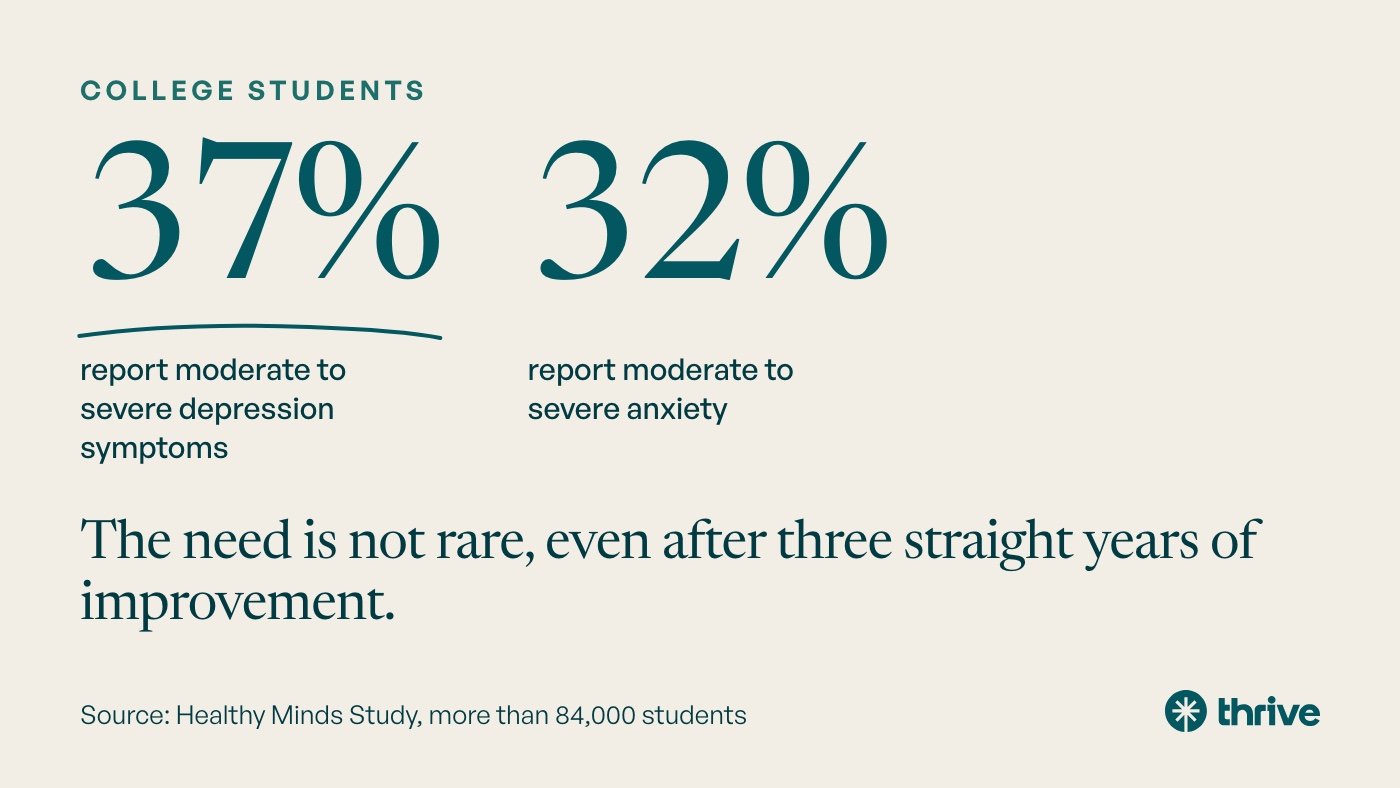
The need is not rare. The Healthy Minds Study of more than 84,000 students found that even after three straight years of improvement, 37% of college students report moderate to severe depression symptoms and 32% report moderate to severe anxiety. Young adults carry the highest rates of mental illness of any adult age group in NIMH’s national prevalence data. Campus systems were never sized for that load, which is why “the counseling center referred me out” is one of the most common sentences our admissions team hears each fall.
Signs a student needs more than weekly counseling
- Attendance is slipping for mental health reasons: missed classes, unsubmitted work, incompletes stacking up.
- Weekly sessions had a fair trial and the trend is flat or worse after eight to twelve weeks.
- The campus center has said so: counseling centers refer students to higher levels of care when acuity exceeds their scope. Take the referral seriously.
- Coping has migrated to avoidance: skipped meals, all-nighters, isolation, substance use creeping upward.
- A recent hospitalization or ER visit with nothing structured in place afterward. Going from hospital care back to campus with one session a week is the classic relapse setup.
If there is any immediate safety concern, the 988 Suicide and Crisis Lifeline is available by call or text around the clock, and campus safety or a local emergency room comes before any program decision.
How virtual IOP fits around a class schedule
A typical virtual IOP week is three group sessions of about three hours, plus individual therapy and psychiatric consultation as needed, for six to twelve weeks. For students, the mechanics matter:
- Morning and evening cohorts mean treatment can sit before or after most class blocks. Many students never change their course schedule at all.
- No commute, no car needed. Sessions run over secure video from a dorm room, apartment, or any private space. A student without a car in a college town has the same access as anyone else.
- Care continues across breaks. Because the program is virtual, going home for fall or winter break does not interrupt treatment, provided the program is licensed in that state too.
- Evidence supports the format. Research in the Journal of Psychiatric Research found telehealth-delivered intensive treatment produced outcomes comparable to in-person care, and group-based treatment, the backbone of IOP per SAMHSA’s Treatment Improvement Protocol, performs on par with individual therapy in meta-analytic reviews.
- Adult-only groups change the experience. At Thrive, cohorts are adults; a 20-year-old sits with people navigating jobs, families, and school, not a room of high schoolers.
The insurance question every student should ask first
Most students are covered one of three ways, and each affects program choice:
- A parent’s plan. Federal law allows coverage on a parent’s plan until age 26. The program must be in network with that plan and licensed in the state where the student is physically located during sessions.
- A student health plan. University-sponsored plans are ACA-compliant and cover behavioral health, including IOP levels of care, under the federal parity law. Cost sharing varies; verify before enrolling.
- A marketplace or employer plan of their own. Same verification steps as any adult.
Location and licensure are the detail that trips families up: the treating clinicians generally must be licensed in the state where the student sits during sessions. A student at school in Indiana on a Florida parent’s plan should confirm both parts: network status with the plan, and Indiana licensure for the program. Our Indiana cost guide and Florida cost guide show what the numbers typically look like.
Treat now, or take a leave? An honest comparison
| Virtual IOP while enrolled | Medical leave of absence | |
|---|---|---|
| Academic progress | Continues, possibly with a lightened load | Pauses; return policies vary by school |
| Treatment intensity | 9+ hours weekly, structured | Whatever is arranged at home |
| Social continuity | Stays in place | Disrupted, which cuts both ways |
| Best fit | Moderate to severe symptoms with some functional capacity intact | Acuity too high to function in school at all, or safety requires it |
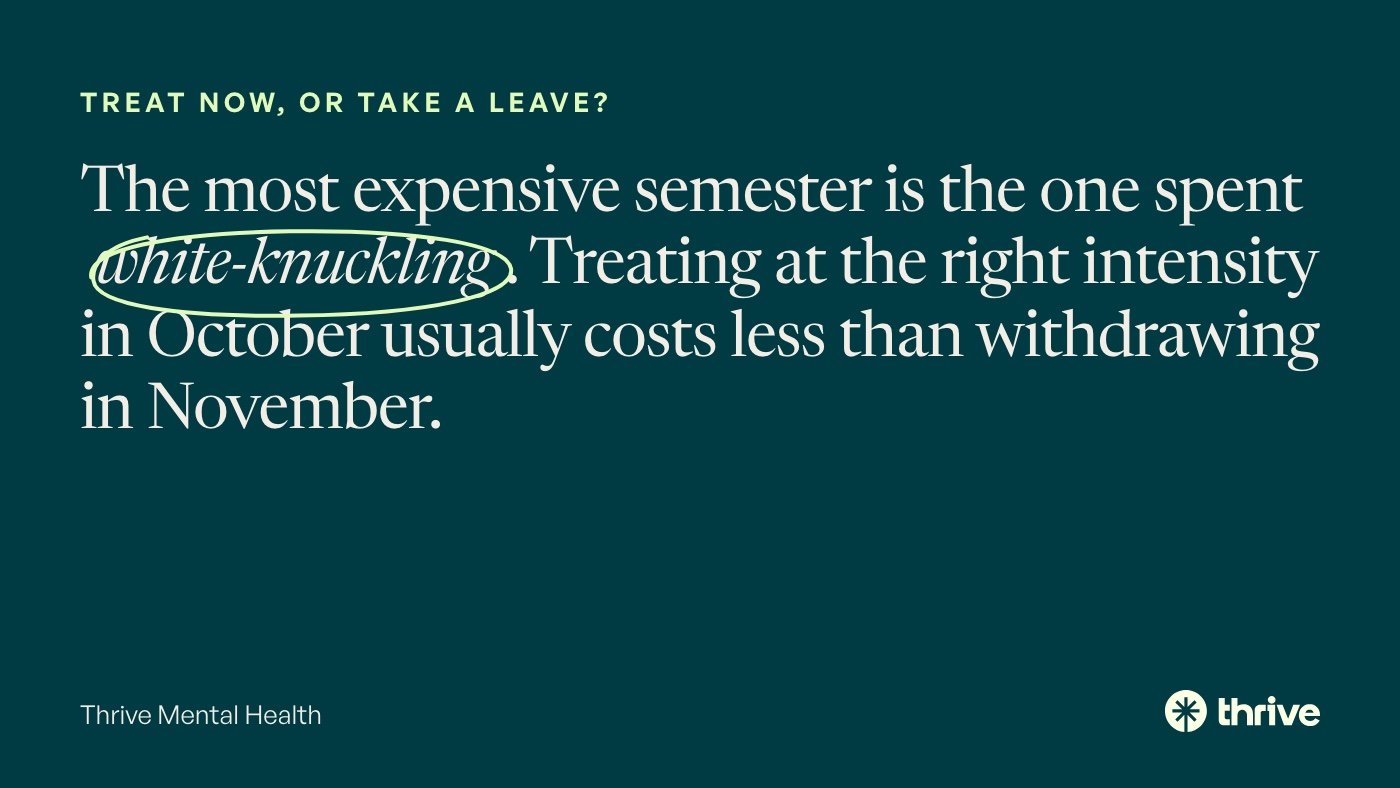
Neither answer is universally right. A useful rule: if the student can attend most classes with support, treat in place; if simply being enrolled is generating the crisis, a leave plus structured treatment beats limping through. Deans of students offices can often arrange reduced loads, incompletes, and accommodations that make the treat-in-place route viable; students registered with campus disability services have formal options.
What parents can usefully do
- Handle the insurance legwork. A benefits check takes one call and removes the biggest unknown while the student focuses on classes.
- Respect that treatment belongs to the student. For adults, clinical information is shared only with the student’s consent. Programs can, with consent, include family sessions, which is often the better channel than daily check-in texts.
- Watch function, not mood. Attendance, sleep, and eating say more than “how are you feeling” answers. Changes in function are the signal to revisit the level of care.
A sample week: treatment beside a course load
| Time | Monday | Wednesday | Friday |
|---|---|---|---|
| Morning | Classes | Classes | Classes |
| Afternoon | Study block | Individual therapy (1 hr) | Study block |
| Evening | IOP group, 3 hrs | IOP group, 3 hrs | IOP group, 3 hrs |
Three practical notes from students who have run this schedule. First, tell the program your class schedule at intake; cohort placement is a solvable puzzle when admissions knows the constraints. Second, protect a real study block on treatment days rather than assuming evenings will absorb everything. Third, most students find the nine treatment hours replace time that symptoms were already consuming: the doom-scrolling, the missed-deadline spirals, the 3 a.m. ceilings. The week does not get bigger; it gets structured.

Common questions about virtual IOP for college students
Can a student do virtual IOP without leaving school?
Yes. Morning and evening cohorts fit around most class schedules, and no commute means the nine treatment hours are the only time cost.
Does insurance cover IOP for a student on a parent’s plan?
Generally yes, until age 26, when the program is in network and medically necessary. Confirm the program is licensed in the state where the student attends sessions.
Will the school find out?
Not from the program. Treatment records are confidential. Students sometimes choose to loop in the dean of students or disability services to arrange accommodations, but that is their call.
What conditions does virtual IOP treat for students?
Depression, anxiety disorders, trauma-related conditions, and co-occurring concerns are the common ones at this level of care. A licensed clinician confirms fit during assessment.
What about students under 18?
Thrive’s programs are adult-only, for ages 18 and up. Younger students need adolescent-specific programs, which run on different clinical models.
What happens over semester breaks?
Virtual care travels. If the program is licensed in both states, sessions continue from home without interruption, which is one of the format’s quiet advantages.
Can a student start virtual IOP mid-semester?
Yes. Programs admit on a rolling basis, and mid-semester is precisely when the need usually becomes clear. Starting in week eight beats limping to finals unsupported, and a lightened course load negotiated with advisors can bridge the gap while treatment takes effect.
Next steps
If this semester is being spent surviving rather than studying, get an assessment before the incompletes decide for you. Thrive Mental Health is a Joint Commission accredited provider of adult virtual IOP serving Florida, Indiana, Arizona, California, North Carolina, South Carolina, and Texas, including students enrolled at schools in those states.
Start with a free, confidential benefits check. Most families receive a summary within 24 hours, and many students begin the same week. Prefer to talk first? Call (561) 203-6085.

This article is for informational purposes only and is not a substitute for individualized clinical advice or insurance verification.