





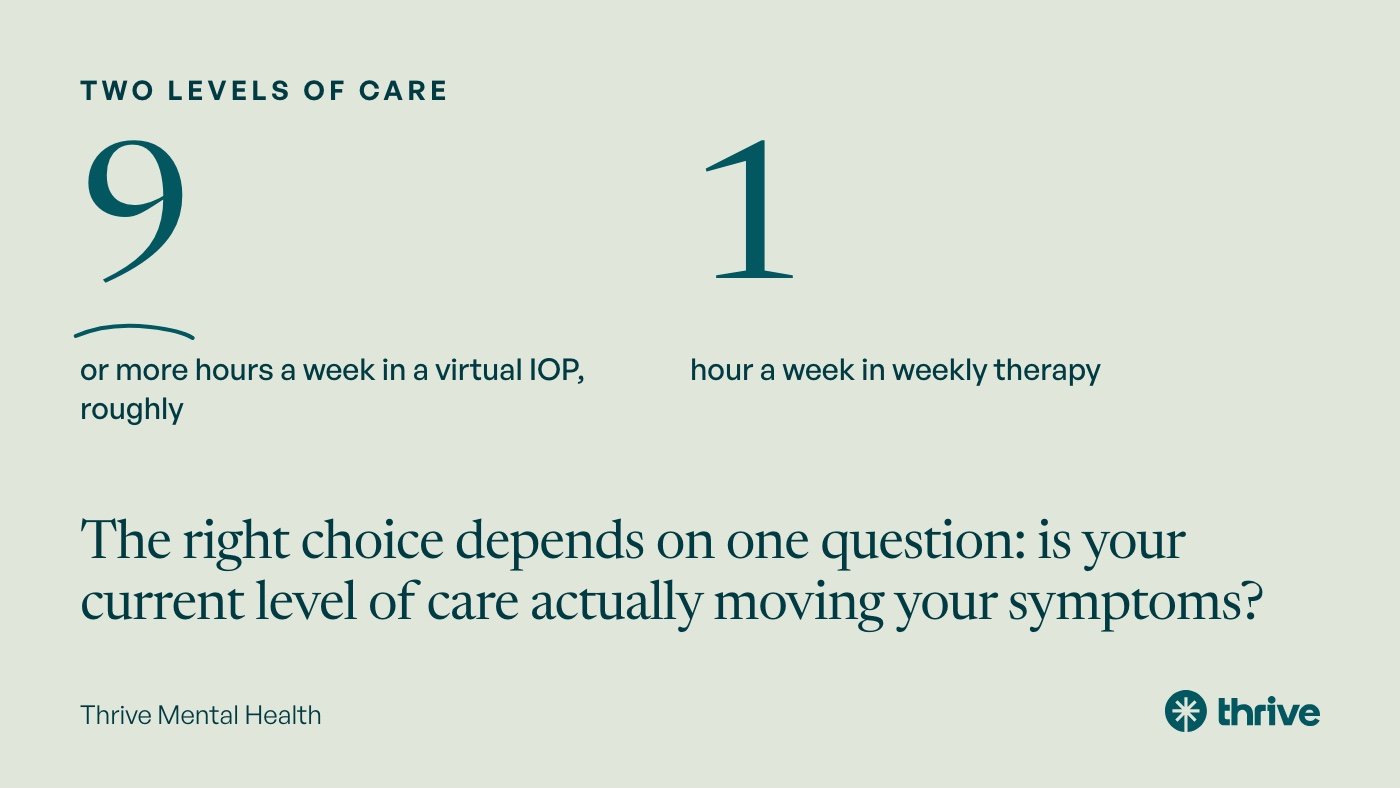
A virtual intensive outpatient program (IOP) provides roughly nine or more hours of structured treatment per week, while weekly therapy provides one. The right choice depends on one question: is your current level of care actually moving your symptoms? If weekly sessions have had a fair trial and life is still shrinking, stepping up to IOP is the evidence-based next move, not a failure of therapy.
This guide lays out the real differences between the two levels of care, the signs that it is time to step up, what the research says about outcomes, and what the change means for your schedule, your job, and your budget. Written by a clinical team that delivers both levels of care, it is the framework we use in our own assessments.
The two levels of care, side by side
| Weekly therapy | Virtual IOP | |
|---|---|---|
| Time per week | About 1 hour | 9+ hours, usually 3 sessions of 3 hours |
| Format | Individual sessions | Group therapy plus individual sessions |
| Psychiatric support | Referred out separately | Built in when medically indicated |
| Structure between sessions | Little to none | Skills practice, check-ins, measurable goals |
| Typical duration | Open-ended, often months to years | 6 to 12 weeks, then step down |
| Best fit | Mild to moderate symptoms, maintenance, growth work | Moderate to severe symptoms that weekly care is not containing |
| Where it happens | Office or video | Secure video from home |
Both levels sit on the same continuum of care. The ASAM Criteria formalize this: outpatient therapy is level 1, IOP is level 2.1. Moving between them is normal clinical practice, in both directions.
Six signs weekly therapy is not enough right now
- You have given it a fair trial and the needle has not moved. Eight to twelve weeks of consistent sessions without meaningful improvement in symptoms or functioning is a signal, not a fluke.
- The week between sessions has become the problem. You stabilize in session, then spend six days losing ground. The gap is where the suffering happens.
- Work, school, or relationships are visibly slipping. Missed days, avoided people, unpaid bills, a shrinking life radius.
- Your therapist is recommending more support. Clinicians refer up when the level of care stops matching the acuity. Take that recommendation seriously.
- You are white-knuckling between appointments. Escalating urges, panic, or hopelessness that a weekly hour cannot contain.
- You are stepping down from a hospital stay. Going straight from 24-hour care to one hour a week is the most common way recoveries stall. IOP is the designed bridge.
If you are in immediate crisis, neither level of care is the first call. The 988 Suicide and Crisis Lifeline is available by call or text, 24 hours a day.
What the research says about stepping up
Intensive outpatient treatment is one of the better-studied levels of behavioral care. SAMHSA’s Treatment Improvement Protocol on intensive outpatient treatment summarizes decades of evidence for the model: structured, multi-hour, multi-day treatment produces meaningful gains for people whose symptoms exceed what weekly care can hold.
The virtual format holds up too. A comparison of more than 1,100 adults in intensive treatment published in the Journal of Psychiatric Research found telehealth delivery produced outcomes comparable to in-person care. And the group therapy at the heart of IOP is not a budget substitute for individual work: the American Psychological Association’s review of 11 meta-analyses covering 329 studies found group therapy as effective as individual therapy across depression, anxiety, PTSD, and more.
Dosage matters in mental health the way it does everywhere else in medicine. The National Institute of Mental Health notes that psychotherapy outcomes depend on fit and intensity, not just modality. Nine hours a week is a different dose than one.
What a week of virtual IOP actually looks like
At Thrive, a typical IOP week runs three group sessions of about three hours, over secure video, plus individual therapy and psychiatric consultation as needed. Groups are small, adult-only, and built around evidence-based modalities: CBT, DBT skills, EMDR for trauma, and mindfulness practice. You can see the full structure on our how virtual IOP works page.
- Morning or evening cohorts exist so treatment can fit around work. Many members keep working full time.
- Skills carry between sessions. You leave each group with something to practice, and the next session starts by checking how it went.
- Progress is measured, not guessed. Standardized symptom scales track whether the program is working, week over week.
Most members complete IOP in six to twelve weeks, then step back down to weekly therapy to maintain gains. Weekly therapy is usually where you land after IOP, not what you give up to attend it.
Cost: the comparison people avoid making
Weekly therapy is cheaper per week; that is obvious. The more useful comparison is cost against progress. Months of weekly sessions that are not working have a real price in copays, in lost work capacity, and in the risk of an eventual hospitalization, which dwarfs the cost of every outpatient option combined.
Most commercial insurance covers IOP under the same federal parity rules as medical care: the Mental Health Parity and Addiction Equity Act bars stricter limits on mental health benefits than on medical ones. For most commercially insured adults, an in-network course of virtual IOP lands between $0 and $2,500 out of pocket. Our virtual IOP cost guide breaks down the numbers.
How to decide, in three steps
- Rate the trend, not the day. Over the last two months, are your symptoms and functioning better, flat, or worse? Flat or worse after a fair trial of weekly care points up a level.
- Ask your therapist directly. “Do you think I need a higher level of care?” is a fair question, and most clinicians welcome it. If you do step up, a good IOP coordinates with your existing therapist rather than replacing them.
- Get assessed. A licensed clinician should confirm that IOP matches your acuity. That assessment is free at most programs, including Thrive.
What stepping up does not mean
Three myths keep people at the wrong level of care longer than any insurance problem does:
 Anthem Blue Cross Blue Shield Indiana: Virtual IOP CoverageInsurance
- “IOP means my life stops.” No. Virtual IOP is built around jobs, families, and school. Sessions run from home in morning or evening blocks, and most members keep working throughout.
- “IOP is basically hospitalization.” No. Inpatient care is 24-hour containment for acute safety needs. IOP is an outpatient program you attend from your own couch, three days a week, sleeping in your own bed every night.
- “Once I step up, I’ll be in intensive treatment forever.” No. IOP is deliberately time-limited. The whole design is stabilize, build skills, and step back down, typically inside three months. Staying at a level you no longer need is a treatment-planning failure, and measured programs catch it.
The step-up decision is dosage, not identity. Nobody concludes they are “a hospital person” from needing a higher medication dose for two months; levels of care work the same way.
Common questions about IOP vs weekly therapy
Do I have to stop seeing my therapist if I join an IOP?
No. Many members keep their individual therapist and coordinate care. IOP is time-limited; your therapist is often the step-down plan.
How many hours a week is a virtual IOP?
Typically nine or more, most often three sessions of about three hours, plus individual and psychiatric time as needed.
Can I work full time during IOP?
Usually yes. Morning and evening cohorts exist for exactly this reason. Many members tell no one at work, though job-protected leave options exist if you need them.
Is group therapy actually effective, or just cheaper?
Meta-analytic research across hundreds of studies finds group therapy as effective as individual therapy for most common conditions. The group format is also where interpersonal skills get practiced in real time.
How long does IOP take?
Most adults complete it in six to twelve weeks, with progress reviewed continuously. Then you step down, usually to weekly therapy.
Does insurance treat IOP differently than weekly therapy?
IOP usually requires prior authorization, which the program handles. Federal parity law requires comparable cost sharing to medical care on commercial plans.
Can I step back down to weekly therapy before the program ends?
Step-down timing is a clinical decision made with you, based on your measured progress rather than a fixed calendar. Some members are ready early, others extend a few weeks. The right program treats the schedule as a starting estimate and lets your trend line, not the brochure, set the discharge date.
Next steps
If the pattern in this article looks like your last two months, get assessed. Thrive Mental Health is a Joint Commission accredited provider of virtual IOP for adults in Florida, Indiana, Arizona, California, North Carolina, South Carolina, and Texas.
Start with a free, confidential benefits check. Most members receive a summary within 24 hours, and many begin treatment the same week. Prefer to talk it through first? Call (561) 203-6085.

This article is for informational purposes only and is not a substitute for individualized clinical advice or insurance verification.