



If depression, anxiety or trauma is the main thing getting in the way of your life, a mental health intensive outpatient program (IOP) is usually the better fit. If drinking or drug use is the main concern, a program built for substance use is the right place to start. Many people have some of both, so this guide walks through the signs that point each way and the questions that help an intake team match you to the right care.
The word “rehab” usually means a substance use program, often residential. “IOP” describes a level of care, and in everyday searches it is used for both kinds of program. That overlap is why so many people looking for mental health help end up on addiction treatment pages.
This article is informational, not clinical or financial advice. A licensed clinician’s assessment is the best way to decide on a level of care. If you are in crisis or thinking about suicide, call or text 988, the Suicide and Crisis Lifeline, any time.
Mental health IOP vs rehab: the short answer
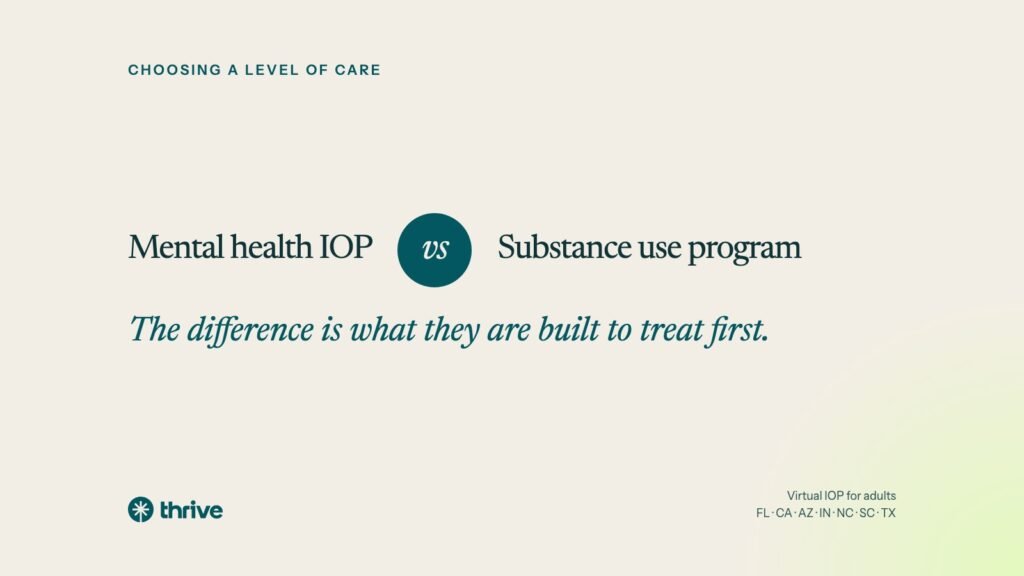
Both are structured programs. The difference is what they are built to treat first.
| Question | Mental health IOP | Substance use program (“rehab”) |
|---|---|---|
| Main focus | Depression, anxiety, trauma, mood and related conditions | Alcohol or drug use, cutting back, staying stopped |
| Who it tends to fit | Adults whose mood, worry or trauma symptoms are the main problem and who are safe living at home | Adults whose use has become hard to control or is driving problems at work, at home or with health |
| Typical therapies | Group and individual therapy using approaches such as CBT and DBT skills, family sessions, psychiatric care | Substance use counseling, relapse prevention, group therapy, recovery support and medical care when needed |
| Settings | Outpatient, in person or virtual, often 9 or more hours a week | Ranges from residential to outpatient, depending on need |
| What to ask | “Is mental health the main focus, and how do you screen for alcohol and drug use?” | “How do you handle depression or anxiety that shows up alongside use?” |
Neither option is better in general. The right one is the one built for whatever is causing the most harm right now. For a wider view of levels of care, see our guide to PHP vs IOP vs outpatient care.
Why searching “IOP” so often shows you rehab
Intensive outpatient care grew up in the addiction field. SAMHSA’s long-standing clinical guide on the subject is titled Clinical Issues in Intensive Outpatient Treatment, and it is written for substance use programs. Mental health IOPs use the same name for the same level of care, with a different clinical focus.
So a search for “IOP near me” or “intensive outpatient program Indianapolis” mixes both kinds of program together. Many listings lead with addiction treatment. Some mention mental health as a secondary service.
Here is a quick way to sort what you find:
- Read the program’s own “who we treat” page. A mental health IOP will name conditions like depression, anxiety, PTSD or bipolar disorder first.
- Look at the group topics. Mood, emotion skills and trauma groups suggest a mental health focus. Sobriety and relapse groups suggest a substance use focus.
- Ask directly on the first call. “What is the main diagnosis most of your clients come in with?” gets a clear answer fast.
If you want the basics first, our page on what an intensive outpatient program is explains the level of care in plain terms.
Signs a mental health IOP may be the better fit
These are not a diagnosis. They are patterns that often point toward mental health care as the starting place.
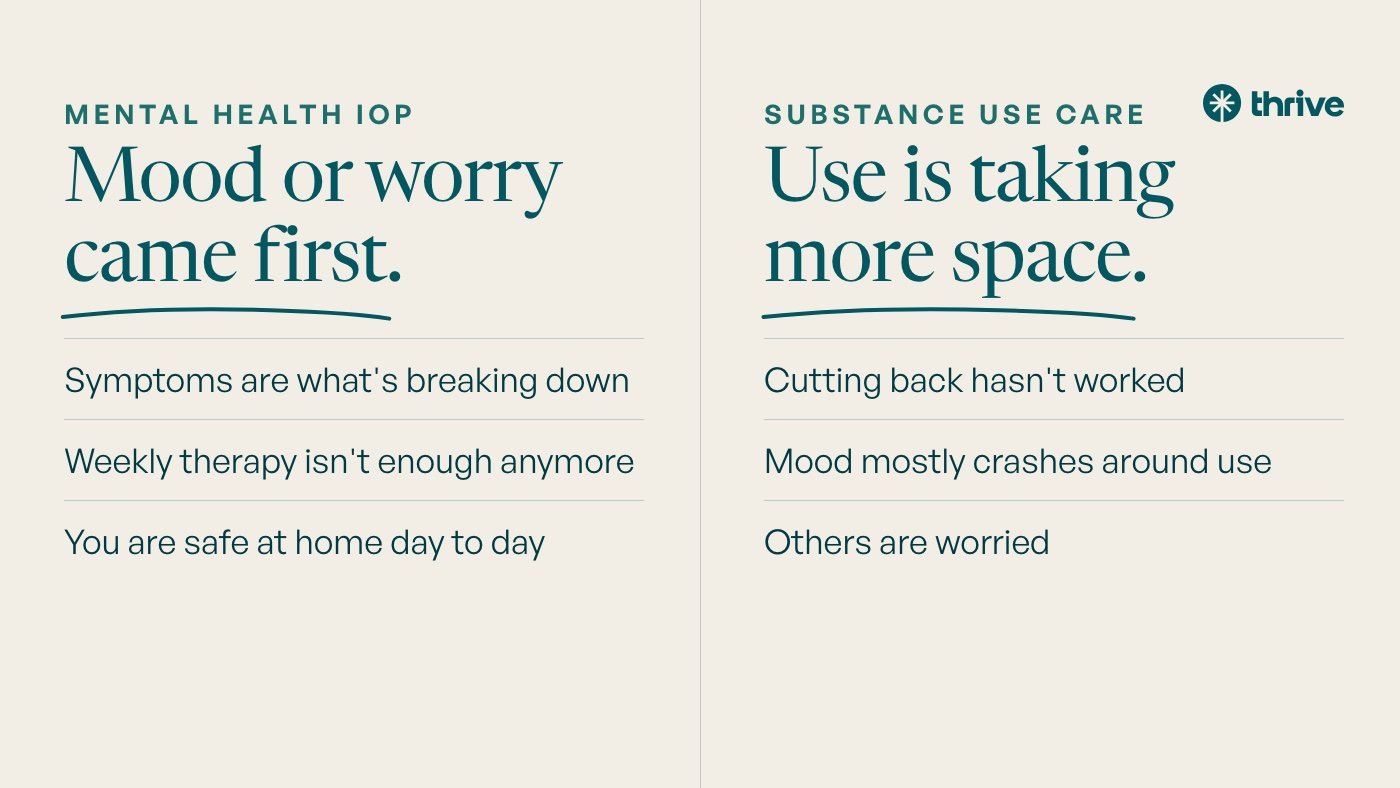
- Mood or worry came first. Low mood, constant worry, panic or trauma reactions were there before any change in drinking or use.
- The symptoms themselves are what’s breaking down. Sleep, work, focus or relationships are slipping because of how you feel, not because of time spent using.
- Use is occasional or steady. If you drink, it hasn’t grown, and it is not what you or the people close to you worry about most.
- Weekly therapy isn’t enough anymore. You have tried a weekly session and still feel stuck. Our comparison of virtual IOP vs weekly therapy covers that step.
- You are safe at home day to day. IOP works best when you can live at home between sessions.
The National Institute of Mental Health’s depression overview lists common symptoms such as persistent sadness, loss of interest, sleep changes and trouble concentrating. NIMH also describes PTSD signs like flashbacks, avoidance and feeling on edge. If those sound like the center of your story, start with a mental health assessment.
Signs a substance use program may be the better fit
Again, these are patterns to bring to a clinician, not labels.
- Cutting back hasn’t worked. You have tried to drink or use less and keep ending up where you started.
- Use is taking more space. More time, more money, or more of your day goes to using or recovering from it.
- Mood mostly crashes around use. Anxiety or low mood shows up mainly while using, coming down, or the next day.
- You feel sick when you stop. Shakiness, sweating, poor sleep or strong cravings when you go without are a reason to talk with a doctor before cutting back on your own.
- Others are worried. Family, friends or coworkers have raised concerns about drinking or drug use.
If several of these fit, a substance use program is the honest first step. Thrive Mental Health is a mental health program. When substance use is the main concern, our admissions team helps you find a program designed for it, and the free resources below can help too.
Why so many people have both concerns
Having a mental health condition and a substance use disorder at the same time is common. SAMHSA calls this co-occurring disorders.
- Nationally: about 21.2 million U.S. adults, or 8.1%, had both a substance use disorder and a mental illness in the past year, according to the 2024 National Survey on Drug Use and Health.
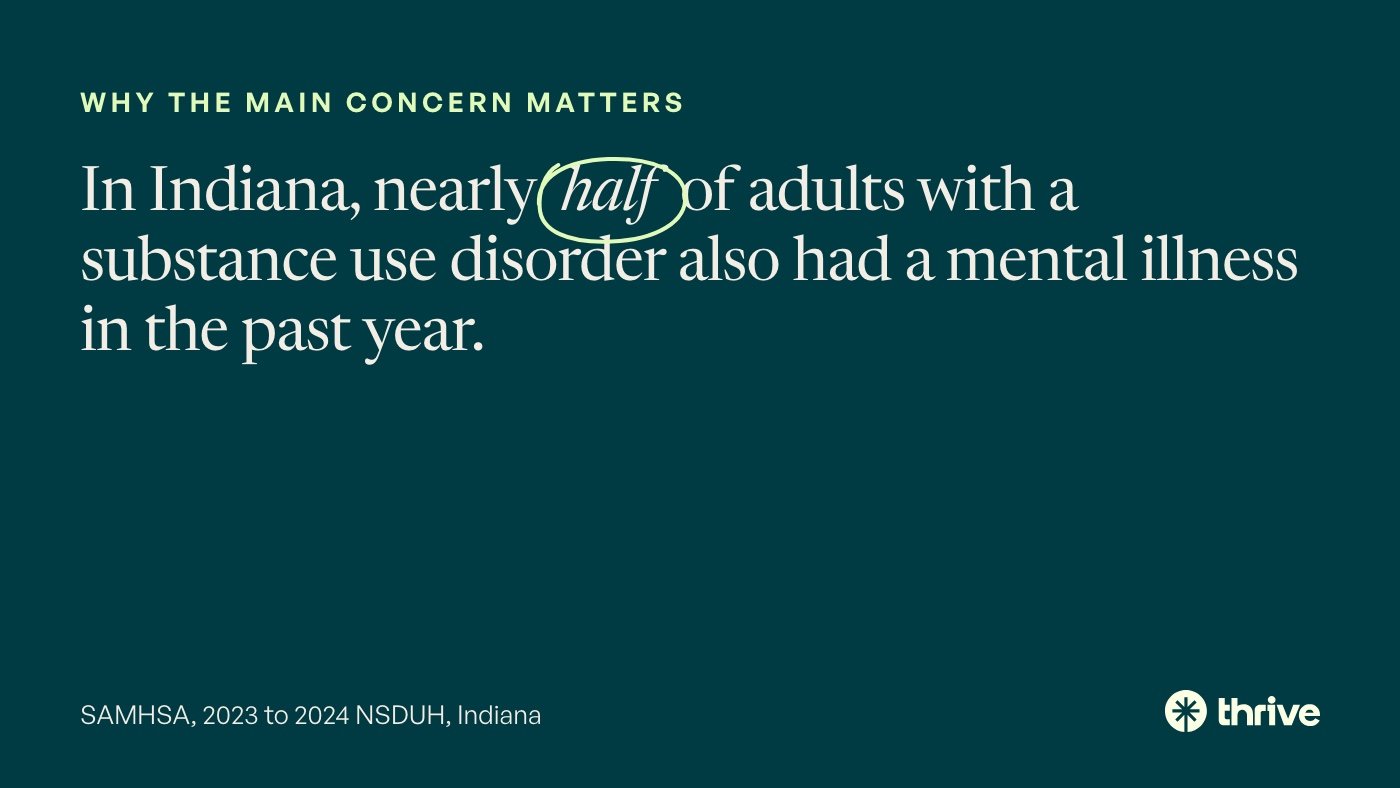
- In Indiana: an estimated 428,000 adults (8.2%) had both, out of 911,000 adults with a substance use disorder, per SAMHSA’s 2023 to 2024 Indiana state tables. That works out to nearly half.
The National Institute on Drug Abuse notes that when someone has both, it is usually better to treat them at the same time. That is exactly why the main concern matters when you choose. When substance use needs its own focused care, a program built for it is the right call. When mood, anxiety or trauma is clearly primary, a mental health IOP is usually the place to begin.
The survey can’t tell you which concern came first for any one person. Only a real conversation with a clinician can sort that out.
What a mental health IOP like Thrive’s looks like
A mental health IOP gives you more support than weekly therapy while you keep living at home. At Thrive, the program runs entirely online for adults.
- Time: 9 to 12 hours of live care a week, usually across three days.
- Groups: small groups with the same peers, using approaches such as CBT and DBT skills.
- Individual therapy: one-on-one time with the same primary therapist each week.
- Family sessions when they fit your plan, plus psychiatric care.
The focus stays on depression, anxiety, trauma and related mental health conditions. You can see the full weekly rhythm on our how virtual IOP works page.
 Your Mental Health Matters: A Guide to Adult TherapyMental Health
Questions to ask any intake team
A good intake call should feel like a two-way conversation. Bring these questions, whichever kind of program you are calling:
- “What is the main focus of your program: mental health, substance use, or both?”
- “How do you screen for alcohol and drug use, and for depression or anxiety, at the start?”
- “If your assessment says I need a different kind of program, will you help me find one?”
- “What does a normal week look like, in hours, groups and individual sessions?”
- “Who do I contact between sessions if things get worse?”
- “Are you in network with my insurance plan, and what would my share be?”
Pay attention to question three. A good intake will point you to the right level of care, even when that means a different program. If the answer is vague, keep asking or keep looking.
Indiana resources for either path
Indiana has free, confidential tools for finding care, whichever direction your assessment points.
- Crisis: call or text 988 any time if you or someone you love is in danger.
- Substance use programs: the SAMHSA National Helpline at 1-800-662-4357 is free, confidential and open around the clock. FindTreatment.gov lets you search state-licensed programs by location.
- Indiana providers: the state’s Division of Mental Health and Addiction provider finder lists community mental health centers and addiction treatment providers.
- Local help of any kind: Indiana 211 connects Hoosiers with community resources. Dial 2-1-1 or 866-211-9966.
For mental health care, insurance is often the next question. In Indiana, Thrive is in network with Anthem, UnitedHealthcare (including Oscar), Cigna, Aetna and TRICARE East, so members pay their in-network share, not out-of-network rates. Our virtual IOP in Indiana page covers group times and how care works across the state. You can also review the full list on our insurance page.
Common questions about mental health IOP vs rehab
Is an IOP the same thing as rehab?
Not always. IOP is a level of care, a few hours a day, a few days a week, while you live at home. Rehab usually means a substance use program. Some IOPs focus on substance use and others focus on mental health.
I drink sometimes. Can I still look at a mental health IOP?
Yes. Intake teams ask about alcohol and drug use as a normal part of assessment. If substance use looks like the main concern, a good team will tell you and point you toward a program built for it.
What if my assessment shows substance use is the bigger issue?
Then a substance use program is the right next step. Thrive’s admissions team helps people find one, and the SAMHSA National Helpline (1-800-662-4357) and FindTreatment.gov are free places to search.
How do I know if I need IOP or weekly therapy?
IOP is usually considered when weekly therapy hasn’t been enough, or symptoms are disrupting work, sleep or relationships. A clinician’s assessment is the best way to decide.
Does insurance cover a mental health IOP in Indiana?
Most commercial plans cover IOP when it is medically necessary. Thrive is in network in Indiana with Anthem, UnitedHealthcare (including Oscar), Cigna, Aetna and TRICARE East, and checks your benefits for free.
What should I do if I am in crisis right now?
Call or text 988, the Suicide and Crisis Lifeline, or go to the nearest emergency room. An IOP is not a crisis service.
Next steps
If mood, anxiety or trauma is the main concern and weekly therapy isn’t enough, a mental health IOP is worth a conversation. If substance use is the main concern, start with the SAMHSA National Helpline or FindTreatment.gov, or ask our team to help you find a program built for it.
Thrive Mental Health is a Joint Commission accredited virtual IOP for adults, serving Florida, Indiana, Arizona, California, North Carolina, South Carolina and Texas. In Indiana, we are in network with Anthem, UnitedHealthcare (including Oscar), Cigna, Aetna and TRICARE East.
Verify your coverage with Thrive: free, confidential benefits check. Most members get a summary within 24 hours, and you can start as soon as you are ready. Prefer to talk first? Call (561) 203-6085.

This article is for informational purposes only and is not a substitute for individualized clinical advice or insurance verification.